If you'd like to listen ad-free and access weekly bonus episodes, extra long stories and our entire back catalogue, you can try out Premium free for 7 days by following the link in the episode notes.
Now, a quick word from our sponsors.
This is an ad by BetterHelp, one of our sponsors.
These days, it feels like there's advice for everything.
Cold plunges, gratitude journals. screen detoxes.
But how do you know what actually works for you?
With the internet and information overload about mental health and wellness, it can be a struggle to know what actions to take these days.
That's where BetterHelp comes in.
Talking to a professional therapist can help you break through the noise and work out the best approach to move forward in your life.
From my experience I know a good therapist takes the time to tailor sessions to get the most out of them with you.
And with an App Store rating of 49 out of 5, based on over 15 million client reviews, BetterHelp will match you with the right therapist to get you where you want to be.
Talk it out with BetterHelp.
Our listeners get 10% off their first month at betterhelp.com slash get sleepy.
That's betterhelpcom.
Slash getsleepy for 10 off your first month.
This episode is brought to you by lifelock, between two-factor authentication, strong passwords and a vpn.
You try to be in control of how your info is protected, but many other places also have it and they might not be as careful.
That's why LifeLock monitors hundreds of millions of data points a second for threats.
If your identity is stolen, they'll fix it, guaranteed, or your money back.
Save up to 40% your first year.
Visit LifeLock.com slash podcast for 40% off.
Terms apply.
Welcome to Get Sleepy, where we listen, we relax, and we get sleepy.
As always, my name's Thomas, and I'm your host.
Tonight we return to our sleepy series exploring the seven wonders of the ancient world.
Written by Joe and read by me.
Don't worry if you haven't heard the other stories yet.
You can continue listening to this one now, and catch any that you've missed at another time.
Tonight, we're travelling to what is today Takiya, to the mausoleum of Halicarnassus.
We'll learn all about this architectural masterpiece, and see it as it was in 350 BCE.
If you'd love more content from Get Sleepy and the very best listening experience, be sure to check out our member's subscription Get Sleepy Premium.
In our Thursday premium bonus episode tomorrow night, Simon will be reading a lovely laid-back story about a retired man who's putting the finishing touches to his garden by building a swing chair to relax in on his sun-soaked patio.
To find out more about all the perks of being a Get Sleepy Premium member, like ad-free listening, early access to episodes, discount on merchandise and plenty more, just visit the link in the description.
Thank you so much for your support.
Now my friends, let's take the time to relax and unwind, preparing for our story in the usual way.
Move into a position that feels easy and comfortable.
Take a deep breath and close your eyes.
In a moment, we'll begin a breathing space meditation, briefly checking in with our thoughts and feelings, before using the breath to reset and refresh.
Let's begin now by observing the mind in the same way that we might watch the weather from a window.
See the mind in its current state.
You can notice thoughts like passing clouds.
Then let them go and return to watching.
I'll leave you for a moment to try this.
Now shift your attention into the body and repeat this practice, but with feelings and sensations.
Simply notice what arises in your body.
Then let go of what you notice and return to observing.
Try this now.
And lastly, bring your attention to the breath wherever you feel it most strongly in the Inhale through the nose and exhale through the mouth, keeping your breathing deep and gentle.
Use the breath to let go of the day and to make the transition into rest and night time.
Now, allow the breath to fade into the background.
And follow my voice as we travel to a place that is known today as Bodrum, on the southwest coast of modern-day Turkey.
This is where our story begins.
Imagine that you're standing with your eyes shut, listening to the sounds of water lapping against a shore.
You can smell the essence of saltwater on the breeze.
It is sea air, refreshing and healing.
Opening your eyes, you look out at the sea.
The Aegean is the color of lapis lazuli.
It has to be one of the loveliest sights, stretching out majestically all the way to the horizon.
Not only is it beautiful, but it's blissfully tranquil. especially today when the sea is so calm.
Rolling waves are little more than ripples, and the breeze is so light it barely touches the water.
Rays of sunlight are reflected across its surface, appearing white and luminous against shades of blue.
It's as if diamonds have been scattered across the water, visible only in moments when they catch the daylight.
In between them, at the center of your viewpoint, a carpet of white light runs across the water.
It highlights the mist that rises above its surface, creating an effect that seems otherworldly.
The morning sun is directly above. a ball of white light behind a thin cloak of clouds.
It outlines every curve, every shadow in the clouds and the patches of blue sky that are scattered amongst them.
It's the kind of scene that you might see in a painting the clouds textured as if they were formed in oil.
Though the colours are soft, muted and pastel, closer to what you'd see in a watercolour landscape.
You'd think it impossible to find a prettier view if it weren't for the one directly behind you.
Turning around, you gaze up a tall grassy hill to the silhouette of what looks like an ancient Greek temple.
Though you can't see it fully, you know what it is.
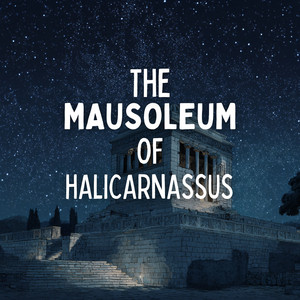
It's the Mausoleum of Halicarnassus.
You've traveled back in time over two and a half thousand years to when this ancient wonder has only recently been completed.
It's 350 BCE, in the region of Anatolia, which will later become Tychia.
Anatolia is part of the massive Persian Empire, which stretches from southeastern Europe to modern-day Afghanistan.
Halicarnassus is at the empire's western end, in the kingdom of Caria on the Aegean coastline.
Caria is ruled by a satrap or governor, who is alterable to the Persians but allowed substantial autonomy.
Until 353 BCE, just a few years ago, the region was ruled by King Mausolus.
You might recognize his name as the root of Mausoleum, a title given only to the most magnificent of tombs.
Mausolus was much more than a governor for the Persians.
He was a powerful king in his own right.
He kept the Persians happy with an annual tribute whilst his armies conquered Caria's neighbors and continuously expanded his kingdom.
Ruling for a total of 24 years, the king earned a reputation as an ambitious builder.
He had newly founded cities built from scratch, laid out in the style of ancient Greek cities.
Mausolus was a fan of ancient Greek culture, from the language and customs to the style of architecture.
Nowhere was this more obvious than in the city of Halicarnassus, which he named his capital early in his reign.
Alongside his wife, Queen Artemisia II, the king spent huge amounts of tax money on the Greek metropolis.
The city was rebuilt on a new grid pattern, and the streets were lined with gorgeous buildings.
A grand royal palace was erected on an outcrop, overlooking the waves of the Aegean Sea.
It was a stone's throw from the temple of Apollo, the Greek god of healing amongst his many titles.
Other temples were peppered about the capital, where visitors could go to worship the gods.
There was also an agora for public meetings and a Greek-style amphitheater where audiences were entertained.
And, of course, there was also the Grand Mausoleum, the crown jewel of Halicarnassus.
You can see it now, above you on the hill.
It looks every bit like a grand Greek temple, overlooking the city on one side and the sea on the other.
Seen as it is in 350 BCE.
It will remain here and intact for sixteen centuries, the second longest survivor of all seven ancient wonders.
Only the Pyramid of Giza will last any longer.
This is particularly impressive considering what the city will endure being sacked by pirates on multiple occasions.
Less than two decades from our visit, Alexander the Great himself will take the city by storm when fighting the Persians.
Halicarnassus will be consumed by flames when the Persians set fires as they evacuate the capital.
And yet the mausoleum will remain untouched, one of the few buildings still standing once the smoke has cleared.
Even when the building does eventually topple after a series of earthquakes in the 1400s, the base of the mausoleum will remain standing, while the rest of the capital is all but flattened.
The structure that we see now in 350 BCE is how the mausoleum would have most likely looked.
It's based on a blend of facts and assumptions, and the many artifacts later found in the region.
Also the words of ancient writers like the Roman historian Pliny the Elder.
His description of the tomb, alongside those of many others, help fill in the details of the building and its surroundings.
With this in mind, let's return to the hillside, where the Aegean Sea laps gently behind you.
You're gazing upwards to the distant mausoleum as you bask in the freshness of the salty air.
You begin walking, finding yourself drawn towards the hilltop.
It's as if you're being pulled up by some invisible thread, though your footsteps are as slow and rhythmic as the waves.
The path you tread is one of loose gravel.
It runs up from the coastline between blankets of grass.
Your feet are dressed in elegant leather sandals.
They are snug and comfortable, a perfect fit.
Above them, you wear a toga-like tunic, similar to those made fashionable by the ancient Greeks.
The salty breeze blows gently behind you, wafting through the lightweight material.
The sounds of the breeze and the flapping of your clothes blend with the rhythm of the waves behind you.
This is further punctuated by the crunching of gravel underfoot as you wander leisurely up the hill.
Occasionally, you pass by buildings on the grass, their walls topped with roofs of terracotta tiles.
Fields of corn sway gently between them, bordered in places by trees and bushes.
Cornstalks rustle and crunch in the breeze, alongside the leaves on the branches of trees.
Songbirds chirp from their nests in the branches, adding more layers to the natural soundtrack.
These sounds wash over you as you wander slowly. as do the sights that surround you on the path.
The landscape seems blurred, beautiful but dreamy, and your attention keeps returning to the structure above.
The building is more visible with each passing moment, with each and every step upwards along the path.
Soon, it is revealed to be gleaming white marble and far larger than it looked from below.
More of the landscape is exposed, where the path curves around near the top of the hill.
You pause for a moment before you continue, glancing over your shoulder.
The view from above is simply marvelous, from the lush green grass to those fields of corn.
The sea looks enormous and the colors are so vivid though you can still smell the salt as if you're standing beside the shore.
You breathe it in, gently and deeply, as you continue your walk.
The path takes you to the other side of the hilltop, where the view looks out across the capital.
You see figures clad in outfits like your own, wandering through a city, latticed with pathways.
Streets are flanked with villas and temples terracotta roof tiles appeared tiny from above.
Halicarnassus is a coastal metropolis that might easily be mistaken for a city in ancient Greece.
Buildings have the flair of Greek architecture.
Many are held up on sleek marble pillars.
The larger villas have gaps in the roofline where open-air courtyards display fountains and statues.
Even more, decorate the streets and roadsides beside fire pits, trees, bushes, and flowers.
A massive stone amphitheater shines white like a beacon on pea-green grass to the left of your view.
It's the last thing you see before turning on the pathway where you walk the steps of a wide stone stairway.
The steps lead up to the mausoleum's entrance, an enclosed ivory passage.
You pass large marble statues on your left and right, the figures of soldiers riding on horseback.
The stone sparkles where it catches the sunlight.
It gives the sculptures an otherworldly glow.
Looking up to the sky, you see the clouds have dispersed.
The golden sun has come out of hiding.
The breeze is cooler at the top of the hill and you're grateful for the feeling of sun on your skin.
The warmth is comforting as you pass by the statues, walking through the entrance to a walled-in courtyard.
The floor here is made of stone.
It's as large in scale as a town square or plaza.
Every inch of the courtyard is bathed in sunlight, from the patterned mosaics to the walls that surround them.
The mausoleum is positioned at the center of the courtyard, though it doesn't look anything like a tomb.
It's far closer in appearance to a classical Greek temple, a building one might find on the Acropolis in Athens.
At 50 metres tall, it towers high above you, on a massive podium of polished white stone.
The surface is lined with decorative strips where various figures have been sculpted across the surface.
On top of the podium, there's a smaller inner chamber, something that the Greeks referred to as a cellar.
This carries the weight of an enormous roof, which counts for a third of the building's height.
Onlookers might assume that the roof is held up by the massive pillars that surround the cellar.
There are 36 in total, placed evenly along the podium, with just as many statues positioned between them.
From where you are at the entrance of the courtyard, you can make out sculptures of toga-clad figures.
Their surfaces have been painted so they appear very lifelike and add a pop of color contrasting with the white.
These colorful figures gaze out across the patio at each of the four sides of the mausoleum.
Though they're ten feet tall, they are dwarfed by the pillars and the walls of the cellar that rise up behind them.
The pillars stop at the base of the roof, where a sculpted frieze forms a band of decoration.
Animals have been carved from the marble, left unpainted against a ruby-red background.
Above it, the roof is shaped like a pyramid, with 24 steps rising up to a platform.
This is topped with another painted sculpture two figures on a chariot with four horses before them.
You stand for some time at the edge of the courtyard, taking in the beauty of this grand mausoleum.
You wonder if this is what the king had imagined when he began making plans for the tomb's construction.
Mausolus had been inspired by what he'd seen in Lycia, a neighboring territory that his armies had conquered, particularly the tomb known as the Nereid Monument, built around the year 390 BCE.
The monument had been designed to look like a classical Greek temple, with lined ionic pillars and a triangular roof.
Statues of sea nymphs known as nereid were positioned on a podium between the pillars.
Archaeologists and experts in the 21st century have used evidence from both buildings to make 3D reconstructions.
The parallels are obvious when looking at the models, though the mausoleum here is far larger and more elaborate.
We can certainly assume that the king would have been delighted, had he lived, to see his resting place completed.
Sadly, he passed away in 353 BCE, leaving his wife to oversee the project.
Queen Artemisia had loved her husband dearly and was determined to honor him with the grandest tomb.
She took the king's plans and expanded on them greatly, sparing no expense in building the mausoleum.
It's said that the queen sent messengers into Greece with the task of recruiting the finest artists and sculptors.
They returned to Halicarnassus with an army of craftsmen.
A sizable workforce needed for such a project.
Included amongst them was a sculptor named Scopus, who had supervised the rebuilding of the Temple of Artemis at Ephesus.
Like the Mausoleum, the temple at Ephesus would later make its name as another ancient wonder.
Sadly, the queen would also pass away just a couple of years after her husband, so she too would never see it completed.
The glorious structure that would house her remains.
It's thought to have been finished during the reign of her brother, King Idraeus, who ruled Caria after her.
And perhaps that makes it all the more special, and speaks to the love and respect between siblings.
What's also rather lovely is that the craftsmen stayed on after the passing of both of their patrons.
Pliny the Elder reported that the artisans saw the building as a memorial of his own fame.
Essentially, it was a matter of professional pride and wanting to finish what they had started.
All things considered, this seems understandable.
On average, it took a whole year to carve a statue from marble.
Knowing this only adds to the feelings of awe and wonder that surround the mausoleum.
You feel as if you're in the presence of something magical or holy as you begin walking across the courtyard.
You enjoy the patter of your footsteps in sandals.
The sounds echo delicately across the stone.
It forms a gentle backdrop below the sound of the breeze and the crackling of fire pits on cast iron stands.
These are lined up beside the courtyard's thick walls, positioned evenly like the pillars of the mausoleum.
Flames dance across mounds of charcoal, sheltered from the wind by the cover of the walls.
You are gazing at the flames on one particular stand when you notice another person with you in the courtyard.
He is dressed in a toga of pristine white fabric.
Its creases catch the sunlight as he wanders between fire pits.
It's likely that his job is to keep the fires burning as he carries an iron rod in his hand.
You watch as he pokes it into the charcoal of a fire pit and reinvigorates flames that had previously been dimming.
The man's demeanor is one of care and concentration.
His movements are slow, seeming almost ritualistic.
The flames of each fire seem to absorb his attention.
You don't think you've ever seen a person so focused, yet relaxed.
He looks happy, too, you note as you pass him.
He smiles and nods as you catch his eye.
In his gaze you sense a feeling of shared appreciation, an unspoken gratitude at being in such a place.
And what a place the mausoleum is.
The floor alone is a work of art.
It must have taken years to complete the mosaics in the courtyard, to create such an array of intricate patterns.
The building is framed by a mosaic of flowers, their massive petals made pointy and star-like.
These are ruby in color, like the circles that surround them, and they shine like gemstones against an ivory background.
Around the flowers, within their circles, there are thick borders of lapis blue stone.
The stone is the same color as the waves of the Aegean Sea, even more so as it twinkles in the glow of daylight.
Strips of blue match others in the courtyard, including a double border around the outer edge.
It's only when casting your eyes towards this that you note the statues of lions on the walls.
As with all of the statues that you've seen so far, the marble carvings are exceptionally well made.
Large and realistic, they guard the mausoleum, made to look as if they're prowling along the walls.
Similar creatures are placed high upon the building, at each corner of the pyramid-like roof.
Above them, a chariot is pulled by four horses. and on it are the figures of a man and woman.
You noticed this structure when you first saw the building.
It draws the eye at the pyramid's Now that you're closer, you can see it more clearly.
You can better make out the king and queen.
It's a fitting tribute to Mausolus and Artemisia. the couple for whom the building was erected.
Brought to life in color.
They look regal and magnificent atop a horse-drawn gold chariot that glitters in the sun.
The sculpture is striking not only because it's handsome, but because it's so unusual to see a queen beside her husband.
This kind of sculpture would be unheard of in ancient Greece.
Wives weren't allowed into the king's chariot.
They weren't given that level of power anywhere, that is, but the kingdom of Caria.
Queens of Caria, like Artemisia II, enjoyed far greater power than their counterparts across Greece.
Scanning down from the chariot beneath the ruby red frieze, your gaze drifts towards the white marble pillars.
The surfaces are ridged with vertical lines, true to the style known as the ionic order.
Colourful statues are striking beside the pillars, their tunics a shade of reddish orange.
Mausolus and Artemisia are depicted in stone, alongside 34 members of their extended family.
This is something else that sets the tomb apart from similar monuments and Greek temples of the time.
There's very little reference to the gods and goddesses which tended to dominate contemporary architecture.
Instead of paying tribute to the deities of Mount Olympus, Artemisia chose to honour more earthly beings.
The building is a love token from a grieving widow to her husband.
It celebrates their marriage and their shared royal family.
The family of statues stand on the podium where a bas-relief has been carved from the stones.
It tells a story from Greek mythology, one known locally as Amazonomachy.
It depicts Greece's victory over the Amazons, an all-female army thought to be brutal and barbaric.
The story was a celebration of all Greece stood for.
It was a win for civilization and mankind's progress.
Images of Greek soldiers are immortalized on marble with weapons raised, some fighting from horseback.
Some wear capes, which appear creased and wrinkled.
They look as if they are flowing behind the warriors who wear them.
The Amazonian women appear equally lifelike. recognizable in tunics which are gathered at the waist.
Here again, the fabric appears ruffled, almost windswept, while their hair is plaited, looking neat and elegant.
Also included are carvings of centaurs, whom the Greeks defeated alongside the Amazons.
These mythological creatures have a male torso, rising above the body of a magnificent horse.
It's hard to imagine a better way to tell a story than this stunning image chiseled from the marble.
Just as impressive are the massive sculpted horses on raised stands at each corner of the base.
Soldiers hold up their swords as if ready for battle, and the horses are rearing with their front legs in the air.
You note the definition in the horse's muscles and the exquisite details in the soldier's armor.
Not only does it speak to the talent of its maker, but the love and care that was given to the project.
In the center of a wall.
You see what would have been a doorway, though now the entrance has been sealed off in stone.
Beyond the walls, there are stairs flanked with lions that lead up to the inner chamber or cellar.
This houses the remains of Mausolus and Artemisia, their ashes placed within decorative urns.
It also contains the Jar of Xerxes, an object considered to be extremely valuable.
The Persian ruler, Xerxes the Great, only gave these jars to people of high importance.
It was likely given to Artemisia I and passed down through the royal family.
Standing before the doorway, you reach out and touch the stone.
It hums beneath your fingers, as if it's somehow alive.
You feel that you're connecting with something magical.
The marble feels cool and also electric.
You pause for a while, enjoying the sensations from the touch of the marble to the breeze on your skin.
Then, you take some more time to wander around the building, absorbing details as you go.
From top to bottom, the mausoleum takes your breath away.
It's a vision of elegance and is uniquely handsome.
It's also symbolic of what humankind can achieve, even without the technology of the 21st century.
It's easy to see why Antepater of Sidon included the tomb in his famous poem.
Though this won't happen until the second century BCE, when he lists what became known as the Seven Ancient Wonders.
It's in part thanks to Antipater's poem that the building will later draw attention from the Romans.
It will inspire the creation of many Roman tombs, which they'll call mausoleums in honour of this one.
In fact, the great monument at Halicarnassus will continue to inspire architects for thousands of years.
It will inspire famed buildings, like the tomb of Ulysses S. Grant, built in 1897 in New York City.
Many Art Deco buildings from the 1920s and 30s are modern interpretations of the ancient tombs, like the National Diet Building in Tokyo Japan, and the Shrine of Remembrance in Melbourne, Australia.
This spirit of the Mausoleum will live on in these buildings a millennia after the earthquakes that destroyed it, just as the legacy of King Morsalis will endure in the name still given to similar buildings.
What's more, the original isn't entirely gone, even in the 21st century.
Medieval knights used the ruins to build a castle in the defense against the Ottomans in the 14th century.
Petronium, as it's called, or the Castle of St.
Peter is open to visitors in modern-day Bodrum.
The ancient mausoleum is built into its foundations along with the remains of Halicarnassus.
Elsewhere, artifacts will be housed in museums, including many found in the 19th century.
British archaeologist Charles Thomas Newton used the accounts of ancient writers to decide where to dig.
That's how he found pieces of wall and staircase, as well as statues from the podium and the top of the building and the jar of Xerxes made of ancient calcite with the Persian ruler's name etched on its surface.
The bas-reliefs, which shows Greece's battle against the Amazons, had been used to fortify the castle at Bodrum until the British ambassador gained permission to transport them to the British Museum, where they still remain.
You think of such things as you stroll across the courtyard, examining the mausoleum from different viewpoints and angles, until you've taken all you can from the marvelous building and you retrace your steps.
Once again, the sun is blanketed by clouds, its rays dimmed beneath their cover.
It gives the illusion of being later in the day than it is.
The early afternoon could just as well be evening.
You exit the courtyard walking around its outer rim, where you can hear the pop and crackle of fire pits.
The flames look even brighter beneath the cloudy sky.
They are a yellow shade of gold with hints of red and orange.
Again, you see the man in his bright white toga.
He is tending to a fire not far from the entrance.
You exchange another smile as you exit through the passageway, walking down the steps and around the hilltop.
You come to a tree that you hadn't noticed earlier.
It's at the top of the slope overlooking the path.
You sit down on the grass and lean against its trunk. beneath the shelter of its rustling canopy.
Here you sit and look out at the sea, absorbing the beauty of the lapis-colored waves.
The Aegean is just as humbling as the building behind you and one of the few things in the world that seems timeless and enduring.
You close your eyes and inhale deeply.
The scents of the tree blend with the salty sea air.
You drink in the aromas with every inhalation, feeling calmer and more rested with each and every breath.
Your last conscious thought is an image of the mausoleum. when you first saw it glowing in sunlight.
Then the image fades and you fall into a state of blissful relaxation.