W -B -U -R Podcasts, Boston.
Think about one of your strengths.
Do you have an ear for music?
A flair for telling jokes?
Perhaps you have a special talent for writing or sports or baking the most delicious cookies ever.
We all have special strengths.
And as we'll hear in today's story, sometimes they come in handy in the most unexpected ways.
I'm Rebecca Shear, and welcome to Circle Round, where story time happens all the time.
Today our story is called Mashup and the Shark.
It comes from the Wampanoag, an indigenous tribe in North America who have inhabited present -day Massachusetts and eastern Rhode Island for more than 12 ,000 years.
some really great people came together to bring you our version of this folktale including Roman Zaragoza who stars in the CBS hit comedy series Ghosts so circle around everyone for Mush Up and the Shark way way back in time there lived a kind and helpful giant named mosh up mosh up made his home in the crystal
clear waters of a sparkling bay and he cared for the people who lived by the showing them how to use the earth's gifts to make what they needed my dear people see how you can cut and sew deerskin to make clothing, how you can hollow out trees to make canoes.
You can build houses from saplings and bark, vines and reeds, and you can use stones and wood sticks to make fish traps so you can catch and eat fish from the bay.
Mashup was all about helping the people, But Masha had a twin brother who was all about harming them His name was Matadu And he made it his business to bring dangerous things to the earth Treacherous things like...
Disease! Yes! I shall create illnesses and ailments to make the people sick and weak I shall create confusion to muddle and mix up their minds And I shall create fear to unsettle and unnerve their hearts Among Matadu's other creations was a creature that dwelled in the sea A big, sneaky fish with razor -sharp
teeth and tough, scaly skin Whom Matadu named...
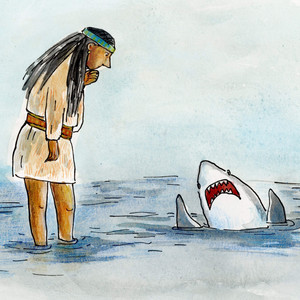
Shark Now, unlike modern -day sharks, this shark didn't have a triangle -shaped dorsal fin on its back.
Still, Shark was a strong, swift swimmer who loved feasting on the other creatures of the sea, especially the fish in the people's traps.
He would swim into the bay, whiz over to a trap teeming with fish, then use his pointy teeth to tear it apart and swallow the bounty inside.
The people did not like this one bit Nor did their benevolent helper, Moshup Oh dear, it sounds like my brutish brother has created a cold -blooded bully I think it's time Shark and I had a little chat Perhaps I can talk some sense into him So, Moshup went to the shore and called out Shark!
Shark! I'd like a word with you, please.
Within moments, Moshup saw Shark's body skimming through the water.
The creature paused, then stuck his head above the surface and fixed Moshup with a scornful sneer.
Well, well, well. Look who it is.
It's my brilliant creator's goody -goody brother, Moshup.
Always going out of his way to help the people And save the people Yes, shark, that's exactly what I do And that is why I am here The people are in trouble Because of little old me?
No, because of big old you And your big old appetite Listen, shark Shark, the people appreciate that an immense animal like you needs to eat, but they do not appreciate you tearing up their traps and gobbling up their fish.
So, could we please make an agreement?
You may eat as much as you'd like, provided it doesn't come from the people's traps.
Shark gave Mosh -Up a long, hard look.
Hmm. That's a fascinating proposition you make, Marshup.
You've given me a lot to chew on.
But you know what? I'd rather chew on something else.
Like the people's fish.
So goodbye, Marshup.
See you around. Marshup's face was grim as he watched Shark dart away.
Boy, oh boy, that did not go as I hoped.
I'll try again tomorrow.
So he did. But after he made his impassioned plea...
Will you please stay away from the people's fish?
Shark made another hasty retreat, turning his finless back on Moshup and swimming off.
Toodaloo, Moshup. The same thing happened the next day.
Ta -ta. And the next.
And soon, Moshup was so sick and tired of Shark blowing him off.
That he reached for his spear, held it up high, then hurled it in Shark's direction.
The pointy weapon sailed through the air, before landing right in the middle of Shark's smooth back.
Oof! Mashup could see the spear's triangular blade sticking out of the water as Shark swam away Well, at least now the people will see Shark coming by the blade that sticks up and cuts through the waves But that doesn't exactly solve their problem I must figure this out I must Mashup put his mind to
work, pondering his options He only came up with one Oh, I was hoping it wouldn't come to this But I'll go and talk with my twin brother While I doubt he will take pity on the people Perhaps we can reach an understanding But the moment Matadu heard Moshap's plea Psst, are you kidding me?
He gave his twin the brush off Look, Mashup, my spectacular new creation may eat whatever he wants, wherever he wants, whenever he wants.
And you can't do a thing about it.
Mashup was at the end of his rope.
He knew he must find a way to help the people.
And as we'll soon hear, he did.
By thinking outside the box and under the sea.
how will mosh up solve the people's problem what would you do if you were mosh up we'll find out what happens after a quick break what are circle round listeners saying about the circle round club the newest membership opportunity for super fans like you here's a taste i love being in the circle round
club because the snuggle times are perfect for when you want to listen to circle round but you don't have that much time grown -ups get your circle round superfan signed up today at wbur .org slash circle round club i'm rebecca sheer welcome back to circle round today our story is called mush up and the shark
Before the break, Moshup's twin brother created Shark, a menacing creature that kept stealing fish from the people's traps.
The people asked Moshup for help.
The benevolent giant tried reasoning with Shark and his twin brother, but it was to no avail.
So Moshup put on his thinking cap.
He sat on the shore, staring at the sea, hoping for a burst of inspiration.
And within moments, he got one.
Or rather, he got three.
Last one to the shore is a rotten squid.
You are going down, buddy.
You'll never beat us.
Mashup smiled as a trio of porpoises swam into the shallow waters of the shore.
Porpoises are marine mammals, like their cousins, the dolphins.
But porpoises' heads are shorter and rounder, and their bodies are smaller and thicker.
Made it! Looks like both of you are rotten squids.
So, which game should we play next?
I don't know. How about hide and seek?
Or follow the leader?
Or freeze tag? Or Simon Says?
Or how about you play jump the shark?
The porpoises were so busy brainstorming games, they hadn't noticed the gentle giant on the shore.
Oh! Hi, Moshup! What is Jump the Shark?
We've never heard of that game.
And you know us. We spend all day playing games.
We're some of the most playful creatures in the sea.
I know you are, but Jump the Shark is a new game, actually.
I've just invented it.
A new game? Cool! How do you play?
Well, to win this game, you need to do one thing.
You must get Shark to stop eating the people's fish.
If you've ever seen a porpoise, then you know they have kind of a smile on their face, right?
Well, when these porpoises heard Moshup's idea, their smiles vanished.
Nobody messes with Shark, Moshup.
That fish is so mean and nasty, he won't listen to anybody.
And have you seen his teeth?
Those chompers could tear us apart!
Nose to tail! There's no way we could fight him.
But I'm not asking you to fight him.
I'm asking you to persuade him to leave the people's fish alone, by using your strength Using our strength?
But Shark is bigger than we are And faster And again, those teeth I'm not talking about strength as in force, or heft, or even teeth I'm talking strength as in skill, ability Something you're especially good at A strong suit And as porpoises, what might your strong suit be?
What do you do best?
Well, like we said before We love playing games So what we do best is have fun Yeah, we are experts in playing and having fun Then use that strength to your advantage And convince that shark to leave the fish traps alone And find his meal somewhere else The next time Shark came skulking into the bay
The porpoises were ready The moment he made a beeline for the fish traps The porpoises made a beeline for him Hiya, shark!
Wanna play? Yeah! Let's play!
Come on! Before Shark knew what was happening, the porpoises were circling around him, leaping in and out of the water and laughing with glee.
Get away from me, you clowns.
Can't you see I'm busy?
Leave me alone. But we don't want to leave you alone.
We want you to play with us.
Yeah, Shark. Play with us.
The porpoises circled faster.
Play with us. And faster.
Play with us! And faster Play with us Until Shark was downright dizzy How many times do I have to tell you I don't want to play I want to eat Now beat it But the porpoises did not beat it Instead they took turns rushing at Shark Here I come Leaping over his body Here I go Then splashing into the water on the other
side There I went From there, they dove down and swam beneath him, using their dorsal fins to tickle his belly as they passed.
Stop that! I'm telling you!
Get away! Well, as you can very well guess, the porpoises did not get away.
They kept leaping and splashing and tickling, until Shark couldn't take it anymore.
He plunged under the water, far below the frisky, fun -loving porpoises, and swam as fast as he could to the deepest, farthest part of the sea.
The porpoises were smiling wider than usual as they watched him go.
Maybe he wants us to chase him, like Tag.
Or follow him, like follow the leader.
Or seek him, like hide and go seek.
Or he wants you to leave him alone, since your strong suit definitely is not his.
The porpoises gazed at Mashup, who had come wading into the water.
I was watching everything from the shore, my friends.
You did an excellent job.
You scared Shark off with your fun.
Speaking of which, these long legs of mine have been known to run really fast.
Last one to the sandbar is a rotten herring!
Thanks to the fun -loving porpoises, mean old shark thought twice before returning to the bay and snatching the people's fish.
In fact, it's been said that even now, if you head to the sea and you see porpoises playing offshore, Chances are good that Shark won't be coming by anytime soon.
Because as far as he's concerned, when it comes to fun and games, it's basically game over.
Now it's your turn.
What are some of your strong suits?
Find a piece of paper and down the left -hand side, write your name one letter below the next.
Now use those letters as the starting point to list your strengths.
So if your name is Cal, C might stand for creativity, A might stand for always willing to try hard, and L could stand for loving or leader or learning new things is my jam.
Share your strong suits with someone you have fun with, and if you'd like, share them with us.
Have a grown -up snap a photo of you and your strengths and send it to circleround at wbur .org.
With your permission, we may feature you in The Lion's Roar, the monthly newsletter of The Circle Round Club.
More on this super fun club for super fans like you in just a moment.
But first... This week's episode, Mosh Up and the Shark, was adapted by me, Rebecca Shear.
It was edited by Dean Russell.
Our original music and sound designs by Eric Shimalonis.
Onus. Eric's featured instrument this week was the acoustic guitar.
You can learn more about this popular string instrument, whose earliest versions date back over 3 ,000 years, and see a photo of Eric playing one on our website, wbur .org slash CircleRound.
CircleRound's artist is Sabina Han.
Sabina has created a black and white coloring page for every CircleRound story, and you can print them out and color them in.
Grownups, visit our website, wbur .org slash CircleRound, and click on coloring pages.
Special thanks to this week's actors Fyodor Chin Zeki Hamid Joe Hernandez Anthony Palmini Jessica Rao and Roman Zaragoza who stars as Sasapis in the hit CBS comedy Ghosts.
Love Circle Round and want to Circle Round with us in even more ways?
Join the Circle Round club and get ad -free episodes bonus bedtime stories music education videos super fun swag a monthly newsletter and early access to our live events.
You can also add cool perks like our snuggly Circle Round Lion and a personalized birthday message from me.
Sign up today and support the public radio podcast you love at WBUR .org slash CircleRound.
And grownups, if you have a moment, please leave us a five -star rating or review on whatever podcast app you're using right now.
It helps other listeners find the show so we can make the Circle Round circle even bigger.
Circle Round is a production of WBUR, Boston's NPR news station.
I'm Rebecca Shear thanks for circling around with us now that you've made it to the end of this circle round episode we want