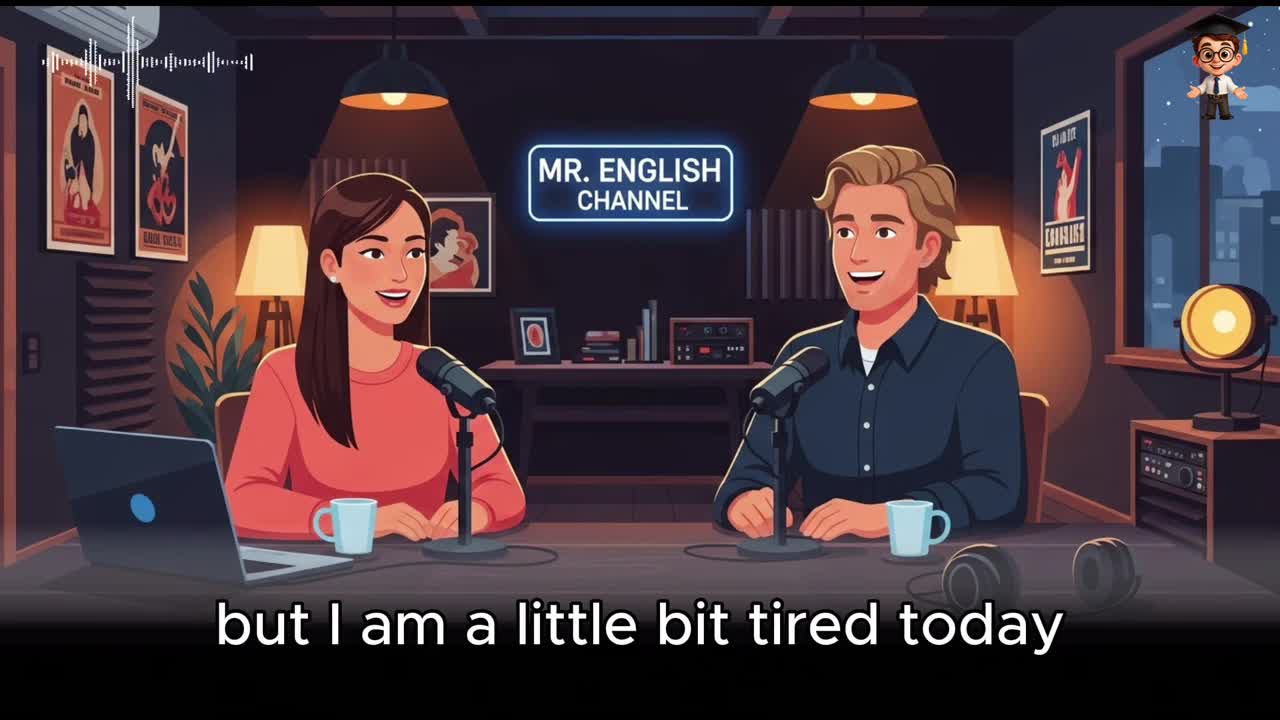
Hello, everyone, and welcome back to Mr. English Channel, where learning English is easy and fun.
I'm Emily.
Hey, hey, and I am very, very happy to be here with you today.
I am Paul.
It is so good to see you again, Emily.
How are you?
I am doing great, Paul, but I am a little bit tired today.
I stayed up late reading a book.
Ah, I understand that feeling.
You need some energy.
You need a big cup of coffee.
Yes, exactly.
That is actually a perfect idea, because today we are talking about exactly that how to order coffee in English.
Oh, I love this topic.
It is so useful.
I remember when I first tried to order coffee in a different country.
Oh boy, I was so nervous.
We are going to make sure our listeners feel confident and happy when they walk into a cafe.
But first, friends, if you like our videos, please click that like button right now.
Yes, and if you are new here, please subscribe to Mr. English Channel.
We have new stories and conversations for you every week.
And don't forget to share this video with your friends who are also learning English.
Sharing is caring.
Okay, Emily.
I am ready.
I can smell the coffee beans already.
Mmm.
Me too.
Hmm.
Wait, Paul.
Do you have a pen on your ear?
Oh, yes, I do.
I was writing a note earlier and I forgot I put it there.
Wow, I'm a bit messy today.
That is funny.
Okay, let's imagine we are walking into a very busy cafe in London or New York.
It is morning and there are many people.
Okay, I can see it.
It's loud, people are talking, the coffee machines are making a sound.
It feels a bit scary if you don't know what to say.
It can be.
But the first thing we do is look at the menu.
Usually it's a big board behind the counter.
Right.
You see words like espresso, latte, cappuccino, and Americano.
Exactly.
Yesterday, I went to a new cafe near my house.
It was so small and cute.
I walked in and the barista, that's the person who makes the coffee, looked at me and smiled.
That's nice.
What did they say?
They said, hi there, what can I get for you?
What can I get for you?
That is a very common question.
It just means, what do you want to buy?
Yes.
And I realized I was so distracted by the smell of the cake that I forgot what I wanted.
I just stood there for a second like, uh, um.
I do that all the time, especially when they have chocolate muffins on the counter.
Right.
But then I remembered our simple formula.
I said, hi, can I get a medium latte, please?
Can I get?
That is so simple and so polite.
Can I get a medium latte, please?
Exactly.
It's perfect for beginners.
You don't need a long sentence.
Sometimes I say, I would like a coffee, please.
Is that okay too, Emily?
Oh, yes.
I would like is also very good.
It is very polite.
I have a story about this.
Last week, I went to a cafe with my brother.
My brother doesn't drink coffee.
He only drinks tea.
Oh, really?
Yes.
So we went to the counter and the barista was very fast.
She said, next.
My brother got very nervous.
He looked at me and said, Paul, how do I ask for tea?
What did you tell him?
I told him to just say the name of the tea.
So he said, hello, I'd like a green tea, please.
And the barista said, small, medium, or large.
That is the big question.
Sizes.
Yes.
My brother looked at the cups on the counter.
They usually have the cups there so you can see the size.
He pointed to the biggest one and said, large, please.
A large green tea.
That is a lot of tea.
It was huge.
It looked like a soup bowl.
He was drinking it for an hour.
Wow, but that is a good tip.
Look at the cups on the counter to choose your size.
So, Emily, what happens after you say, can I get a latte?
Usually the barista asks more questions, right?
Yes, they might ask about the milk.
This is very important these days because many people don't drink cow's milk.
True.
I usually drink my coffee with oat milk.
I love the taste.
Me too.
Oat milk is great.
So the barista might say, any particular milk?
Or what kind of milk would you like?
And I can just say, oat milk, please.
Or do you have almond milk?
Exactly.
You are asking a question.
Do you have?
It is very useful.
Do you have soy milk?
Do you have coconut milk?
Ah, do you have?
I will remember that.
Wait, Emily, I think I just dropped my phone.
Oh, no, it's okay.
It fell on my bag.
Oh, you scared me, Paul.
Be careful with your phone.
I am a bit clumsy today.
Maybe I really do need that coffee.
Well, back to the cafe.
So you chose your drink, you chose your size, and you chose your milk.
What is next?
Sometimes they ask if you want sugar or syrup.
Yes.
They might say, would you like any sugar with that or any flavors?
I like vanilla, so I can say one pump of vanilla, please.
One pump.
That's a good word for the syrup.
Or you can just say, can I have some sugar on the side?
On the side.
That means I want to put the sugar in myself, right?
Exactly.
You get the little paper packets of sugar and you do it at the table.
That is much better.
I don't like my coffee too sweet.
If you are still listening, comment latte below.
We want to know who is practicing with us.
Yes, comment latte.
It's one of my favorite words.
It sounds so fancy, but it's just coffee and milk.
It really is.
So, Paul, after all the questions, it is time to pay.
The most important part.
Usually, the barista tells you the price.
They might say, that'll be $5.50.
And then they look at you and wait.
In many countries, we use cards or phones to pay now.
Right.
I usually use my phone, so I ask can I pay by card?
Or I just hold up my phone and they point to the machine.
The machine makes a little beep sound.
I love that sound.
It means my coffee is coming.
Yes, the beep of happiness.
And then the barista might ask for your name.
Oh yes, this is a classic.
They want to write your name on the cup.
But sometimes they make mistakes.
One time I told the barista my name is Emily.
E-M-I-L-Y.
When I got my cup, it said Amelia.
Amelia?
That is not even close.
I know.
I just looked at the cup and laughed.
I didn't say anything because it doesn't matter, but it was funny.
One time, my friend went to a cafe.
His name is Mark with a C at the end.
When the barista asked for his name, he said Mark with a C. And what happened?
The barista wrote Cark on the cup.
C-A-R-K.
Cark!
That is amazing!
Poor Mark!
We laughed for a long time about that.
So, listeners, if the name on your cup is wrong, don't worry.
It is a very normal thing.
Definitely.
Just wait for them to call a name that sounds like yours.
When they finish the coffee, they usually put it on the counter and shout the name or the drink.
Like medium latte for Emily or large green tea.
Exactly.
And then you say, thank you, have a nice day.
Have a nice day.
That is the perfect way to finish.
It's friendly and simple.
I always feel so good when I say that and the barista smiles back.
It's a nice connection.
It really is.
Hmm Emily, I was thinking what if someone wants a snack with their coffee, like a croissant or a cookie?
Oh, good point.
You can use the same sentence.
Can I also get a chocolate croissant, please?
Can I also get?
That is very easy.
You just add the word also.
Yes.
Or you can point to the food behind the glass and say, I'll take one of those, please.
I'll take one of those.
I use that a lot when I don't know the name of the cake.
Sometimes the names are very long and difficult.
I do that too.
That brown thing, please.
The one with the strawberries.
Exactly.
It works every time.
Wow, Emily, I feel like I am a coffee expert now.
I want to go to a cafe right now.
Me too.
I really need that caffeine.
Let's think about what we talked about today.
It was a lot of good stuff.
It was.
We started with walking into the shop and looking at the menu.
And we used that great phrase, can I get and I would like.
Right.
And then we talked about the sizes, small, medium, and large.
Remember the soup bowl tea?
Yes, the giant T. And we talked about different milks, like oat milk and soy milk.
And asking for sugar on the side.
That's very helpful if you want to control the sweetness.
Oh, and the names on the cups.
Don't be sad if they call you Cark.
Poor Cark.
And finally, paying with a card and saying, have a nice day.
It's so simple when you break it down like this.
It's not a scary lesson.
It's just a conversation.
Exactly.
And that is the best way to learn.
I agree.
I feel much more confident now.
And I think our listeners do, too.
I hope so.
Remember, everyone, it's okay to make small mistakes.
The barista just wants to help you get your drink.
Yes.
If you forget a word, just point.
Use your hands.
It's all okay.
Well, Paul, I think it is time for us to go find a real coffee.
I agree.
I am ready for my oat milk latte.
And I am ready for my, hmm, maybe a cappuccino today.
Sounds perfect.
Before we go, friends, please remember to subscribe to Mr. English channel if you haven't yet.
And give us a thumbs up.
It really helps us make more videos for you.
Also, comment below and tell us, what is your favorite coffee?
Do you like it with milk or black?
I want to know.
I love reading your comments.
Me too.
They are always so kind and helpful.
Okay, everyone.
Thank you for listening to us today.
Yes, thank you so much.
You are doing a great job with your English.
Keep practicing.
See you in the next episode.
Bye-bye.
Bye.