Microsoft has disappointed everybody with how they've approached this kind of AI world.
We're out there right now in production with thousands of customers, and they're just not at that level.
And I think this co-pilot thing has been a huge disaster for them.
Welcome to The Logan Bartlett Show.
On this episode.
What you're going to hear is a conversation I had with co-founder and CEO of Salesforce, Mark Benioff.
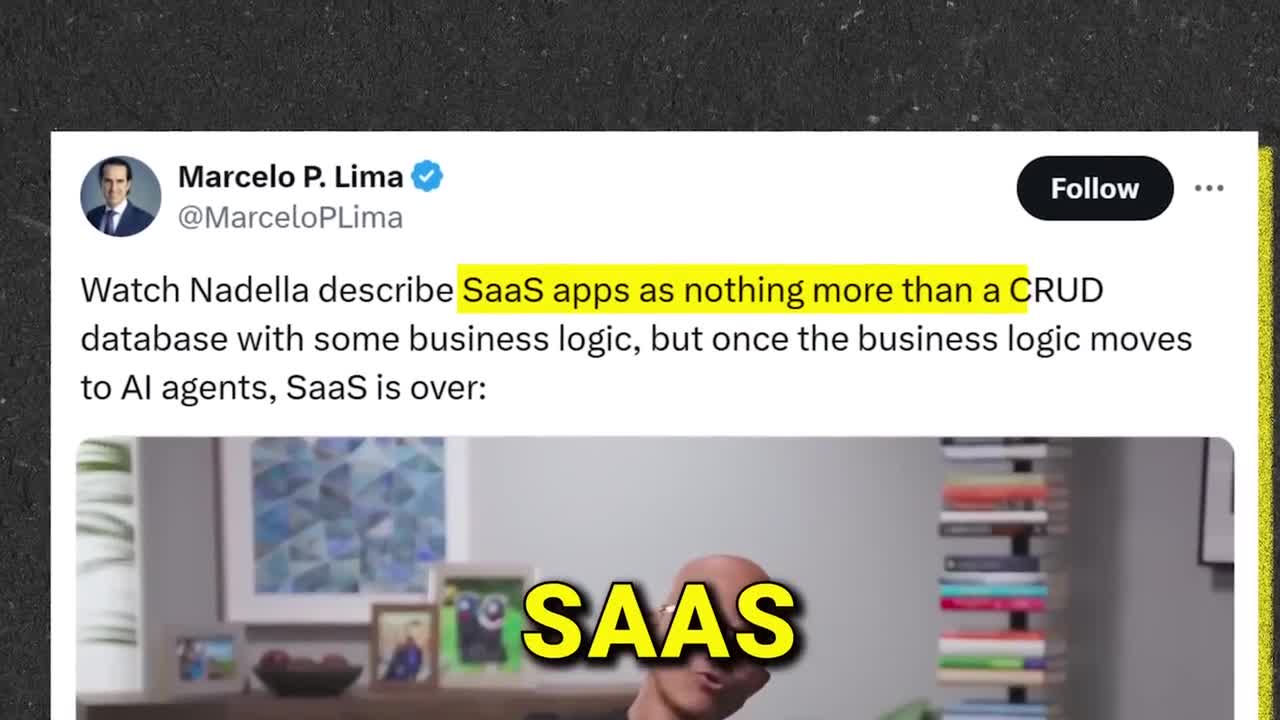
Now we go deep into a number of different things related to artificial intelligence, including Mark, responding to Satya Nadella's recent comments calling a number of SaaS applications simply crud databases that aren't going to survive the future of AI.
That's probably where they'll all collapse, right, in the agent era.
I don't know what AGI they're using, but it's not the one I have, at least.
You're describing the post-PC, post-phone, post-Zoom, post-Slack, post-email world.
And I'm not in that world.
I'm in the current reality.
It's 2025.
Here is my desk, I'm in the now.
We also talk about the trillion dollar opportunity that Mark sees for digital agents, as well as what the impact of AI is going to be for different revenue, including what he thinks the split is going to look like for agentic revenue versus more traditional software revenue that we see.
I'm joined in this episode by my partner at Redpoint, Jacob Efron.
Jacob leads a number of our artificial intelligence investments here at Redpoint and also has his own podcast called Unsupervised Learning, where you'll go deep in AI with people like employees from OpenAI, including Noam Brown and Bob McGrew.
On Reefset episodes
If you enjoy going deep into artificial intelligence, I highly recommend subscribing to Unsupervised Learning.
Now, without further ado, you'll hear Mark Benioff.
Well, Mark, thank you for joining.
I appreciate having you on.
It's great to be with you, always.
So one question I guess we're going to talk about the commercial applications of AI and how Salesforce is using it externally to your end customers.
I'm curious.
I heard you say something on a podcast recently about maybe not hiring more engineers this year, keeping that flattish and maybe customer support going down over time.
Can you talk about how it's actually impacted the business of Salesforce?
Oh, yeah.
Let's just talk about that because I just think it's such an exciting moment.
For the last 25 years at Salesforce, we're really all about helping our customers to connect with their customers in new ways.
We automate all these customer touchpoints and we're helping them manage and share information and manage data.
Huge database of, you know, 230 petabytes of information.
It's awesome.
And all of a sudden, you know, and that's a huge TAM, by the way, all of its own.
I know you guys are venture capitalists, so you like to talk about TAMs.
So you know the TAM world is, you know you look at like, you know, just like well, just take one, like call it Slack, the Slack world that we're in.
Hopefully you guys are on Slack.
You know it's like a hundred billion TAM, the collaboration world.
Then you've got.
You look at the sales and service and marketing like kind of the traditional CRM world.
Maybe that's a multi-hundred billion dollar TAM.
The analytics world we own Tableau it's like a 100 billion TAM.
But we're in the hundreds of billions of dollars TAM.
But I think we're in a new world, and this new world is the world that none of us have been in before but we're all about to go into, which is the world of digital labor.
And this idea of digital labor this is a trillion-dollar TAM or multi-trillion-dollar TAM this idea that we're not just supplying information management tools to our customers anymore to help them manage and share their information, but we're now providing digital workers digital labor.
And that is like the huge awakening that this is a new, exciting world.
That is what's really transforming.
And I think, as we've moved into these different levels of AI, from kind of the predictive world, where know we kind of started 10 years ago with einstein, which was this world of you know it's.
It's about machine intelligence, machine learning, predictive intelligence.
And then we moved a couple years ago, two or three years ago, into generative and where generative ai was really cool and we're all on there and doing our search and saying hey, I'm looking at buying this new camera, and which one
Oh, the Sony camera could do that.
Oh, I had no idea.
And then listen, it's like, how is it doing this?
And then now we're, though, moving into the agentic world.
And the agentic world is this exciting world.
And then we're moving into the robotic world.
And I'm sure you guys are making investments in that category, you know, in the agentic category.
And you probably were in the degenerative category.
And I know you were in the predictive category.
And when you look at these four areas and how it's played out, it's awesome.
But this third chapter has started, and we're all in it, and customers are really excited.
I mean, we've signed thousands of customers now on our AgentForce platform and I've never seen anything go faster.
Yeah, no, I'm curious.
I feel like a question a lot of folks are asking is just the timeline toward you know, some of this agentic revenue and kind of that larger TAM that you talk about.
I'm curious, as you think about a few years out two, three years from now, what do you think the relative split ends up being of this digital labor revenue versus different types of traditional software revenue?
And then even looking at a decade from now, where do you think that goes?
Wow.
Well, those are three or four questions.
Let's try to take it apart one by one, and then, if I've missed one, let's go back and kind of close the door.
So when we were getting ready to talk about this at Dreamforce, I thought the most important thing for us is to start talking about how it's humans, with agents, driving customer success together.
And that you know at some point.
These agents are not like our agents, are 85 to 95 accurate right now.
And to talk about that with you and what we're seeing.
But at some point the customer says actually I want to talk to a person and bam, you're back in the customer support world with a human and that whole screen in front of you is filled with the whole agenda conversation and you see everything playing out dynamically from what happened in the agent and now I'm seeing what's going on with the humans.
So that is very powerful.
And that is the deep integration between the two worlds, is that we're not in a pure agent world.
Maybe we, you know I don't know if you're talking to her every night.
You know from the movie and on your way home you're having a relationship with a digital agent, but I'm not.
You know.
But if you do go to helpsalesforcecom you'll see that I'm trying to be customer zero and I took our stuff.
And you know we have 9000 employees doing support at Salesforce.
And We basically put an agentic layer on our whole system and you log in and we ground you.
That means connect into your Salesforce data so we know what products and all your cases and everything.
And you're working with the agent.
And why that's important is we do about 35000 of those customer support inquiries every single week.
And a month ago, 10,000 of the 35,000 have to go to humans.
So they're on there working with the bot or something, trying to kind of work inside the electronic world.
And then they eventually got ejected into the human world.
Well, now only 5,000 are not resolved by the agents.
So we've gone from 26,000 resolved to 31,000 are resolved by the agent.
So there's still 5,000, but we just need less support people because of that.
So that is a big thought where all of a sudden wow, we're getting a lot more automation, a lot more capability, but there's still a deep integration required between the agentic layer and the software layer.
And connecting humans and agents is extremely important to deliver customer success.
So that that's certainly how we see it right now, and you have these great case studies.
I mean similar to what you've done internally.
I feel like you've published with, like disney and wiley and all these folks, some really impressive outcomes of.
We have signed now thousands of customers with a revenue relationship.
That is incredible.
And these deals are from very small deals to deals that are as big as eight digits just for agent force, in addition to all the other products that they're then, you know, buying as well.
So that is very exciting.
And you know, we can see.
You know, when we do a deal with a customer, if we're talking about a large customer like, let's say, a large.
I'll give you an example a large telecom customer deal we recently did.
It's a large deal.
You know, it's a nine digit deal and it's very significant and it's multi-year, and so forth and so on.
And the total, we call the total contract value or the TCV is this long, this big.
And then in that deal, we saw like an eight-digit Asian Force deal.
So that is very exciting.
It pulled also all the other products along with it, because it makes all the other.
We don't just have a service cloud.
Like you know, we are the number one service cloud in the world.
If you look at the Gartner Magic Quadrant on Service Cloud, we're up and to the right.
Oh, by the way, that's all pre-agentic.
Now we're the first agent for Service Cloud in the world.
We have a complete agentic platform around our Service Cloud.
And for all those customers who have Service Cloud, who are about to buy Service Cloud, it's all going to be agent first.
So that is very cool.
And it's not just the only agent for service cloud.
Our sales cloud is now agent first, our marketing cloud, our commerce cloud.
Even if you go to our website, you'll see that we took WordPress and we have built an agentic layer on the front of it, ingested our website into our data cloud and then built an agentic layer on the top of it.
It's an experiment that we're running, but I think it's a very neat idea that agents can be, you know, front-ends to websites as well.
So we're in a new world.
I don't think all of us understand where we are.
It happened so fast.
I don't think we had time to all really debate it and discuss it like we normally like.
Oh hey, this is what's going to happen.
Like, boom, it just happened.
And so now we're all just trying to go as fast as we possibly can.
I'm curious as you think about that example with the telecom and the service cloud revenue and the agentic revenue, just from a proportionality standpoint, I guess, as we sort of internalize some of these use cases.
Does it end up being, you said, an eight-figure deal for the agentic?
Is that ballpark?
Does that end up being like 10%, 20%, 30%?
We're just trying to quantify, as venture capitalists, how to even think about the incremental opportunity for some of these things.
Every single customer is going to be different.
I think that it's impossible to say exactly what that's going to be.
In that case, the customer was about a third agentic and two-thirds traditional.
I can't tell you yet exactly.
I just don't have enough examples to be able to say this is exactly how it's going to play out.
But in that case, that customer was about a third agentic.
And that was a very exciting transaction and very exciting for us to take this very good size telecom company.
Here is the platform to automate them.
Let's get them to another level.
We're able to paint a vision of what the future is for these customers that is incredible and also help them show they're going to lower their costs with the agentic layer but radically increase their customer intimacy and their capabilities to be able to deliver value to those customers as well.
So it's a tremendous use case and it's just an awesome opportunity.
A CEO of this upstart business Microsoft, Satya Nadella, said recently on a podcast something to the effect.
Let me read it for you, and I want to get your reaction to it.
He said, business applications will collapse in the agent layer.
They are essentially crud databases with essentially a bunch of business logic.
And once the AI tier becomes the place all the logic is, they will start replacing the back end.
I'm curious, it felt like that was maybe a veiled or direct shot at Salesforce in some ways.
I'm curious your thoughts.
It wasn't veiled.
And I think that I had to watch it and then try to.
I'm glad you wrote it down because I think a lot of people are trying to figure out what is he exactly saying.
This is what he's basically saying.
Microsoft has disappointed everybody with how they've approached this AI world.
Today, when we look at Copilot and what they've done.
They've repackaged OpenAI and dropped it into Excel or something to say, oh yeah, now here, now you can, You can try to do this, do something, but customers are not finding themselves transformed with this co-pilot technology.
I've spoken to these customers.
They barely use it, and that's only if they don't have a chat GPT license or something like that in front of them.
It's not at all what we're talking about, and I think that We're delivering an agentic platform in production today to our customers.
And we're already the largest enterprise AI provider in the world.
We'll deliver 2 trillion enterprise AI transactions this week to our customers.
Now we're delivering not just predictive and generative, but also agentic AI.
We're delivering this at scale globally to our customers.
This is what customers really want.
Look, Microsoft's a very good company.
They're the number one software company in the world.
We're the number two software company in the world in the enterprise.
They're very good fast followers.
I'm sure they will try to copy our stuff like they usually do, and try to copy our language and move towards us.
But we're out there right now in production with thousands of customers and they're just not at that level.
I think this co-pilot thing has been a huge disaster for them from a branding and validation standpoint.
Customers don't look at them and don't take them seriously in AI.
Nor should they, because they're not even making the AI themselves.
One of the debates we've had internally on this is as we move to more of a UI-less world and we're interacting more and more with some chat-based system, does that remove some of the incumbency advantages that a system of record has?
And it could be Salesforce, it could be Workday, it could be whatever.
Let's take that head on, because I think that if you kind of heard what he said and kind of what you're saying, which is we're moving into the environment of her,
So if we haven't watched the movie, this is what you're saying, right?
You're like, well, listen, And I just talk to, hey, how's my sales forecast?
And, by the way, I'm trying to close a deal with these guys you know at their venture firm and want to make sure they're using our products.
So let's make sure we follow up and get that on my calendar.
And let's do this.
And that's not how I'm.
I don't know how you guys, how you operate every day, but I have this thing called a phone, which is this really cool invention that I will be on when I'm done with the podcast, checking my text messages, my emails, my Slack messages, working on my forecast.
You guys may not use it anymore because you're way out in advanced in venture capital world.
But how I operate is like I have a phone, I have a computer, I have a.
I do Zoom.
I have a lot of things, these tools, that I use and I don't know what world that he's in, where these SaaS applications are only CRUD databases.
But the funny thing is, it's a mishmash of words because SaaS applications are CRUD databases.
CRUD is Create, Read, Update, Delete.
So yes, we are creating reading updating, deleting sales information, service information And kind of the example of if you go to helpsalesforcecom and hopefully your portfolio companies are all using our service cloud and our sales cloud and they get on there and they are having a great experience in resolving 90 of their things on the agentic layer.
And then they go, no, I need to talk to a Salesforce employee now.
And then boom, that person comes on the screen and then everything flips.
And what happens for the Salesforce employee is a huge screen of all the information appears in front of them and they're looking at the screen and they can see exactly what the agent has been doing with you and looking at the case information and looking at your company and all your agreements with us and all the products and every interaction that you've ever had with Salesforce is right there on the screen.
Okay,
That world is not the world that you are describing.
You're describing the post PC, post phone, post Zoom, post Slack, post email world.
And I'm not in that world.
I'm in the current reality.
It's 2025.
Here is my desk.
I'm in the now.
I know what I could do for people.
Oh, and by the way, the AI is not 100 percent perfect.
I don't know if you've tried it, but these things are good, but not great.
And, you know, AGI is not here quite yet.
I know you may have read some blogs this weekend, but I don't know what AGI they're using, but it's not the one I have at least.
I'm trying to make good of some very good AI that's a lot better than what we've had.
But you know, we can do a lot for customers, but we can do not everything, but we can do some things.
I mean, I think what you're saying makes total sense.
I don't know what I'm saying.
I haven't really had the chance to respond to that, so I appreciate it.
We're happy to provide the forum for it.
Listen, it's a question that we've debated internally, even outside of that clip itself.
We've thought about the UILess world.
It's a spectrum.
It's like this.
Did you ever see the movie Space Odyssey, I think it was called?
I did.
It's been a while.
And there's the moment in Space Odyssey where he says open the door.
And he says The computer says no.
Remember that moment?
That isn't how I go into my house today.
Maybe one day it will be that I'll be able to open my doors with my voice and everything.
We're just not in that.
Look, there's a spectrum of, you know, technology is a continuum.
It's constantly getting lower cost and easier to use.
And we could see where we are and where we're going.
And it's great to have like a marker in the future.
Yeah, we're all heading to her.
But then to say that that's where we are now.
I think it's a deception to customers and to people like you good, hardworking investors, who are trying to figure out what companies should they invest in to actually make money for your LPs in the next five years or the life of your fund.
And that is not...
I think useful right now, which is that the reality is we do have a world where humans and agents are going to have to work together for probably the short term.
And at some point, if we move into the computerless world, let me know, because that will be very exciting.
But that's not where we are right now, is it?
I appreciate you looking out for lowly venture capitalists, Mark.
Someone's got to do it.
All this FUD and crud out there, it's making it hard for us to do our jobs.
Hey, I'm an investor too, and we have a little thing, Time Ventures.
We're an angel investor.
Please include us on your deals.
And you know we're investing in a gentic robotic.
You know world, you know regenerative biology, you know these things are exciting, but We have to kind of operate in the here and now, otherwise we get too far out there.
It was probably not a great situation.
I mean it makes total sense that the human support rep that is gonna take the handoff from the AI agent certainly needs something like Service Cloud to be able to navigate this.
How do you think about, like the you know, as more and more just agents are doing some of this work, and maybe you know at some point we get, you know, companies that outsource all of support to agents.
What are those agents themselves need?
I mean, do they, you know, does the tools that they need to like to log into or get access to, or be able to get the information they need?
Does that look like Service Cloud or is that something different?
I'm sure it's something you thought about a lot.
Well, I think that our fundamental architecture has had to change in the last couple of years and it's kind of happenstance how it's kind of started to line up with what we've had to deliver in the agentic world.
I think the big change that we've made is and I think you understand how Salesforce is architected which is our sales and service and marketing and commerce and even our analytics.
It's all one platform now.
It's one code base.
It's one sharing model, it's one user model, and it's all amalgamated.
So all the workflow and all of the capabilities, where we had separate workflows because we acquired companies, we've really united them into one workflow that we have called one user interface, which we have called Lightning.
And then you're able to basically bring in the functionality you need to have that application.
And then we've also added a data cloud on top of that, which helps you amalgamate all of the data and federate that, which means connect off to the snowflakes and the data bricks of the world and do all of those things.
And that idea of an application layer and a data layer are extremely important.
And that's what we thought two years ago pre-agentic, because we didn't really think that we'd go into agentic as fast as we have.
And now that we're in the agentic world and we're shipping an agentic platform on top of that is layer three.
So that third agentic layer is also part of a single code base.
So the agentic layer, the data cloud and every customer touchpoint at Salesforce is one code base and one piece of code and one data model.
And why that is important is because the AI needs data to make the right decision.
So it needs to have the seamless understanding of the data and the metadata.
You know, the data is my phone number.
The metadata is it's a phone number.
So that idea that the metadata, the data, the apps, the workflow, the data cloud and the agentic layer are one code base is kind of Salesforce's unfair advantage, because it makes our AI more accurate.
And that's how we look at it.
And I think that's why customers are... you know, going so fast with our platform.
You probably saw, we deployed because we kind of released it nascently into 135000 customers and now they just have to turn it on and then they can turn on and build within the platform their agents.
So we should get to our goal of a billion agents.
That is very exciting for us.
And I think this is an exciting moment.
And I do not think that you know, this is just a crud database.
I think it's a misunderstanding of the vast power of the platform of Salesforce and what you can do with it.
And don't ask me.
Ask the customers, because they're the ones who are going to really be able to deliver that you know value.
I guess I'm curious as you kind of zoom into the future a little bit.
It seems like today there's a bunch of enterprises that are adopting these support agents and they're talking directly with customers.
In the future, not to beat her analogy to death, but I imagine consumers may have their own AI agents that are talking back and interacting with that.
And where does this all go and what does that mean for the agents that we actually build?
I don't know.
I mean, it's probably a really good lunch at the Village Pub.
You know where we can like sit and everybody's talking about this conversation really.
Like everybody, I think, all of a sudden has gotten thrust into this, you know, in a way because you can see, like whoa, this is going faster than we all anticipated.
And I think that's the cool part about our industry right now.
And this is a moment where we are all like sitting there going.
When are we all just going to be in the her world?
And I think it's a totally fair question.
And then I think it's a continuum.
So where are we?
I think it's a good point.
Like, where are we in this moment?
Because I don't think we can exactly predict when it will happen.
Maybe there's people out there who can say well yes, in 2029 all phones will shut off and we will just talk into the microphone.
But watch this.
Hey, what is my schedule today?
Oh, nothing happened, by the way.
So...
What is Logan's schedule today?
Siri, what is Jacob's schedule today?
Well, given that we're VCs, a blank calendar might be the right answer there anyway.
So I'm clear, if that was correct.
Tweeting, you know, podcasting, everything VCs do.
So that is the amazing thing, which is like...
Not quite there yet.
And I think that that is the Turing test for her.
We just did it.
One of the things I've heard you've been thinking about is just global labor shortages and some of the economic outlook or implications for this AI agentic layer that we're moving into.
Can you maybe elaborate on some of your thoughts around that?
I think that this is a big moment for our customers to be able to transform themselves to become agent first.
And it's kind of a leads into your next world, which is we are going through a global labor shortage where we see all these declining birth rates.
We understand that it is harder to hire, especially people here right in the United States, and sales and service.
You can see it.
And this is gonna give us the ability to do more.
And as an example of that, look at engineering.
I think in engineering this year at Salesforce we're seriously debating.
Maybe we aren't gonna hire anybody this year because we have seen such incredible productivity gains because of the agents that work side by side with our engineers and making them more productive.
And we can all agree that software engineering has become a lot more productive in the last two years with basically these new models.
And this idea that there is somebody who's kind of along the ride with us and kind of having this incredible experience helped making our engineering teams even more successful.
That has not been true in our sales and service and marketing teams.
I mean, maybe it isn't content.
I think that's one of the reasons that Adobe is struggling right now is because you can see what's happened in the content world.
Like I watched that Jensen Wang keynote last night in Las Vegas, which was epic.
And that keynote, almost every example was a content example, except for the robots and the driverless cars.
And like the examples were awesome on all the content that was being built.
But in all those cases I would have been using Adobe products before to generate a lot of those movies or to do a lot of those images.
And then i'm like whoa, this is like really powerful that there is just a huge ecosystem of companies, you know, that are doing these amazing products, that are competing against adobe in incredible ways.
But even just the generic models are able to do incredible.
You know, I'm sure we've all had the experience like hey, draw me this.
And that's so good.
I can now just put this on a T-shirt.
And you could not do that two years ago.
So that has definitely changed.
So there's no question the world is changing.
When it gets down to labor and delivering the next generation of labor, this idea that we can start to provide these digital workers to our customers.
That is the big thought, that we've only been a software company up to this point.
We've only been, yeah, we've only been a database company with apps, okay.
Yes, I think even Slack, it's a database in apps.
You know, Tableau, it's a database in apps.
Salesforce is a database in apps.
And now though, agents, yep, that's different.
It's.
We've created a new TAM, and that TAM is this multi-trillion dollar TAM of digital labor that is going to supplement the human labor that we can't really get.
You've been very thoughtful about how business can make social impact as well, from the founding days of the company with the 111 program.
I'm curious.
The Industrial Revolution happened over 100 years, 120 years, 140 years, depending on how you size it or scope it.
And I'm curious as you think about the retraining maybe we'll take within Salesforce, just because it's it's you know it's within your purview.
Um, i'm curious how you think about like, the re-skilling of your own workforce and the ability to move someone from customer support, where maybe it's going to be declining over time, to sales, which maybe will be increasing over time.
Do you think it's on the onus of companies to move people around and provide the learning opportunities for them to stay within an existing organization as roles maybe get cut?
Well, you're right.
You know, before I started Salesforce 25 years ago, I was at Oracle for 13 years and I loved being at Oracle and I loved my boss, Larry Ellison.
But one of the things that I realized when I was at Oracle because I was trying to create it was it could have had a more philanthropic culture, especially in really powerful moments.
And so I just committed to myself that, when I started Salesforce, that I would take 1 of our equity, 1 of our profit and 1 of all of our employees' time and put it into a 501 foundation.
And it worked out really well.
This 1-1-1 model, we've been able to give away about a billion dollars.
We've done about 10 million hours of volunteerism.
And we run about 50,000 nonprofits and NGOs for free on our platform.
It's pretty awesome.
And almost 20,000 companies have joined pledge1percent.org, which is our 1-1-1 model.
And it's a pretty big contribution to the theory of business that Business can be the greatest platform for change, and I really encourage every entrepreneur that I invest in and I hope you will too to think about this, especially at the beginning, because it really shows how you can use your business to do something good in the world through your product, through your people and through your money.
You know as you get forward and how what those things are will be completely you know, at your discretion.
So that that's a really cool part of i think you know starting and running and building and scaling a business, And so do you think that within that now the retraining is an impetus as leaders.
Do we have some moral obligation to try to repurpose the existing talent we have versus just hiring the net new person?
Or is it?
We live in a capitalistic society and so if you can hire someone better externally, you should just do so.
Well, I think that there's a debate in Silicon Valley about exactly as you just said it, like do we have any moral obligations at all?
But also, and then what is the point of capitalism and its level of purity?
But I actually think they're the same thing, because I think You actually will do better and create a better economy if you actually accept some of those moral obligations.
And we've been doing AI for a long time, and we do a lot of retraining.
We have our own retraining platform, Trailhead.
We invest a lot in AI.
You may know that we've given more than 150 million to the San Francisco and Oakland public schools, not just because of the moral obligation.
It's very practical.
Our employees, this is where they have their kids.
And we've put a lot of AI education into the schools as well a lot of math education, a lot of things to increase attendance in the schools, especially in the middle schools.
And that's been very valuable and I think very important for us.
And I think that each one of us probably has a great idea on how to make our schools better, how to make our hospitals better, how to make our communities better, especially in the way that AI is moving, including retraining and rescaling.
And I think all of us should do it because it's going to make all of our businesses much better.
Yeah.
One thing you know I was struck by when you were talking about, you know, watching Jensen's keynote was.
You know you mentioned kind of these different products that like were kind of in the world of Adobe and how there's all these startups doing that.
And I feel like in the VC world, you know we obviously see a bunch of like upstart competitors in.
You know we'll take customer support, for example.
And you know, there's your former coworker of Brent Taylor's company Sierra, there's Decagon Maven folks that are kind of focused singularly on this agentic problem.
How do you think about that and where that space evolves?
Well, it's a powerful moment in technology.
And I think everyone has been inspired by this next generation of AI.
And then everybody has their vision of where it's going to go.
And of course, the vast majority of them will be wrong.
And that's just the nature of our industry.
And that's the cool part.
And then a few of them are going to get it really right.
And each one of us hopes that either Salesforce Ventures is investing in that right one you know like hopefully it will be Typeface, you know, which is one of our big you know investments in the content world.
Or Time Ventures will, you know, get one of these things really right, like zipline is one of our you know investments, like in the drone world.
Or you know, and you guys I'm sure have your list of hey, I hope these are going to be really right on and you know it's a little bit of we're at the you know where it's.
We're making our bets to see you know which way the future is going to go.
And then we have as many failures as the successes as I'm sure you have.
You know, we're just writing these things.
Well, that one did not work.
Boom.
That was a bad idea.
And it was just not happening.
And I think that that's what makes our industry fun and enjoyable and exciting, and that nobody gets it exactly right.
Everybody has a success and everybody has a failure.
And hopefully we're learning from our failures and turning it into our next success story.
And do you think some of these other folks are maybe betting that this, like her moment is sooner than it sounds like you think it is?
I just look at what our customers need right now, and I'm working with our customers.
So I'm talking to customers and Delivering product.
I expect to be the first to deliver a billion dollars in agentic revenue in enterprise software.
That's my goal.
And when I deliver that, hopefully in the short term, that I'll be able to say Well, that's because we understand the current product requirements.
And I think that being out with the customers, talking to them, helping them to understand where they are and where they want to go, while also looking at the technology, all has to kind of work together.
These companies have spent Trillions of dollars, you know, putting in in very advanced systems to run their businesses governments, organizations of all types all over the world.
And those things aren't just going to turn off.
I'm sure you probably know we go into a lot of banks and they're still running IBM mainframes.
You know that they started putting in decades ago.
So technology tends to coexist and not just all of a sudden replace itself.
And when we look at our data cloud today, not only is the data cloud connecting to Snowflake and Databricks and Redshift and on and on and on and on, but it also connects to IBM mainframes as well, because a lot of the data is there.
So it's important for us to be able to bring all the data in, to get the agentic layer on top of it.
These architectures, these enterprise software architectures, these are going to last for decades.
This isn't just something like I'm going to change my phone or I've decided to move from iPhone to Android sim, and that's how I've changed my software.
That's not how company enterprise software works.
Mark, last one, and then we'll let you go.
I guess I'm curious.
What role do you think the government and regulatory maybe plays in AI, as we're looking forward in it?
Do you think we're in too embryonic of a state for anyone to actually get involved and try to come up with terms or structures?
Or do you think it's such a powerful technology we need to get out in front of how we work with it?
Well, I think it's going to be a balance.
And I think that you can see that because look, everybody kind of is looking at Elon Musk right now and what he's doing with Doge, but I think pre-Doge um, he did something very interesting.
He supported the regulatory bill that california was considering for ai and everybody was looking at that bill, which was, you know, very significant.
It didn't pass, it got vetoed by the governor, but before it got vetoed by the governor, it was supported by elon musk And everyone remembers when Elon tweeted hey, I'm supporting this regulatory moment.
And yet he's very anti-regulation.
So there's going to be a balance.
And I bet that we're all going to be switching back and forth a little bit, because I think in this technology, a lot of us still are trying to wrestling and grappling with what is really happening.
How far are we?
One of the reasons that I and I mentioned the Jensen keynote a couple of times, that I liked it was it was very practical.
It was very specific.
It was very actionable.
You knew what products you can buy from him.
You knew what he was building.
You could see where he was going.
I think in a lot of cases, AI leaders are doing keynotes and you're going to hear.
One of the things I really loved about the keynote is he didn't use these three initials that get everybody like head-spinning AGI.
And of course, AGI is getting reframed.
It's not the AGI that your father knew.
It's a new AGI.
It's like, well, it's not AGI what we were talking about two years ago.
What we're talking about it now is this.
It's like, he didn't mention AGI.
He mentioned basically here are the four layers of AI today that he can see that he's building products, for that he's able to deliver today to customers that he thinks customers are going to get value from.
I think that's where CEOs need to be.
It needs to be, here's my solution.
Here's the product I'm building.
Here's how it's priced.
And I'm going to deliver success for you when you implement this.
And I'm going to lower your costs, improve your customer relationships, improve your business KPIs.
The power of AI today.
And I think if we get too into these other worlds, it becomes very.
It becomes very, I would say conflicting, and I think in the regulatory world is where you can see that conflict expressed as, I think, this example that I just gave, which is in some cases you may say I'm pro-regulation and in other cases you may say I'm against it.
And so it's not going to be a black and white issue.
There's going to be some gray areas and regulation with AI.
And I'll tell you, nobody wants a Hiroshima moment with AI.
Nobody wants to see that kind of experience.
I watched this movie. over the weekend, I think it's called Creator.
It's an AI movie.
If you haven't seen it, it's worth watching.
It's about robots and agents and humans all coexisting together.
But there's a Hiroshima moment with AI that they talk about.
We don't want to get there.
We want to have an AI world that we, you know, have a safe AI and an AI that we work with and that's productive for society and that doesn't do all these terrible things that we know AI can do.
So there's probably a balance and hopefully we'll find that balance and that we'll all be more successful for it.
Well, Mark, thank you very much for doing this.
We'll take you up on the Village Pub at some point here.
But maybe we can run it back in some period of time and see how all this stuff has played out, if we're in this her moment.
Finally,
But thank you for coming on and doing this.
It's great to be with you guys.
Thanks for asking me to come on.
I really appreciate it.
Yeah, of course.
Of course.
Thank you for joining this episode of The Logan Bartlett Show with co-founder and CEO of Salesforce, Mark Benioff.
If you enjoyed this conversation with Mark.
We'd really appreciate it if you subscribed on whatever podcast platform you're listening to us on.
It really helps us continue to grow the show and bring on great future guests.
We'll see you next week with another great guest on The Logan Bartlett Show.
Have a good weekend, everyone.