takeaway Chinese, where you can take some Chinese away and experience progress day by day.
Takeaway Chinese. We will promise you a difference.
Welcome to take away Chinese.
I'm Yuho Lin, joined by Tada Steve Heatherly.
Hi Steve. Hello. Thanks for having me back.
Always a pleasure having you back.
You have such fresh perspective when it comes to Chinese language yet you're very skillful and sophisticated when it comes to sharing things that are related at China, but you can find equivalent in outside of the world.
I'm learning things, it's fun.
Yeah, it is fun. Yeah.
And it's fun to look at the world from different angles, for sure.
Look at different things from different angles would actually provide you a different perspective and having some insights coming out.
But that was, in my opinion, based on the fact that we We all have a lot of things that we share.
For example seasons.
So for most people in the world you have relatively warmer days.
You have relatively colder days.
And here in Beijing specifically, we say perfectly.
Perfect. So fèn means four.
Zhi. Zie. are three seasons.
Season. And fèn means they are very distinctive from each other.
They are very different and you can tell which is which very easily.
Canada has the same.
We have four different seasons as many countries do but some of the seasons are longer And winter we always say in Canada winter is the longest one and we have spring for like two weeks And then we have fall for maybe two three weeks and yeah Same here.
Yeah, but we also have relatively longer summer, which is okay It's like the warmer days and the colder days are basically the same period.
But the time that are warm or cool, the good ones are relatively shorter.
It's true, and it's sad, isn't it?
It's a little bit sad.
It is the time of year when we vacuum pack, vacuum seal our summer shorts and t -shirts and we bring out the long padding coats and the scarves and the mittens and the lotions to make your skin stay moist.
All of that stuff. That's very important.
And also I don't know you, but for us girls we would match our outfit as well as our purses with the season as well.
In summer days your purse is supposed to be relatively thin and relatively light it's easy to carry around and if you have a very furry bag, then it's a bit, you know weird It does not match the season whereas in winter days You would see a lot of very cute very fluffy and very plushy kind of bag that are like kittens Oh cute and it's just when you have that bag with you, you feel warm and happier I didn't know I'd be learning about fashion on takeaway Chinese today Just a tiny little bag Here we are.
Here we are. So the kind of warm and fluffy and cuddly and cozy stuff in winter days is definitely something that can bring us a little bit joy.
It does make sense.
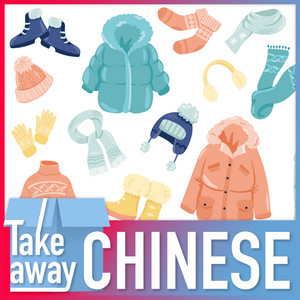
So, for our dear listeners, today we are going to talk about how to keep ourselves warm in a very cold winter day.
In Chinese, we call it, how to stay warm this winter.
If you're interested in Chinese culture and you wanna get a grip on the Chinese language, then this is the show for you.
Stick with us for 30 minutes and you soon see the rewards.
And for more fun Chinese learning, follow our Facebook page, Learn Chinese, to watch many fun videos and livestreams.
But now, let's provide you with some FREE Chinese for takeaway!
way. So the first bunch of Chinese I'd like to provide for you to take away freely is the title of this episode because I find it quite delightful because it combines the keywords which is, dong zi.
We talked about zi ji gi being season, so dong is actually winter.
Oh, okay, so Ji comes at the end of each of the seasons yes, okay So don't gee is winter season precisely Don't is winter Don't gee winter season the winter Don't gee don't gee again.
We talked about Chinese people prefer two -syllable words So if you say don't people understand you perfectly if it's in the right context But don't see no one would misunderstand you anymore.
Okay got it So, Domji winter days or winter season.
Domji. And Baoh Noan.
Baoh Noan. Baoh carries the meaning of Baoh Chih, keep.
To keep. To keep on a certain state or to keep you warm.
So, Baoh Noan, Baoh Chih would be keep.
And Noan, Wen -Nuan, warm.
Oh, try that one again, please.
Wen -Nuan. Wen -Nuan.
Yes, both Wen and Noan carries the meaning of worm, so, bǎo nō 'á means to keep warm, to stay warm.
And góngzìa, góngzìa is funny because góngghe is the meaning of attack.
So góngzìa attack gives me some time to explain this one.
Lìa is like a summary.
So qiè luǎ or luǎ ciè so keep it short and simple, keep it in a summarizing kind of form.
So gùng luǎ is kind of like the kind of summary, the kind of tactic that help you know how to attack, so this evolves into something that when you're playing games, the certain tips helping you to get around certain part of the game, help you navigate in the game, help you find out what is the best way to conquer a certain enemy that you are fighting against.
So it is kind of like a playbook for the game.
And here, winter is the enemy.
You can't understand it that way, or Gong Lue is actually very much used in everyday life here in China as well.
It generates, or it was originated from video game playing, but now it's kind like kind of tips or the kind of suggestions or the kind of strategies that you may have concerning certain issue.
So here the strategies we talk about are the strategies helping you to stay warm in the winter.
So if I were to ask the question related to many different things, how do you do that?
then your answer commonly might include gong -lue.
It depends because gong -lue definitely is a noun and if I say, 个和砑成, if I'm gong -lue.
say, let's say you asked me a question about how to do a certain thing.
For example, how to apply for a new computer in your workplace.
Yeah. And I can say, 个和砑成, if I'm gong -lue.
I give you a gong -lue and the gong -lue would be the way to do it, the step -by -step way to do it.
I think that answers your question that is definitely you can use this word in this kind of scenario Okay, how about this one?
If I were to ask you You say to me, oh I'm going to go to this piano concert this weekend and I want to ask you Oh, how do I get a ticket or how can I get a ticket in that context?
Can I still use Gong?
I can say I give you go on you give me so in the question I don't ask you you don't ask in the question because we talked about the origin of the word and it's considered something that's relatively multi steps it's considered something relatively difficult to achieve so to start with if we're talking about a gongluo, relatively speaking, it's always in the form of a written document.
Unless we're being a little dramatic and having fun with the word in the sense that a bao nuan gongluo is giving you a entire gongluo to keep you warm.
In the winter date it does not have to be a real gongluo gongluo, it's more like an expression.
And in daily life, if you're talking about a gongluo, because if you ask me for a gongluo, you are assuming I have a written document of how to do that, I might not.
But when I'm answering your questions and giving you the directions or the suggestions, I can make it in the form of gong lui.
Okay, so a gong lui is like a step -by -step guide.
Most vitations, yes.
Got it. So again you would still see the word gong lui much more often in video games than in how to keep you warm in Winter days.
A step -by -step guide to staying warm in Winter.
Or maybe multi steps, different ways to stay warm in Winter that is what we are talking about today.
So in your opinion what are some most have objects in Winter days?
Must have objects. You know, when I first saw the long padding coats many years ago, but not that long ago, I feel like long padding coats are relatively new to the fashion scene.
When I saw people wearing them in the beginning, I thought, pfft, that's a little bit much, isn't it?
It looks like you're walking around in a sleeping bag.
And then I tried one.
And after I tried one on, I realized...
You understand. Well, I realized I was the dummy.
They were the geniuses who were really fully protecting themselves.
So I think number one on the list for a must -have item in the winter time is a long padded jacket.
A long padded jacket can be a mian ao in Chinese.
Mian ao. Mian ao is a clothing.
It's basically clothing.
And also mostly, I think, it's a jacket.
So if it's trousers or long pants, you don't really say an ao.
So ano is like a top and mian is actually cotton.
So a cotton top, a cotton jacket.
That was relatively fashionable when I was a kid, not fashionable, common to see.
So when I was a little kid, we would 좋미애에우.
미애. Because we know 미애 is cotton and you fill the cotton in your clothes, make it very puffy and mostly heavy and to keep you warm.
That's 미애어. mian ku is cotton trousers or long pants so that's mian ao and mian ku but what you have described i think would be a yu zong fu goose down yeah yes so yu zong is feather and also the fluffy type of feather.
i'm not really sure if you've seen the long feather on a duck and also the small but softer ones, apparently, it's the softer and shorter Oh I didn't know there was a difference!
Yes, because I think on every bird, there are the really long feathers.
And the shorter ones?
On their wings so they can fly, but the shorter ones are the ones that keep them warm.
Make sense. And people harvest the shorter ones and put them in their own clothes.
So these shorter things are Yu Zhong in Chinese, and they are much lighter.
They're puffy as well, but they're lighter so that when you're wearing them it's not like you've got an entire, you know bedding it's not 10 kilograms okay so how do I say the long padded jacket then like the goose down jacket again you use on for you a jong fool yes you know you you don't phone food yes so your own food there are the relatively shorter ones and also the one down right above your angle yes that's the one I'm talking about.
And if you have one of those in winter, then you know what I'm talking about.
But if you've never worn one, please put that as number one on your list of things to buy.
So if you put that on your list of things to buy, then let me give you a even more detailed suggestion.
Do you know here in China, we can actually have the kind of Y U R O N FU that generates heat on themselves because generally your body temperature would be kept by the clothes you wear, no clothes would generate any heat themselves.
But we have this kind of Y U R O N FU, actually I have the Y U R O N FU, that you can attach to a power bank.
You plug your coat in?
Yes, you plug your coat in and there's this button and you have a three level heat choices.
What? And then it would be warming from the back and also the belly area it covers and generates warm and cold winter days.
It makes you very very happy.
So you charge, it's like an electric blanket.
Yes. But it's very thin.
Yeah. And it can generate just right amount of heat.
So you plug it in? You plug it in.
So it charges - it charges.
And then how long does the charge last?
No, you just carry a power bank in your pocket.
So you charge that.
Oh, this is excellent information.
Yes, I think I got one the year before last year and it's a game changer telling you.
Oh, this is exciting.
Yes. Okay, cool. So a lot of things can generate heat.
This one is a plugged -in one and do you know Shie -Dia?
Shie -Dia. So sie is kind of like a shoe pad or insole.
Yeah Yeah, so sie is your shoe and then basically is a pad.
There are the kind of shoe pad again that can generate heat But you do not have to plug them in I think they are using the kind of shredded iron and when the iron because they're so tiny Particles and they're shredded.
So when they encounter oxygen in the air they started to generate heat so those are just insoles you don't need to buy the whole shoe you just buy the insole the same size as your other shoes and then put it in there yes but the only problem is it's most occasions a one -time use okay but still yeah if you're out and it's going to be super cold that day that's really really good to know before doing the show I didn't realize I'm gonna give information like these and I think these information deserve to be called kong lui.
Yeah. Well, I haven't experienced a Beijing winter just yet, but everyone around me is saying, oh, just wait.
Just wait. So I'm expecting it to be super cold.
So I'm going to need these types of things.
Yes. And also another thing I'm pretty sure you would have many experience with is the snow boots.
Do you wear snow boots a lot?
Yeah, in Canada, I don't really.
Oh, really? Well, because they're quite cumbersome, which means, kind of heavy and awkward to walk in and wear, but that being said, in the dead of winter when it's freezing cold outside and you're going to be outside for a long time then yeah those types of boots are a must -have and in Canada many people wear those.
Yes, and they are called shi di shi.
Shi di shi. Shi di shi.
shu dee is snow, dee is floor or ground or soil.
So basically shu dee is when it snows, and it's not only snow, like light snow, it's heavy snow, so that the ground is covered with snow.
So the ground turned into a snow ground, shu dee.
Yes we know dee is floor, so snowground would be a shu dee, and shu dees is boot.
Shiz is shì is shì and shì is boot.
Oh, shì sounds similar in English and Chinese.
Shì, shì, Shì. Shì.
And shìsì. Shìsì, boot.
Yes. Shì, dì, shì. Perfect.
Here we go. Thank you.
Something important and again, I think most no, not really.
Because when I think of it, I thought we would only wear them during heavy winter days with heavy snows.
No, no, not really.
No, no, no, just any time it's really cold outside.
There's no worse feeling in the winter time than your hands and your feet being really, really cold.
So you have to make sure that those are nice and warm.
So winter boots a must have in the wintertime.
Yes. And another thing that are generating more and more popularity, I think is 바우입 내의 바우안.
Remember 도지 바우안. 거우우.
That's keep yourself warm in winter days.
So 바우안 is to keep warm, stay warm.
바우안. 내의 underwear. Ah -hah...
warm underwear. Yes.
And also 내의 in order to understand this word, you have to really read the context because it can be lingerie underwear underwear.
And it can be for ladies.
Your bras can be called a nei yi.
Okay. And in this sense, normally we're talking about the long underwears.
Do you know what we call the pant version of the long underwear in English?
What? Long johns. Oh, long johns.
Yes. Long johns are very very popular here in China.
We call them chiu ku, at least in the northern part of the country we call it chiu ku.
Chiu ku. This is a funny one because qiu means autumn.
It's the autumn pants.
So it's the pants that you start wearing during autumn days.
And take them off in springtime.
They stay on all year.
Yes, chōku. Yes. So I think some people in the southern part would call them mian mao ku or something, but let's remember chōku for now.
yes, one word at a time.
So, and if we're talking about, then you would think about what are we talking about?
So like what kind of underwear are we talking about?
But if it's definitely the long sleeve, long jounce kind of pants or clothes.
But just is the general term for all men's and women's underwear?
because nài means inside, i wenao is efu, clothing.
So, the clothes you wear inside of your jacket.
So, bao nuà nài. The reason I believe these are getting more and more popular is that people started to prefer the kind of really tight and also close to your skin kind of underwear that can keep you warm so that they do not have to wear too many layers in winter days.
Yes. And also it's under your clothing so you don't really need to care if it's fashionable or not.
That's not the point at all.
Again, it's really popular in Canada too.
Everybody wears this.
Yes, so yes, these are some common clothing that we usually wear during winter days.
Hopefully they are your winter must -haves as well.
Now let's do a short recap of the Chinese expressions of these clothing, of these words.
Which one do you still remember?
Oh mian is cotton. Cotton yes so mian yi or mian lao.
Mian lao .mmian aao.
That's perfect. Bao nuan means warm.
Stay warm. Yes. Nei Yi.
Néi means under garments.
Translated literally would be under your clothes or inside clothes.
What about yu zhù fu?
Oh, yu zhù fu, the long padded coat.
Yes and especially the one with feather in it instead of with cotton in it.
Yes the goose down, so yu zhù fu.
And also shi dei, remember shi dei, shi.
Shi dei, shi, is snow covering the ground.
Yes, that's shi dei.
Shi dei. And shi is the boots.
Ah, shi is the boots, and shi dei is snow.
Snow covering the ground.
Snow covering the ground.
So shi dei, shi together would be snow boots.
Snow boots. Yes, these are.
And also, gung lue.
Gunglue is like a step -by -step instruction or tips or suggestions for something.
Perfect. And these are the words that we've already covered that maybe, I'm pretty sure you will need in Winter days!
You're listening to Take Away Chinese with myself, Neil Hongli and Steve, we would love to hear from you!
Send us your thoughts via email to learnchinese .cri .com .cn.
Coming up next, let's talk about some more things that are getting a little bit creative when it comes to keep you warm in cold winter days.
Don't go away, so you will take some Chinese away.
Welcome back to Take away Chinese I'm Neo Hong Lin, joined by Steve.
We've already talked about some must haves in terms of clothing and shoes and boots in wintertime.
But actually, there are other objects that are very, very important in winter days.
One thing for me, for sure is nuan qi.
Noan chi. Yes, you already know noan means warm.
Chi is air. Warm air.
So maybe a... I think in English we call that a space heater.
Actually yeah. The machine.
The machine. And in China, in the northern part of the country, we have central heating system.
Meaning that the entire building shares this one heating system.
mainly. So that you do not really have to worry about staying warm in winter days as long as you're indoor.
Because most places, I think, like 99 % of the places, are with essential heating system.
So it's the same system for your air conditioning, right?
Not really. Because you stall your air conditioning system by household.
You make that decision of whether or not you want it.
In China, most places, most buildings, I'm talking about the northern part of the country, would have, it's a default setting for the entire floor.
Ah, okay, okay. It comes with the apartment.
Oh, so it's just, you don't control it?
You don't control control it.
I mean, you would definitely have a on and off switch in your home, but you are going to be able to enjoy it as long as you turn on the one at your home.
Oh, that's good. have to like air conditioner you buy the air conditioner and you do not affect other places but the heating is provided for the entire floor.
Got it. Nuanqi, something very important for me because I like to wear like my old season pajama at home.
Yeah because in winter days indoors it's just really warm I understand yeah you can suffer and go outside but when you come home You don't want to have to suffer and be home at the same time.
So, nuan qi is just warm air, that's not the name of the machine.
That is the name of the system in China.
Oh, it's the name of the system.
Yes, we call it nuan qi.
Is there a different name for the small machines.
Again, we call them space heaters.
You plug them into the wall and they provide heat directly from their source.
Actually, there are different names for them.
So, to start with, if you're talking about Nuanxi in a sentence without specifying it, people would automatically understand it as the central heating system.
And if you call, for example, Dien Nuanxi, electric … Ah, an electric heating system.
Yes, that would be – if you talk about Dien Nuanxi, to start with, most people would assume that you buy the Dien Nuanxi yourself and you plug it in, so it's the small thing we're talking about yeah and there's also Xiao Taoyang, Xiao Taoyang, Xiao means small, Taoyang is the sun, the small sun is talking about the one that when they heat up they turned red yes yes and it looks like a fan uh -huh and yeah it's a small sun keeping you warm.
What was the word for electric again?
struggle! Yes I see I bought one of those for this season.
But I don't have to well because you don't know about the central heating system..
Maybe... No I knew about it it's just that I thought that that might make the air so what I'm trying to do is balance the humidity in the house with the heat in the house, so I'm trying to find this perfect level of warm yet moist but not really moist.
You know how winter air is just so incredibly dry it's bad for your skin if you have sensitive skin and throat and your throat and your nose, and everything.
So I bought one of these Jin Nuan Qi and I thought I might need maybe two or three of them for the apartment.
Nope, nope, just one, just one.
And I turned it on to its highest level on the first day and turned it off very shortly after the room was like a sauna.
But anyway, it was, it's great product.
So yeah, So I have that plus the humidifiers going in the house and I'm still trying to balance the levels You know in Chinese we have this saying It's a bit complicated for your level currently but I'm Telling you this for a reason that is this is the kind of method that some people would go for When they're making a dough when they're cooking a dough for bread or for dumpling and they do not know the ratio They're not really expert That's why when there are too much water, they add more flour.
And when it's too much flour, they add more water!
Add more water, yes.
And I feel like the logic aligns with your method.
Add more heat, add more humidity, yeah, it's true.
It's a great growing environment for jungle plants, I think.
My plants are loving it right now.
At least the plants are happy.
Yes. but definitely would be something especially people in the southern part of the country would need because they do not really enjoy a central heating system and in the meantime when you're walking outside if you're the kind of person who do not want to wear too much, do not want to look puffy like a panda, one thing in China is this is a funny one because nuan is warm we know that Baobou is baby.
Warm baby. I know it sounds weird.
So in China, just if you're cold, just go and find a small human and just carry them inside your coat with you.
It sounds both cute and… And illegal.
And illegal, like in a horror movie, horrible.
So this is why literal translations can be very confusing sometimes.
What is a nuan bao bao?
Okay, so nuan bao bao are actually heat packs.
These are compact, single -use heating pads that can be attached to your clothing or placed in your pockets, and they share similar principles where they share a similar function with the shoe pad we talked about.
That is, one day when you opened the package, they start to - get hot.
Get hot. Sometimes you have to shake them.
A little bit, yes. Right.
Yes. You can put those anywhere in your pockets of your genes.
I've done that in the past, which keeps your legs nice and warm, or at least the top part of your legs nice and warm.
Yeah. Hot packs. Those are great in the wintertime.
I really don't know why they're called non -ball ball in Chinese.
Yeah, I was gonna ask.
Is it because the packs themselves are not the same size as a baby.
No. They're much smaller.
I think again, baby, definitely baby.
But they also cares the meaning of treasure, little precious objects kind of meaning.
So I think it's because the very first bunch of these products that got popular here in China named themselves LuanbaoBao.
And starting from there, the brand became the name of the product.
It's like Band -Aid?
Yes, yes. Right, that's not the name of the product itself, it's the company name, I see.
Okay, question. So baobao means baby.
Now, in English, you can use the word baby to refer to an actual human baby, but you can also use it romantically like hey baby.
So can I say to my wife, hey baobao?
You can, it's perfect.
Excellent, baobao. Now you're learning things.
Oh yeah, this is very useful.
Yes, you can say baobao.
Baobao, yeah, it's baby.
Mm -hmm. Can you give me an example of, like, the tone of voice you would use this?
不現行mail. Baby, are you there?
不現行mail. 不現行, that's you.
不現行 are you there? 不現行mail.
Yes, just about that works.
But still, let's focus on the theme of today, that's 不現行mail.
It's a kind of pack or the, you know, warm heat packs.
Mm -hmm, okay. So, that's 不現行mail.
What about an electric blanket?
Is that on your list today, I wonder?
Oh, yes. Actually, we talked about 介 being electric.
And 什 is actually hot or heated and 什, that's a blanket.
Okay, so 什 is electric?
什 heat or hot. 什 blanket Okay.
So electric hot blanket.
Yes, precisely. Diàn zhúa tà.
Do you use one in the wintertime?
I don't because my central heating system is quite good.
Oh, yeah. Even though you have the central heating system, or even though the air is warm in the room, some people still like to use these so they get that heat from directly beneath them.
Yeah, but I'm like you, I find it too dry already.
And then again, do you know when you're sleeping or when you try to go to sleep, actually a a little bit cooler or colder would make you fall asleep faster.
Yeah. My roommate, uh, when I was in university and this is in Canada, he used to sleep with an electric blanket underneath him and open the windows in his bedroom.
So it's like, you know, minus 10 outside maybe.
And so the air in his room is, I mean, Oh, when you breathe, you can just, it's like crystallized immediately.
And then there he is under his warm blankets.
That's how he preferred to sleep I don't think it's good for the environment.
I don't think it's good for your body either Okay, so sorry.
Can you tell me heat again or hot usually sure?
Yein, Julie tan, yeah, you're done perfect, and do you remember the heat packs mm -hmm bow bow Yeah, never forget that's your wife.
Can I just take about what you have to say no.
I'm Ba Ba Yes, no, no, no.
No, no. Perfect. Yes.
Yes. Yeah don't go into a store and look at the person and say, bao bao.
No, please don't. That might get you in trouble.
Do you know what? Nowadays, because we feel like language is inflating a little bit already.
So, on the internet, when you're shopping and the shop owner on the internet, when they interact with you online, sometimes they would also call you bao bao.
Really? Yes. Oh, because they're just trying to be cute and playful?
Oh, that seems a little dangerous… Somehow be dangerous in the sense that it would be easily misunderstood.
Not really. No, because everybody knows.
Not anymore, because everybody does that.
I see. I see. Sometimes it's baozi.
Not baobao. I think baobao is too cute and cuddly and romantic.
Ah -ha. Baobaozi is a bit better.
I don't know why I'm sharing this.
But... Baobao man. Well, that's good to know.
Did you understand?
Well, that's great to know in case any shopkeeper calls me baby someday.
I'll understand why.
Well, yes, now you do.
And maybe they are just trying to sell you some nuan bao bao.
You never know. Yeah, that's true too.
How about this one?
Actually, I see it a lot in the office and I'm assuming it's going to be even more popular in the wintertime.
People walk around with these giant thermoses to carry the hot water for their tea.
And that is bao wen bae.
Again with the bao.
Yes, bao wen, so bao nuan, bao wen.
We talked about wen nuan being warm because both wen and nuan carry the meaning of warm so you can say bao nuan or bao wen both work.
Bao wen bei, that's the thermos.
Bao wen bei is the thermos.
Yeah, I really need to get onto this because I feel like I'm the only one in this building that does not have a conveniently and these are huge by the way.
There are huge ones.
There are pocket size ones.
There are a lot of different types of bao wenbei out there.
But culturally office culture, everybody seems to have one.
So this is a common thing I guess is it the northern part or just all over China or you know in the west I guess you see people walking around with coffee cups all the time right?
But here at the office you see people with their thermoses.
They're always walking with their thermoses.
So it's kind of a common thing?
Relatively speaking, I think it still depends on the exact company you're in, but I'm pretty sure it's much more common in China.
Or the temperature of the building you're in.
Yeah. Right. hopefully these objects will keep you warm in this winter day.
Perfect. That brings us to the end of today's Takeaway Chinese.
I'm Nyong -ho Lin with Steve here in the studio.
For more episodes of the show, you can visit our website at rido .cgtn .com and go to the column podcast.
You can also listen to the show and read the script there.
Find us wherever you listen to your favorite podcasts.
Just search for Takeaway Chinese.
Don't forget to leave your questions, comments and a 5 -star rating!
HelloG you all, thanks for watching.
See you next time.