These topics that I deal with are important not only for the majority of society, but also for me.
It's like getting to know my own story and identity and my roots.
I have the impression that I am full, but not only that.
In general, it makes me happy in some way, but it also makes me very depressed and sad that wherever I go, all these patterns are always repeated and the stories are often very similar.
But, despite this, it is very important for me to say this, because I think that art is such a tool thanks to which you can say everything in a very simple way, without imposing, without shouting, without shocking, although you can sometimes shock some, I think.
For me, this is not a shocking theme, but for some it may be.
Thank you.
My name is Małgorzata Mirgatas.
We are in my studio, which is located near Czarna Góra.
I am an artist of Roman origin.
I deal with topics related to Roman culture identity appropriation, regaining of memory and topics that are related to with multiculturalism, but also with anti-gypsyism.
For me, work is important, and what is important to me is the routine, which gives me a lot of comfort.
Every morning when I get up, I drink coffee with my mom or with my husband, it depends.
Before that, of course, I also feed my animals. to the cat and the dog.
So it's always in the morning.
That's how I do it.
And then I go to the workshop.
In the workshop, of course, I meet the girl.
Of course, I send a message earlier.
I go to the workshop because the workshop is 20 kilometers away from my house.
When I come to the workshop, I think that my life is very well arranged.
In general, it always starts like this.
The process is very ... I don't even think it's complicated.
In general, when dealing with the Roman subject or the subject of your own culture and identity, you are constantly in this, not only in the environment, but also in the whole story.
And you start to look, not only to look for topics, but to read and find certain things that I have the impression should be shown or said.
And then, when I find something interesting, I start with sketches, And then, when I choose a sketch, I have some archival photos from which I also choose characters and I want to tell an interesting story or portrait anyone who is important to me.
It seems to me that it is simple, although it can also be complicated for some.
And, in the end, because I also have very nice girls Gosia, Stasia and Halinka in my studio.
They are also part of this work on different topics, and then we leave the last part to the girls.
They pin, cut out the appropriate shapes and sew them together.
This is probably the sweetest part of the whole process.
But the work with the community is a work on collective memory, but also common actions counteract the stereotypical thinking about the Roma community.
This gives an additional aspect, but I also think that this is something that is important.
Another interesting aspect that I have discovered over the years finding activists for whom art is also very important, because art helps you in telling important, important stories, and they want to share these stories themselves, not only the positive ones, but also the very traumatic ones, which should be discovered and said directly.
So art is like a tool in telling something important.
The deeper you go into this story, the more you know.
And you know that, for example, until the 20th century, All the images of the Romans were created by non-Romans, and you often have the impression that they are copied from the 15th century to the 20th century.
It gives you such a field.
You know those many 400 years of creation of stereotypical images, racist ones, but also the multiplication of the same scheme.
Telling about our society in such a way gives a lot of opportunities to counteract this and simply to subjugate the subjugated image.
And telling these stories again telling about me, even about my family, about people who come from, who are from the Roma community, who live it and encounter various injustices every day, but also with the good ones not only with the bad ones, but they also have good experiences and telling about them as ordinary, simple people who are just the same as everyone else.
This is the part of counteracting the stereotype and marginalization.
This is the part in my art that talks about us as a human being, as these people who simply have the same rights as someone else, like every other person in this world, on this planet, and we want to be ourselves and we don't want anyone to take away our dignity.
So this is important.
You are in a studio with a lot of materials, it is true, and they come from various sources.
At the beginning, when I created the work in the fabric.
Generally half of this work was painting and half of it was, as it were, where the fabrics were added, usually from my own wardrobe or the wardrobe of my mother sister cousin, aunt.
Later, at a larger exhibition that I held, Fabric was a medium that helped me to arrange the space.
Painting was no longer there, it was the fabric itself.
But now they come mostly from second-hand, but also from people who willingly give them to me because they want to be part of a certain story, because something additional is connected with each material, with each outfit.
Fabric is not a simple medium at all and a tool thanks to which, for example, you can tell each story in a very quick, simple way.
It's not like that at all.
And sometimes it happens that there are traumatic stories, stories about violence, on which you wonder how to show this part of the story at all.
It happens, for example, like with Siukar Manus that, having in mind the people who survived the Holocaust, who survived the Second World War in general, I began to wonder what is the background and what is important in the painting of the fabric.
Whether having here in the workshop a lot of different patterns, patterns and also the type of fabric that would be the best in telling or presenting these characters.
And then it occurred to me that each one would be only on a very simple background because, in fact, these characters and these people were the most important.
And I wanted to dress them, I wanted to show them in the way I imagined them having their photographs from their own children, but also watching documentary films about people who survived the Holocaust.
I think it was the simplest way and probably the most indicative of what was important.
Very simple and smooth.
And velvet helped me with that.
On the one hand rough, on the other smooth soft, and it gives such warmth.
But the character that was in color was the most important there.
And we are talking about her, so the background did not scream in any way and did not receive energy with this character.
Generally, this is the way of thinking about what such work should look like.
Sometimes it's very intuitive and sometimes it just comes to my mind one day okay, it will look like this, not differently.
I've been thinking about it for a long time that in no way would I want to talk about these traumatic situations through black and white and gloomy colors.
On the contrary, I think that the choice of these strong and visceral fabrics is important to me, and is important because each such situation should be told in color.
That's how I feel, at least.
That this color is important, that I do not want to intensify this trauma.
I do not want to multiply traumas, experienced traumas.
I do not want in any way for these traumas to take over life and also the future of given people or even mine alone.
So for me it is a story that should also be taught.
Amen.
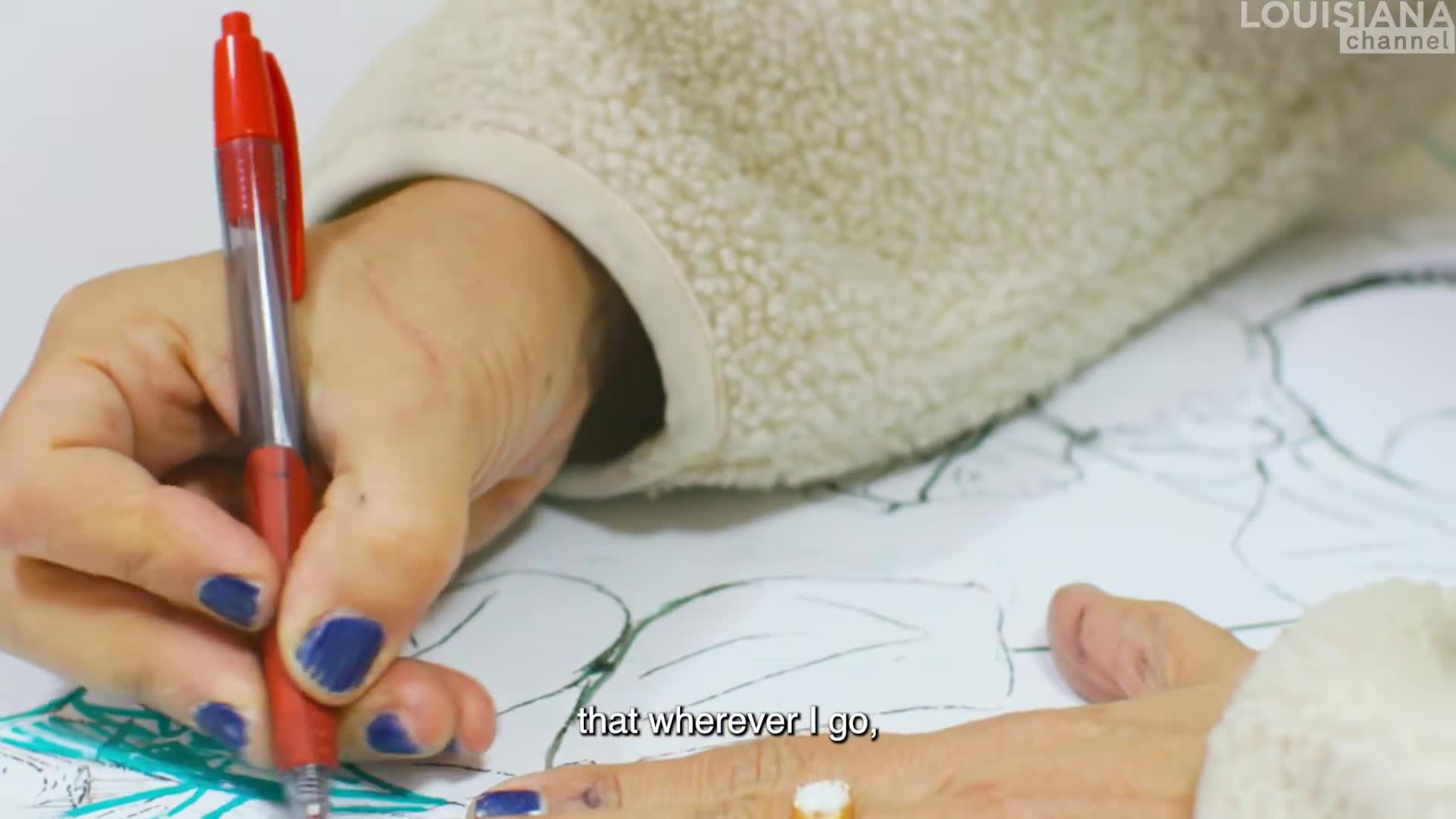
In my studio on the wall, you can see a lot of drawings and also photographs.
Some of them are historical it's like a copy of historical images and some are based on photos that someone shared with me or shared with me, but also my own photographic archive, which is quite large.
I think that this experience is not only an experience, but it is also a form of education.
An example can be all these exhibitions, where each proposal from the museum gives me the opportunity to get to know not only places, but also people who live there, groups of the Roma community and other Roma groups who have something to say and would like to say something.
So I'm always looking for opportunities to get to know them.
I think it's out of my own need to learn something more and discover new stories.
It is a part of my Roman heritage.
In Italy, for example, I met the Sinti group and I met an amazing family who not only shared their stories with me, I had the opportunity to find documents, or they provided me with a document from the 14th century indicating that the Romans visited Bologna in 1422.
When I got a proposal for an exhibition in Copenhagen even if part of the work is borrowed or borrowed and together with the curator we want to show the whole story, the whole journey, the past and present life not only my group, but also the majority of Roma in Europe and Sinti.
I use it in Copenhagen and find a kind of
Radość, in the newly recreated work or appropriated work of Roman images from the 1860s, the family of the Roman group called the Tatars, which is there since the 15th century, which was immortalized by one of the artists, and the original paintings are in the Copenhagen Museum.
So it's like discovering this group, this family rooted there for so many centuries, which has been noticed, which exists to this day and which we can remember, even through such paintings, is a special experience for me.
I myself did not know that such a group existed there.
Of course I have met Swedish Finnish, Roma and also Lovars who live in Stockholm, but I have also never met Tatars.
I hope I will meet one day, but this part of history is also quite important to me.
Yes, and these two recalls and two newly recreated situations taken from these two paintings and something added from myself, of course I added to these paintings.
I connected the past with the present, is a part of me and gives me a lot of energy to act.
I think they can have and also have an impact on changing the perception of certain situations or communities, as in the case of my art, where it is important for me to counteract exclusion, marginalization and stereotypes.
This is my guiding thought to show us that we are normal people and we do not agree with discrimination.
We do not agree with being in the shadows and we want to speak our own voice.
In this way, my art can work and change, but also other Roma artists, because I'm not the only one.
But when you think about art and we think about artists and how art influences culture, we have examples from the very beginning of history where, just by looking at rock paintings, we learn how people I don't know how people approached life, how they treated animals, what dishes they used.
This is something that is part of culture, which simply enriches you, which educates you and which impresses you, so I think we could be free without it.
I think that creation and what I do are partly the same.
I can't imagine a life without art, without what I do, without creation, without touching certain things.
It makes me happy and I think that these topics that they take up are very important to me.
It's not like I insist that I will only continue my whole life on one topic, because I also carry out.
Other topics are not entirely connected to the Polish community, but this is the main topic, because I really want to explore it and discover it, and it gives me.
It becomes a part of me, and art is my language, my storytelling tool.
Sculpture, but also my actions.
In general, I don't think I would be happy doing anything else.
Thank you.