This message comes from Amazon One Medical.
Have you ever been banished from your bed by a loved one because of a cold?
Amazon One Medical has 24 -7 virtual care, so you won't have to stay on the cootie couch for too long.
Health care just got less painful.
Amazon One Medical.
A quick note before we start today's show.
You may have heard that President Trump has issued an executive order seeking to block all federal funding to NPR.
This is the latest in a series of threats to media organizations around the country.
Whatever changes this brings, NPR's commitment to reporting and to serving the public will never change.
Even as paywalls rise elsewhere, we offer our reporting as a resource to everyone, regardless of their ability to pay.
This is a pivotal moment.
It's more important than ever that every supporter who can contribute comes together to pitch in as much as they're able.
Support the news and programming you and millions rely on by visiting donate .npr .org, and if you already support us through NPR Plus or another way, thank you.
Your support means a lot to us now more than ever.
You help make NPR shows freely available to everyone, and we are proud to do this work for you, and with you.
You're Hey, it's Mariel.
I think we all understand that our friendships are going to morph somewhat throughout our lives.
Like if you and a friend met in the sandbox at age 3, you're not expecting to sit around building sandcastles every time you hang out.
Though if you do, do that.
Kudos, that actually sounds super fun.
There are few changes as dramatic though as when one friend becomes a parent.
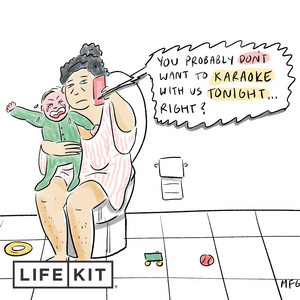
Suddenly they can't make plans as often they're experiencing a whole new set of stresses and they may only want to talk about their baby for the child free it can feel like their friend with kids just disappeared into their own world and for the friends with kids it can feel like non parent friends just don't understand I would say a lot of the friendships that I held before becoming a mom I saw how those kind of just transformed Mariah Maddox is a writer a photographer in a doula.
When she had a child four years ago she was the first parent in her close friend group and it was lonely.
I sometimes felt like I wasn't included in um plans a lot because of course you know people assume oh well you have a baby you won't be able to go out as much or do certain things.
I think it's easy to feel disregarded.
People without kids often feel the same way.
On this episode of Life Kit, reporter Emily Seiner is diving into how parents can strengthen their relationships with the child -free folks in their lives.
She'll share scripts and creative ideas you can use.
And she'll be speaking primarily to the parents in the room.
But if you don't have kids, you might learn something, too, about how to keep a friendship alive and flexible in different stages of life.
This message comes from Progressive Insurance.
You chose to hit play on this podcast today.
Smart choice. Make another smart choice with Auto Quote Explorer to compare rates from multiple car insurance companies all at once.
Try it at progressive .com.
Progressive Casualty Insurance Company and affiliates not available in all states or situations.
Prices vary based on how you buy.
This message comes from Charles Schwab with their original podcast Choiceology hosted by Katie Milkman, an award -winning behavioral scientist and author of the bestselling book How to Change.
Choiceology is a show about the psychology and economics behind people's decisions.
Hear true stories from Nobel laureates, historians, authors, athletes, and more about why people do the things they do.
Download the latest episode and subscribe at schwab .com slash podcast or wherever you listen.
This message comes from NPR sponsor, Microsoft Azure, the AI platform shift brings immense opportunity, but the road to success isn't always clear.
Leading the shift is a new podcast from Microsoft Azure where leaders and visionaries from organizations of all kinds share what they're learning as they navigate this new era of technology.
Listen and subscribe now to explore stories of real innovation in real life available wherever you get your podcasts.
This message comes from Discover.
Are you still quoting 30 -year -old movies?
Have you said cool beans in the last 90 days?
Do you think Discover isn't widely accepted?
If this sounds like you, you're stuck in the past. Discover is accepted in 99 % of places that take credit cards nationwide.
And every time you make a purchase with your card, you automatically earn cash back.
Welcome to the now.
It pays to discover.
Learn more at discover .com slash credit card. based on the February 2024 Nielsen Report.
Support for NPR comes from The Wallace Foundation, an independent nonpartisan research foundation collaborating with grantees and partners in the arts, school leadership, and youth development.
More at wallacefoundation .org.
When my son was a newborn, I went to a Moms Meet Up in my neighborhood.
It was my first entree into a world of socializing that revolved around kids.
It's a whole thing.
I now get invited to many many toddler birthday parties.
There's family programming at my synagogue, playdates, clothing swaps.
It's nice to have these moments of connection, especially because I know many people feel isolated during this stage, but I also see how this social life that's easy enough for me to tap into excludes an entire set of close friends.
People who I love, but who don't have kids.
It's sort of like a social silo.
Culture writer Anne Helen Petersen has thought about this a lot.
She does not have children.
And a few years ago in her newsletter called Culture Study, she asked readers how they showed up for friends without kids.
I think a lot of people were kind of stunned by even the question.
I think a lot of the discourse is about how you show up for friends with kids.
When your friend has a child there are social scripts.
You bring over food, you work around their schedule, you offer to babysit.
and there was very little discussion of reciprocality just in terms of, okay, how do you make time for your friends without kids?
What Anne -Helen heard from readers was that a lot of people without kids felt ignored once their friends started families.
Like, their friends were in this new stage of life and too busy to care about their non -parent friends.
But she also heard that people with kids felt the same way, like the non -parents were out there having a great time socially and never inviting them to hang anymore.
That whole entire like series of conversations.
I illuminated some hurt that some unspoken hurt on both sides, overcoming this mutual hurt is a good idea.
And not just because of any individual relationship between parents and non -parents.
It's a good idea because friendships and communities are really important.
Research shows that people with friends are less likely to suffer from depression and more likely to live longer and healthier.
In other words, it's in our best interest to keep up existing, healthy friendships.
And that means we've got to stop unintentionally shutting each other out.
What I found was guys were telling me, like, well, I just thought you were busy, so I didn't ask.
And it's like, well, I mean, give me a chance to say I'm busy.
Justin Kello is a father of two and runs a TikTok account called Parenting Cheerleader, and he brings up our first takeaway.
Instead of making assumptions about what your friend wants or allowing them to make assumptions about you, communicate clearly.
This is good advice for every single relationship, but especially when you have friends across life stages and assumptions run rampant.
You have to be extra intentional about communicating what you want.
Like, you have to say, I am busy, but this friendship is important to me.
Please don't give up on me.
If you have to decline an invitation to hang out, you might even explicitly say, I can't go to this, but please keep inviting me to things.
Or, hey, this next six months is wild.
Can Can we re -circle back up, you know, middle of next year and try and get something going?
Do you think that friendships can still be maintained at the same level if you're really having to schedule that far out?
I think that friendships that are strong can survive sort of a break, especially when it's open communication.
If they perceive you as you just ghosted them, then yeah, that friendship may not last. But if you just say, hey listen, the kids are wild right now.
I think just being honest because so much of friendships break down because people just aren't saying what's actually going on.
This open communication gives the other person a chance to respond and decide whether this hypothetical six -month break works for them.
And if not, we're going to talk later in the episode about how to find creative ways to maintain a friendship even during the busy seasons.
Honesty and friendships can also look like saying explicitly that something the other person did hurt you.
And you can say you want to talk about it because this friendship is important to you.
Mariah Maddux says, think about this kind of communication as an opportunity to deepen the friendship.
I just wish more people, more friends would be willing to have the hard conversations.
But I don't think that people realize that on the other side of those uncomfortable and messy and vulnerable conversations lies an intimacy like nothing you've ever experienced before.
For example, Anne Helen realized at one point that there was a secret text thread among her friends with kids.
It was like a subset of her big friend group chat with just the parents.
Instead of stewing on it passive -aggressively, as some of us might, Anne Helen decided to talk to them about it.
And I was like, that makes me feel left out that I'm not on that thread.
And they were like, well, we thought you wouldn't wanna be on it because it's just like pictures of rashes.
And I was like, that's okay, you know, like you can include me on that.
Another time, Anne Helen asked if she could support her friend's child in a school play.
her friend had assumed she would never want to go.
But she saw it as a way to deepen her relationship with this friend and child and family that she cared about.
I think oftentimes parents don't invite their friends without kids to kid -oriented things because they find those kid -oriented things kind of wild and or boring.
They're like, why would they want to come to this like birthday party of three -year -olds when in fact all of these things that are ways that you can include someone in that tight focus of the family are meaningful.
This leads to takeaway number two.
If you have children, invite friends without kids to be involved in your family life.
It's an act of inclusiveness that can reap benefits for your friendship.
For example, maybe you have a child -free friend who's been hanging back a bit.
You might assume that they just aren't into kids.
But remember, we are not assuming.
So you can say something like, hey, I want to see you more.
Would you be willing to come over during a family dinner?
If they're interested, it can be an opportunity to strengthen your relationship and their relationship with their kids.
And if it turns out that they really just aren't into kids, we'll talk later about how to make time for kid free hangs.
Or plan a gathering with a mix of parents and non -parents so you can introduce your friends from different parts of your life to each other.
Like this is a way to integrate them into that group of parent friends, right?
so that's not just like a weird other world that you talk about sometimes, and that it feels like you're getting cheated on with parent friends, right?
Now, this isn't without its pitfalls.
I told Anne Helen I have a vivid memory of being invited to a friend's house before I had kids, and the whole conversation revolved around potty training.
I didn't enjoy that.
Anne Helen says, yes, it's good to be aware of who's in the room when you're having in -depth conversations about parenting.
But that's the case with any group of people and any kind of commonality.
Whether it's a life stage or job or a mutual friend, just keep the conversation inclusive.
Including friends without kids in your family life also means honoring the fact that they have a full life too.
Maybe your friends have come to your baby shower or brought you meals.
You can find ways to reciprocate with moments of support or celebration.
Or in my case, my friends threw me like a really big book party.
But it could be a birthday or something like that, but it could be a celebration of your friendship, right?
Or when someone moves into a new place or like things that I think aren't always celebrated but deserve to be celebrated.
That seems very basic, but it sometimes needs to be, I think, articulated very clearly.
Ok, so you and your friend have talked about what you both need out of the friendship.
Maybe you've started breaking down the silo between family and friends.
But the fact remains, parenting takes a lot of time.
It's just a logistical challenge to hang out.
So Justin says, in order to actively maintain friendships, you have to be more flexible about what it means to connect.
For example, a lot of men he knows like to do activities together rather than just talk.
But that's hard for Justin to make time for.
So we started scheduling phone calls with a friend every other week.
And I don't love talking on the phone, but because I don't have time to grab lunch or to go do an activity with them, that's the best I can do, and it is good.
Every time I hang up, I'm like, I'm glad I did that.
Takeaway number three, get creative about quality time with friends.
For Mariah, this meant finding activities where the kids could be present without being too distracting.
So my friendship hangouts turned from being able to go and get dinner late at night if I wanted to, to inviting a friend over and going for a walk around the neighborhood with my child and his stroller.
It allowed us time to catch up while kind of relieving me of any worry of having to find a babysitter or wait until my husband was off of work in order to be able to go out by myself.
Or maybe you invite a friend to run errands together.
Anne Helen has written about the joys of having an errand friend.
You both need to go to the laundry service, you both need to go to the bank, you both need to go to Target, and that's easier when you have two people doing it together and you can stop and get a sweet treat or listen to dumb top 40 radio.
It's wonderful. It's better together.
I feel like I, I just like want a friend to come over while I'm like folding laundry.
But that feels like a, I don't know, like kind of a presumptive ask.
No, I mean, you could be like, bring your laundry.
Like you both take your loads of laundry and you fold them together.
And Helen says this has the added benefit of removing some pressure for your house to look perfect when friends come over.
Whether or not you have kids, we should all embrace the unfolded laundry.
But not every friendship hang has to be some kind of creative compromise with kids in tow.
It is possible to go out to dinner with a friend, adults only just like old times, but it takes more planning and additional help.
For people who have a strong partnership I think one thing you can do is create what I like to call PTO for parents.
PTO as in Parent Time Off, that's take away four.
Schedule Parent Time Off with other people in your life.
It could be something you plan ahead with family members or even a babysitter if you can afford it.
Or with a partner, like in Justin's case.
Let's agree, like, okay, one night a week each of us can bail and the other one has to manage things.
You have one guaranteed night a week where you can go be alone, you can go be with friends, you can go to dinner, whatever.
And then Justin says he and his wife take it a step further.
In addition to this one night a week, they also give each other a full day off a month and then a full weekend off at least once a year.
like you should be absolutely able to go away, visit with friends, visit with family without having to manage children, and each of you get that.
I think if you make a structure like that, you're more likely to do it.
I love this tip, because it's not about waiting until you're already drained by the demands of parenthood, and then making time to get away from the family.
It's something you're doing proactively and consistently.
By making it a habit, you can fill your own cup, and invest in friendships at the same time.
So, once we're all communicating what we need and we're finding creative and structured ways to make time for friendship, everything should be great, right?
Well, not always. Takeaway five is that it's okay to let friendships evolve.
Not every friendship has to be forever and for life.
Anne Helen says different seasons of life bring different configurations of relationships.
Whether you're moving to a new city or starting a new chapter with children, you just won't maintain the same level of closeness with every friend.
And so either you can resist that and get angry about it and resentful, or look at it head on and be like, I can't offer them what they're looking for in this particular moment.
That doesn't mean I don't love them.
That doesn't mean I don't cherish them.
It just means that, like, our friendship isn't working.
Before you let the friendship go entirely, go back to takeaway one, see if it's time for some more open communication.
Maybe there's an opportunity for repair.
See what happens after you give feedback and do your part to show up.
But at a certain point, it is okay to move on.
How would someone know if that is like the right step for their friendship with someone?
I think it's all about just feeling how you feel in that relationship.
Do you feel supported?
Do you feel seen? Do you feel valued?
Mariah says when the answer to these questions is no… It's better for everyone to just take a step back." And she says you don't have to have a full -on friend breakup.
Just let the friendship evolve.
And who knows, maybe life will bring us back around to each other, maybe not.
But it's all about allowing yourself to just go with the flow of the process.
Justin has noticed this evolution in the context of group relationships, too.
He's part of a church community that has a lot of families.
But he's noticed how some people try to cling to an old congregation that's no longer serving them.
I've seen people have to leave their churches as their kids got older, because they didn't have a youth ministry.
And I think you gotta be honest. Say, listen, I love this church, but it's not actually geared towards me.
And I can't be mad at them because they can't be everything for everyone.
I need to find what works for me and my life situation.
And yet, Varaya, Justin and Anne Helen all agreed investing in friendships across life stages is incredibly valuable.
For one thing, logistically, Justin says he finds it much easier to schedule a hang with someone in a different stage of life.
So for me, my best friendships are sometimes with older guys whose kids have gone beyond, you know, the bedtime routine and I find myself gravitating to those men because their schedules are way more flexible than mine is.
But also because of our identity.
We are multifaceted people, Mariah says.
Not just parents. My friends without kids, They are able to help me live a little, remind me of who I was or who I am outside of just being a mom, being able to have those people at different stages of life.
It just creates a balance all around.
By contrast, when your whole social life revolves around other parents, it's easy to get lost in the minutia of sleep schedules and daycare options.
Anne -Helen says your child -free friends will keep you grounded.
Having someone who is not in the thick of that to say like, your kid is really kind and loving and curious, and you're doing a great job parenting, it can kind of remove you from that incredible anxiety of like, what if I'm not doing everything exactly right the way that I feel like these other parents are doing?
Mm -hmm. Like giving some perspective?
Yeah. Like, we are not meant to only be friends with people exactly like us.
It doesn't build character.
It doesn't make us more interesting or curious.
We need people who are living life differently.
So invest in your friendships across life stages by taking these steps.
Takeaway one, instead of making assumptions, communicate clearly about what you both want.
Takeaway two, invite friends without kids to be involved in parts of your family life.
Takeaway three, get creative about quality time with friends.
6. Takeaway 4, schedule PTO—parent time off—with the help of other people in your life.
And takeaway 5, it's okay to let friendships evolve.
That was reporter Emily Seiner.
For more LifeKit, check out our other episodes.
We have one on how to make friends as an adult and another on how to prevent burnout when you're a parent.
You can find those at npr .org slash LifeKit.
And if you love LifeKit and want even more, subscribe to our newsletter Also, we love hearing from you, so if you have episode ideas or feedback you want to share, email us at lifekit at npr .org.
This episode of LifeKit was produced by Sam Yellow Horse Kessler.
Our visuals editor is Bec Harlan and our digital editor is Melinda Grebe.
Megan Kane is our supervising editor and Beth Donovan is our executive producer.
Our production team also includes Andy Tagel, Clare Marie Schneider, Sylvie Douglas, and Margaret Serino, who helped with production on this episode.
Engineering support comes from Co.
Takasugi Chernovan.
I'm Mariel Segata. Thanks for listening.
This message comes from Schwab.
At Schwab, how you invest is your choice, not theirs.
That's why when it comes to managing your wealth, Schwab gives you more choices.
You can invest and trade on your own.
Plus, get advice and more comprehensive wealth solutions to help meet your unique needs.
With award -winning service, low costs, and transparent advice, you can manage your wealth your way at Schwab.
Visit Schwab .com to learn more.
This message comes from NPR sponsor 1Password. Protect your digital life with 1Password. If you're tired of family members constantly texting you for the passwords to streaming services, 1Password lets you securely share or remove access to logins.
Access from any device, anytime.
1Password lets you securely switch between iPhone, Android, Mac and PC with convenient features like Autofill for quick sign -ins.
Right now, get a free two -week trial for you and your family at 1Password .com slash NPR.