Okay, we've spent some time visiting unusual schools.
How about one where square dancing is a P.E. requirement?
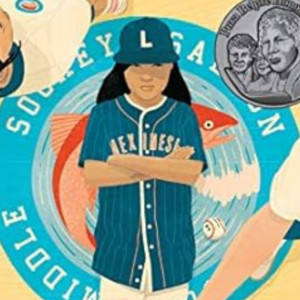
Give a listen to Lupe Wong Won't Dance.
It's the book club for kids.
It's the book club for kids.
It's the book club for kids podcast.
Hi, I'm Kitty Felde.
This week we meet a very determined young softball player who is willing to fight the system when she thinks something is unfair.
In this instance, it's square dancing.
Square dancing belongs somewhere far away where it can't embarrass anyone, like the 1800s.
That's our celebrity reader, Diana Rock, former president of the United Square Dancers of America.
Our readers from Charles Hart Middle School in Washington, D.C., give the book a thumbs up.
Once you start reading, you won't stop.
But while our readers are split about their love of baseball...
Writer Donna Barba-Haguera is not.
I think if you're a baseball lover, it becomes part of your spirit, and it's just who you are.
This is The Book Club for Kids, the show where kids talk about books.
We'll tell you how you can be on the show a little later on, but first, let's meet our readers.
Hello, my name is Troy.
Hello, my name is Genesis.
Hello, my name is Sanaya, and we're all 7th and 8th graders at Charles Hart Middle School in D.C.
The name of the book is Lupe Wong Won't Dance.
It's basically about a girl who wants to go to do baseball, but she has to get straight A's.
She feels like it'll be pretty difficult because they're doing a dance class.
She doesn't really want to do it.
She doesn't think it's fun.
What kind of dance are we talking about here?
It's a square dancing.
And for people who maybe don't know what square dancing is, how would you describe it?
It's line dancing.
But you have to have like a partner to do the dance?
They do it in PE, and in this book they make it sound like everybody's done this in PE for a thousand years.
I never did it in PE.
Do you guys do it in PE?
No, I haven't.
I've never done it before.
You've never even seen it before?
No, I've seen it on YouTube before, but that's it.
And what's Lupe's problem with square dancing?
Well, she didn't like that.
She had to dance with a boy and she she needs to pass.
I don't know why she doesn't like it, but she does need to pass to meet fully hernandez, her idol.
Her idol was a baseball player and she wanted to see him play.
He reminded her of her dad kind of, and she wanted to go to him to see if she, if he, had anything that could remind her of him.
Yeah, i guess we didn't mention that her dad passed away.
Yeah, he was fishing and he died.
It's pretty sad.
So how would we describe lupe as a character?
I say she's really determined and motivated to get the things that she wants done.
She's stubborn.
She's very stubborn.
And she's smart because she went to a website.
So what she wanted to happen, she made it happen.
She wouldn't choose her friends over other people, even if she's upset.
Well, let's hear the scene from the book where Lupe comes face-to-face with her nemesis square dancing.
Our reader is a former elementary school teacher and past president of the United Square Dancers of America, Diana Rock.
I've never associated the inside of a gym with such horror.
There has to be a way to make it stop.
Fuli Hernandez wouldn't be caught dead square dancing.
Dancing belongs in nightclubs and ballet studios, not a gym.
And square dancing belongs somewhere far away where it can't embarrass anyone, like the 1800s.
We spend the remaining 20 minutes of PE watching different versions of the same routine.
I'm clenching my toes inside my shoes the entire time.
I glance down the line.
Most faces are aghast, like they just saw their grandmother in her underwear.
Except Carl Tronson's mouth is slightly ajar and his eyes are closed.
Is he seriously sleeping through this horror?
And Gordon Shenley, he's actually tapping his foot along with the music?
Each square dance starts with a different man or woman, all with southern accents wailing.
If it hadn't been for Cotton Eye Joe, I'd be married a long time ago.
And when the women sing, Cotton Eye Joe sounds like even more of a jerk.
What had he done to them that they all would have been married and happy if he hadn't come along?
Bad enough Cotton-Eyed Joe had ruined their lives.
Now he's trying to ruin mine.
Now let's talk about some of the other characters in the book.
Who's your favorite character?
Gordon.
I like Gordon the best.
It was one part where they did capture the flag and Gordon, the way she explained it.
He was running around but he wasn't moving that much.
And I just imagined him in my head as a funny-looking person.
And they said that he was missing his front two teeth.
I say Lupe's granddad.
I say that because he was like really nice and caring and he made sure that her grandma's words weren't getting to her.
I say Lupe, even though she's the main character.
She's very interesting, and we see most of her thoughts throughout the story, and she's funny.
Would you say there's any part of your own personality that you saw in Lupe?
I kind of see the part where she's really motivated and determined to get the things that she wants done.
I see that in me too, because when I really want something done, I try my hardest and I don't really use people because that's what Andy said she was like but I try to get people to help me out on the stuff that I need done.
Same thing, yeah, her determination.
I see that in myself.
She is absolutely bonkers about baseball.
I am too.
But I'm guessing that this generation don't really care about baseball.
What do you think about baseball?
I love baseball.
My favorite player is, dang, it's Mike.
He played for the Houston Astros.
But yeah, I like it.
I'm not a baseball fan because it's not as intriguing to me.
I mean, when they show it on like movies and kids shows, I'll watch it because it'd be funny.
Like how they do the cartoons and stuff.
But no, I'm not a baseball fan.
I'm not a baseball fan either.
I'm more of a person who likes to watch basketball, but I run track.
Okay, there's a big question that goes on with the boys in this book, and that is Star Wars or Star Trek.
Star Wars.
Han Solo is better than any character in Star Trek.
They do get the little hand thing that they do, but that's not better.
The Stormtroopers are more iconic because they're known for having bad aim, but they're still fun to watch.
But Star Wars is better.
I haven't really watched either one, but I see people talk about Star Wars more than they talk about Star Trek, so I believe that Star Wars is better.
This book is about a girl who is part Chinese and part Mexican-American and her kind of search for her own identity.
Do you see a lot of that at your school?
Do you see a lot of kids who come from different ethnic backgrounds here at Charles Hart?
I have a Hispanic friend, but I don't really see other people.
Same.
There's like only two races of children that we actually see, Hispanic and black kids.
So how did this book read to you then?
I feel like a lot of people can relate to the whole story because a lot of people face those issues, you know, not liking certain things but still pushing through to get what you want in life.
For me, it's not relatable at all.
We don't do fun things in gym and stuff, so it wasn't relatable to me.
The one thing that I thought that resonated with me because it's been a while since I was in middle school was the crowding in the hallways when classes change.
I thought that was a detail I hadn't seen anywhere else.
Was there anything else in there that caught your eye?
Yes.
In sixth grade, the last time that we was in person, it was very crowded.
And it took me extra minutes to get to the classroom because some of the classes were across the building.
So, yeah, that is relatable.
Anything else, though detail-wise, that she picked up on about life in middle school that you thought yeah, that's my middle school.
There being people that feel they're better than others when they really aren't.
How would you describe this book to somebody else who hadn't read it?
Is it like another book?
Is it like a television show or a movie?
It's a trusted process book.
For me, it got good.
40, 50 pages in.
But since I watch shows, I know that I have to wait to get a connection with the characters.
But for traits, it's fun.
It's funny too.
Once you start reading, you won't stop.
I read the book in two days.
I can't really compare this to any of the movies or books that I read, because the movies, the shows and books, the shows that I watch, are like A lot of drama.
Not like this kind of drama, but other kind of drama.
And the books that I read, they're from an app called Wattpad, and they're very interesting.
I know you guys have lots of questions for our writer, Donna Barba-Higuera.
Who wants to start?
Are you China-can?
I am Chicana, which means I am of Hispanic or Latina descent, and my children are half Chinese.
And so the terminology of Chinnakan and Mexenese, I cannot claim them.
My daughter Elena came up with those.
And in reference to her sister, we were talking about which bubble to fill on the Scantron, because it often says choose one or the other.
And that's difficult when you're composed of a lot of different cultures.
And so they decide to choose other and they mark other and put Mexenese or China.
See who who will understand their own made up terminology.
Why are you so against dancing in the square dancing with a boy?
I'm not against square dancing and I'm not against square dancing with boys.
I'm against not being given the choice.
And this all came about because my youngest daughter Sophia, wanted to dance with her best friend Gracie, and came home and was upset that she was told she couldn't dance with Gracie.
She had to dance with the boy.
She had to dance with whichever boy asked her.
She didn't have a choice.
And that felt so unfair to her.
We should have the choice to choose who we want to dance with.
What made you like baseball?
I guess, you know, I've always loved baseball.
I come from a baseball family and I grew up playing baseball in the fields.
And by fields, I mean the desert, the oil fields.
And I played with cousins and we would, you know, it would be hot and dirty and we would just get grimy.
That's what baseball is to me.
I think if you're a baseball lover, it becomes part of your spirit and it's just who you are.
And so it is a difficult question to answer because it wasn't something that came out of practice.
It was just part of who I was and my family.
Why did you choose square dancing and not any other type of dance?
Well, I didn't choose square dancing.
Square dancing chose me.
It was a dinner conversation where my daughter Sophia came home and was upset that in PE that day she had learned that she was going to have to square dance.
And I thought to myself, wait a minute.
The first question was, are we still square dancing?
I had to square dance when I was younger.
And then I started asking around and I realized it is curriculum and probably about 50 of schools still.
There's still square dancing.
And I think that in some ways there, there can be value to it.
There's you, you know, it's, it's teamwork.
You do have to work as a team when you dance and and Sure, there's a social aspect to it as well.
But it also comes at kind of an awkward time when you know, in my daughter's case, she never held a boy's hand and she was suddenly going to have to hold a boy's hand and dance with him.
And I needed to address something that.
I realized I had felt that I had no power over when I was a child.
And I realized, my gosh, my daughter is having the same issue.
And so I wanted to write a story about those things that don't make sense.
And, of course, in this book, other things come up, like girls having to wear shorts to their fingertips, whereas the same doesn't hold true for boys, the things that don't seem to pass the smell test.
Why did Lupe keep trying to hang out with Andy and keep trying to see if Andy wanted to be friends with her, after Andy kept getting mad at her and wanted her to go away?
Friendships are powerful and when we lose a friend, a true friend, sometimes we have to learn how to say we're sorry and to know that we're not always right.
Sometimes we are the ones who need to change.
And it's a good thing to look at our relationships with friends and see when we could have done better, or that maybe we had done something wrong.
And in this case, Lupe really loves Andy.
They have this amazing friendship, but she doesn't always treat Andy with the respect that she should.
Sometimes isn't the best listener.
And that's a huge part of friendship.
And so Lupe has to grow and she has to realize that it's not always about Lupe and that sometimes she has to put her friends first.
Is Niles a real person?
Niles is not a real person.
You know, my daughter has had friends throughout school who were like Niles.
She's had friends who are on the spectrum and just had these cherished friendships.
So yeah Niles, I guess represents several people, but he's not based on one person specifically.
I wanted to give Niles his own story and his own interests.
Some of the interests that Niles has, he's he's a karate teacher for little kids.
And my daughter is she's a black belt and she teaches the little dragons at her karate studio.
And it's She is inspiring and she writes them notes.
So parts of those are things that I borrowed from my daughter.
Parts of Niles, his love of sci-fi, that is me.
But I think that Niles, in my mind, he's very real.
And all of these characters are very real.
And so I often daydream about what they're doing and where they are.
And Niles is just one of my favorite people to daydream about.
What in Fuli Hernandez reminded you about your dad?
Fuli Hernandez is a character who represents being of multiple cultures and still playing the game against odds.
In today's day and age, I think we're in a more diverse society.
But when my father was growing up and playing, it was difficult for him.
He wasn't always treated so well when he was on the field, whether it was baseball or football.
He heard the comments that came from the stands and it was hurtful but he was resilient and he powered through and he didn't take the comments to heart.
They made them stronger, if anything.
Fuli Hernandez also, he has good advice for Lupe.
And my father always has wonderful advice for me.
And he's almost 80 and he just, he always has something wise to say.
And in the book, Lupe hears also the voice of her father.
I think that there are male characters and having a strong male role model can be very powerful and important.
And for Lupe and myself.
Is some of the story based on real life?
Yes.
Yes.
A lot of this story is based on real life and real happenings.
I took a lot of humor to these stories.
And there are a lot of things that happen in my life and things that my kids do and say that are so funny to me.
And a lot of those made them into the book in one way or the other.
A lot of the things that happen to Lupe, the comments that she hears sometimes happen to me.
And I think that sometimes it's hard for people to hear those things and think that they really happen.
I just wanted to represent those in a way that didn't overpower the book, didn't take over.
The book has so many other elements that are important, but the happenings in the classrooms, or a lot of those, are things that happened to me or my children, and my kids come home with the funniest stories and I wanted to use those.
A lot of the happenings that happen in the book are universal and we can read those and go wow, that happened to me too.
All right.
We've been talking about books and our favorite books.
So let's just get to the big question, which is what is your very favorite book and why?
My favorite book is Hunger Games.
It's my favorite book because it just it made me, it made us.
So like as soon as I got up I wanted to get off my phone and start reading it, because I like how they went to, like the games and they put a lot of interesting details in it.
And it was entertaining.
It sounds like you like action-adventure-y kind of fantasy books.
Yeah, I read, you know, Geronimo Stilson?
Yeah, I read those kind of books when I was younger, and Dork Diaries.
I used to love those books.
Pure Perfection.
I don't read hard copies.
Like I mentioned, I read Wattpad books.
I liked it because I like mafia books a lot, and they're really good.
And because of the way how she was developed and...
I can't really explain it, haven't read it in a long time, but it's really good.
My favorite book is Harry Potter's Sorcerer's Stone, the first one, but right behind that is Amulet.
I like Sorcerer's Stone because when I read Sorcerer's Stone I was reading many books and that was like the first good book that I liked.
So I think most of it is nostalgia rather than being better.
And Amulet?
Amulet.
Oh, yes, I haven't read those books in a while.
I had a whole bunch.
Those were nice.
Like the best graphic novels I've had.
The characters look nice.
It's not relatable at all, actually.
But I just like the characters.
What about you, Donna Barba-Higuera?
What is your favorite book?
This is a very loaded question because I have so many books that if I sat here, I could talk about 50 books that I love.
But I want to go back and this is why I'm choosing this, because I have to go back at the first book that I think I was obsessed with, to the point where I read them over and over and over again.
I was going to say A Wrinkle in Time, but it had to be The Chronicles of Narnia because...
Because the Chronicles of Narnia, there are several different adventures and you don't just go to one place and you're with other characters.
And so it allowed me to escape.
And the same thing with A Wrinkle in Time.
But I grew up in this small little dusty town and those books took me to very, very different places.
That kind of escape, whether it's just going to your room and reading a book that takes you out of your bedroom or your apartment or your home or your school.
If you're reading in the classroom, those books are powerful.
Your turn, Diana Rock.
What is your favorite book?
My favorite book was actually a series called The Little House on the Prairie Books.
And this was a series of eight autobiographical children's novels written by Laura Ingalls Wilder.
And the stories take place in the mid to late 1800s out in the Midwest of the United States.
And they follow Laura Ingalls' life story and her adventures and the difficulties and the happy times that she experienced growing up in a time that is so very different from ours.
I enjoyed it so much as a child.
I used to pretend to be Laura Ingalls when I played.
And then as an adult, when we had our three daughters and they were in early elementary school, I read aloud the entire series to them.
We have a list of everybody's favorite book at our website, bookclubforkids.org.
You'll find hundreds of book suggestions there from every single person who's ever been on our show.
So no excuse if you think you can't find the next book you'll fall in love with.
And if you do have a favorite book, you can be on the Book Club for Kids podcast, too.
Just have your teacher, librarian or even your mom or dad send us an email and we will send out all of the information.
Really, all you need is a smartphone and a favorite book.
Email us at kitty.com. at bookclubforkids.org.
That's K-I-T-T-Y at bookclubforkids.org.
Thanks this week to producer Austin Silver and associate producer Chad Francis.
Brandon Baker composed our theme music with additional music from Charles Nilman.
Emma Steinkalmer designed our logo.
Thanks this week to our writer, Donna Barba-Higuera, and our celebrity reader, Diana Rock from the United Square Dancers of America.
We'll have links to both at our website, bookclubforkids.org.
And thanks as well to our readers this week Sanaya, Genesis and Troy and their librarian Najima Isad from Charles Hart Middle School in Washington DC.
We have an educator's guide you can download from our website, bookclubforkids.org.
That's also where you can sign up for our newsletter full of free tips about how to get a kid to pick up a book.
This episode was made possible by a grant from the Greater Washington Community Foundation.
And coming up on February 28th at noon Eastern Time, you and your class can join me for a very special webinar from the US.
Capitol Historical Society.
I'll be talking about the upcoming State of the Union Address, which also just happens to be the name of the latest Fina Mendoza mystery novel.
The webinar is free, and there is a link at the bookclubforkids.org website.
It's a great way to introduce civics education to kids.
I'm Kitty Felde.
Thanks so much for listening.