This is Hidden Brain.
I'm Shankar Vedantam.
For thousands of years, poets and musicians have celebrated the arrival of love.
Songs like At Last talk about the long-awaited moment when a soulmate says yes and the doors of heaven open.
But while musicians preach the melodies of love and manuals teach people how to fall in love, there is much less advice about how we should think, feel and act at the end of relationships.
Today we bring you the conclusion of our month long series about love.
Our focus over the past few weeks has been on what comes after the euphoric buzz of new infatuation has worn off.
We've explored how to better understand our partners and how to be better understood.
We've talked about acceptance and apologies and how to let go of our annoyances and frustrations with the people we love.
Today though, we're going to look at what happens when rifts between partners are too wide to bridge.
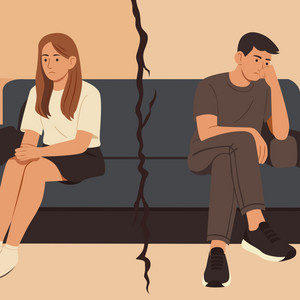
We're going to talk about the psychology of breakups.
We'll examine the most common mistakes we make when it comes to splitting up and explore techniques that can help us do better.
How to Set the Past to Rest.
This week on Hidden Brain.
Any aspiring novelist will tell you that it's easy to start a story and very hard to bring it to a close.
The same is true in real life, as most of us have discovered.
Navigating the conclusion of a relationship with someone we loved and who once loved us is not simple.
Antonio Pasqualeone is a psychologist at the University of Windsor in Canada.
He studies the emotions we feel around these complicated events and how they shape our behavior.
Antonio Pasqualeone, welcome to Hidden Brain.
Thank you so much for having me, Shankar.
Antonio, as a young man in your late teens and 20s, you were an aspiring actor.
I understand that you also like to write poetry.
You must have cut quite a romantic figure.
It depends what you call romantic.
But yeah, I started as a.
I wasn't sure if I wanted to study biology and go to medicine or if I wanted to go into theater.
I ended up going into theater and somehow ended up in a compromise, which I think is psychology.
And many years later, I sort of realized that there's something that happens on stage.
An actor generates an emotional experience on stage for the entertainment of the audience.
But those are real emotional experiences.
A therapist could help somebody have an emotional experience that's curative in its own right.
This isn't for the entertainment of anybody.
This is their life.
It's for the purposes of health care that going through certain experiences can be curative, a corrective emotional experience.
What kind of poetry did you write at this time of your life?
Mostly quite bad poetry.
Thanks for asking.
You know a lot of them.
I guess I identified very much with the lovesick kind of unrequited love poetry right.
Yeah.
I think that was also part of an identity that somehow I had.
You know, this is like late adolescence, early 20s sort of thing.
So I understand that you had a girlfriend at the time, someone that you cared about deeply, but at one point the relationship founded.
I was very enamored, right?
And I think I kind of you know, the relationship sort of fizzled out, but my approach, I guess, was to lean in harder, right.
So I had a friend who was also became an actor and a scriptwriter.
And that probably didn't help, probably made things worse looking back.
But the last attempt, the rally, was to go back in the street underneath her balcony of her apartment to call her out.
She comes out on the balcony and I proceed to serenade her with the help of a, of a buddy.
And um, There's singing.
A poem might have been read.
A big finish bucket of sand with fireworks in it to end it all.
Oh my gosh.
Yeah, kind of a crash and burn, but very dramatic.
You know, looking back...
You know, it was about the performance.
It wasn't about the relationship, right?
And it wasn't about what I needed.
There wasn't a lot of relating, actually.
Sense of insecurity, a sense of what did I really need?
And and and how do I feel about this and what's missing for me?
Did anyone get this serenade and this poetry reading on camera?
Because this would be one for the ages if someone recorded you.
I'm very glad that it's not on camera.
No.
In fact, this is the only telling of that story.
In fact, I talked to my wingman friend.
We're now just old friends.
And he firmly said to me, definitely do not tell that story.
I'm glad you didn't take his advice, Antonio.
Now, of course, you know, you're far from the only person to have had a hard time with a breakup.
In the 2011 movie Crazy Stupid Love, the actor Steve Carell plays a character who is trying to get over a breakup.
Here he is talking to his ex with whom he is still in love.
When we were first married, you were the only woman that I had ever slept with.
And now I have had sex with nine different women.
God!
Nine?
That... Nine?
Wow!
You showed me.
I wasn't trying to show you.
I was trying to move on.
So, Antonio, you're a therapist.
Do you see examples of this kind of behavior in real life?
Yes, absolutely.
There's sort of a, shall I say, desperate kind of attempt to move on.
I mean, it's a behavioral approach.
It's like, I'm just gonna, you know...
There's an old saying in Spanish, which is un clavo saca otro clavo, right?
To push out a nail, you just drive in another nail, right?
Replacing the old with the new.
You know, and that is not something that helps you necessarily figure out what you really need.
Right.
So, I mean, you might get over somebody, but...
But you haven't learned anything from the relationship.
You haven't changed as a person.
And you're likely to end up in a similar sort of predicament.
So if one model is basically people trying to plow ahead and not look back, you also have people who do the opposite, who basically are fixated on what happened in the past.
In the 2019 movie Marriage Story, we hear the voice of the actor Adam Driver, who plays Charlie, a man in the middle of a very nasty divorce.
In this clip, he's addressing his soon-to-be ex-wife.
Every day I wake up and I hope you're dead.
Dead like if I could guarantee Henry would be okay.
I'd hope you'd get an illness and they'd get hit by a car and die.
Antonio, what do you hear when you hear that very dramatic scene?
Well, it's horrible.
It's also an example of, I hate you for not loving me.
Right.
So what's really going on here underneath all the hostility?
No, it's anger.
It's anger.
But the anger is all about it's blaming anger.
It's rejecting anger.
It's about what I don't want.
So what's he fighting for?
That's not so clear, right?
What are you fighting for?
What do you really need?
That part's not clear, right?
It's clear he wants distance, but that's not an assertion of an existential need, really.
So there's...
I mean there are a lot of ways of having poor outcomes.
When we look at psychotherapy and you're trying to predict outcome.
We generally don't try to predict poor outcomes because there's a million ways of having a poor outcome, lots of reasons why it wouldn't work.
And what's interesting is actually there are a few, a finite number of reasons why, why people have good outcomes.
And so that tends to be something, the focus of psychotherapy research.
Whether we spend our days brooding for people we love, or desperately trying to fill the void of relationships that have slipped away, or exploding in rage at an ex who has wronged us, there are many ways to badly handle the end of a relationship.
When we come back, why we are so bad at breakups and the key to parting well from people we love.
You're listening to Hidden Brain.
I'm Shankar Vedantam.
This is Hidden Brain.
I'm Shankar Vedantam.
There are lots of ways to do breakups badly.
We can torture ourselves, behave badly toward others, and drive everyone to exasperation.
At the University of Windsor in Canada, psychologist Antonio Pasqua-Leone studies how and why we go off the rails when it comes to moving on with our lives.
So your research has found Antonio, that people who don't deal with their feelings can get stuck in an undifferentiated state of negative emotion that you call global distress.
So, as part of the process of unpacking this undifferentiated ball of emotions, you suggest that people get out three pieces of paper and make three lists.
What goes on these lists, Antonio?
Yeah, I mean, if we were talking about grief, you know, part of the puzzle is what have you lost?
And people are often thinking about the good things.
What have I lost in terms of what I enjoyed about the relationship and will no longer come to pass right?
This might be the way we used to have the little jokes together, or the idiosyncrasies of that person that I cared about.
But then you could also think about you get a different piece of paper if you wanted to do it as an exercise.
And, you know, saying goodbye to the bad things, the things that I put up with or tolerated.
It might be the idiosyncratic quirks that that person had, which I didn't really enjoy, but was part of the relationship and you just sort of took it.
So that's a different sort of thing. and listing those, right?
I never really liked when the person did X, and now I don't have to put up with it anymore.
So it's almost like a form of accounting in some ways.
You're totaling up the minuses, but also potentially totaling up the pluses.
Yes.
And those two are part of the relationship.
It's like, surplus reality, right?
It didn't happen, but it was kind of baked into my experience of the relationship.
Like one day we would have children or one day we would go on that trip together.
And now those things, those will never happen, right?
So there's all these undeclared losses and kind of putting up I'll call it little tombstones for those things helps make them more real and helps make them easier to let go of.
Antonia, you conducted a study that looked at the effects of the various kinds of stories we tell about our experiences.
Two kinds of narratives had particularly detrimental effects the superficial, shallow narrative and the type of narrative that you call the same old story.
What are these different stories, Antonio?
Narratives will both shape the emergence of a story and describe the story.
So one thing we were doing is getting people to write about traumatic experiences or the most difficult experiences they've had, and then looking at the way they tell those stories right.
And it turned out that there were certain markers and you've mentioned them here the sort of the same old story and also the superficial story.
The superficial story is this you know, might be big on plot and characters but never really getting into the deeper experience.
And the same old story would be yes, they get into the emotional experience, but they're stuck in some sort of maladaptive state.
Right.
This is it's always like this for me.
It might be the poor me story, or it might be feeling like a victim, or it might be.
I'm just giving some examples.
Right.
When people told stories like that, irrespective of the content, right?
It's the manner in which they told their stories, right?
So this is the phrasing, this is highlighting certain things, irrespective of the content.
We could actually predict symptoms, their symptom levels.
So depressive symptoms, anxious symptoms, even trauma symptoms.
So I can't stress enough.
It isn't... that they're telling stories about trauma and therefore they've suffered trauma.
It's rather the way they tell this story.
And so it's like I can tell.
I know what you're feeling, meaning I know what your symptoms are to some degree, and the symptom severity based on how people are telling their stories.
So, in other words, you're looking as a therapist to not just what the stories are, but sort of the form of the stories, the form the stories are taking.
Yeah, because you can think of emotion in terms of immediate experience, but it also gets embellished and elaborated as a narrative.
Right.
And sometimes people cling to a certain narrative.
Emotional loop or an emotional state becomes the centerpiece of the story they tell about who I am.
So you've mentioned that you are married now Antonio, but before you met your wife, you were in another romantic relationship that came to an end.
You were able to use that ending as a kind of forge for making yourself into a different and better person.
Tell me the story of what happened and what you did.
Well yeah, I mean, I remember being in a relationship and leaning into it and Yeah, I guess, now that I'm thinking about it, there's sort of a theme here, right?
I mean, not wanting to be the reason why the relationship ends, right?
And in some sense she was the brave one and she ended the relationship, which had come to a kind of a natural conclusion.
Relationships really need to be reinvented every seven years or so.
But this one had run its course.
And yet I was having trouble letting go of it and just wanted to make it work, right?
But then, when it became really clear the relationship was ending and was over, I guess I realized that you know the way you handle the end of a relationship defines you in some way, or that it would define me right.
I mean, I'm the kind of person who And then you fill in the blank for yourself.
If you're the kind of person who's hateful and angry and destructive, well, then that's who you are.
And I think there's kind of a moment where I realized that This was an opportunity to honor the relationship to.
You know, I was unhappy that it was ending, but at the same time it was somebody I learned a lot from.
This was somebody like... who I cared for, who cared for me, the relationship's now over.
And in some sense, give it the funeral it deserved, right?
I think that changed me because it's a choice point, an existential choice point.
I think I also came out with a, with a sense of clarity or a sense of direction, realizing that I needed somebody that was ready to put me first, that was ready to champion me in a way.
You know, there's an old saying Definition of love is something along the lines of when you are able to make other people's needs your own.
Right. or kind of support somebody in what they need.
And so I was willing to do that for somebody, but I also needed somebody who's willing to do that for me.
When I met my future wife, I knew it was right.
And I think that was part of the ending of the relationship in a clarifying way where you realize you're both the author and the reader of your own story.
There are times when relationships don't just come undone.
They explode.
They blow up.
Couples don't just drift apart.
They betray each other and then disappear from each other's lives.
Parents don't just pass away.
They leave behind complicated histories and long buried secrets.
Their children are left with endless questions.
As we grapple with the end of such relationships, we may feel we cannot get closure until we know the answers to our questions.
But those answers are not forthcoming.
In some cases, the person is no longer alive.
In others, the person has disappeared or is otherwise inaccessible.
When we come back?
How can we deal with situations like this, where we feel we have been left in limbo?
You're listening to Hidden Brain.
I'm Shankar Vedantam.
This is Hidden Brain.
I'm Shankar Vedantam.
Do you have questions for Antonio Pasqualeone about breakups that you've experienced in your own life?
Are there losses that have left you feeling stuck?
Have you come up with techniques of your own to move past a breakup and discover a better version of yourself?
2 or 3 minutes is plenty.
Use the subject line, breakups.
Again, that's ideas at hidden brain dot org.
There are many situations in life where the end of a relationship brings endless questions.
Sometimes those are questions we can answer for ourselves.
But other times we need answers from a lost partner or an absent co-worker or a dead parent.
Answers that are not forthcoming.
Without being able to understand how and why the relationship came apart, we feel we cannot move forward with our own lives.
Antonio Pasqualeone is a psychologist at the University of Windsor in Canada.
He is the author of Principles of Emotion Change What Works and When in Psychotherapy and Everyday Life.
Antonio, you say that one reason grief is sometimes complicated is because our current situation stirs up older and sometimes deeper hurts.
I understand that you once got to know a woman who discovered that she was being cheated on.
And instead of getting mad at her former partner, she got mad at herself.
Tell me that story and how in some ways, it points to this idea that sometimes, when we have setbacks in our lives, it makes us question ourselves rather than question the setback.
Right.
So she was saying things like, I feel like an idiot.
I feel I must have been... You know, I'm such a fool is something that really stuck with me.
Her saying, I'm such a fool.
How could I...
You know, have been so blind that this was happening and so on and so forth.
And of course, it rattles her.
Right.
It's not just the loss of a relationship because the relationship was ending, but it's also, you know, rocked her confidence.
Yeah.
Yeah.
And these sort of doubts about feeling adequate, feeling lovable, feeling attractive enough feeling, you know, like somebody wants to spend their life with me.
You know, so that's an injury to identity in some ways.
There was one time when you had your own heartbroken Antonio, and the woman who was saying goodbye to you left you with a parting shot that really stuck with you in a distressing way.
What happened?
So, yeah, I mean, that's in some ways a similar example, right?
I mean, I was quite young and, you know, a teenager, what?
And it was... somebody saying to me, you know, we were sort of breaking up and I wanted to know why.
You know, the why question is never a real question.
When people want to know why, it's not a real question.
It's a rhetorical question, right?
It's I don't want to break up.
But in any case, I was really hooked on why.
And she said to me, well, you're just not good at getting stuff done, which was funny.
Yikes.
It was right, right in my soft spot.
Right.
Because I had my own doubts.
I had my own things.
I was struggling.
I was young.
I wasn't, you know, wasn't always very assertive and was having trouble getting, You know, blossoming into the kind of person I wanted to be.
So, I mean, that was particularly difficult.
It's kind of like a mercy killing, really, because it also helped end the relationship.
But ending the relationship, I think this is to your point.
Ending the relationship left me with a wound that that no longer was related to the loss of the person, but was an injury to my, my sense of self.
Thank you.
Another reason our grief might be complicated is that we learn something about the person we've lost that is hard for us to accept.
I want to play you a clip from the 2011 movie The Descendants.
It features a man named Matt, played by George Clooney.
His wife suffers a serious injury and goes into a coma.
Matt then discovers that she has been having an affair.
In this clip, Matt talks to his wife as she lies unconscious in a hospital bed.
She cannot hear him and she cannot respond.
You're going to ask me for a divorce so you could be with some Brian Spear?
Are you kidding me?
Who are you?
The only thing I know for sure is you're a goddamn liar.
So what do you have to say for yourself?
You should go ahead and make a little joke.
Tell me that I got it all wrong.
Tell me again. that I'm too out of touch with my feelings, and I need to go to therapy.
Isn't the idea of marriage to make your partner's way in life a little easier?
For me, it was always harder with you, and you're still making it harder.
Lying there on a ventilator and **** my life.
You are relentless.
So you can hear, Antonio, how complicated this is for George Clooney's character.
He's dealing with a partner who has suffered life-threatening injuries, but she's also hurt him and he doesn't have a way of getting answers out of her.
Yeah, I mean, so there's a couple of things going on, right?
This is an issue of betrayal, you know, and he's angry and you can hear that, but he's also really hurt.
The fact that she can't answer, you know...
People are often feeling like they need to have a conversation or finish somehow to get closure.
But there are ways to do that that don't really involve the other person.
Right.
Can you say more about that?
Because I think when most of us think about getting closure, especially in a situation like this, we think it's very much about the other person.
We want the other person to explain themselves, to apologize, to beg our forgiveness because they've hurt us.
How is this not about the other person, Antonio?
Well, I mean, of course, it's about the other person, in the sense that I've had an interaction with the other person.
But it means something to me.
And the unfinished business I have is my own.
You can't change the historical facts.
But you can change quite a lot.
What you feel about it when you think about it, you can change what it means.
And, you know, even some of the details of what you remember.
Memory is actually very dynamic and more dynamic than what people tend to believe.
In the end, exactly what happened or what was said matters less than what it means and what I'm going to do with it.
Right.
In working with victims of trauma or complex trauma, sometimes the other person isn't like in this clip.
Right.
You know a partner or an ex-partner who's unconscious in a hospital bed but was actually a perpetrator right of abuse.
That kind of person is not a person who.
Usually that one can have a conversation with.
They're not going to acknowledge the abuse.
So clients will say things like, I've told them and they deny it.
And it's sort of like, yeah, yeah, they...
I agree.
That's not a conversation you can actually have with them, because they always deny it or dismiss it or shut you down.
So actually not having the person here can be more useful.
In some ways Antonio, what you're saying is that the relationship might have been a shared project, but getting closure for the relationship does not need to be a shared project.
That's exactly right.
Me getting over the relationship is no longer a shared project.
Me deciding what it means to me.
It doesn't have to mean the same thing to me as it does to the other person.
We often have, you know.
There's this question of well, isn't it just better to talk to the other person?
And there was a study that kind of looked at that.
That's a great question, right?
An imagined dialogue versus a real dialogue.
So this was basically...
There were rifts that were very painful related to the adolescent's suicidality.
And, you know, they could randomize and treat in two ways.
One, you could...
Put them in family therapy where they actually have dialogues with the parent about what's going on.
Or you can put them in individual therapy and have imagined dialogues where they imagine that the parent is alive, is living somewhere else, but they're imagining a dialogue here.
So this is really interesting.
It answers that question because you actually get different outcomes, different kinds of outcomes.
So if what you're looking for is relationship resolution, if what you're looking for is to improve the relationship, have a better relationship, then having a real dialogue with a real person is gonna be more effective, right.
That's where you'll see the change in the quality of the relationship, not necessarily in the degree to which they've worked through their own unfinished business right.
So you can repair the relationship and still not feel entirely resolved.
On the other hand, if you had people imagine a dialogue Emotional processing, I'll call it is better if the dialogue is imaginary.
So the working through is their own project.
Even if the person is alive, right?
You still need to do your work.
They can't process it for you.
So you say that one thing that people can do is that you can write an email to the other person but never send it, or write a letter to the other person but never send it.
What would be the value of doing this, Antonio?
Yeah, you know.
So the idea is there might be things to say and you need to clarify the boundary violation, if that's what it is, or you need to clarify what you're defending or what the loss is for you to move on, to unhitch And to move on with that teaching the other person a lesson, or educating them or correcting them.
You know, that's often what people are wanting to do.
Right.
Or punish them.
I mean, that's not really going to get you the change you're looking for.
And you'd have to actually ask yourself, do I really want to reeducate the person?
Is that really what this is about?
So the idea is to have a venue where you can express yourself with clarity.
You could sit and think about it.
Turns out that thinking about your your difficulties is not particularly effective.
Right.
There's something about writing it down in some form, whether it be an email.
That's tricky because you really want to hit the send button.
But writing a letter, these are ways that compel you, that put you in a scenario.
Therapy is similar, right?
Puts you in a scenario where you have to...
It creates sort of a coherent story of what you're feeling and why.
So the scenario puts demands on you to be more clear and more coherent than if you were just going for a walk and daydreaming about it.
People's daydreams about their emotional difficulties tend to be full of incomplete sentences or the analog of that right.
And lack clarity.
So it's good to have a formal exercise of some sort. might just be talking to another person.
You've.
Sometimes, as you're working with clients, you'll have them pull out an empty chair and have a conversation with the empty chair.
What's the value of doing this, Antonio?
It's very evocative.
I think this is the first thing, right?
So if you need to activate emotion and you do, people need to feel their feelings, right?
And one way of activating emotion is to imagine the other person.
People do this all the time.
I mean, you talk to yourself in the mirror, you kind of imagine, at least I do it all the time.
My wife is always like, who are you talking to now?
And I'm like, I'm not, I'm brushing my teeth.
But you know, like you know, there's a clarity there you have in imagining a conversation, but it's also much more evocative.
Imagine the difference between telling somebody now we're not talking about unfinished business, we're talking expressing love here.
But if you say oh, I really love so-and-so.
Or you imagine they say I love you and use their name.
I mean, the second is much more evocative, right? or I forgive you, or I'll never forgive you.
I mean, saying it to somebody in an imagined scenario is much more evocative.
So it evokes emotion.
That's the first thing.
It helps with clarity.
So you clarify what you're feeling.
You can say the things that you would never be able to say in real life.
So sometimes there's a vulnerability or what, or a conversation.
You can have conversations with people who are no longer available, who are passed away.
But then you can also, taking it a step further, you could actually change chairs and imagine.
You know, it's that come over here and be the other person.
What happens?
You know, what would they say if they could hear you?
And this is an entirely fabricated part of reality.
It's definitely not a rehearsal.
But there's an unpacking, a meaning.
There's always expectations and things that one has of other people.
I could give examples of where people in therapy sort of reveal an understanding of the other person, or rather they create an understanding of the other person that they didn't have by enacting them.
You tell the story of one of your clients who had a very difficult relationship with his father.
And in a session you had the man talk to an empty chair but also then exchange places and sit in the empty chair and talk to the other chair.
Tell me what happened, Antonio.
So, yeah, that's the sort of changing that I'm talking about.
This was a client who had suffered a lot of trauma.
But you know, what was salient to this person was the constant criticism, the teaching of a lesson with a very hard lesson.
A hand.
And I had him speak to speak him, tell him what he doesn't understand.
And here there's an unpacking of a conversation that isn't permissible, that could never happen, that wouldn't be tolerated, for example, by the father.
And then as you're saying a next step, come over here, what would it be like for your father?
Like in his heart of hearts.
If he could hear this, If it could somehow make sense to him, how might he respond?
And this is fabricated, right?
This is an invention, but it's full of the client's deeper understandings, projections and expectations of his own father.
And he imagines, you know, he can imagine his father expressing regret and says you know, I'm like, I'm sorry.
I'm anxious.
I'm just fearful.
Really, I regret being so mean.
I'm a nasty, miserable person, but it's like I'm anxious for you.
Right?
I mean, that doesn't make the abuse any less abusive.
It doesn't excuse it.
But for the client, it starts to mean something different.
You know, and later the client says to me I don't think.
He says I don't think my dad could ever explain that about himself.
He doesn't really, he doesn't know why he's mean, but I know.
And the client ends up in some ways forgiving his father for their terrible relationship, which isn't always the way these things work out.
And there's not a mandate for that.
But it was a very interesting turn.
He decides to forgive his father, but to always keep a healthy distance.
He says, I'm going to shield my daughter from her grandfather.
He's a mean guy.
You had an Aunt Antonia to whom you were very close.
Tell me her story and how your relationship with her evolved over time.
Yeah.
I don't have a lot of extended family.
I never met my grandparents on either side because my parents immigrated and they were older.
But I had an aunt who was the oldest person in the family.
And I was very close.
I mean, when I was born, she actually named me, right?
She named me after her husband, my first name.
And they were like grandparents to me in many ways.
They were an aunt and uncle.
They never had children of their own.
They couldn't.
And so I guess there was a closeness.
I mean, they had other nephews and nieces, but for me, it was a very special relationship.
It was for them, too.
She was she was brilliant.
She was like a prize winning researcher in endocrinology and very vivacious and sharp witted.
Right.
And so in some ways, a role model.
And I remember her.
You know, I've been writing this giant book, which is now finished.
But, you know, I mentioned her in the dedication.
I was looking forward to showing it to her.
But she died.
The thing is, you know, she dies at 91, just this past year.
So there's the loss of the person.
But...
She also started to lose herself a little bit.
She suffered dementia in her last... It became more obvious in the last year or two.
And so she became quite different, right?
So...
You know, I remember visiting her in Spain and sitting across from her and talking, and and she wasn't there anymore.
So it's quite hard to say goodbye to someone or to a relationship when they're sitting right there.
So that's kind of, you know...
The analog is the person's there.
They're not really available.
I don't really want to say goodbye, but the relationship has ended, right?
Part of the process, you know, and I...
You know, I cleaned out her apartment, big apartment.
I think that was part of, you know, part of it to sort of, you know, you go through people's stuff.
Yeah.
And she doesn't know, but I know.
I guess I'm not finished yet, right?
But I still need to find a way to kind of honor that relationship.
I'll go to Spain actually on sabbatical.
My kids are...
Eight and 10.
So they're actually about the age where I remember feeling really close to her.
So I guess I will show my kids around and maybe bring a bit of that back in a different form.
I'm wondering if I can ask you to do one thing that you ask your clients to do.
I'm wondering if you can sit in the empty chair and tell me how your aunt would have responded to your dedication of the book to her, but also how you felt about her.
Oh, yeah.
You got any Kleenex?
You know, I would think she would say she would say.
Antonio.
Antonio.
I'm really proud of you.
It's good.
I'm proud of you.
I'm proud of how you honored the people in our family.
And, uh, And when I say that, if I imagine her saying that, it gives me a sense of, I feel good.
I was going to say proud, but it's more like I just feel good.
Good.
I'm really happy that I'll be bringing my kids to Spain visiting some of the places she showed me, and that creates kind of a continuity.
I'm excited.
I'm looking forward to the future.
Antonio Pasqualeone is a psychologist at the University of Windsor in Canada.
He's the author of Principles of Emotion Change What Works and When in Psychotherapy and Everyday Life.
Antonio, thank you so much for joining me today on Hidden Brain.
Thank you, Shankar.
It was...
It was a delight to talk about this work and a really refreshing interview.
Do you have questions for Antonio Pascual Leone about breakups that you've experienced in your own life?
Are there losses that have left you feeling stuck?
Have you come up with techniques of your own to move past breakups and discover a better version of yourself?
If you'd be willing to share your question or story or comment with the Hidden Brain audience, please record a voice memo on your phone and email it to us at ideas at hiddenbrainorg.
Two or three minutes is plenty.
Use the subject line, breakups.
Again that's ideas at hiddenbrain.org After the break, our popular segment, Your Questions Answered.
Cognitive scientist Phil Fernback returns to the show to respond to your thoughts and questions about what's known as the illusion of knowledge.
You're listening to Hidden Brain.
I'm Shankar Vedanta.
This is Hidden Brain.
I'm Shankar Vedanta.
Our minds are complex organs that can process extraordinary amounts of information.
Using the superpower, humans have achieved incredible feats.
We've harnessed electricity, eradicated diseases, and flown to the moon.
But all these accomplishments are largely the creations of experts.
Most of us couldn't design a spaceship or a new vaccine.
In fact, how many of us even know how a light bulb produces light, or how music is piped into our earbuds or, as we discussed in a recent episode, how a toilet works?
Put another way, we're very smart as a species, but not so smart on our own.
At the University of Colorado Boulder, cognitive scientist Phil Fernback says this paradox is at the heart of humanity.
We recently talked with Phil in an episode titled, How Much Do We Really Know?
Today we welcome Phil back to answer your questions about knowledge, ignorance and why the people who are least informed are often those who sound the most confident.
Phil Fernbach, welcome back to Hidden Brain.
It's great to be with you again, Shankar.
So Phil, to recap a couple of things from our last conversation, one core idea that psychologists like you study is that we think we know more than we do.
How so?
That's right, Shankar.
The illusion of explanatory depth or the illusion of understanding, is the very human tendency to feel like we understand things in a lot more depth and complexity than we actually do, to treat the world as much more simple than it actually is.
And psychologists have conducted a number of experiments to demonstrate this.
Because, of course, if you ask me, do I know how something works, I'm going to tell you yeah, I'm pretty sure I know how it works.
But you and others have run experiments to actually test whether people like me actually know what we think we know.
That's exactly right.
In a typical study, what you would do is ask people their sort of initial feeling of how well they understand some object or phenomenon or process.
Typically, as you just mentioned, what people feel is that they understand it in some depth.
But then the trick is you ask them to explain it in detail how it actually works.
And what then typically happens is people realize that they don't understand it as well as they had initially thought.
Their feeling of understanding decreases.
Their assessment of how well they understand it decreases.
They become a little bit humbled.
So a second ago, Phil, you used a phrase, the illusion of explanatory depth.
And in some ways, this describes the illusion you were just talking about.
But can you unpack that phrase for me, please?
Sure.
This is the sort of jargony way that cognitive scientists talk about this.
Explanatory depth means the depth with which you can explain some phenomenon.
And we have an illusion that we can explain things more deeply than we can.
So if I ask you about pretty much anything, You mentioned toilets and we talked about that previously.
People feel like they have sort of an annotated plumbing diagram somewhere in their minds, but they don't.
So they feel like they can explain it in some depth, and then you say oh, how does it actually work?
And they go, hmm.
Well, I guess you push the handle down and it flushes.
So that's the typical pattern.
One of the important points that you and others make is that this illusion is not necessarily a flaw, that in some ways the mind is designed to discard details, that we are generalists, not specialists.
Can you talk about this idea?
Why is the mind designed in some ways to extract general information about something and to discard the details?
That's a really wonderful question.
And I think it gets to what cognition is really all about and what it's for.
Why did we evolve the ability to think?
We evolved the ability to think so that we can act more adaptively in our environments.
And storing a ton of detailed information isn't necessarily that useful, because in the world that we live in we're faced with very different situations.
That might have some deep structure in common across different situations, but the details are often different.
So what we really need to be able to do is extract the more fundamental principles that allow us to behave adaptively in new environments.
And retaining all of that detailed information might not necessarily help us.
In other words, if you were a forager, for example, and you were living by your wits and living off the land and you wanted to know what plants to eat and what plants not to eat, you don't actually need to have the deep knowledge of a botanist to understand how different plant species evolved over time and the details of plant cellular structure.
You really need only just a few general rules that can keep you healthy and not have you eat something that makes you sick.
I think that's right.
You know, that's just one area of life.
And if you think about trying to maintain a giant database of complex information about every area of your life, it quickly becomes really intractable.
And that's why human society has experts in different domains, because one individual can't possibly master everything.
That would be futile.
Can you talk about the idea that, because we're often embedded in communities of experts, people know things?
There's someone in my community who knows a lot more about my toilet than I do, and someone in my community who knows a lot more about house construction than I do, and somebody who knows a lot more about building computers than I do.
That in some ways this rubs off on us because we're surrounded by people who know how to do all these things.
That adds in some ways to our illusion of knowledge that all this knowledge somehow is ours.
That's exactly right.
So we live in what we call communities of knowledge, where the expertise is distributed across the community.
And what we found in our studies is that just by virtue of participating in in that community of knowledge, we come to feel that we understand things that are actually understood by others in our community.
You know, a good example of this is politics.
If you think about whatever the complex issue of the day is, when we hear people talking about it we sort of nod along as if we ourselves understand.
And that process of nodding along with our community members and knowing that the information is out there in other people's minds sort of gives us a little bit of an inflated feeling that we ourselves understand.
I'm wondering Phil, if this might be, you know, in some ways related to what people sometimes call the Google effect, which is that I can Google everything and I can come up with answers to seemingly everything.
And therefore, I kind of think I know everything.
I think that's right.
The fact that we have all of human knowledge in our pockets.
It's the most amazing community of knowledge that's ever existed on planet Earth.
And I think that does give us a very strong feeling of understanding and knowledge because we have very easy access to that.
Just by virtue of searching the internet, we come to feel that we understand things better than we do or that we have more knowledge than we do.
If we subsequently try to perform, take a test or perform some task without the internet, we actually do worse than we expect.
And this has really important consequences, for instance, in education, students who can look things up might actually not master the material and might do poorly on exams and things like that.
What I think makes this really interesting interesting and exciting at this moment is with the advent of artificial intelligence, meaning that our search of the internet it's no longer a google search.
Now it's something you know orders of magnitude more intelligent, more capable.
And so there has begun to be some really interesting research looking at what the effects are of using AI on people's levels of confidence.
And I'm excited to see where that research goes.
So we received an email from a listener named Dennis who wrote that, in his experience, the more people know about a subject, the more they realize how much they actually do not know.
In other words, expertise makes us humble and more likely to recognize the limits of our knowledge.
Do you think this intuition is backed up by research, Phil?
Absolutely.
Dennis makes a beautiful point that has actually been made by some of the greatest minds throughout history.
People like Aristotle and Einstein have said similar things.
And that's precisely right.
What happens with expertise is that we develop more of an understanding of the boundaries of a domain.
If you are a novice at some task, you might think that there's not that much to know.
But as you learn more and more, you realize how much there is to know and how complex things are.
So Dennis is absolutely right about that.
You know.
I'm wondering therefore Phil, if experts in fact are more aware of what they do not know, whether education in general can serve the same role that the more we learn if we go to school, for example, the more we come into contact with the ideas that might be at the boundaries of knowledge.
Do you think this might be possible?
I think to some extent that's correct.
The more we learn and the more we realize how complex and nuanced most things are.
That might make us more habitually sort of careful about jumping to really strong conclusions or opinions on issues.
That being said, people aren't that great about generalizing their knowledge from one domain to another.
So I might learn a little bit about some topic and become more humble about that topic.
But then tomorrow, I might jump right back into feeling like I'm an expert on some other topic.
That's a very human tendency as well.
When we come back, the challenge of engaging with people whose views are strongly held and factually incorrect.
You're listening to Hidden Brain.
I'm Shankar Vedantam.
This is Hidden Brain.
I'm Shankar Vedantam.
Cognitive scientist Phil Fernback studies why we tend to believe we know more than we actually do.
It's a pernicious problem that affects many domains of our lives.
Phil, can you talk a moment about how the illusion of knowledge can have serious consequences in our lives, everything from airplane safety to the well-being of financial markets?
I mean, this isn't just fun and games or humorous examples of people believing they know more than they do.
This can actually have serious consequences.
Absolutely, and that's why I got so interested in this topic, because I realized it's not about toilets.
It's about pretty much everything that we argue about, both as individuals and as a society.
If you think about... say, your financial well-being.
If you feel super confident about your ability to beat the stock market and you start taking on more and more risky bets, you can get yourself into a lot of trouble on a personal level.
At a societal level, our core beliefs about policy issues and social issues are what determine the laws that we pass, the decisions we make as a society about how we're going to set up our government, when we're going to go to war.
These really kind of important decisions are determined by our strength of belief about whatever the underlying issue is.
You know, I was talking with a group of doctors some time ago in the Pacific Northwest and one of them told me that she has the feeling that when patients come to her they now come armed with information about the illnesses and problems that they think they have, because they have looked up those problems on the Internet.
And she was telling me that she often feels like she's a vending machine, that patients are basically coming and they want to press a couple of buttons and get the medicines that they themselves have chosen for themselves, before they've even come to see her.
And she was talking about how dispiriting this is as a doctor and how difficult it is to talk patients off the ledge to basically say no, you think you have condition A, but in fact you have something completely different.
That's a great observation.
And in fact, I started a project a few years ago on precisely this.
We called it the WebMD effect.
And the idea was people were going and Googling their symptoms and doing a few minutes of of diagnostic work and then going into the doctor and being super sure that they knew what they were talking about.
But of course medicine is a highly complex field and the body behaves in ways that are very hard to predict and understand for someone who doesn't have detailed training and knowledge.
And so I very much relate to what your doctor friend was saying.
So a moment ago Phil, you talked about how the illusion of knowledge can apply not just to our knowledge about how toilets work or how pens work, but also to our political opinions.
We often overestimate how much we know about public policy, and that can lead to heated differences in opinion between people who don't really know what they're talking about.
We got a question from a listener named Rob about that issue.
Here he is.
You suggested that one approach to improving dialogue with people with whom we disagree is to ask questions and be genuinely curious about their positions and how they arrived there.
As with those experiments where Phil Firnbach exposed the ignorance of those who felt they knew about public policy, How would we avoid making people feel like we're grilling them?
I'm sure some subjects in his experiments were chagrined to find out that they didn't really know as much as they thought.
Surely there are some tricks about asking questions without making others feel like it's an interrogation.
Could you offer any tips on that?
So Phil, in a good faith discussion, we want to be curious about someone and ask them questions, but I can also imagine alienating them if we press too hard.
How do we find that balance, Phil?
Well, Rob makes a very insightful point.
And this is something that I've struggled with and thought about so much over the last 10 years or so.
When people are challenged... on their knowledge, they may become defensive.
And the goal of a dialogue is not to make someone feel stupid or ignorant.
So I think that the key when engaging in this kind of dialogue, which I do think can be very productive, is to set some ground rules first.
The idea is...
I'm not trying to grill you to show that you don't know what you're talking about.
But I'm acknowledging that I don't know what I'm talking about either.
And we're going to work together to interrogate both sides.
We're going to interrogate both positions.
And then I think both people are in equal footing.
That can be a very productive discourse.
I think Rob's insight is exactly right, that if the dialogue is one person interrogating the other and trying to make them feel stupid, you're not going to get anywhere.
You know, I was talking to a friend some time ago and he was pointing out that the Socratic method of asking a series of questions and having the other person answer them and then over time you show the person who was answering the questions didn't know very much about what they were talking.
And the idea is that this is eventually how you lead people to enlightenment.
My friend was pointing out that this is a really condescending way to have a conversation with someone, where you're asking them a lot of questions.
And they stick with the conversation, even though they slowly get to see that they in fact don't know what they're talking about.
And so Rob's point, I think, is well taken here, because to actually practice this, to actually be curious about someone without coming across as interrogating them or grilling them, is not easy to do.
That's right.
The Socratic method implies that you have a teacher and a student, and the teacher knows the answer and is helping the student to come to their own realization of the answer.
In a typical discourse around some public policy issue, both interlocutors aren't going to have all the answers.
And so the goal should be a little bit different.
So it shouldn't really be a guided interrogation like a Socratic kind of approach where one person is leading.
I think it should be more of a joyful approach where both are conversing in this more open-minded questioning way.
I think To me, that would be more helpful.
We got a question from listener Kate, who also asked about how to manage tricky discussions.
She said I struggle with how to manage conversations where the opposing view is based on facts that are nonsensical.
Is there a way to continue when the facts we believe are not the same?
Yeah, Kate raises another really interesting point, which is facts are another place where the world is a lot more complicated than we often give it credit for.
We often speak about that something can be true or false.
Most complex issues what goes into a fact or a statistic or whatever it is.
There's a lot of background and context that determines what that fact or statistic means.
And so part of the discussion really has to get pretty deep, I think, in terms of understanding exactly what that fact is and what it's predicated based on.
I think that most people are generally reasonable, but some people are unreasonable.
And if someone is unreasonable and they're unwilling to actually engage in that deeper discussion about what the fact means and they just want to assert that as true regardless of anything else, then maybe that's not a great person to have political discussions with.
Maybe you should talk about something else.
One of the things that Kate mentioned a second ago Phil, is this idea that she finds it difficult to have conversations with people who come up with nonsensical facts.
In our earlier conversation, you talked about having a conversation with people who believe that the earth was flat.
Talk a moment about whether you found it difficult to have those conversations.
At the back of your mind.
Surely you were thinking it's absurd that we're even having this conversation.
How did you maintain a spirit of openness and curiosity as you were talking with people who fervently held this belief?
Yeah, the flat earthers are a great example and really fun to talk about, because the core overarching belief is preposterous.
But what I found when I was at this conference was that it's based on a whole set of knowledge and facts within this community that they believe they have established.
And what you find when you get into this is that individual facts are hard to refute because there's so much that goes into it.
And I myself...
I'm not an expert, right?
I can't tell you what an eclipse should look like from a certain vantage point, on the face of the earth or whatever the relevant fact is.
That's really difficult for me to do.
And so I didn't go in there with a goal of trying to convince those people that they... are wrong.
I don't think that that's the correct goal in a dialogue most of the time.
The goal should be to try to develop a deeper understanding of where the belief comes from.
And so I found that to be more productive.
Asking these people about oh Why is it that you believe this?
In trying to understand all of the nuance to their position?
When we come back, Phil Fernbach shares how we might remedy the illusion of knowledge.
You're listening to Hidden Brain.
I'm Shankar Vedant.
This is Hidden Brain.
I'm Shankar Vedantam.
Phil Fernback studies how we often overestimate how much we actually know about a given topic.
Along with Stephen Sloman, he is co-author of The Knowledge Illusion, Why We Never Think Alone.
Phil, we heard a question from a listener named Rob earlier and he actually had a second question.
I'd like to play for you.
This episode seemed to correctly suggest that the majority of people fall on the overconfidence end of the spectrum.
I'd like to suggest that you might have a separate discussion about people on the other end of the spectrum, us poor souls who struggle every day with how little we understand the world.
This can be quite a burden to those of us who lack confidence about everything from physics to cooking.
Even some accomplished people, such as movie directors and actors, have struggled with self-confidence during their careers.
A discussion about this smaller group of people might be an interesting complement to your analysis of those who are overconfident.
So if the problem of overconfidence is a serious problem, when it comes to the knowledge, illusion fail, what about the problem of underconfidence?
Yeah, Rob makes another really wonderful point here.
I like to think about intellectual humility as the goal.
What that means is that we have calibration between how well we understand something and how well we think we understand that thing.
Underconfidence is sort of the other pole relative to the illusion of understanding.
Our feeling of understanding is even lower than it should be.
And that can be equally detrimental to people's experience.
Moreover, human beings tend to like people who are confident and express confidence.
If you think about the leaders in your organization, or our political leaders, your favorite athlete, they tend to exude a lot of confidence, maybe even more confidence than is warranted.
And people like that and they respond to it.
So people who are chronically underconfident can suffer a great deal because they're not put into positions of power or leadership.
They can lose their self-efficacy and so on.
So if you are a person who tends to be chronically underconfident, I think it's really important to appreciate that the world is really complicated.
And it's okay not to know everything and to understand everything.
And a lot of the people around you who are going around expressing tremendous confidence about whatever it is.
It's not because they necessarily have much more mastery than you do in the topic.
It might be that their psychology pushes them to be more confident.
And so getting comfortable with the fact that we can't know everything and that the world is really complex and it's important for us to take positions on issues regardless of that is really critical.
So one of the implications of what you're just saying Phil, is that overconfidence might be bad and underconfidence might be bad, and we have to find that middle path where, in some ways our, Our confidence about a subject is calibrated to what we actually know about the subject.
Monica from St.
Paul has a question that addresses this very issue.
How do we right-size our reflection of what we know and what we don't know?
And also right-size our reflection of our capabilities and our self-doubt, so that we don't descend into imposter syndrome.
Thank you.
So the tricky thing here Phil, is that you've told us that our minds are flawed, in that our minds tend to make errors in judgment in terms of how much we actually know.
But our minds are all we have to actually make judgments about whether our judgments are correct.
What do we do?
This is a very tricky point.
What we're trying to do is act with wisdom or prudence, right?
We want to do the best that we can given the situation.
And that determination can be pretty challenging, because to take a position on an issue, it's just not practical to study it as if you were going to get a PhD in that topic.
At the same time, to jump to some really strong opinion based on nothing, based on having read half of one article or seen one post on Twitter.
That's also really bad, right?
So what we need to be able to do is find some common ground, some middle path, as you said.
And exactly where that middle path lies...
That determination is a pretty tricky one.
But if we get in the habit of trying to aim for somewhere in the middle of that distribution, I think that people are pretty reasonable and we can do it.
So having a little more discrimination and deliberation than we normally do, but not going so far to think that we need to know everything about a topic or an issue before we have a position on it.
Somewhere in the middle, you're going to be better off than where you are right now.
A listener named Nevio asked whether there are any practical things that we can do that can help us reach this middle path.
Here's his question.
I was wondering if there is any system or frameworks that one can implement in their everyday life to prevent falling victim to the illusion of knowledge.
I'm looking forward to hear from you.
Have a great rest of your day.
If I understand Nevio correctly.
Phil, I think what he's asking is whether there are practical things that we can do, practical questions that we can ask ourselves that can guide us toward that middle path.
I think absolutely.
And this is a habit that I've gotten in myself, which is practicing checking your understanding.
Nevio asked if there's a way to stop the illusion.
I don't think there's a way to stop the illusion.
What I think we can do is we can experience the illusion and then we can mentally calibrate after we've experienced it.
So when I jump to a strong position on something, I can habitually ask myself after that to try to explain, to really test whether I know what I'm talking about.
And then when you notice that there's a big gap, Sort of make a mental note of that.
Maybe even write it down and see how many times that's occurring over the course of your day.
And I still.
You know, I've been studying this topic for many, many years and I can promise your listeners that I fall for this all the time still.
But I have gotten better at habitually checking my understanding.
And that practice I do think has made me more humble about my knowledge overall.
I'm wondering, Phil, if the illusion of knowledge is partly domain specific.
And by that I mean if there's some issue that I care about a lot let's say I care about a political issue a lot it might be that I tell myself that I know a lot about this issue because I care about it deeply.
But there might be some other issue or some other technology that I don't really care very much about.
It's sort of peripheral to my life.
I don't really know very much about it.
I don't care very much about it.
And if you ask me how much do you know about nanotechnology or material science or astrophysics, I might say well, I really don't know very much.
Is it possible that the knowledge illusion in some ways is tied to our own self-concept, that there are things we care about, and those are the places, precisely where the knowledge illusion rears its head most dramatically?
Well, I think the knowledge illusion occurs both for things that we care about and for things we don't care about.
I mean, who cares about how a toilet works, right?
However, I think your intuition is right that things that we care deeply about we're more prone to an even stronger illusion.
And let me give you an example of that.
I've done some work looking at the opinions of people who had very strong counter-consensus views about science.
So people who are very anti-vaccination or very opposed to genetically modified foods and things like that.
And what we find is that the people who have the most passionate, strongest views often know the least about the issues.
And one reason that could be is because that passionate, strong view is backed up by a strong feeling that they understand the issue already.
And because they have that strong view and they feel they understand the issue already, it's very hard to reach them with new information.
They're not going to look for new information because they feel like they already have mastery of the topic.
And so I think, issues where we feel like we've really studied them and that we care about them a lot, we're going to be even more closed off to new perspectives, different perspectives on those issues.
You mentioned that sparking curiosity is a way of fighting the illusion of knowledge.
We got an email from a listener named Zach.
He writes that he and a colleague are avid cyclists.
They go on bicycle tours around the country.
And Zach finds that when they roll into a random town, the locals there are often quite curious about them.
And Zach and his colleague, likewise, are curious about the new place they're in.
And it opens up a dialogue between them and the people around them.
So Zach's question is are there environmental conditions or circumstances that are more likely to prompt people toward curiosity?
That's such an interesting observation from Zach that being in a new environment can prompt this curiosity.
I really like that.
I don't know for your listeners who have children, young children.
They ask why questions all the time?
There's a never-ending string of questions that they'll ask about some topic, because the world is endlessly complex, as we've been talking about.
As we grow... we stop asking those questions so much.
We sort of forget about all the complexity in the world, that part of that is our brains and our minds, sort of protecting us from all that complexity and trying to focus us on what's actually gonna improve our lives, be functional for making decisions and all that kind of stuff.
What is going to force us into actually asking those why questions?
I think it is being in a very novel environment where things seem different.
So if we're just in our normal environment, we just go along as if everything is explained and we've already done the hard work of thinking through all of the possibilities and complexities.
And when we're put into a new environment, it's like we're a child again.
Oh, I've never seen that before.
That's curious.
So these things kind of jump out to us, I think, that need to be explained.
And that can probably prompt people to be more curious about asking those why questions.
I mean, I've noticed that when I'm a tourist Phil, I'm traveling somewhere, I also don't feel any pressure to know everything about the people around me or the situation around me.
I'm open to asking questions because, of course, I've just been there for two and a half minutes.
I can't be expected to know anything.
So in some ways...
Being in novel environments lifts the pressure off our shoulders to in some ways appear smart or to know a lot, because of course, by definition, we don't.
I love that idea.
We sort of have a license to be dummies, which can be a very powerful thing, because when you're in your profession or in your friend group or whatever it is, you do feel this pressure to be sort of a master of that domain, because it's the one that you live in.
And when you're thrust into something new, everybody knows you have no idea what's going on.
So it sort of frees you up to ask those questions.
And that's a very wonderful idea.
I like that.
Phil Fernback is a cognitive scientist at the University of Colorado Boulder.
With Stephen Sloman, he's author of The Knowledge Illusion, Why We Never Think Alone.
Phil, thank you so much for joining me today on Hidden Brain.
Thank you so much for having me.
Hidden Brain is produced by Hidden Brain Media.
Our audio production team includes Annie Murphy-Paul, Kristen Wong, Laura Querell, Ryan Katz, Autumn Barnes, Andrew Chadwick and Nick Woodbury.
Tara Boyle is our executive producer.
I'm Hidden Brain's executive editor.
Our unsung heroes today are a group of Hidden Brain superfans who came out on a blisteringly hot day for a meal and conversation with me after our live event in Mesa, Arizona.
Lewis and Tracy Bazile, Kevin and Amanda Ahern and Julie Zucchini.
It was wonderful to connect with you.
We're truly grateful for your support of our work.
There's still time to join us for the Hidden Brain live tour.
We'll be in Los Angeles on November 22nd and more cities in 2026.
For more information and tickets, go to hiddenbrain.org slash tour.
I'm Shankar Vedantham.
See you soon.