This is an iHeart Podcast.
It may look different, but Native culture is alive.
My name is Nicole Garcia, and on Burn Sage, Burn Bridges, we aim to explore that culture.
Somewhere along the way, it turned into this full-fledged, award-winning comic shop.
That's Dr. Lee Francis IV, who opened the first Native comic book shop.
Explore his story along with many other Native stories on the show Burn Sage, Burn Bridges.
Listen to Burn Sage.
Burn Bridges on the iHeartRadio app, Apple Podcasts or wherever you get your podcasts.
Hey guys, it's AZ Fudd.
You may know me as a gold medalist.
You may know me as an NCAA national champion.
You may even know me as the people's princess.
Every week on my new podcast Fudd Around and Find Out.
I'll be talking to some special guests about pop culture, basketball and what it's like to be a professional athlete on and off the court.
Listen to Fun Around and Find Out a production of iHeart Women's Sports in partnership with Unanimous Media on the iHeart Radio app, Apple Podcasts or wherever you get your podcasts.
Hey, I'm Kurt Braunohler.
And I am Scotty Landis and we host Bananas, the podcast where we share the weirdest, funniest real news stories from all around the world.
And sometimes from our guests' personal lives, too.
Like when Whitney Cummings recently revealed her origin story on the show.
There's no way I don't already have rabies.
This is probably just why my personality is like this.
I've been surviving rabies for the past 20 years.
New episodes of Bananas drop every Tuesday on the Exactly Right Network.
Listen to Bananas on the iHeartRadio app, Apple Podcasts, or wherever you get your podcasts.
We feel like we have to earn our love, that we're not enough just to be there, that we have to somehow earn it through these external criteria.
I have to be so attractive and so funny and so entertaining.
And you do have to earn love, by the way, but you earn it by being relational with Laurie Gottlieb at DAR Constitution Hall in Washington DC.
Wow, wow, wow, everyone.
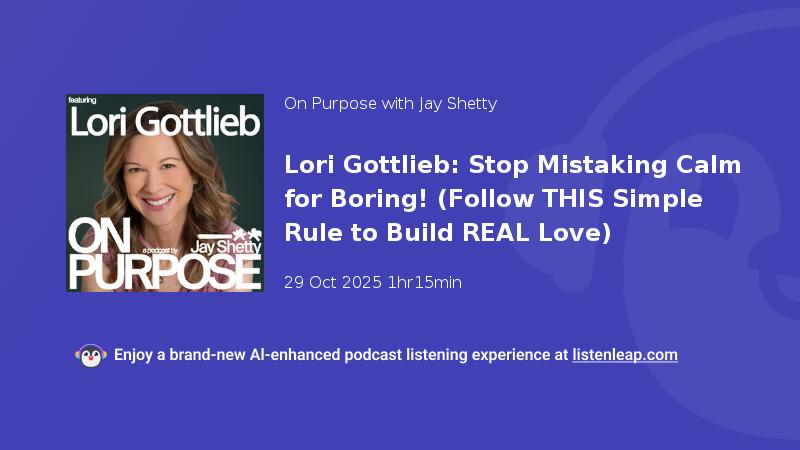
I am so excited to be here tonight at the Dahl Constitution Hall in Washington DC with the one and only Laurie Gottlieb.
Give it up for Laurie, everyone.
Now.
Laurie has been a dear friend for the last few years and has been one of our most popular on-purpose guests.
She's been on the show at least three times and we're going to have her back on every year that she possibly can.
So, Laurie, to do this in person, when we're usually in the studio, is a real treat.
So thank you so much for flying out as well.
I'm so grateful that you're here.
Oh, I'm so happy to be here with this wonderful crowd in DC.
I love it.
So I want to dive straight in with you, Laurie, because I really want to dive into your mind.
You have so many incredible insights.
And something we've been talking about tonight is this idea of being worried about what people think of us.
And the hardest person's perception that we take the most seriously is our partners.
Yeah.
And a lot of us can sometimes feel we're performing in relationships to try and get that validation, to try and get that attention, to try and get that affection.
Why do so many of us feel that way and what do we do about it?
It's interesting, I think in the beginning of a relationship there's this joke that you're not you, you're the ambassador of you.
So we're all trying to put our best foot forward, we're trying to impress the other person.
But I think that once we're in the relationship, we all have some part of us that worries that we're not lovable, and maybe we're going through something hard or maybe we're not feeling great about ourselves.
The other person is going through something like, they're having great success and we don't feel like we measure up.
And so I think what happens is we feel like we have to earn our love, that we're not enough just to be there, that we have to somehow earn it through these external criteria.
Like I have to be so attractive and so funny and so entertaining and, you know, all the things.
And what you do have to earn love, by the way, but you earn it by being relational.
So people want to be in relationships with people who are relational.
They don't want to be in.
Relationships with people who can't listen aren't emotionally generous those kinds of things.
But I think that when we think about performing in a relationship that has to do with I don't believe that you will love me if I don't earn your love.
And that's a belief that we need to get rid of.
How do we do that?
Well, I think you need to understand that that's not the way that you earn love.
So the way you earn love, as I said, is being relational.
It's not about all of these other things that we try to do like I need to look this way or be this way.
The person cares about you.
They're with you.
So you need to show up.
And I think that that's really the answer is how can you be in a relationship with somebody?
You have to show up.
Otherwise, if you're just in your head the whole time, you're not even there.
So many of the people that I speak to, and I'm sure a lot of you can agree with this.
I think a lot of people feel that at one point in their relationship they find that their partner doesn't wanna open up, doesn't want to talk about their feelings, isn't comfortable being vulnerable and may actually be more closed off.
So I often find in relationship there's one person who wants to talk about everything and then the other person doesn't want to talk about anything.
And so, even though we want to be relational, you often find that one person doesn't, whether they don't have the emotional capacity, whether they don't feel they're ready, whether they don't even allow themselves to think about these things.
What do you do when you're in a relation?
Can everyone relate to that by the way?
Let's make some noise.
All right.
When you're with someone like that, what do you do?
Where do you start?
Because you want to be with them.
They're not being relational.
They don't want to listen to you.
They don't want to talk about their life.
How do you navigate that?
First of all, I think it's really important that you notice that at the beginning of a relationship.
So many people will say, you know oh, this person doesn't really open up or they're not really there, they're not really being vulnerable with me, but that's okay, because that will come.
And then you keep going and you think, okay, well, it will come later, but it's still not coming.
Why do we do that?
Why do we ignore that?
Because it's almost like attribution bias.
It's like you want to attribute certain traits to the person that they don't actually have.
And that's why I always say at the beginning of a relationship, you wanna bring things up.
People are afraid to.
For the reason that we said.
You know, we want to be the ambassador of us at the beginning of the relationship.
But actually, you wanna bring things up early and often.
And that's because relationships are like cement.
If you let the cement dry and so you say okay, this will change later, then you're going to have to get out a jackhammer, dig everything up, Right?
It's really hard.
But if there's still room you can say to your partner hey, I'm having trouble making contact with you.
What's going on?
Is there something about the way that we're relating?
Why is it?
You know, I really want to get to know you better, but I'm having trouble and really understanding what's going on inside.
And some of that is gendered.
Okay.
So some of it is a lot of times men feel like if I open up and be vulnerable, then I'm gonna be perceived as weak, or I'm gonna be perceived, you know, differently.
And there's some part of women that we need to learn to provide space for men to be vulnerable.
Because what happens is, when I'm doing couples therapy, what I'll see is, if it happens to be a man and a woman, I will see that the woman will say to her partner I'm so glad you're here.
I really want to talk about all this stuff that we can't talk about.
And I want you to tell me what's going on.
I want to really know what's going on inside of you.
And then he opens up.
And then maybe he tears up, maybe he starts crying, and she's like, whoa, right?
So part of it is I don't feel safe when you don't open up to me, but I also, in a weird way and I can't explain it I don't feel safe when you're crying either, right?
So we need to make sure that we are providing the space for the partner, who's not vulnerable, to be vulnerable.
We can ask them what would be helpful.
And I think we just don't ask the questions and then we say, well, this person's not capable of it.
They might be very capable of it if you give them the space.
We're all looking for that safety.
And we're so scared that if we showed our true selves, then it wouldn't be a safe space anymore.
And that maybe that part of us will be too hard to handle, too hard to hold, too hard to embrace.
And so we just lock it up inside.
And we never share that.
We never show that.
And the challenge that happens is the other person thinks you don't have the capacity.
And actually you're thinking well, I don't think you actually have the capacity for me to be all of myself.
And it really does require a lot from people to allow their partner to be all of themselves.
How do we communicate that we're ready to create a safe space for that person?
And how do we actually create the resilience in ourselves to have the space for whatever may come?
Like I remember when I was talking to a couple a few years ago, it was similar to the gender play that you mentioned, where she was like I want you to be really, really open to the man.
And he was just like, well, if I tell you this, I'm scared you won't like it.
And then he opened up about some of the challenges he'd had in his past.
And that really made her feel insecure about him, even though it wasn't to do with them.
So it can be really complicated.
How do we truly have emotional availability to make space for what someone has to say for us?
That's such an important point, because it's not just saying that you have the space, it's actually having the space.
And it's hard for us sometimes to separate out who we are from who they are.
So they're telling you something about them.
And they're asking you to sit with them.
They're inviting you to come closer.
And we think, oh, they're telling me something that feels threatening to me.
So when we talk about vulnerability, there's two kinds of vulnerability.
There's vulnerability of, I'm going to tell you something about my past that feels delicate to me.
But what really kind of triggers the partner sometimes is?
I'm going to tell you something about you in relation to me that is delicate.
And so how can we be vulnerable about something relational between us?
And that's where couples get into a lot of trouble.
Because, instead of hearing the other person, they're getting defensive, they're feeling blamed, they're feeling criticized.
When really, the invitation is, please come closer.
I trust you and I feel close to you.
So isn't it funny how we hear the opposite message?
We hear like, something's wrong with you, you're damaged, I'm criticizing you.
That's what we're hearing.
But actually, the invitation was the opposite.
And that's because, in any moment when there are two people in conversation, there are up to a dozen people in the room.
And by that I mean, think about who's in the room.
Like, take attendance.
Have any of you ever been talking to somebody else in the room, and it feels like it's not just the two of you?
Anybody?
Where it feels like wow, something else.
I don't know what just happened with the other person, but that's not what I said.
That's not what I meant, that wasn't you know what conversation are they in?
Well, that is because you need to say, who's in the room?
A parent, a grandparent, their parents because of the generational patterns that have gone down through the generations.
A teacher who told you that you would never amount to something.
The teacher who told you you were fabulous and the first boyfriend or girlfriend you had.
All those people are in the room, but we don't know it.
So if you're having a big reaction to something, we always say if it's hysterical, it's historical.
If you are having a reaction that feels outsized to what is actually being said.
It's like you went from zero to 60 in your body.
If it's hysterical, it's historical.
Who else, who are these figures in the room?
Take attendance, see who's in the room.
And then who do you want to invite in the room And who's not invited?
And then tell the people very kindly hey mom, hey dad, hey grandma, hey sibling, you're not invited into this conversation.
So you go, and I'm gonna come back into the conversation with this person that I'm talking to.
Wow, I love that.
I love that.
That's so powerful.
It resonates so strongly with so many interactions I can think of.
I wanted to ask you, Laurie, can you truly love someone if you don't love yourself?
I get asked that question all the time and I think the better question is can you truly accept someone if you don't accept yourself?
One of the most loving things you can do to yourself and to other people is acceptance.
And acceptance doesn't mean settling or compromising.
It means embracing the fullness of the other person's humanity and embracing the fullness of your humanity.
So when people say, you know, will you love me if, right?
It's do you accept me fully is really the question.
And I don't think that you can accept someone else fully if you don't accept yourself fully.
Because we can't order up people a la carte.
We think we can just order up anything the way we want nowadays.
You can order online, you can get anything.
It's like, what are your special instructions?
Leave this on the side.
You can't do that with people.
They just come the way they come.
So you can't be like yeah, I love everything about you, but I want to leave your anxiety on the side.
I want to leave your neuroses on the side.
I want to leave that history that you have with that other person on the side.
I wish that didn't happen.
You can't do that.
So they come fully formed, no substitutions.
It's the way it is on the menu.
That's how they come.
And you do too, by the way.
So we forget, sometimes we think like, I have to accept all these things about the other person.
What about the things that they're accepting about you?
And if you were truly honest about it, not like in a job interview, when people say what is your greatest weakness and you couch it as a strength like I work too hard.
That's my greatest weakness is I'm just a perfectionist and I work too hard.
Well, no, that's not on your list.
The list has to be something real, like I can be really inflexible or I am still working on this one thing and that can be challenging for my partner.
You know, whatever the things are, be honest.
You know what the things are that you have to accept.
And once you accept those in yourself, what happens is something kind of miraculous.
Not only do you feel more loved because you are more accepted, but they become smaller.
So those things that feel very huge to you, once you've said you know what, I'm not going to focus on them or obsess about them anymore.
All of a sudden, they don't take up so much emotional real estate.
It's like, I just accept that about myself.
Moving on.
Yeah, that's super powerful advice.
There's a... That...
That resonates so much more, the word acceptance versus love.
Because I think love kind of gets convoluted when you're having that conversation.
Like, do I love myself?
Do they love me?
Do I love them?
Whereas acceptance kind of gets to the heart of it.
And even as I was listening to it, I was thinking about, like I was talking to someone else yesterday about this, and I was talking about me and my wife Radhi.
And I was explaining that really acceptance is what helps our relationship work.
We're very different people.
We have very different priorities and we have a lot of different things that we like and engage with, but we respect that.
That's what makes the other person attractive to us.
So what I mean by that is when Radhi met me.
I'm the same person I've been, which is a mission oriented.
I'm very focused on my purpose.
It's my top priority in life and I love it.
And thankfully, knock on wood, in the last 12 years, Radhi's never said to me, you work too much.
Because she knows I love this.
This is who I am.
It's who I always was.
And for Radhi, her top priority is her family.
She loves them, her niece and her nephew, her grandma, her mom and dad.
Like, her sister, like that's her top priority.
And so she loves visiting them in England and going back, even though we live in LA.
And I love that because I'm like.
The reason why Radhi is so lovable is because of her loving relationship with her family.
And so it becomes an acceptance point of recognising that what it's almost like you don't want to take away the secret source that makes your partner your partner.
Whether it's their ambition, whether it's the love for their family, whatever it may be.
And when you respect it and accept it, it allows for things to blossom.
Whereas when you try and take it away, you actually end up becoming their kryptonite.
And you're making them weaker by taking away the very thing that they value.
Does that make sense?
Yeah, I think of relationships as almost like a relationship is like a startup.
It's like you're building, you're co-founding this, whatever you're building.
And every single relationship, it's like a snowflake.
It's unique.
There's no other relationship out there like it.
There will be overlap.
But the fact is, these two individuals coming together are creating something that no one else can create.
And so if you take away something from one of the other people, that might be something that is really adds to the richness of the relationship.
You don't want to change the person that you're with.
There might change interactions between you.
That's different.
Yeah, I want to give another example of a weakness that I had to work on, which really helped me when it comes to this acceptance point.
At one point in our relationship I was always like I was upset that Radhi didn't organize more vacations.
And I was the one doing all the organizing.
Anyone can relate?
If anyone's me in the relationship, yeah.
And so I was upset about that and I remember communicating that to her and I said look like I'd really appreciate it if you also organize the vacations.
And she said something that was so honest to me and it really, really resonated with me.
She goes, Jay, I would happily organize any of our vacations.
But the problem is if I organize it, you'll have a million pieces of feedback.
But if you organized it, I'll just happily do whatever you want to do.
And it took me a second, but she was spot on.
I'm like a perfectionist.
I want it done this way.
And I realized, I was like, actually, she's the sweetest person in the world.
When I organize a vacation, she's happy to be a part of it and won't even ever say to me like oh, I wish we did this or we should have done this.
Whereas I would be like that the whole time.
And it was such a like holding up a mirror to me.
And I realized that I was the one discouraging her from taking responsibility in a relationship because of how I would respond.
And that was a lot of self-awareness that I didn't have at that moment.
And it was such a powerful thing to learn to accept that, even though I thought she wasn't doing something for me.
Actually it was because of how I was behaving.
That happens so often.
I remember when I was seeing this couple she was saying you know, I want you to stop by on the way home from the gym.
I want you to stop by to the market and I want you to get these things.
And they had a baby and she wanted him to get organic strawberries.
He did not have organic strawberries at Trader Joe's that day.
So what did he do?
He got the regular strawberry.
Oh, no.
We know.
How this goes, guys.
Now, I want to say hashtag first world problems, right?
But at the same time, these are like the tiny, what do people fight about most?
There are these tiny things that mean something much bigger.
So for her, this meant you don't pay attention to what's important for me and our baby.
Right?
And for him, it was like, no, I did.
I did exactly what you asked.
And if I had done it my way, I would have gone to the other place and maybe they would have had organic strawberries, but I was following your directions so I wouldn't get in trouble.
And then I got in trouble anyway.
Right?
So these are the kinds of things when we try to control our partners, we're not giving them the autonomy to creatively do the things that actually would enhance the relationship.
And when we look at what is the number one trait, when we say what makes couples work, okay?
Emotional stability, and that means like you basically, you know, you're working on your stuff.
And the second thing is flexibility, that you have to be flexible.
And so if you're the perfectionist in the relationship and you're trying to control your partner, that's going to make you very, very difficult to live with.
And what will happen is you will start to lose control, because now that person doesn't want to pay attention, They don't trust you.
They're going to try to go around you because they're you know.
It's kind of like we say that you need an aquarium, in a relationship also with parenting.
But an aquarium is like, if it's a fishbowl, it's too tight.
It's like too constrained.
If it's an aquarium, there's no rules, nobody knows what's going on, it doesn't feel good, it doesn't feel safe.
An aquarium is just right.
Can you give the other person the equivalent of an aquarium?
So they have room to swim, but there are also certain agreed upon rules in the relationship.
Got it.
That makes sense.
I've been dying to ask you this question, Laurie.
You've, you know, coached couples and relationships for decades now and you know been in therapy with couples individuals, everything.
I wanted to ask you what is the difference between compatibility and chemistry, and which one's more important?
Let's do a poll.
Let's do it.
Let's do it.
That's the fun of getting to do it with all of you.
Who thinks that compatibility is more important than chemistry?
Make some noise.
Okay, and now the chemistry folks.
Make some noise.
All right.
All right.
There's a good amount for each.
But here's the answer that I would give.
And this is from seeing couples for all of these years.
And I will say that I think that the most important form of chemistry is compatibility.
Wow.
So you're all right.
And what I mean by that, so compatibility is do we vibe?
Do we have the same ideas about how we like to have fun?
Do we have the same ideas about our goals for ourselves and for our relationship?
Do we bring out the best in each other?
That's like red hot chemistry, right?
But it's compatibility too.
Some people would say that chemistry is.
I always feel on edge with this person, but wow, that person's so hot right.
Well, the other person can be really hot.
That's part of your compatibility too.
But you need the other things.
If you bring out the best in each other, that is chemistry and compatibility all wrapped in one.
Yeah, I agree.
I love that answer.
Yeah, go.
Give it up.
There's...
You reminded me of this amazing study that I read, that I loved, which was talking about how, when you meet someone and you feel the spark or the chemistry, Really what it is is anxiety and excitement at the same time.
So it's like excitement and stress.
I'll give you an example.
The excitement is, oh my gosh, they're hot, right?
The stress is, do they think I'm hot?
Right?
The excitement is, oh my gosh, I got their number.
I'm going to text them.
The stress is, are they going to text me back?
Right?
The excitement is, I thought we had a great day.
The stress is, do they think we had a great day?
And so that's what chemistry chemically actually is.
It's stress and excitement.
Now what's really interesting.
What this study said, is that over time, when you get to know someone and you've spent time together, your stress goes down because now you're used to being around them.
You know they like you.
You know they like being around you.
You know they're going to text you back.
And so because the stress goes down, excitement kind of starts to diminish and you now think it's boredom, when actually it's peace.
So it's this really weird idea that compatibility is boring and chemistry is exciting, but really real great compatibility is a sense of peace, that we actually feel peaceful around each other.
I now don't feel on edge around you, and I don't have to worry about whether you like me.
And that's why it's so interesting how so many relationships go through this border mirror when you've got to actually check in with yourself and say are we bored?
Or have I just lost the stress of them liking me and texting me back and messaging me?
Right, but what you get instead is you get the dopamine of this person loves me, right?
Like there's something all of the people who are dealing with what you said of you know the date went well.
Did they think the date went well?
You know, I got their number, are they gonna call me back?
You know, all of that.
That is so, when people are going through that, you know what they say in therapy, when they tell you what they're really feeling.
They say, all I want is to feel safe.
I want peace.
I want all of that, right?
I just want to feel good and I know that this person likes me and I want to have fun with them.
That's what they want.
And then when they have that, they say, oh, no, I want the other thing.
I want that other thing at the beginning.
You weren't happy at the beginning.
You were stressed out all the time.
You were like, is the person gonna call?
What's gonna happen?
What did it mean that the person waited this many hours between the text and the time that it right?
Nobody enjoys that.
They think they did in retrospect.
But at the time when they're reporting it, they're like, I hate this.
Yeah, that's so true.
That's so true.
We forget very quickly how anxious and nervous and stressed we were at the start, when we were dating someone, and what that looked like.
The Super Secret Bestie Club Podcast Season 4 is here.
And we're locked in.
That means more juicy chisme.
Terrible love advice.
Evil spells to cast on your ex.
Hey!
No, we're not doing that this season.
Oh, well, this season we're leveling up.
Each episode will feature a special bestie and you're not going to want to miss it.
Get in here.
Today we have a very special guest with us.
Our new super secret bestie is the diva of the people.
The diva of the people.
I'm just like, text your ex.
My theory is that if you need to figure out that the stove is hot, go and touch it.
Go and figure it out for yourself.
Okay.
That's us.
That's us.
My name is Curly.
And I'm Maya.
In each episode, we'll talk about love friendship heartbreaks, men and, of course, our favorite secrets.
Listen to the Super Secret Bestie Club as a part of the My Cultura podcast network, available on the iHeartRadio app, Apple Podcasts or wherever you get your podcasts.
I'm Jonathan Goldstein and on the new season of Heavyweight, I help a centenarian mend a broken heart.
How can a 101-year-old woman fall in love again?
And I help a man atone for an armed robbery he committed at 14 years old.
And so I pointed the gun at him and said, this isn't a joke.
And he got down, and I remember feeling kind of a surge of like, okay, this is power.
Plus, my old friend Gregor and his brother try to solve my problems through hypnotism.
We could give you a whole brand new thing where you're like super charming all the time.
Being more able to look people in the eye.
Not always hide behind a microphone.
Listen to Heavyweight on the iHeartRadio app, Apple Podcasts, or wherever you get your podcasts.
Hey guys, it's AZ Fudd.
You may know me as a gold medalist.
You may know me as an NCAA national champion and recent most outstanding player.
You may even know me as a people's princess, but now you're also going to know me as your favorite host.
Every week on my new podcast, Fudd Around and Find Out.
I'll give you an inside look at everything happening in my crazy life as i try to balance it all from my travels across the globe to preparing for another run at the natty with my yukon huskies, to just trying to make it to my midterms on time.
You'll get the inside scoop on everything.
I'll be talking to some special guests about pop culture, basketball and what it's like to be a professional athlete on and off the court.
You'll even get to have some fun with the Fudd family.
So if you follow me on social media or watch me on TV, you may think you know me.
But this show is the only place where you can really Fudd around and find out.
Listen to Fun Around and Find Out a production of iHeart Women's Sports in partnership with Unanimous Media on the iHeart Radio app, Apple Podcasts or wherever you get your podcasts.
Before we go on to something really exciting and interesting I want to do with the audience, I wanted to ask you one more question, which is this idea of should couples in therapy also be going to individual therapy?
And how do you...
You're happy I asked that question?
Yeah.
How do you figure that out?
Like, do you go individual therapy?
Do you also do couples therapy?
Do you only do couples therapy?
Like, how do you figure that out?
I think that in a lot of ways, couples therapy is individual therapy, and at least the way that I do it.
And what I do is, before people come into therapy, I say to each person separately if you are going to be the best version of yourself in this relationship, regardless of what the other person does, What do you want to work on?
What is one thing that you want to work on?
And I ask each of them that.
They don't tell each other what it is.
That's their sort of individual goal in the therapy.
And so, no matter what happens in the therapy, the whole time they are working on, each of them is working on that one goal.
And guess what happens?
As each person is kind of doing their individual work, you don't change another person, but you influence another person.
So now, oh, I am being more aware of this now.
And look at the, effect it's having on the other person.
It's a virtuous cycle.
So, instead of like the vicious cycle of well, we're doing this dance and what I do upsets this person, and what they do upsets me, it's like I'm doing something different and they're responding well to it.
Now they're responding well to it and they're responding well to it.
It keeps going back and forth.
And I think that's so interesting because, you know, often in a relationship we have this way of thinking, like if I snap at you it's because I was tired and my boss was really demanding.
If you snap at me, it's because you're disrespectful and you don't care about me.
That's real, yeah.
So what happens is we have context because we know in our own mind why we did what we did.
And we think we know why the other person did what they did, but we have zero context for it.
We don't know.
And because we feel hurt by it, we don't ask.
So I think it's really important to consider that we don't know the whole story.
And so when you're doing couples therapy, you're working with the individuals at the same time.
You can't just work with a couple and you can't just work with like, here's our problem, here's my stuff, here's my history, here's like all the 12 people I'm bringing in the room.
Here's you, your stuff, your history, the 12 people you're bringing in the room.
Let's disinvite the people who don't need to be here.
Let's talk about what is going on underneath the problem of who's doing the laundry.
Yeah, well said, well said, Laurie.
Amazing, all right, well.
You know the joy of doing this live with all of you.
Usually we're in a studio the joy of doing this live.
First of all, I just want to say how much this means to me, because I absolutely love this.
I wish we could do every podcast like this.
It's so fun to see what resonates with you and what connects with you and what you relate to.
But I just want to get a show of hands.
How many couples do we have in the house tonight?
Raise your hand if you're with your partner tonight.
Okay, amazing.
Quite a few.
I love that.
Now look, every couple as I was sharing with me, and Radhi too, every couple goes through disagreements and things like that.
I want to give someone the opportunity to have and do an exercise with Laurie on stage right now.
So if you have any couples that would love to join us on stage, raise your hands.
I'm going to come out and talk to you.
Raise your hands.
Hello.
This is going to be fun.
Hi.
Hi, it's gonna be super fun.
All right.
Okay.
Well, first of all, thank you guys.
You guys are so brave.
I'm not part of the relationship.
I'm just sitting here.
We might bring Jay in for some mediation.
So, okay, tell us your names.
I'm Stephanie.
Stephanie?
Nico.
Nico.
Okay, so how are you guys at acting?
Not very good.
Okay.
Well, we're going to do our best.
He's terrified.
No, no.
Behind closed doors, I think I'm pretty good at it.
All right.
So I'm casting a play.
And you're playing Nico.
You're playing Stephanie.
Nico.
Okay, what is this person's name right here?
Everybody say it.
Nico.
I'm Nico.
Good.
What is this person's name over here?
Stephanie.
All right.
So I want you guys to hold with a non-mic hand.
Hold hands.
And we do this a lot in couples therapy because your nervous system calms down.
It keeps you connected.
And, Nico, can you tell me what the issue is with Stephanie?
And when I say what the issue is, not just what the issue is, but what does it make you feel?
What comes up for you?
I guess just like worry and stress, just overwhelm of emotions.
Yeah, but what's the issue?
What is the issue that you guys are disagreeing about?
I guess the worthy of yourself.
Meaning, so what happens between the two of you when you're disagreeing about...
I guess I just don't sometimes feel like I level up to the expectation of how I should be.
Oh, how Stephanie wants you to be.
Tell me more about what you think Stephanie, what Stephanie wants from you.
What does Stephanie want you to be like?
I guess, just like the best I can do in any aspect, like as a mom, as a partner, just to be able to be present for the other person.
So Stephanie wants you to be a good mom?
Listener.
You're Nico.
I'm confused.
You're Nico.
You're Nico.
Right.
So you're Nico.
It's okay.
It's hard to get into the mindset of the other person.
So you're Nico.
I'm Nico.
Okay.
Okay.
And Stephanie is not listening to this.
So you're Nico and you're telling me what you feel like you can't tell Stephanie.
About how does she make you feel about whether you're living up to her expectations?
So I'm Nico, and I'm communicating.
So you're Nico.
And what is going on with you and Stephanie?
What are you feeling like?
From Nico's perspective, what are you seeing as the challenge?
I got just like the overwhelm of supporting for the family and letting Stephanie know that I am doing my best to take care of myself and you, but I also need to focus on my mental health.
And what does it feel like when you feel like Stephanie doesn't feel like you're doing your best?
I guess just like annoyance.
That they're not understanding of what I'm feeling.
What does Stephanie not understand?
That I also need to have me time.
Okay, and what happens, why do you think Stephanie has trouble giving you the space to have me time?
I think she also wants me time and that understanding that there is a balance, and if you get this, I have to have that too.
Okay.
So it has to be sort of equalized in Stephanie's mind.
Yes.
But not in your mind.
Right.
Okay.
All right.
Stephanie, what's going on for you?
So I can see why this is hard to switch into that mindset.
Yeah, so Nico works from home and he goes to his computer early in the morning and I have to obviously help out with Natalia, our baby girl.
You know I might see him, that he might go for a run in the middle of the day, and there's something that you know, and I think that Nico does that because he just wants to clear his mind and he wants to provide for his family.
You know, maybe if I do something that's not necessarily me being glued to my desk, then Stephanie might... Or Nico... I get upset if maybe I don't see Nico, if he's not 100% working at his desk, and he might be doing something that... you know, he might be dedicating time for him and I'm not getting that and I'm, you know, I also want to be doing my things and I'm not able to do that and I'm jealous that maybe Nico is doing that.
You know why you guys are having so much trouble remembering who the other person is?
Because you have the exact same complaint.
That you both feel like the other person doesn't give you enough me time and the other person doesn't understand why you need it.
So this is interesting, because normally when I do this with couples, one person has one perspective on something.
The other person has a completely different perspective on it.
You guys literally have the same complaint.
So what I want you to do is I want you to imagine, while you're in your roles, how you come across to the other person.
So I'm going to bring you back to your actual selves.
So you're Stephanie, you're Nico, okay?
I want you to act out Stephanie, how you think, and make it really big, and make it really, you know, like exaggerated.
How you come across to Nico when you're frustrated with him and you want me time or you don't like him having me time.
I feel like I sometimes act like a child.
Well, let's see it.
Actually, go for it.
And by the way, we all have these moments that are normally not on a stage.
So please know that every single person in this audience has done this just in the privacy of their own home.
Or on my couch.
Goodness gracious, babe, you don't listen.
I need to just do me, have a moment for myself, stop thinking about yourself, and just listen.
Baby, I have a lot.
Okay, no, no, I'm not actually going to respond.
I'm ready.
That was a great performance.
Okay, Nico, tell Stephanie what it feels like when she does that.
About you.
You're only going to talk about you.
You're not going to say you this.
You're going to talk about yourself.
I feel... Yeah.
Baby, you know how I like to be approached.
I'm very just big on... thinking before you say something?
No, no, you're telling her.
I don't like triggering words.
I don't like it when... I'm gonna give you some like a multiple choice.
Okay, okay.
Because we don't know.
We need, like it's almost like you know, we don't.
We didn't get a lot of training on like what are the feelings right?
We know, like, mad, sad, happy, but we don't know anything in between.
It's like we know the primary colors, but we don't know the shades.
What I saw here was I feel angry.
I feel shame.
Does that resonate?
Yeah.
Okay, tell her about the shame.
It's like how I'm trying to fix this.
No, just tell her what the shame is like.
I feel.
How it feels, when you feel when she says that to you, when she acts in that way to you.
How does that shame feel to you?
Yeah, I feel like I'm trying to juggle a lot and it doesn't make me feel heard or my point of view is being listened to.
I just wish that it was more of a conversation instead of an attack.
I want to go back to the shame only because I think that that's sort of the core of What does it mean if you disappoint her?
So she's disappointed by you, rightly or wrongly.
I'm not gonna get into that, although I do have an opinion about it.
But she's disappointed, and she's saying, I want to feel safe.
I want you to provide.
I want you to use your time well.
I want you to be productive.
And you feel like, If I don't do that for her, then I feel bad about myself.
Tell her about the part that makes you feel bad about yourself.
Oh, okay.
Yeah, you know I'm very supportive of you and I do feel bad when I see you stressed out in those situations and I do want to.
Make sure that you get as much time as possible.
It's just hard for me to... But you're talking about her, and I want you to talk about you.
And this is really hard.
But what happens for you when you feel ashamed?
Like, I can't measure up to what you want, so I'm going to shut down.
I'm going to stop listening to you.
What happens to you?
I do shut down.
I guess it's hard sometimes to have that conversation and listen, and I just, yeah, shut down.
Can you act out for her what a different approach would be for her to say what she wants to say?
But it doesn't look like the way she approaches you.
How I would want her to?
Yeah, what would you like her to say to you instead?
Baby, do you think I can, between one and two, have some me time?
Well, when she's feeling like there's a contest between who gets more me time, what would you like her to say to you instead?
You know, baby, I need me time to focus on myself.
This really helps me as a person and just mentally.
And I think it would help our relationship more.
If you know, maybe I just had an hour here to meditate and listen to my Jay Shetty podcast.
All the time.
All the time.
Okay.
And so I want you to say that to him right now.
That's what he wants you to say to him.
Go ahead and say it.
So, baby, I think I need this one to two hours to really focus.
Wait, I don't think he said two.
I don't think he said two.
I don't think he said two.
I'm saying three now.
I think he said one, and I think that was generous.
One is two.
So I need this hour to focus on myself and my mental health and make me, you know, listen to my G-Sheddy podcast.
And the question might be, is that okay?
Is that okay?
And what can we do for you to have that?
So I'm adding to that.
So is that okay?
And what can I do in order for that to happen?
What does that feel like to you when she says that?
Does that feel different from how it normally goes?
A little bit, yeah.
Yeah?
Yeah.
I'm also on a schedule, right?
There's a lot of things that I'm trying to manage. when it's just like, hey, I need an hour here.
And I'm just like, well, I want to give it to you, but I don't have a meeting at 9.
And then I have to get work done from the next three hours.
And then I'm more of on a schedule and it's tough for me maybe just step away from my desk or just do something just randomly in the day of like an hour of.
Okay, so what you're requesting?
The two things I want you to take away from this.
One is, how does the approach differ?
It helped a little bit, you said.
And then also what are some of the practical parts of this like.
For example, When you approach me, I can't necessarily just drop everything on a dime.
So you're smiling because it sounds like that's what you've been asking for, right?
Yeah.
Yeah, okay.
So you can understand that he's trying and he wants you to have me time and he needs some me time.
But what's not being taken into account is he can't just do it spontaneously like that.
So can you find a way so that he doesn't then argue back well, I can't, and this and that, and then you feel shut down, and then he feels shut down, and then it's like we didn't even do this interaction.
So you're going to ask differently.
And you're going to make sure that you ask, maybe the night before, like hey, here's what I'm thinking.
Does this work?
And I want you guys to see what that would be like.
And I want you to see what happens when it's a request and not a demand.
Because when you acted it out, it was a demand.
When you did what he said might work better, and it worked slightly better, that was a request.
So here's one example.
Normally, people have very different ideas about things, and it really helps them.
These two have exactly the same issue.
So this exercise was a little bit different, but I hope these two takeaways are going to be helpful.
All right, thank you guys for coming up.
How do you guys think they did?
Very, very, very brave to come and do that in front of 2,500 people.
It takes a lot.
And, as you can see, I love what Laurie was doing because it really shows us like we don't get to sit inside of these exercises.
We only get to sit inside of our own.
And when you're inside someone else's therapy exercise, you start to recognize just how we don't have the emotional vocabulary.
We don't have the communication skills and it's not our fault.
It's because no one's ever taught us them.
And so a lot of us are learning.
And so having that bit of grace when we're with our partners, to recognize that we can't expect people to have these emotional skills.
We often expect people, Laurie, to just get us.
We expect our partners to just get us.
It's common sense, you should get it.
And we don't.
Well, it's so interesting because we believe that that's the true test of love.
Like, do you just get me?
And it's interesting because you think when we're babies, we don't have warts.
And the only way that we can communicate is by crying.
And the parents are dancing around like, oh my gosh, are you hungry?
Are you cold?
Are you hot?
Are you tired?
Do you need a diaper change?
We don't know what it means.
But then we grow up and we expect our partners to like solve the problem in the same way.
Except now we do have words and we can use those words.
But our first loving experience was all about how much was my parent or caregiver whoever able to guess like we want our partners to do what I needed in that moment.
Wow.
Wow, wow.
And now what we have instead is so then we have words and we can say hey, I'm hot, I'm cold, I'm hungry, I'm thirsty, I'm tired, right.
And we learn how to do that.
Somehow with our partners, we think, I don't need to tell them that.
They should just know.
Because it's our early experience of loving.
It's our earliest is of being loved.
And so now what we have instead is we need to learn the operating instructions of our partner.
So everybody comes with.
You know their history, the things that work well with them.
Don't push this button.
Do push this button more right with our partners.
We all know that about our partners.
But then we think, well, they should just guess.
Why don't you just tell them so you can get what you want?
Right?
Right?
Why do we make it so hard on our partner?
Just tell them, these are my operating instructions.
What are yours?
I want to give a big shout out to Nico and Stephanie for having the courage to do that.
And I want to take it out to all of you.
I want to take some of your questions.
Me and Laurie are both here.
We'd love to answer your questions.
Paige, where are you, Paige?
There you are.
Paige from my team.
Give Paige a round of applause, everyone, please.
Paige from my team is going to come around and hand you the mic if you have a question.
So raise your hand if you have a question and Paige will come and find you.
Hi, I'm Kurt Braunohler.
And I am Scotty Landis and we host Bananas, the weird news podcast, with wonderful guests like Whitney Cummings.
And tackle the truly tough questions.
Why is cool mom an insult, but mom is fine?
No.
I always say Kurt's a fun dad.
Fun dad and cool mom.
That's cool for me.
We also dig into important life stuff, like why our last names would make the worst hyphen ever.
My last name is Cummings.
I have sympathy for nobody.
Yeah, mine's Brown-Oler, but with an H, so it looks like Brown-Holer.
Okay, yours might be worse.
We can never get married.
Yeah.
Listen to this episode with Whitney Cummings and check out new episodes of Bananas every Tuesday on the Exactly Right Network.
Listen to Bananas on the iHeart Radio app, Apple Podcasts, or wherever you get your podcasts.
It may look different, but Native culture is very alive.
My name is Nicole Garcia, and on Burn Sage, Burn Bridges, we aim to explore that culture.
It was a huge honor to become a television writer because it does feel oddly like very traditional.
It feels like Bob Dylan going electric, that this is something we've been doing for a hundred years.
You carry with you a sense of purpose and confidence.
That's Sierra Teller Ornelas who, with Rutherford Falls, became the first Native showrunner in television history.
On the podcast Burn Sage, Burn Bridges, we explore her story, along with other Native stories, such as the creation of the first Native Comic Con or the importance of reservation basketball.
Every day.
Native people are striving to keep traditions alive while navigating the modern world, influencing and bringing our culture into the mainstream.
Listen to Burn Sage.
Burn Bridges on the iHeartRadio app, Apple Podcasts or wherever you get your podcasts.
Hey sis, what if I could promise you you never had to listen to a condescending finance bro?
Tell you how to manage your money again.
Welcome to Brown Ambition.
This is the hard part when you pay down those credit cards.
If you haven't gotten to the bottom of why you were racking up credit or turning to credit cards, you may just recreate the same problem a year from now.
When you do feel like you are bleeding from these high interest rates, I would start shopping for a debt consolidation loan, starting with your local credit union.
Shopping around online, looking for some online lenders because they tend to have fewer fees and be more affordable.
Listen, i am not here to judge.
It is so expensive in these streets.
I 100 can see how in just a few months, you can have this much credit card debt and it weighs on you.
It's really easy to just like stick your head in the sand.
It's nice and dark.
Even if it's scary, it's not going to go away just because you're avoiding it.
And in fact, it may get even worse.
For more judgment-free money advice, listen to Brown Ambition on the iHeartRadio app, Apple Podcasts or wherever you get your podcasts.
Hi.
Hello, what's your name?
I'm Priya.
Priya, nice to meet you.
What's your question?
My question is more of a scenario.
If you were going somewhere with your partner and, let's say, you had a disagreement and there was something that really bothered you, what's the best way to handle that situation so that you're happy and your partner's happy?
And do you speak when you're upset or do you wait?
And how should you communicate that?
What's the best way to communicate that?
I feel like when something happens, we feel like we have to resolve this right now.
And if we don't resolve it right now, it's going to live with us all night and it's going to ruin our time.
But you're so worked up about it that you haven't thought about it, you haven't processed it.
You aren't giving the other person grace at this moment.
So that is not the time to try to resolve it.
What you need in that moment is to say to each other, hey, we really care about each other.
We're having this disagreement.
We know we are confident.
And you have to have confidence that we know how to resolve things.
We're gonna resolve this later.
Let's go have a good time.
And people think I can't do that because I'm gonna be thinking about it the whole time.
Well, that's your choice, but I wanna say it's a choice.
It is a very volitional choice.
People say, I can't help what I think about.
Yes, you can.
So a lot of times in relationships, you have lots of choices that you can make.
You choose not to make them.
Yeah, well said.
And Priya, I'd say that You know, for me, there's two things that come to mind.
One thing is what Laurie's saying this idea that sometimes I'll get some friends call me in a panic, like Jay, I've got an issue, and maybe I'm on stage when I'm getting it and I'll be like call me back in three days.
And the reason why I say that sometimes is because, unless it's life or death, usually in three days when I mess with them and go hey, what about that issue?
They're like, nah, it's all right now.
It was just this panic moment.
And so I think there is something to be said for that.
For me and Radhi.
I talk a lot about in my book Eight Rules of Love that I wrote.
I talk a lot about fight styles.
I realised, it took me a while to realise that me and Radhi had different fight styles.
So my fight style is the venter, the talker, the fixer, like I want to fix it now.
So if I'm on that date, I want to fix it right now.
And Radhi's is the hider.
She wants to think about it, reflect, introspect, and have time.
So I want to talk about it right now.
She wants to talk about it in three days.
And what we had to realize was, like Laurie said, have the confidence to say okay, we're going to meet in the middle.
We'll talk about it tomorrow.
We're going to go out and have that great time.
We're going to meet in the middle.
I want to talk about it now.
You need three days to process.
In one and a half days, we'll take a look at it because right now it's not worth our time.
You're not even ready.
And actually, even though I want to fix it now, I actually don't know enough to do that.
And so recognizing the different ways in which you approach conflict, because what I used to think before is well, if you want to talk about it in three days, that means you don't care as much as I do, which isn't true.
She's actually saying well, the fact you want to talk about it now means you don't care as much as I do, because I want time to think about it.
So you've got to build up that understanding of the way you both respond to conflict and, taking Laurie's advice, recognize that now's not the time or the place.
And we're probably going to be in a better mindset if we let this go and deal with it at a proper time and place.
So I love Laurie's advice.
Right, and also you have to realize that the connection is not severed.
Just because you have a disagreement doesn't mean that the connection has been damaged in any way.
People are gonna have disagreements all the time.
And it's kind of like when you start a new exercise and you start building up muscle.
You need to build up the muscle of.
We know how to resolve differences between us.
And so the more you do it.
So the first time it might be a little shaky, the second time it still might be a little shaky, but every time you learn something new about how we resolve differences together.
And then, when you resolve differences all the time it's like oh yeah, we had a difference, we're going to still have a good night because our connection is strong.
We're confident we can resolve it later.
Thanks, Priya.
I hope that helps.
Thank you so much for your question.
Hey, man, what's your name?
Hey, Jay, I'm Snell.
Snell, nice to meet you.
My wife's not here today, but I came with my sister, but... Then you can tell us everything.
Exactly.
She's not here, so it's...
No, but my question is, like, sometimes, you know, we don't communicate.
Like, we're just sitting there.
I'm going to give a scenario.
Sometimes I'm really trying hard to understand, but there's no communication.
And the biggest thing that I struggle with is the love language.
Is gifting right what to get her on her birthday or what to get her for a certain event?
And then you spend so much time and then you get her something, and you see the reaction on the face and it's not always perfect.
So, you know, but sometimes I hate it, right?
It's like, you know, sometimes I get it and sometimes I don't.
But what do you do to kind of really understand what is it that that other person wants?
Right.
And yeah, that's my question.
Thank you.
I know my wife's probably going to watch this.
Video my sister took, but yeah, yeah.
Thanks for that question, Laurie.
So this goes back to the mind reading that we were talking about that people think somehow you know, if you loved me that much, you would know what gift I want and you would not get it wrong.
But I think there's something so beautiful.
To kind of turn it around and kind of turn it on its side is to say I love you so much that it hurts me to disappoint you.
And so if you could give me a list of like five things and I will surprise you with one of them, but at least now I have some idea of you want all of these things, you will be happy with all of them and I can show my love by getting you exactly what you want.
You won't know which one it is, so it's still kind of a surprise.
But I think that we have to understand that there's different ways to love people, and one way to love someone is to say making you happy is my way of loving you.
So, can you help me with that?
Yeah, I completely agree.
I think that.
So when me and Radhi first started dating, my love language was gifts, as in I like receiving gifts.
But I like surprises.
And this all goes back to childhood.
My mum.
We didn't have a lot growing up, but my mum would surprise me with the one gift I always wanted on my birthday, right.
And it could be the smallest thing, but I remember it so well.
So when I first started dating Radhi and I hadn't really thought that through and I wasn't aware of that I wanted her to surprise me with a gift.
So she kind of knew that I wanted a tablet, right?
And my birthday came around.
This tablet-sized box was there.
It was wrapped up in gift wrapping, whatever.
I open it up.
I take it out.
It's a tablet box.
It's an Asus.
What the hell is an Asus?
Right?
And I'm mortified.
I'm like, I'm like, what's an Asus?
Like I was trying to read it.
I'm like, am I even reading it right?
Is it Sousa?
Is it Asus?
Is it like...
And I'm like, tablets are iPads, right?
Like, there's an iPad or there's nothing.
Like, there's nothing else.
And so I am mortified that she got me an Asus.
And I remember talking to her about this.
And then she was like, yeah, but I spoke to my dad and my brother-in-law.
And they were telling me Asus is the best deal and the spec is really good.
And I'm like, my mom doesn't care about what the best deal is.
I just want the best tablet.
And so I've been there.
I know what that feels like.
And gifting in our relationship was a long time conversation.
And it really did take that where it got to a point where I was like I'm setting up the person I love for failure.
I'm literally setting them up for failure by wanting them to guess, wanting them to get it right, wanting them to know the perfect thing.
I'm setting them up for failure.
And guess what?
No one wants to feel like a failure in a relationship.
And so when you can openly say that to someone, to Jellic and saying hey, look like what Laurie was saying, like I don't wanna feel like a failure.
Like, I love you.
I want you to have the best birthday ever, but I need you to help me understand what that looks like for you and what that means.
And yes, I hope that one day I will be able to understand, because we've talked about it so much.
But without the communication and without that I just won't know.
Right, I just won't know.
And so it's hard in your situation because you're on the receiving end, you're the radi in the relationship.
But that's where we got to in the end.
And I realized and obviously over time I realized how wrong I was for my approach and my perspective on it.
And it made me realize how much our childhood as Laurie was saying earlier has programmed us to believe what a perfect birthday is.
Now I've changed my views on what a perfect birthday is because of that negative experience, because of making the person I love feel that way.
And so I hope that stays with you, to take Laurie's advice, to really communicate that, to make that point that hey, I want you to have the best birthday.
I don't want to let you down.
I don't want to feel like a failure.
I want you to have something amazing, but I need your help because I can't read minds.
I wish I could, but I can't and no one else can.
By the way, not even Radhi can.
And, you know, Jay said that, you know, he's kind of like you.
So hopefully that helps too.
And I think that childhood stuff is so important because we think you know, if you were someone who got everything, your mom did it perfectly.
Then you think well, that's what feeling special is like.
So if she doesn't do that, then she doesn't think I'm special.
Or if you didn't get the gifts that you wanted because you think my parents didn't really know me like I was an artist and they got me like a baseball bat.
You know, it's like what.
Like, do you even know me?
That's what you, then you project that onto your partner.
It's not that your partner doesn't know you, but you know the fine tuning of it.
Sometimes they need some help.
Absolutely.
And I realized I did tell my mom.
She was just sneaky at finding out.
It's not like she knew.
I would tell her, I was like, I want a Power Ranger.
It was very basic.
That's sneaky, Jay.
That's really sneaky.
I want a Power Ranger.
But it's like you did.
They didn't read your mind either.
You would find out in a multitude of ways.
All right, next question.
I actually had to write mine down because I thought I was going to get nervous.
OK.
So my question is am I being selfish or showing narcissistic traits for needing more time and attention in a relationship?
Or is it valid to simply express what I needed to feel connected and valued?
So if you were to ask Instagram this question...
You guys all know what the answer on Instagram is, right?
No, you're not a narcissist.
You should have all the time and attention that you need, right?
That's the Instagram answer.
I have a slightly more nuanced answer.
And I think that we have to really understand that being in a relationship is relational.
That the person that you're with has needs too.
And so when for them it feels too demanding, the question is, are they getting their needs met too?
Because usually, when they think the other person's too demanding, it means that there's not enough room for both of you in the relationship.
So that's really your guide.
Like do both of you feel like you're getting your needs met?
Do both of you feel like there's enough room there?
So it's not just a cut and dry.
You know well they should.
Of course, all of my needs should be met for how much time I want to spend with them, right?
It's a conversation and it evolves.
I think it comes down to a few things.
The first thing I'd say is, are you clear about what that means?
Like, for example, if it's unclear, like I wish that person would message me all day, call me twice a day, be there for me every evening.
You know it's like that can be a lot and it may not be clear.
Whereas if it's clear like hey, I just want to spend two hours with you on a Saturday afternoon and have it just be us right.
It's really clear.
It's really specific.
It's really organized.
Or is it like, hey, I just need you all the time.
And so much of this comes down to our attachment styles and how the other person makes us feel as well.
I think the challenge we have in your question is we don't know enough about the other person in the relationship.
And often I've seen it that if the other person's prioritizing a bunch of other stuff and you don't feel prioritized and you're not a part of the priorities and the schedule, then that's unfair, right?
If you've had a conversation.
But that's why it comes down to having a conversation, setting expectations extremely clearly, being really specific, and then looking at the reality of their lifestyle.
Like, I meet a lot of people who say to me I really want my partner to be ambitious, but I want them to be really available.
And I'm like, those two things just don't go together.
Like the reality is that person doesn't exist.
It's really really hard for someone to be super ambitious and super available, because that comes with certain give and take.
I'm not saying it's not possible to have someone who's slightly ambitious and available.
I'm saying that having both in their most extreme form is unrealistic.
And so I think it's really looking at the complete person rather than this one area of them, because they may be really great at a bunch of other stuff and they need to improve in this area, Or they're not great at any of it and they're not good at this area.
And then you've got to really look for what you deserve and not settle for less.
And I want to say one thing, you used the word narcissist, it is not narcissistic to have needs.
So a narcissist is someone who is all about themselves.
But that doesn't mean because you have needs and you want to spend time with your partner, even if those needs are maybe more than that partner wants or can deal with.
You're not a narcissist.
You're human.
That's human.
We want to connect.
We have needs.
Absolutely not a narcissist, for sure.
It's good we're clarifying that.
We'll take one last question.
I really love you, Jay.
You're a re-singer.
Love you too, Kaylin.
I'm learning about you.
I really appreciate you.
We're talking a lot about couples and relationships and everything that you've talked about today.
How does that apply to couples that are experiencing neurodivergence?
Because when you're saying, you know, in the role play earlier, I was thinking yeah, like an hour would be great.
But if you're a neurodivergent like myself, It's really hard to go from one test to another, to another, to another to another, like a switch to.
You know, task was switching and executive functioning and so you're talking a lot about it just feels like Caitlin.
In this scenario you're the neurodivergent person or your partner is.
My question is how do you Everything that you've, All the advice that you've given for couples?
How would that be different or the same for a couple that has someone with with one person that's neurodivergent, or both, because my husband is also neurodivergent.
So it's a learning curve and it's wonderful.
But everything that you're talking about applies differently.
And so...
Oh, hello.
So I'm just trying to understand what that looks like.
I think that we are all.
Neurodivergence is on a spectrum and we are all, whether we have a diagnosis or we don't have a diagnosis.
We're all different from each other.
And whether you have a diagnosis.
That makes it a little more challenging.
Regardless, we still have to learn who the other person is.
What are some of their strengths, what are some of their challenges?
What are some of our strengths, what are some of our challenges and how do we communicate about them?
And I see so many couples where someone will say well, my partner's on the spectrum or my partner deals with this or that.
And it's the same.
There's specifics to a specific diagnosis.
But at the same time, the same kind of human issues around how do we communicate about our differences?
What do we do with these challenges that maybe are a little bit more challenging because of this person's neurodivergence?
But I think when people kind of try to label and get kind of stuck in because of this this is why I'm acting this way, or this is why my partner acts this way we lose the person behind the diagnosis and we never ever, ever want to do that.
You will lose so much about the person if you see everything through the lens of their neurodivergence.
Unfortunately, that's all we have time for today for the questions.
I want to give it up for Laurie Gottlieb, everyone.
Thank you.
Please make some noise.
So, so grateful.
Thank you, Laurie.
This is so great.
Thank you.
Give it up for Laurie, everyone.
Thank you so much.
Thank you.
Hey everyone, if you loved that conversation, go and check out my episode with the world's leading therapist, Laurie Gottlieb, where she answers the biggest questions that people ask in therapy when it comes to love relationships, heartbreak and dating.
If you're trying to figure out that space right now, you won't wanna miss this conversation.
If it's a romantic relationship, hold hands.
It's really hard to argue.
It actually calms your nervous systems.
Just hold hands as you're having the conversation.
It's so lovely.
Have you ever looked at a piece of abstract art or music or poetry and thought that's just a bunch of pretentious nonsense?
That's exactly what two bored Australian soldiers set out to prove during World War II when they tricked the literary world with their intentionally bad poetry, setting off a major scandal.
We break down the truth, the lies and the poetry in between.
On Hoax, a new podcast hosted by me, Lizzie Logan.
And me, Dana Schwartz.
Every episode, Hoax explores an audacious fraud or ruse from history.
Listen to Hoax on the iHeartRadio app, Apple Podcasts or wherever you get your podcasts.
Do we really need another podcast with a condescending finance bro trying to tell us how to spend our own money?
No, thank you.
Instead, check out Brown Ambition.
Each week I, your host Mandy Money, gives you real talk, real advice, with a heavy dose of, I feel uses, like on Fridays when I take your questions for the BAQA.
Whether you're trying to invest for your future, navigate a toxic workplace, I got you.
Listen to Brown Ambition on the iHeartRadio app, Apple Podcasts, or wherever you get your podcasts.
The risks they took would be unthinkable to any doctor today, but odds are.
Someone you know is alive because of them.
Welcome to the Wild West of American medicine.
I'm Chris Pine, and this is Cardiac Cowboys, a podcast that tells the gripping true story behind the birth of open-heart surgery and the maverick surgeons who made it happen.
Listen to the Cardiac Cowboys podcast starting February 6th on the iHeartRadio app, Apple Podcasts or wherever you get your podcasts.
This is an iHeart Podcast.