All right.
Are you an advanced English speaker?
Then you are in the right place.
We are going to practice speaking English with a loaded topic.
Loaded topic.
We'll get to that.
We'll get to that.
Now, today's text is very long.
We're going to take it nice and slow.
Sometimes we will repeat after me, sometimes shadowing, sometimes just looking at the definition.
We'll just take it as it comes, all right?
Here it comes.
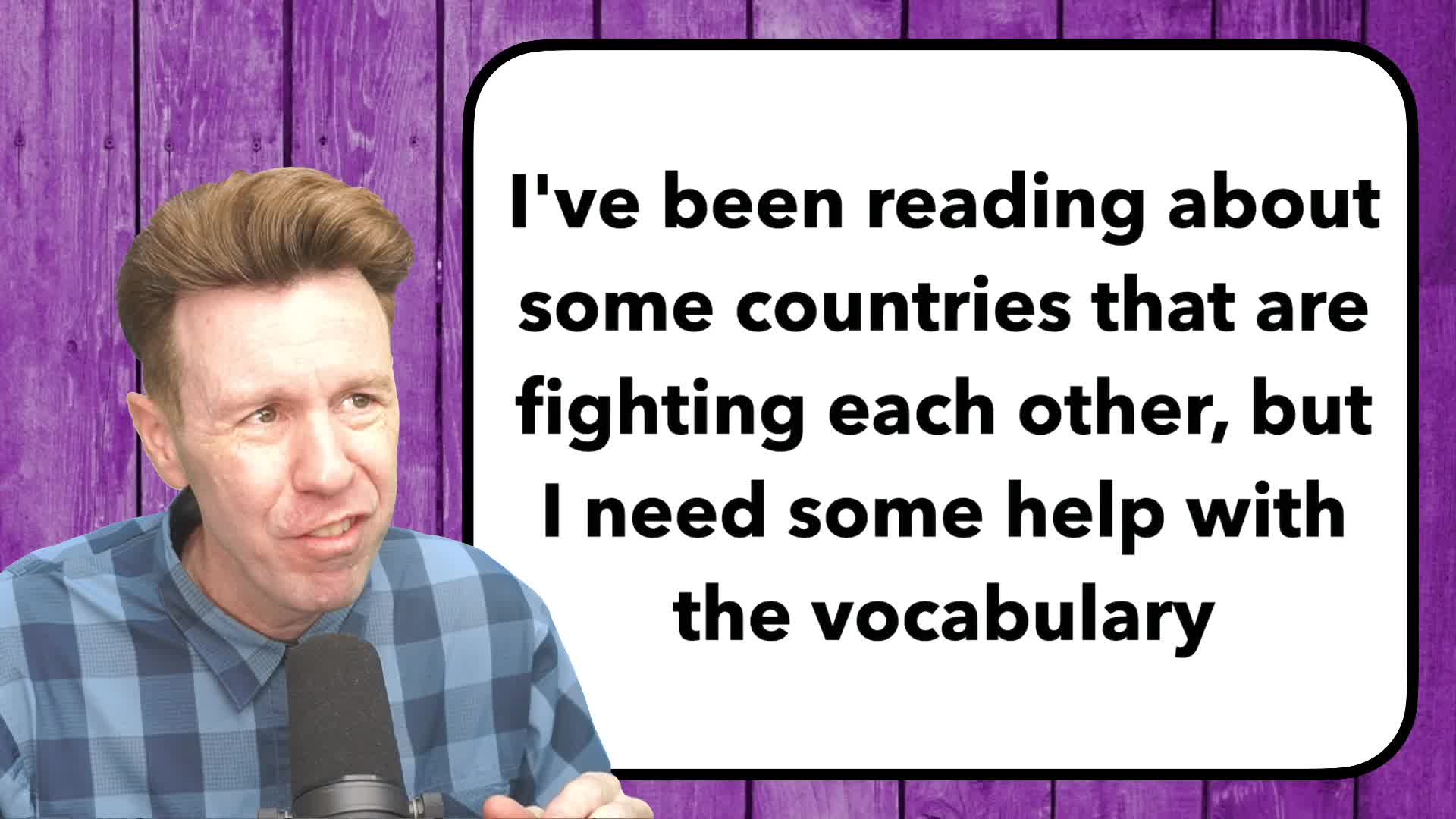
I've been reading about some countries that are fighting each other.
But I need some help with the vocabulary.
All right, I'm going to say that again.
Feel free to join me if you wish.
I've been reading about some countries that are fighting each other.
But I need some help with the vocabulary.
And, well, frankly... how to talk about it casually with someone.
And well, frankly, frankly speaking, I need to know how to talk about it casually with someone.
When I pause, I'm waiting for you to repeat if you like.
All right.
That's a loaded topic.
A loaded topic.
Now, loaded means tricky.
Charged, sensitive, delicate.
It's a sensitive topic.
It's a delicate topic.
It's difficult to deal with.
If someone asks you a question that maybe you don't want to deal with it, you don't want to answer it, you can say well, that's a loaded question.
That's a loaded question.
In this situation, that's a loaded topic.
That's a loaded topic, but also great for learning advanced vocabulary.
Don't you think?
Yeah.
That's a loaded topic, but also great for learning advanced vocabulary.
Plus, understanding global issues is always a win.
A win.
It's a positive thing.
It's good.
Plus, understanding global issues is always a win.
So, from what I understand, the conflict is all about political and ideological differences.
Political and ideological differences.
Ideological.
Ideological differences.
Ideological.
Ideological differences.
So from what I understand, the conflict is all about political and ideological differences.
But man, I get confused when I hear terms like ideological intentions.
But man.
So that's showing frustration, right?
But man, I get confused when I hear terms like ideological intentions.
Can you break those down for me?
Okay, so today's text is a conversation between two people.
We're not focusing on the conversational aspect.
We're going to focus on just what the text says.
Sure thing.
So ideological basically means a set of beliefs or ideas.
A set of beliefs or ideas forms your ideology.
So your ideology is formed by your beliefs and ideas, right?
Sure thing.
So ideological basically means a set of beliefs or ideas.
A set of beliefs or ideas forms your ideology.
For example, one country has a different ideology compared to the other.
They have ideological differences.
I'm going to say that again.
For example, one country has a different ideology compared to the other.
They have ideological differences.
I stumbled.
Oh, well, I'm going to make mistakes throughout this lesson.
You'll see.
I promise I will not disappoint you.
All right.
Perhaps one nation is very religious and it's ideal ideologies clash with a neighboring country.
In that situation, tensions might arise.
Sound familiar?
I think it sounds familiar.
Perhaps one nation is very religious and its ideologies clash with a neighboring country.
In that situation, tensions might rise.
Tensions are just like stress between them, right?
Is that what you're talking about?
Tensions are just like stress between them, right?
Kind of like when two people don't get along?
Is that what it's like?
Is it like when, is it kind of like when two people don't get along?
When there's tension, it's like there's always a chance for things to blow up.
Blow up in this situation is an outburst of anger.
Rah!
Or literally blow up, huh?
When there's tension, it's like there's always a chance for things to blow up.
You can use that word even in everyday situations like there's tension between Kim and her boss because they don't see eye to eye.
They don't see eye to eye.
They don't agree with each other on something.
If you don't agree with someone on something, you don't see eye to eye.
Let's look at that example sentence again.
There's tension between Kim and her boss because they don't see eye to eye.
Okay, so what if one country doesn't recognize the other?
As a legitimate state.
What exactly does that mean?
What exactly does that mean, a legitimate state?
They don't recognize the other as a legitimate state?
What exactly does that mean?
Legitimate is another one of those words that trips me up.
It trips me up.
What trips me up?
It confuses me.
It's like you trip and you fall down.
Legitimate is another one of those words that trips me up.
I think it just means valid, right?
Okay, here's a point I want to make right here.
If you're, If you're giving a definition of a word, you want to pause and then emphasize the definition.
So I think it just means, and you want to pause right there for a second and then emphasize valid.
I think it just means valid, right?
One more time.
I think it just means valid, right?
You try.
Valid.
Legitimate.
Yeah, pretty much.
Pretty much it means valid.
Legitimate means something is legal or official.
Like a company is legitimate.
Meaning it's not shady and it follows the laws.
That means it's legitimate.
In this context, one country doesn't see the other as a legitimate country, which causes a whole lot of drama, right?
Causes a whole lot of drama, whole lotta, lotta, lot of, lotta, a whole lot of drama.
In this context, one country doesn't see the other as a legitimate country, which causes a whole lot of drama.
I also came across the word friction.
Is that just like a fancy way to say conflict?
I also came across the word friction.
Is that just a fancy way to say conflict?
Pretty much.
Friction is like a low key conflict.
A low key conflict.
What's low key?
Low key means not so intensive.
It's a modest or restrained conflict.
Pretty much, friction is like a low-key conflict.
Low-key means not so intensive.
It's a modest or restrained conflict.
Something that's kind of simmering under the surface.
You know, simmering.
Simmering is like boiling water.
Water that's boiling just a little bit.
It's like a negative emotion or a disagreement is growing slowly, simmering under the surface.
Something that's kind of simmering under the surface.
You know, when you feel like there's a bit of awkwardness or disagreement, but no one's saying anything.
That's friction.
So there's some awkwardness.
It's awkward.
Things don't feel right.
It's awkwardness.
That's describing the feeling in the room, in the air.
Or disagreement, but no one's saying anything.
That's friction.
Sometimes me and my wife, we have friction.
You know, when you feel like there's a bit of awkwardness or disagreement, but no one's saying anything.
That's friction.
Again, you know when you feel like there's a bit of awkwardness or disagreement, but no one's saying anything.
That's friction.
Ah, like when someone's talking during a movie and you feel the tension in the room, but no one says anything.
Ah, like when someone's talking during a movie and you feel the tension in the room, but no one says anything.
Exactly.
You nailed it.
You nailed it.
That's it.
Okay, so moving on.
Let's say that one country is concerned about the other's nuclear program.
Oh no, now we're getting serious.
Okay, so moving on.
Let's say, hypothetically...
Let's say that one country is concerned about the other's nuclear program.
I don't even know if I say it correctly all the time.
Nuclear, nuclear, nuclear, nuclear program.
Nuclear, nuclear, nuclear program.
There we go.
I know that... Oh, wait, what's going on?
Let's go back.
Let me say this again.
Okay, so moving on.
Let's say that one country is concerned about the other's nuclear program.
I know that concerned is just another way to say worried or anxious.
But how would you use it casually?
How would you use concerned casually?
You can use it like, I'm concerned about this project deadline.
It's a little more formal than worried, but totally common.
Okay, I'm going to say it again.
You can use it like I'm concerned about this project deadline.
It's a little more formal than worried, but totally common.
So I could say I'm concerned about my English speaking skills.
I could say that, right?
Well, yes, you could.
You could say that.
But honestly, your English is solid.
No need to be concerned.
Your English is solid.
I mean, it's very good.
It's very solid.
Your English is solid.
No need to be concerned.
Let's see.
What else have I been reading about the conflict?
What else have I been reading about the conflict?
I read that both countries are trying to assert their power in the region.
What's assert all about?
Okay, I'm going to say that again.
I read that both countries are trying to assert their power in the region.
What's assert all about?
To assert just means to declare something confidently or push something forward.
To assert just means to declare something confidently or push something forward.
If you're asserting your authority you're showing people you're in charge here.
If you're asserting your authority, you're showing people, you're in charge here.
Countries assert their power by flexing their military or making alliances with other countries.
Countries assert their power by flexing their military or making alliances with other countries.
Flexing their military is when a country publicly uses military power to intimidate an enemy.
That's flexing their military.
All right.
Okay, that makes sense.
So I could say something like, she asserts her opinion in meetings.
Yeah, you could say that.
Yeah, that's a good way to use it.
It's when someone doesn't hold back and just says what's on their mind.
So it's when someone doesn't hold back.
They just say what's on their mind.
I changed up the tense there, didn't I?
Yeah, that's a good way to use it.
It's when someone doesn't hold back and just says what's on their mind.
One final word.
Ambitions.
I get what it means.
I understand the word.
I get what it means.
But how do I use it without sounding too formal?
Ambitions can sound a bit formal, but you can use it casually too.
It's just a strong desire to achieve something.
So you could say he's got big ambitions to become a CEO.
Or even more casually, my ambition is to travel the world.
It's all about context.
It's all about context.
I'm gonna take a sip.
I'm going to take a sip of liquid.
All right, here we go.
Nice.
Well, I've got ambitions to become fluent in English and watch movies without subtitles.
Do you have that ambition?
Do you have this ambition here?
He said, nice.
Well, I've got ambitions to become fluent in English and watch movies without subtitles.
Ooh, that's difficult.
That is so difficult because it's not just about being fluent in English.
No, no.
You have to be culturally fluent.
You have to know pop culture.
You have to know...
There's so much involved in understanding a movie's... You know, the words in a movie.
It's not just typical English.
Sometimes.
Sometimes it is.
It depends on the movie, right?
All right.
That's a solid ambition.
You're on your way for sure.
You're on your way for sure.
You'll soon be flexing your English skills for all to see.
All right, that's a solid ambition.
It's a good ambition.
You're on your way.
You are making progress towards that goal for sure.
For sure you are.
You're doing wonderful.
You'll soon be flexing your English skills for all to see.
All right, I'm going to say that one more time.
That's a solid ambition.
You're on your way for sure.
You'll soon be flexing your English skills for all to see.
All right.
Hey, guess what?
That was the text.
And now we are going to do a shadowing part.
It's a long text, so I'm just going to read it.
And you can try to read along and say it out loud if you can.
Match my pace.
Let's do it.
Here we go.
I've been reading about some countries that are fighting each other, but I need some help with the vocabulary.
And well frankly, how to talk about it casually with someone.
That's a loaded topic, but also great for learning advanced vocabulary.
Plus, understanding global issues is always a win.
So, from what I understand, The conflict is all about political and ideological differences.
But man, I get confused when I hear terms like ideological and tensions.
Can you break those down for me?
Sure thing.
So, ideological basically means a set of beliefs or ideas.
A set of beliefs or ideas forms your ideology.
For example, one country has a different ideology compared to the other.
They have ideological differences.
Perhaps one nation is very religious and its ideologies clash with a neighboring country.
In that situation, tensions might rise.
Tensions are just like stress between them, right?
Kind of like when two people don't get along.
When there's tension, it's like there's always a chance for things to blow up.
You can use the word in everyday situations like...
There's tension between Kim and her boss because they don't see eye to eye.
Okay, so what if one country doesn't recognize the other as a legitimate state?
What exactly does that mean?
Legitimate is another one of those words that trips me up.
I think it just means valid, right?
Yeah, pretty much.
Legitimate means something is legal or official.
Like a company is legitimate, meaning it's not shady and it follows the laws.
In this context, one country doesn't see the other as a legitimate country, which causes a whole lot of drama.
I also came across the word friction.
Is that just like a fancy way to say conflict?
Pretty much.
Friction is like a low key conflict.
Low key means not so intensive.
It's a modest or restrained conflict.
Something that's kind of simmering under the surface.
You know, when you feel like there's a bit of awkwardness or disagreement, but no one's saying anything.
That's friction.
Ah, like when someone's talking during a movie and you feel the tension in the room, but no one says anything.
Exactly.
You nailed it.
Okay, so moving on, let's say that one country is concerned about the other's nuclear program.
I know that concerned is just another way to say worried or anxious, but how would you use it casually?
You can use it like, I'm concerned about this project deadline.
It's a little more formal than worried, but totally common.
So I could say I'm concerned about my English speaking skills.
Yes, you could.
But honestly, your English is solid.
No need to be concerned.
Let's see.
What else have I been reading about the conflict?
I read that both countries are trying to assert their power in the region.
What's assert all about?
To assert just means to declare something confidently or push something forward.
If you're asserting your authority, you're showing people you're in charge here.
I'm in charge here.
Countries assert their power by flexing their military or making alliances with other countries.
Flexing their military is when a country publicly uses military power to intimidate an enemy.
Okay, that makes sense.
So I could say something like, she asserts her opinion in meetings.
Yeah, that's a good way to use it.
It's when someone doesn't hold back or just says what's on their mind.
One final word, ambitions.
I get what it means, but how do I use it without sounding too formal?
Ambitions can sound a bit formal, but you can use it casually too.
It's just a strong desire to achieve something.
So you could say, he's got big ambitions to become a CEO.
Or even more casually, my ambition is to travel the world.
It's all about context.
Nice.
Well, I've got ambitions to become fluent in English and watch movies without subtitles.
That's a solid ambition.
You're on your way for sure.
You'll soon be flexing your English skills for all to see.
One more time.
That's a solid ambition.
You're on your way for sure.
You'll soon be flexing your English skills for all to see.
Boom.
Good workout.
Way to go.
Keep moving forward.
One step at a time.
Get all the steps at EnglishCoachChad.com and I will see you in the next step.