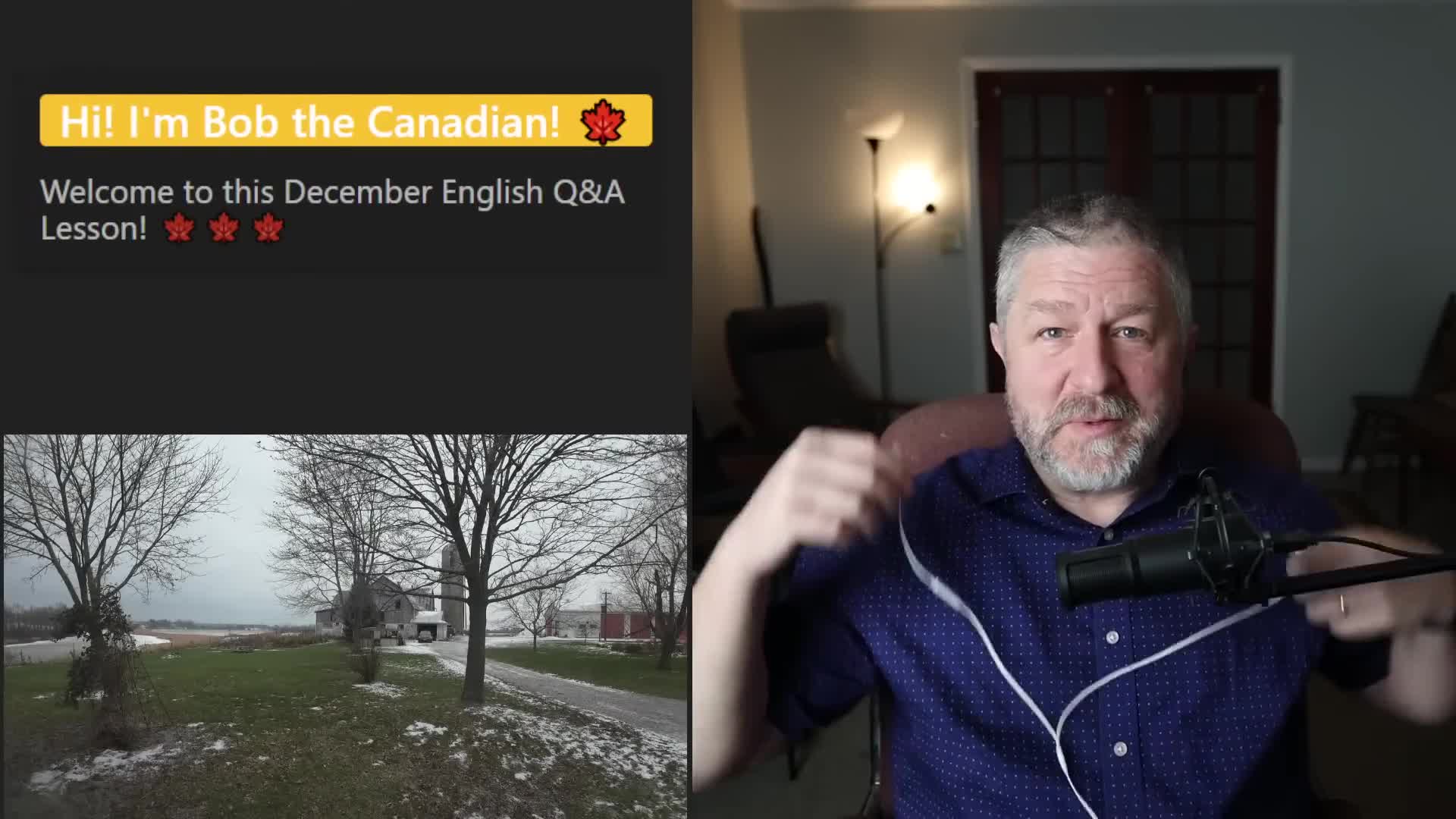
I believe I have done everything correctly and a live stream should be starting on your screens.
I'm pretty sure I've done what I'm supposed to do and I hope everything on my end continues to work.
I hope, if I go on outdoors, you can see what's happening out there and let's let's talk about the English language for about an hour.
Maybe more depending on how I'm feeling.
I'm feeling pretty energetic this morning, and So we might be here for 55 minutes, or it might be an hour and 10 minutes.
I'm not sure.
However long it takes for me to answer all the questions.
In the chat says, know that.
So, no glow up Bob today.
Yesterday the sun was shining in from the window all the way over in my kitchen and someday, when my house is cleaner, I'll actually show you the inside of my house.
Um and then it was making me glow yesterday.
So it was kind of a strange kind of a strange look but no.
If you look outside today let's go to the outdoor section here.
You might think this is a picture.
It is not.
It is a live video feed.
If you look at the plant right above my head I
Um you can see it's moving slightly but this is what our place looks like on December sixth 2025.
I think it's about zero degrees.
Let me just check for a sec what the actual temperature is.
Oh it says it's one degrees.
One degree.
Sorry.
It says it's one degree outside.
So yes, yesterday sunny, today cooler overcast, and you can't quite see it, but it is snowing slightly and it's going to be about one or two degrees today and it's going to snow a little bit here and there.
I'll keep this up on the screen here.
You might even see Jen go to the barn to feed the goats with the dogs.
We'll see.
Uh in the chat Mr. Fisheri says overcast indeed.
Yes Hafiz.
This is the uh definition of an overcast day if you see it.
Um Freddie Wolf says the sunset is 30 minutes away way too early.
Yes, the days are definitely short for those of us in the northern hemisphere right now.
What are we doing here?
Well, this is an English lesson where, if you ask questions using the link in the description below or the link pinned in the chat, wherever your chat is about the English language I try my best to the next hour to answer about 30 to 60 questions about English, about me, about Canada, whatever you want to learn about.
Um and you'll sorry, I'm just giggling cuz I saw no that's comment in the chat.
Um know that the ground froze and we don't have our sticks in yet.
So, know that says you haven't stuck your sticks into your lawn yet if I saw correctly.
Um Yes.
So normally along our driveway we put in little orange poles so we know, when it's snowy, where where we can drive and where we can't drive and the ground froze on us.
So you can't put them in frozen ground.
So we're hoping that at some point.
Let me just check something again.
We're hoping that at some point the ground thaws again before before it's too late.
Um okay.
So what is the plan here?
There is a form I mentioned.
Please use that to ask your questions.
Please use the chat to have fun English conversations with each other.
Just enjoy your time together and I will see how many questions we have.
Oh there's already 10.
I should probably I should probably get going.
So here we go.
First question on the screen from know that.
Oh and I should have a sip of water.
Hello Bob.
Is there a difference between the phrases to know one's way around something and to know something like the back of one's hand, or do they have a similar meaning?
Thanks Bob.
They definitely do.
So my brother is a mechanic.
He knows his way around a car.
He knows a car engine like the back of his hand.
Think the second phrase might show more familiarity.
Like it might be a stronger like because it implies that you have something memorized right?
Um when you know how to drive from your house to work you know the route like the back of your hand.
So that does have a slight variation there.
I wouldn't use the first phrase for that.
You could say he knows his way around town.
He knows his way around the city of Toronto.
But He knows the city of Toronto like the back of his hand.
So, those would be two examples where they mean the same thing.
So I know I kinda explain it one way and then the other, but I hope that makes a little bit of sense for you.
Brent says, driving around and listening to the lesson.
Hope everyone is doing well.
Good to see you, Brent.
Uh American English Brent is in the chat.
If you wanna say hi to him, another YouTube English teacher who is happy, as always, to help you out um, with videos uh, to help you learn English.
So, uh let's see what the next question is from Yuri.
Bob which is correct.
No one should or can walk on the grass in that park.
So if it is a law, if there's a sign, you would say no one should walk on the grass in that park or people should not walk on the grass in that park.
Or, more precisely, you would say you are not allowed to walk on the grass.
You say no one can walk on the grass.
To me that means they're not able to like, maybe it's slippery or maybe it's a really steep hill and if you walk on the grass you fall.
But but it does also imply that you're prohibited or not allowed to right.
Like, no one can go in the gym today because there is a tournament from another.
There's other schools here for a tournament, so no one can go in the gym.
Yeah, as I'm saying it, I'm thinking I'm changing my answer a little bit.
They are interchangeable in some ways.
Like no one should drive over the speed limit is different than saying no one can drive over the speed limit.
Okay?
So let me explain that one.
I think we had a dog go by there and we missed it.
Let me explain that one for a moment.
No one should drive over the speed limit implies that no one should decide to do that.
When you say no one can drive over the speed limit, it means the road's really rough.
You're not able to do it.
So I hope I explained that well, because it's a little bit it's.
There's some subtleties there, for sure on that one.
Um Judith.
Hi Bob.
Christmas time is coming to town.
How how will your live streams be during the holidays?
Thank you.
So I haven't looked at the dates yet.
I likely my thought during the holidays would be I probably won't make a video for Tuesday.
I might even take two Tuesdays off but I think I will still do a live stream.
Live streams for me are pretty, not simple, but it's a.
It's a cozy indoor activity that I can prepare for.
But I have to check the dates.
Let me check the dates here.
And no promises on this people.
I I might change my mind at any point in time.
But for now I'm thinking let's see.
Yeah I might do a live stream on we'll see.
I might do one during the break because I'm not sure if on January 2nd I'll feel like doing a live stream.
But let's see what what the future holds.
But I'm definitely going to have a lighter, lighter schedule because it's just less people watch during the the holidays as well.
Unsel.
Hello Drone Pilot Bob.
How are you doing?
Do you need special licenses or permits to fly drones where you live?
Thanks.
Yes but it depends on the weight.
So we have a drone that is light enough and small enough that we are allowed to fly it on our own property without a license, and there are some restricted areas.
Um like I'm not sure of the laws of flying a drone around people.
Um I certainly wouldn't do anything unsafe but Jen and I need to research that a little bit.
Uh to see what those laws are.
I'm just making sure things are still moving on this camera.
Oh yes.
If you look right there we do still have a little bit of movement. on the camera there.
Um, but yes, if you have a drone, if it's a certain size or bigger, you do need to have a drone license for that.
Uh let me get a okay let me see.
Um, the citizens of the town near you have already put up their sticks, as we know, at least those on the street where you made your Tuesday video a week ago, Bob.
Yes I sometimes it's like the snow removal company.
They sometimes come in and do the sticks because they don't want to accidentally hit things.
Uh hi to Ismail.
Good to see you there.
Uh in the chat.
CSTM is here as well.
Good to see all of you.
This is live by the way.
If you're watching it at 1007 Eastern Standard Time.
Um Mr. Fisheri says I live not that far from the airport so I can't drone here. point.
Ah I think even the drone doesn't work automatically.
Yes you must have geofencing.
Geofencing is when the drone knows where it can go and where it can't go.
Notice I just used can to talk about something being prohibited.
Know that says thanks for answering my form question Bob.
I get it.
Awesome.
From Tina. a driver drives a car.
What verbs can we use with planes, ships, boats, and submarines if we control these things?
So you fly a plane.
So a driver drives a car.
A pilot flies a plane.
Um, I think okay, I I'm not an expert here, but I think you can.
You drive a boat, but I think you might pilot a ship.
I'd have to look that one up and I'm not sure about submarine.
Um sail like you sail a ship.
Right?
The ship is going he the captain's going to sail the ship out of port.
Even if it doesn't have an actual sail.
Uh, you would use that verb as well, but again, I'm not the, I'm the English expert and I probably should know this.
I don't know exactly.
Um from chill and explore with Yoshi.
In this season is it snowing a lot usually? my area usually we start to get some snow.
Like if you look here you can see right beside me.
There's a little bit of snow on the ground.
So it does start to snow a bit.
Um but yeah it can also rain in December.
We've had really warm Decembers before.
So Eva's here.
Eva says, hi, everybody.
I'm watching at 4 PM.
It's already dark in Poland.
Yes, it definitely is the darker time of the year, isn't it?
Okay, from Akil.
How, hi, how are you, sir?
I'm good.
How are you?
What is the difference between loo and toilet?
So in Canada we usually say we need to go to the washroom or the bathroom, and In America you would most likely use bathroom.
I think loo and toilet are more commonly used in the UK, in British English, but in Canada.
If you said either of those, I would understand what you were saying.
If you said, can you tell me where where's the loo or where's where are the toilets?
Um that would I would understand that but we often say washroom in Canada.
Like I have to go to the washroom.
Um where's Joe?
Oh, he's in the washroom right now.
Oh, we have dog activity out there.
Look at them go.
They are excited.
Not sure what they're excited about.
Sometimes the cats are hanging around in front of the barn and uh, they go tearing out there.
And sometimes my son is here and then they go say hi.
So yeah I think Walter is like gone.
Oscar came back.
Oscar is the brown dog.
So I think I'll leave it on this screen while I read the next question.
Let's see here.
Let me pop up the question here for a moment.
Sorry I'm being entertained by the dogs.
What they're actually probably doing is running outside to go to the washroom.
They're probably peeing on things.
So Alessandro.
Hi Bob.
How's it going?
What is the difference between for and since?
Could you please explain it to me?
So this is challenging to explain in a short explanation.
I wasn't trying to hide.
There goes Jen.
Jen actually Jen has a YouTube channel and a company sent her a heated coat. the Aurora Company.
I think it's called ORORO.
Um and she's been wearing it all week to test it out.
So it's a good time of year to have a heated jacket.
Um so here's how I'll explain this okay.
So they sent Jen the coat a week ago.
Jen has had the coat since Friday.
Since a week ago Friday.
Jen has had the coat for eight days.
Now there's a whole bunch of different ways to explain for and since.
Um are you guys with me?
I went right back to answering the question after talking about Jen's coat.
Have been doing YouTube for nine years.
I have been doing YouTube since 2017.
So there's there's a lot more to it. but there are two example sentences for you.
Um I have been doing this lesson for 12 minutes.
I have been doing this lesson since 10 AM.
So another couple of examples there Alessandro, for you to kinda dig into and hopefully figure out the, the nuance between the two.
From Kwan.
Do you have any advice for learning advanced vocabulary in IELTS or IELTS speaking?
There's two things I recommend for people preparing for a test.
Um and both of them will reveal to you that I am a traditional teacher.
One is buy a study pack of some kind.
If you buy an IELTS study pack it will have a lot of vocabulary in it.
It will have ways for you to practice learning that vocabulary.
The second thing I would do is I would find a tutor on a place like Preply.
I think there is a link in the description below to Preply.
Um, and when you go on the website at Preply, find someone where it says specializes in IELTS prep or preparation for IELTS.
Um those two things would help you a lot Kwan.
Both are going to cost you money.
But if you're at the stage of your English learning you where you are taking tests.
You probably are already spending money and investing in your future.
Uh so I highly recommend that you do that.
Number one buy a book or study pack to prepare for the test, and number two find a tutor on a place like Preply in order to have someone who has some experience.
Help you learn about that.
Um let's see here. from.
Is it raining in Canada?
It says in the chat.
No it's snowing a little bit.
You just can't quite see it.
No that says the dogs are super excited as usual.
More so in the winter.
Because I think Jen and I we tend to like.
Jen goes out very early in the morning during the growing season on the farm, but in the winter it's a little later in the morning.
Um from Mahmoud, is it possible to speak totally like a native speaker?
Yes, it is challenging to get to that level.
Um it is possible but I would argue that it's also not necessary.
What I usually recommend is that you become fluent, but then, if you have kind of a residual accent from your native language, do some accent reduction training.
But if your goal is to sound exactly like a native speaker, that can be challenging, like when I speak French.
I speak it fluently, but I you can hear all the hints of that I'm an English speaker and that doesn't mean I can't communicate, okay.
So, it's a good goal but a better goal is fluency.
Goal number two, reduce your accent with a coach.
You can find coaches that help you reduce your accent.
Those are the two.
Um in the chat says, when does it often start snowing in Canada?
Usually around now.
Like November, December.
Uh we could have we could have a snow day.
Um next question is, does mister Bob know about the disaster that has happened in Indonesia?
So, we need to go to the news here.
We need to go to Indonesia and I think I just saw that this morning.
I did not read an article on it yet but there is flooding.
So we're just starting to see that news here an hour ago.
So that's pretty recent news.
Oh my bad.
No.
Three days ago.
So Um yes, that's that is that is difficult.
Deadly floods.
Okay, so thinking about the people in Indonesia right now, that is a pretty catastrophic thing to um to happen.
From Judith.
Hi Bob.
What kind of Christmas market are you going to visit during Christmas?
Thanks.
I'm not sure we're going to.
Usually we go and sell things at a Christmas market but that market isn't happening this year.
So we might go to a Christmas market for fun, but we haven't actually started doing things for fun yet.
We're still today we have to actually deliver wreaths.
Wreaths are like a ring of greenery, like from pine trees and spruce trees that people hang on their door.
Um and that's what we will be doing this afternoon.
We did that last Saturday as well with Jen's sisters, and my brother-in-laws and sister-in-laws came down.
Mode in the chat says, use since to refer to an exact point in the past.
He's been teaching since 2017.
Use four to talk about the length of a period.
He's been teaching for eight years.
Yes, excellent written example.
Uh who was it?
Was it Mahmood that asked that question, or?
I think I might be getting people confused, but if you're still here uh, have a look.
That is a great description of how it works.
Thanks mode for that.
Okay.
Um just making sure I answered the question.
From hi mister Bob how do you ask about someone's size and clothes?
For example, by the way EG, when we read it, we say, for example, it's correct you, everything you've written is correct.
But for example, what size are you in T-shirts?
What size do you wear in shoes?
Thanks so much.
So if I said to someone hey, those are nice shoes, and they said thanks, and I said what size are you?
They know I'm talking about their shoes and then they would say size nine or ten, or if you're in a different country, the number might be different.
Um but if out of the blue, I would say, what size shoe do you wear?
Okay, or what size T-shirt do you wear?
What size um?
Pants are a little different, like in Canada, men's pants have a waist measurement and then a length measurement.
Um so that's what I would say.
Uh what size T-shirt do you wear?
What size shirt do you normally wear?
What size shoes do you wear?
That's a good question.
Um, if you're working in a clothing store and someone comes in and says hey, I'd like to try on t-shirt, you would say oh, what size t-shirt do you wear?
Or what size do you wear?
Um your questions work too like what size are you?
Um but I think the way I'm saying it is probably a bit more common at least where I live.
From Un Sol.
Have you ever dreamed of becoming a real pilot?
Thanks a lot.
I think I mentioned this before.
There were a couple of dreams I had as a child.
There was a time where I really wanted to be a helicopter pilot.
Just making sure the audio's working.
Um there was a TV show called Airwolf.
There's another one called Blue Thunder.
Um and then if you watch Magnum PI was it TJ flew a helicopter.
I just liked helicopters.
It was really cool.
But I also am afraid of heights.
So I don't.
I don't know why as a child I thought that I might want to be a helicopter pilot, when I'm actually afraid of heights.
I don't like being way up in the sky.
Sorry, I'm laughing at Hafiez says wreath Witherspoon LOL.
So a wreath is something that you hang on your door at around Christmas time, and Reese Witherspoon is an actress.
So, he's combining the two which just made me laugh.
Um Let's see here.
Mohim.
Hello, sir.
How is everything going?
Good.
Sir, could you please teach us some verbs about arm wrestling?
I don't know a lot about arm wrestling, although I think there's actually like there's a grip and then you put your like I think, professional arm wrestling.
You actually hold a post and you have an arm wrestling table and then you try to defeat your opponent by yeah, I don't know any special vocabulary.
You try to get their arm down.
That's all I can say.
Uh I used to really enjoy arm wrestling as a teenager.
I was pretty good at it.
My left arm surprisingly was always stronger than my right arm even though I am right handed.
So let's see here.
So that says, if you appear in Jen's videos a few more times, you might also get a heated jacket at some point Bob, even if you probably don't need one.
You know I was thinking about that know that because I
Sometimes, like generally when I'm outside in the cold, I stay warm, naturally if I have a winter coat on.
But I thought sometimes there's days where I'm trying to make an English lesson and I do get cold and I thought a heated jacket might be nice or a heated sweatshirt, or the company has a whole bunch of different types of heated products, so we'll see.
Maybe they're watching right now and they're like hey we better send him one too.
Freddie Wolf says about pants if you say you've got, you've nice pants in a to a British woman, you will get slapped.
Yeah, like talking it's, it's a, it's a delicate concept, complimenting someone on their looks or what they're wearing.
Um, they actually not something.
I do that often if I don't know the person.
Well, I will tell Jen.
I'll say oh, you look good today, that looks good on you.
That's a common way to talk about clothing.
But with colleagues I wouldn't be as complimentary about something like that, because how people look and what people wear can be kind of yeah, more of a private topic here in Canada.
Um let me see next question.
Did not teach any verbs about wrestling.
Uh from Kurdistan.
What is one English phrase that learners often use incorrectly and how can we fix it?
Um.
So job and work get confused sometimes and sometimes.
Okay, the next sentence I say is going to be wrong.
So don't say it.
Um, but you might hear somebody say something like um, let me get this, Let me make the mistake properly.
That's what I've tried to do.
Um I want to thank you for your job.
So don't don't say that.
If you watch one of my videos and you like it, you would say, I want to thank you for your work.
I want to thank you for your hard work.
But when you say to someone, I want to thank you for your job, that is incorrect and I hear that quite a bit.
So again, don't say that.
It's I want to um really like the work you've done.
That you can say that.
I really like the job you've done.
You can say that but you can't say I want to thank you for your job.
It just doesn't sound right in my ear.
Um okay.
Next question.
Ali.
Hi Ali.
Sorry I slurped a bit there everybody.
Would you please explain a bit about pop in pop out.
Thanks.
So, uh oh, know that.
Thank you very much for uh generously giving memberships to that's awesome.
Thank you very much.
Uh, I will uh do the same in a bit, but I'm not doing five, but know that I very much appreciate that and all of those people are just got memberships.
If you go to the posts section of my YouTube channel you will now see all of the members posts.
Um very good.
Very very much appreciate that.
Know that.
That's awesome of you.
Um okay.
If I am in my house or if I am at work in the building and I can leave the building to go get something and I can use pop out to describe that.
I can say this.
I forgot my lunch today.
I'm just gonna pop out and go to town, or I'm just gonna pop out and go to a restaurant to buy some food.
We can also use it the other way to talk about visiting someone.
Later today, I will be in the town where my mom lives and I might pop in to visit her.
Okay.
So if you're at work or even at home like oh, I might pop out and go get some groceries later.
It means I'm going to leave my house and I might pop in to my mom's place later today to have a cup of tea.
Chill and Explore says have you ever played rugby before?
Uh like yes but not according to the official rules.
A couple months ago Canadian rugby team came to Japan.
In addition to this women rugby in Canada is so strong did you know that?
I did know that.
We have a very good rugby program here in Canada.
Oh and Mode saying Freddie's joke was about the fact that they're called trousers in Britain.
Ah yes and pants refers to Undergarments, underpants.
Um okay, let me get back to the actual questions.
Where are we at?
Well, we're 25 minutes in.
That's pretty good.
Christian, what new phrases will you teach us from your shorts channel?
So, believe it or not, Bob the Canadian doesn't make shorts.
I don't make short one minute or less videos.
I haven't really gotten into that.
I did used to have, and I still do have, a channel where I teach in a shorter format, about four minutes long.
I will need to put a video out on that channel once this month or next month because if you don't do that, eventually YouTube they don't shut the channel down, but they see it as not being alive.
But I actually reduced the amount of lessons I made in September.
So I will not be teaching any phrases on my shorts channel.
Sorry.
Let's see.
Says hi Bob, you speak so clearly and slowly.
I can understand most of that.
You think I can understand people who speak very fast, and how to remember low frequency vocabulary.
It's always forgotten, so one of the things is is most people here have gotten used to my voice.
They have listened to me over and over again, and when you listen to the same person, it becomes easier to understand that person.
So If I was to speak really quickly right now though, some of you would have a hard time understanding what I'm saying.
This is my normal speed right now.
Okay so I should uh should I switch this?
Did it just freeze?
Let's see.
Oh no.
Privacy.
Privacy for the dog.
Sorry.
Uh there's a dog outside.
In English we might say doing his business.
That was what we were just witnessing there.
I think he's now run away.
I'll need to go uh clean that up later.
It's easier to clean up dog poop in the winter by the way because it freezes.
Too much information.
We have a phrase in English.
Too much information and we use it when someone talks about something that you just don't want to hear about.
So, anyways, where was I looking here?
Oh, yes.
So, right there, I was almost speaking normal speed for a while.
So, hopefully, that was understandable for all of you.
Um next question from Moroccan Bee.
Hello Bob.
So going to be some lessons about holidays and Christmas.
I really I'm putting a space in there.
I really like cozy Christmas related videos and I hope you can make a lesson about it.
So a little fix there.
I hope you can make a lesson about it.
Um probably not.
I, I'm not Um.
I've done a few Christmas English lessons um, but this year I don't think there's anything new to teach.
So I will just let you search for and watch some of my older uh English videos.
So From Natalia.
Ooh, the questions are stacking up and I gotta go to members only mode in a bit.
Natalia, hi.
He was known to devour up to 18 scoops of ice cream after lunch.
Number one, what exactly does it mean to devour?
It means to eat something rapidly similar to how an animal would eat something.
So it?
It simply means to eat, but like devouring.
Um, if you can imagine, when we give Walter his dog food, he will devour it.
Like he'll eat it in less than a minute.
So, it means to eat really fast.
Um and then two, how much ice cream is in one scoop?
Thanks.
I don't know.
One scoop it's like two scoops of ice cream would fit in my hand.
That's how I would say it.
Um and it's usually like here's my lens cap.
I don't know if this helped.
Um a scoop of ice cream is smaller than that.
Um it's probably I don't have any I don't have any scoops of ice cream around to show you.
It's very tiny.
It's like it would fit in my hand if I put my hands like that. scoop of ice cream.
So let's go to outdoors and let me go to members only chat.
Uh let me get that set up for a second here and uh for everyone who is not a member don't worry.
We will go back to non-member chat in just a bit, but this is a time where members uh are free to ask questions directly in the chat.
And if you are interested in becoming a member, there is a link in the description below that explains more of that.
I'm also at this time going I'm losing track of which screen I'm on.
Here's the right screen.
I'm also going to buy a membership.
I'm going to do a gift a membership to one person.
Let me get that fired up and click the right buttons.
Will have already seen this in the chat already, because this I'm pretty sure the gifting happens.
And it's not delayed and I think oh that was good timing.
We got to see Jen coming back in from the barn.
So so Chang Learning English has gotten a gift membership.
If you go to my YouTube channel and go to the posts tab you will see all of the members posts.
And now.
Okay, so I'm going to do one question from the queue and then I'm going to move to members chat in just a bit.
I see no that has a question there.
That's cool.
Maxime has a question here.
Hello mister Bob.
Does your family have any special customs or traditions associated with celebrating Christmas?
Yes to a degree.
Like we have a Christmas tree.
We give gifts.
We have Christmas dinner with our own kids.
We go and have Christmas dinner with my brothers and sisters and my mom.
We go and have Christmas dinner with Jen's family.
That's probably the extent of it. basically we eat too much and we also don't work.
So generally people have the day before Christmas off, Christmas day off, Boxing Day is the day after and they usually get New Year's Eve day and New Year's Day off.
So usually most people get five holidays during the Christmas.
Um so that's that's how I would describe traditions at Christmas.
And if there's snow we are outside a lot.
Because we like to toboggan and do other things.
Although our kids are pretty old now.
Um from the chat here we go back up to no that's question.
Hey Bob what are you up to today or tomorrow?
Do you have anything special planned?
Thanks in advance.
Nothing special really.
We are delivering wreaths today.
There is a parade.
There is a Christmas parade tonight.
Um in not our local town but a couple towns over.
We might go. don't know.
I haven't I don't actually feel like going to a parade.
I think when our kids were little we would go to parades.
Um a lot and I'm not sure I feel like standing there and getting cold.
Although there's a really good pizza place where we usually stand.
So maybe.
We'll see.
Um again I'm answering questions from the chat right now if people are wondering.
Uh thank you know that for that question.
Mode says member for 55 months.
That is a long time mode.
That is a that is very cool.
Uh never take these Q and A streams for granted.
Give a thumbs up.
Yes, because at some point in my life I might stop doing them.
But, as many of you know, I have promised that I'm definitely doing YouTube for two or three more years.
I don't know at what point this will become boring for me but right now, I still really like it.
So, when I like it, I'm going to keep doing it.
So, I wanna check something here.
My stream.
Oh, it is working.
It's uh I just had to click there.
It was like low quality on my screen but I think it's better now.
Um Mr. Fisheri says, hope the dog has washed his paws.
Yeah.
No dogs allowed in the house after that. that says Bob.
Has Jen crossed everything off her fall list in the meantime, or does she still have some tasks left to tackle?
So one of the annoying parts of running a business is the paperwork.
Like you have to send out invoices and collect money and report to the government how much money you've earned and pay your taxes.
We have we have to do all that yet for the farm.
It is one of our least favorite things to do.
In terms of outdoor work um she's usually outside an hour to a day.
Um, if you watch her video from this past week, there are still tasks to do, but um, by mid January she'll be um, have a very light work schedule outside, but a pretty heavy work schedule inside.
Wolf says Bob, have you ever heard of the Global Giving Tuesday campaign, created in the US in 2012 following the days of intense consumerism like Thanksgiving, Black Friday and Cyber?
I have not heard of that but that would be a good idea.
Um, one place in particular that always needs donations at this time of year would be your local food banks, if you have a food bank, and A food bank is a place where people who uh, don't have enough money to buy good groceries every week to buy food.
They can go and get free food.
Uh so Jen and I usually donate to our local food bank at this time of year.
Um but that would be good to do on Giving Tuesday.
Uh Hafiez says, do you watch Pluribus, Bob?
Yes, I do.
Um Carol is the main character.
New show by creator of Breaking Bad.
Pretty good but a slow burn type show.
Also still up to date with Blue Light season three.
Yep, done Blue Light season three.
Um and watching every episode of Pluribus as soon as it comes out.
Um also, what else did I finish watching?
I watched a show called Trigger Point.
Um also takes place in the UK.
It actually has the same actress as Line of Duty.
I'm getting too deep into British police dramas but yes I am watching Pluribus.
And I think I'm saying it right.
Pluribus.
Mode says thanks for answering my question earlier Mr. Bob.
So if I understood correctly it should be what size t-shirt are you?
Yes.
What size t-shirt are you? you were selling T-shirts and someone said I'll take the black one.
You would say what size are you?
What size T-shirt are you?
What size T-shirt do you wear?
Know that.
Could you explain the meaning of the expression to look charged up about something Bob?
And give some examples of how to use it.
A heartfelt thank you.
I think that is a British phrase. assuming it means to be charged up about something.
And I think we might say to be hyped about something.
To be charged up means to be very excited, enthusiastic, energized, or passionate.
Um honestly, haven't really heard the phrase here in Canada or North America.
We would probably say he's really hyped for the soccer game.
He's really hyped for the football game.
He's really hyped because he's going to see Ed Sheeran in concert.
Um Um so there you go.
Chill and Explore says for better communication with English speakers I need to learn slang.
You need to understand slang.
But if you are using English at a place of work, you'll probably hear more idioms, contractions and reductions than slang.
But yes, you do.
You do need to know some slang to understand it.
You don't have to be able to use it.
But you do need to know a little bit.
Um Tommy says when do little fix there.
When do you usually set up the Christmas tree?
Uh usually the end of November beginning of December.
Ours is up.
It's been up for two weeks now actually.
Freddie says, Bob, Jen did her last video with her funny sisters.
That was amazing.
So, what about Bob doing his one day with his funny siblings?
It would be really really nice.
I will try and convince one of my siblings to go on camera but not everyone likes being on camera.
Uh Mr. Fisher, he says, what's your Spotify rap looking like?
I don't use Spotify.
I use Google Music.
If you use Spotify that is.
YouTube is going to do the same thing called YouTube recap.
They abolish YouTube rewind.
Yes.
And at noon says hello everyone.
Hello at noon.
Uh yeah I don't use Spotify.
Um we have um I think because I have YouTube I have YouTube music.
I'm it just was simple to have everything in one area.
One place.
Let me just check to make sure I got all of these.
Yep.
Mr. Yep.
Yep.
Expression.
If I missed it, just yell at me in the chat.
Um and then I'm just going to pull up um some questions from uh Here, let's just make sure.
Let me check.
Yep, it's still moving.
Do you think I should learn English slangs?
You should understand some English slang.
This must be the same person or people are on the same wavelength.
They're thinking the same thought.
So, yeah, you should under know how to understand some slang.
You don't have to know how to use it.
Alessandro.
Could you explain it to me?
How must I use it?
Please.
I'm not sure what I'm explaining Alessandro.
Um so you can submit more than one question now.
Maybe resubmit and let me know what you want me to explain.
Um Mode says, I haven't heard that phrase either.
Similar phrases I heard that mean excited are pumped, stoked, or fired up.
Yes.
Yeah.
Those are definitely used in North America.
Know that.
I stumbled across it in the book Sphere and made a note.
Thanks for the explanation, Bob.
Yeah.
And it might just be a literary choice.
Um like maybe the author in that book Oh, are you talking about the Michael?
Are you talking about the Michael Crichton book?
So yeah, it might even be that it's a phrase that was used in the past and isn't really used much anymore.
Um anyways, um where am I?
Hafia says, same wavelength, one hive mind, a pluribus reference.
Yes.
Uh vibing together.
Um okay, questions.
From Quan.
I'm from Vietnam and work in the tourism industry.
Just wondering do you have the any plans to come to Vietnam in the future?
So I did a few little fixes in there Quan as I read it.
Let me read it again.
I'm from Vietnam and work in the tourism industry.
I'm just wondering do you have any plans to come to Vietnam in the future?
Maybe someday Jen and I are at the stage now where we are still parents of children.
They are getting older.
They and we don't have a lot of time to travel, but in the future we may decide to, but when we do, we will most likely visit France and the Netherlands first.
Um and then after that a few other ones.
Mode says have a sit Mr. Bob.
What size are you by the way?
If you don't mind sharing.
That's a funny question.
Funny to me.
I am a large actually more like like right between medium and large.
So sometimes I will buy a large shirt and it will be too big.
And sometimes I will buy a medium and it'll be a little bit too tight.
Um so I'm somewhere right in the middle.
These shirts are large.
Um but I feel like they're large but they're a little bit small.
So they fit nicely.
Like it feels it's a nice shirt.
Um to wear.
And Freddie Wolf has sent a membership.
Thank you Freddie to Bike Lee.
So very cool.
If you go to the posts section of the YouTube channel you will see all of the member posts now.
I know that says yes Bob that's the book I meant.
I think I've read that book.
If I haven't I should read it again.
Um mister Sherry says shirt or shoe.
I wear size nine and a half shoes.
I
That's the North American sizing.
I'm not sure what that is in the other sizes that we use in the world.
Okay, I know it's still members only chat.
I will turn that off in a moment.
Unsel, are you interested in researching education systems around the world?
Which one impresses you the most things?
I think a lot of different countries have different education systems and have some parts that are really cool.
The Scandinavian countries have pretty good education systems, like countries like Finland and Norway and Denmark.
Um, I think I would be interested probably in seeing some of what people do for outdoor education in some countries.
Um, but uh yeah, if you're asking, should I go back to school and do a degree in international educational studies and travel the world and look at different schools?
That that would be fun.
I then I would know how to answer your question.
Uh okay I'm gonna turn off members only chat.
Give me a minute here to do that.
I'm way faster at doing that now.
I'm also going to just take a peek here at any questions that are left.
Mode says and also I think pant measurements are the same all over the world.
Waist and length and fit.
Um Yeah, I think I'm a 32 waist, sometimes 34 inches and then a 32 length.
So, I'm a pretty standard shaped person.
This is a good way to describe it.
I'm 5'10".
I'm when I'm in good shape, I'm 190 pounds and there's nothing unique about me.
I'm just an average looking North American person.
If you ever met me on the street and Um no, that says I finished the book a few weeks ago and now I'm reading Dune.
If you're reading Dune for the first time I hope you're really really enjoying it.
Um I usually read Dune and the Dune series like I think I've read Dune three times now.
Um and then the later books that were written by his son and Kevin J Anderson.
I like those a lot as well.
Um Okay, let me see here.
I turned off members only chat.
Yes, I did.
And I'm going to answer a few more questions.
Here we go.
Um getting distracted by the chat.
Uh hello mister Bob.
Merry Christmas.
In your opinion, what is the best way to overcome laziness in learning English?
So, it depends on where you are at.
Um, if you were studying and you just haven't studied for a while, I always say start listening to English music.
Some really good English songs.
For me that would really energize me and get me pumped again.
It would get me stoked.
It would get me fired up for learning English again.
Um it would make me really enjoy doing it.
So to me that's my solution usually.
Um when I'm lazy with my keeping up with my French I usually listen to some new French music.
Um that helps me quite a bit.
Um Um let's see here.
So Harry how can we level up our English from B2 to C1?
So here's what I always say and this is my opinion.
I think the only real way to do this is to live in an English speaking country to hire a tutor that will help you transition from B2 to C1.
I think it's very I think you can learn English on your own up to the B1 or B2 level.
I think you can do a really good job using the internet to get to those levels, but when you get to the B1, B2 and certainly the C1, you need a tutor or you need to live in that country.
Um and mean it's not a hard and fast rule.
You could get to see one on your own.
Um but certainly having a tutor from a place like Preply there is a link in the description below.
Um to Preply that would help you enormously to get to that level.
And you could find someone who specializes in in those types of lessons.
That so that's my recommendation.
Um see here.
What does a stray kid mean?
So we usually only use the word the verbs the word stray.
Sorry something can stray.
Like the goat tends to stray away and you can also have a stray goat or a stray dog.
Uh we don't usually use this for people.
So if I read this sentence I would think a farmer is a young goat that has wandered away.
It's outside of the field.
If I saw a dog when I was out for my walk and there were no houses nearby, I would call it a stray dog.
So it's a dog that is somewhere in the wilderness.
Samuditha.
I intend to pursue my higher education in English but I'm not perfect at it yet.
You will get there.
That is a really good motivator.
If your goal is to actually go and learn something at an English speaking school, I think that will certainly light a fire under you.
We sometimes say in English.
Um to help you well.
Judith says, hi, Bob.
What kind of present are you getting for your family?
I can't say that here.
They will hear me.
If it is not a top secret information, thank you.
Have a great month.
Yes, it is definitely top secret for sure.
Um let's see.
Let's uh know the natural way to ask it.
Recently, I started learning Norwegian.
It's similar to English.
I guess what do you think?
It's good for my English vocab.
Possibly.
I don't know anything uh chill and explore about Norwegian.
Um Astri.
Hi, Bob.
What accents you use now?
Is it British or American?
This is a North American accent.
It is the accent you will hear in most parts of Canada and my accent is very similar to some parts of the northeast United States.
Like if I go across the border to Buffalo, everyone sounds pretty much like me, but I would be in the United States.
Um would you mind sharing what accents are better to learn as a non-English native?
Thank you so much.
It depends on what your goal is.
If your goal is to live uh in the UK.
Let me see.
Is there a cat running by out here?
I thought I saw a cat.
If your goal is to live in the UK I would focus on learning that accent.
If your goal is to just learn English for fun, I would learn all the or learn to understand all the accents.
Um, and if your plan is to live in the United States or somewhere like that, I would um, I would learn that accent.
But you have to realize most English speakers can understand all the accents.
So, that should also be your goal to be able to understand all of them.
Leon.
I'm speaking English with the British dialect and I want to fly to the USA in a few weeks.
So are there things that many Britons or Brits in the USA say wrong in the USA?
Probably.
You're probably going to say things like Lori and Lyft and Uh why can't I think of the words for it?
Uh we say apartment.
They probably say flat.
I say grocery cart.
I think they say trolley.
Um but people will understand you.
Most people are quite gracious and they can understand when people use the wrong words.
I'm going to skip the next question because it is a very detailed grammar question.
So I'm going to skip that one.
I'm going to skip the next one as well.
Sorry for skipping.
Junji.
Is it okay to send you a greeting card or small gifts to express my gratitude for your free English lesson?
Actually I already did.
Yes.
There is a in the description below I have a post office box.
Uh, often every year at this time, I do start to receive Christmas cards from all over the world, and I, I love it.
It's really really fun.
Also, if you send me a hammock, there's no guarantee the hammock will get set up anytime soon, because I already have a hammock from mode that I haven't set up yet.
So that's just a warning.
So if your gift is a hammock that you have to wait in line.
I still have one one to go.
Although the Matt Damon poster was pretty cool.
But yes you can send me a gifts.
In fact, it's just fun.
I really, really enjoy getting gifts.
You do not need to send a gift.
There's also a bobblehead Bob right there still.
That was fun.
Let me see need to keep moving here because the queue is pretty full.
Alessandro, how to use these linkers, but although, even though, despite instead however, could you explain it to me?
If it isn't bothering you, if it doesn't bother you, that that's how you would end that?
Okay, I?
I will use them in example sentences.
Wanted to eat breakfast at eight, but Jen was still sleeping.
I wanted to eat breakfast with Jen at eight but Jen was still sleeping.
Um although Jen was still sleeping.
No that's not a good way to start that sentence.
I'm trying to tell a story using all of them.
Um Yeah. you drive even though it's not?
Yeah.
So the even though I can do like would you drive even though it's snowing outside?
Yes I would.
Um despite the snow he drove to work.
Um I prefer coffee instead of tea.
Um but yeah I didn't get the although.
Why can't I think of an although example?
Maybe someone in the chat can come up with like Although he was already rich, he still bought lottery tickets.
There you go.
Um.
So I know I didn't give a description of when to use them, but there you have some example sentences that you can use.
Hey, Ario's here.
Hi, Ario.
Hello, mister Bob.
How are you?
I'm going straight to the point on this.
Can you tell me the meaning of back to back in English?
I often hear it on Disney.
If you watch episode one of a TV show and then you watch episode two and episode three, you have watched them back to back.
If you watch one of my YouTube videos and then another one and another one, you're watching them back to back.
Sometimes a new TV show comes out on Netflix and people watch the whole series back to back in one day.
And we can use it for other things as well like the team played two games back to back.
That means they played one game and when they were done they played another game.
So that is your examples.
Safin, what's the difference between X? like ex-friend and RE, reheat the tea.
So, an ex-friend is someone who's no longer your friends, no longer your friend.
An ex-wife is someone who's no longer your wife.
You have a divorce and then when you reheat something, you simply heat it up again.
So, your tea was hot.
It got cold and maybe you put it in the microwave and you reheat it.
Alessandro.
Could you explain how to use used to?
Um I used to play hockey.
It means it's an activity that I took part in in the past but I don't anymore.
Um, I used to do archery but now because of my collarbone, I don't.
But I am going to do it again, but I used to do it quite regularly.
Um, I used to go out with my friends, but then eventually I met Jen and we dated and got married and had kids.
So I don't go out with them as much.
So there are some examples.
But used to.
Simply refers to action that happened over and over again in the past, that no longer happens or is pretty rare.
Okay,
So, I used to like cats and now I like dogs.
So, I no longer like cats.
That was kind of a bad example but I think it'll work.
From Luis, what's the difference or Lewis?
What's the difference between English from the US and English from Canada?
I'm asking to because I'm in the US.
I don't know what's the difference thanks.
The English I speak is 99.9% the same.
I know I'm making that number up.
There are probably maybe 20 or 30 words that I might use differently than someone like Brent.
Uh the other English teacher in the chat.
If he's still there. is from the United States.
So very very very similar.
Like if I said apartment building instead of yeah.
Tenant house.
I don't know what the other word is in the UK.
Tips to.
How could I understand fast speech in English?
There's a few things you can do to practice.
One is you can speed videos up so you don't even need another person.
So if you watch a show and you have the speed set to normal, you can set it to 110, and then it will sound very much the same, except everyone will be speaking faster.
Um so that is one way to do it.
I think that's a very effective way.
Uh from Samia, there's no need to ask.
I just want to thank you for the wonderful channel and your obvious effort on it.
You are welcome.
I continue to enjoy doing this and I will keep doing it for a very long time.
Going to skip your next question, Alessandro.
I'm going to avoid some of the challenging grammar questions.
Um so sorry about that.
I will keep them in mind and try to make lessons on them.
Uh but your questions would require quite a bit of time to explain.
But we will do this one.
Could you explain the uses of the infinitive with two?
So I like to talk.
So when you express preference you often have the second verb in the infinitive.
So I like to talk.
He likes to walk.
Um they want to order their food.
So, that's one example um and I'd have to do a longer lesson on this.
Jeremy says, what is your current weight if you don't mind sharing it?
Um I'm normally when I'm really healthy, I'm 190 and I am not 190 right now. talking in pounds.
Um but I think in a couple of months I will probably be close to that.
So I put on some weight because I broke my collarbone and my hamstring.
I tore my hamstring.
So I sat around too much.
Um so we'll we'll be working on that.
My face will get a bit thinner over the next couple of months.
Let's see here.
Besides English, combien de langues est-ce que tu parles?
I speak two languages.
English is my native language.
Et aussi je parle français.
C'est une langue que j'ai appris à l'école quand j'étais petit.
So I speak two languages.
I learned French when I was younger in school.
Um so again English is my native language.
French is my learned language.
I would say I am extremely fluent at understanding French.
I can read French.
No problem.
I can watch French TV.
No problem.
Writing is still somewhat challenging.
I often have many grammar and spelling errors.
Uh and speaking is very fluent for me but very easy to do and I can communicate well.
That would be the best way to say it.
Um and then accent I still have a bit of an English accent.
Uh from Judith.
Hi Bob.
Which Christmas cake can you make yourself in a kitchen?
Thanks.
So, surprisingly, we do not make a a Christmas cake as part of Christmas tradition.
Um I know if you're from Quebec, you might make a Yule log.
It's a cake that looks like a log and I have made those with my French classes before.
Um, but uh yeah normally uh, Christmas is more about cookies like shortbread cookies and things like that.
Okay, last question.
Should I start learning daily life vocabulary first?
Yes or jump directly into business English vocabulary.
You can do both at the same time if you want.
I had to do this, like if I knew I needed to learn both.
I would just split up my week and one day I would learn five daily life vocab words and the next day I would learn five English English vocab words.
Sorry, I'm kind of trying to to go quick here because I want to.
I think I can wrap this up.
Yes, we can in one hour, so anyways it everybody.
We're done.
Thank you so much for hanging out and learning a little bit of English.
I hope you had an enjoyable time.
Uh, I am going to click the outro button in just a moment and then Jen and I are going to head out and deliver some wreaths on this beautiful, cold-ish winter day.
I guess one degree isn't too cold.
One degree Celsius but anyways Thank you so much for hanging out and bye to everyone who is here.
Uh bye to Hafiez, Mr. Fishery, Mode Eggs, know that.
Um let me scroll back.
Judith, I know is here.
Uh that's Aerosmith 77.
Uh Sadiq Academy, Rafatz, um in the chat here.
Mode Eggs know that.
I said bye to you guys already.
I think And Bear Wilson is here.
Long time member as well.
Uh good to see all of you but uh hey bye Freddie Wolf.
Thank you very much.
Freddie says Bob, when you speak French, try to slow down the pace, otherwise you would swallow the end of the words.
Hopefully I said that all right.
Um great lesson from Hafiz.
Thank you very much.
And from Tommy.
Bye.
Have a nice rest of the day.
You too.
Um thanks for the live says Ismail.
Wishing you a great day.
You as well.
Chill and relax.
Chill and explore says have a great day.
Yes.
No problem Freddie.
Uh thanks for this Q and A lesson.
Bye everybody.
Have a good day.
Um Bye.