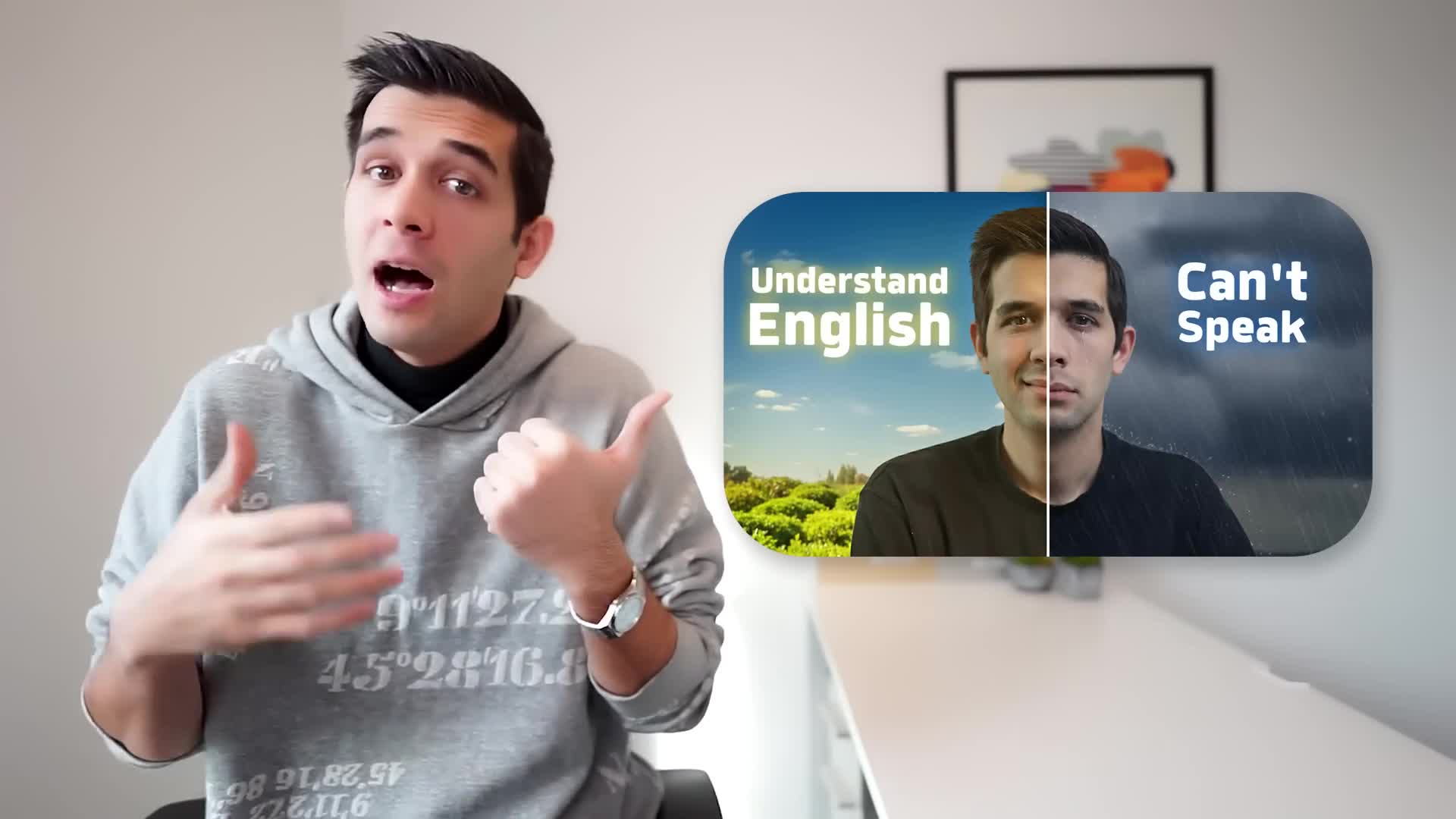
A while ago I made a video called understand English but can't speak and it went viral.
But something interesting happened.
I started receiving many comments like this one I can speak, but I can't understand.
So today let's fix this problem.
Think about it when you are talking to someone, if you don't understand what they are saying, can you answer?
If you don't understand, there is no communication, and communication has two sides listening first, speaking second.
So the first step is to listen, the second step is to talk.
This is why many learners feel stuck in their communication.
They only focus on their to reach speaking fluency, which is a good thing.
But if you reach speaking fluency and don't improve your listening at the same time, it doesn't mean anything, because you will be a person who can talk and talk, and talk, but never understand.
Huh?
What?
Sorry, repeat?
Huh?
You don't want to be that guy, right?
So let's improve your listening.
To do this, what to listen to, the material you need, and two, how to listen to that material.
In this video, I will show you both step by step.
Chapter one, what to listen to.
You can't improve your listening by listening to anything randomly.
Your learning material must match your level of English.
Learning material, level of English.
They must match.
But why is this so important?
Let's say you are a beginner level student and you want to improve your listening by listening to Adele.
The thing is, I was in her dressing room and there was only a little curtain separating us while she was having her makeup done and I started.
Or, let's say, Peaky Blinders.
Yeah, well, alone I ain't never gonna do, am I?
As for the cane, don't worry about it.
That's just my sciatica.
It always plays up around the winter and the summer solstice.
Yeah.
See, that's not gonna help.
Similarly, if you are an advanced level student, you shouldn't listen to something that is so simple for you.
Therefore, Your learning material must match your level of English.
So depending on your level, let me introduce some very useful resources.
Let's just start with beginner students.
The best website you can use to improve your listening is this one, listenaminute.com.
This is by far the best for beginner students.
On this website, you can find thousands of topics and for each topic, there is a small audio file.
Duration is maximum one minute.
Why am I talking?
Let me show you.
This, in my opinion, by far is the best resource for improving your listening skill as a beginner student.
ListenTheMinute.com.
There are more than, I think, 3, 4, 500 topics.
And depending on what topic you like, you can choose one.
For example, let's say speed.
There is a one-minute audio that you can listen to.
ListenTheMinute.com.
Speed.
Speed kills.
And you can find the transcript down below.
There are also quizzes and exercises, and you can also download the PDF of the transcript.
This is fascinating.
If you like, you can also print this out, because here you not only have the transcript, but also the exercises, together with the answers.
But how can you use it?
Wait until the end of this video.
I will explain how to use this material to develop your listening skill.
Okay, for intermediate students, listeninminute.com is very easy.
So what should you do?
I highly recommend podcasts.
You can listen to some general-purpose podcasts, the podcasts that you like.
It can be on Spotify or on YouTube or anywhere.
But as a teacher, I highly recommend specific podcasts designed for students like you to improve their listening skill.
Like what?
The best one, in my opinion, is BBC Six Minute English.
This is designed specifically for intermediate level students to improve their listening skill.
Let me show you how you can access it and what's included.
This was my go-to resource for improving my listening skill as an intermediate level student.
And as you can see, they themselves say that this is useful for intermediate level students.
There are more than a hundred topics.
You can choose the topic you like, for example, the topic on protein and diet.
You can download the PDF or the audio or the transcript.
I'm going to click on the transcript to see what it has.
And there you have it.
Here's the transcript of the podcast together with the new vocabulary and phrases that you may need.
And at the end of this, you will see the full list of the new words and vocabulary.
This is fantastic.
There are many other podcasts, such as VOA Voice of America, but in my opinion and in my experience, BBC 6-Minute English Podcast is the best.
Okay, for advanced students C1 C2 you can listen to podcasts.
That's good, but they have something much better for you.
This is something that helped me a lot when I was learning English, and this is the only resource I used when I was preparing for the IELTS test.
And in my IELTS test, I got nine in the listening part.
So it's very useful and it's proven.
TED Talks, you may be familiar with them.
They're amazing.
These are real English, natural speed talks, usually about complex topics and ideas.
They are amazing. for life in general, and for advanced learners to improve their listening skill.
Let me show you.
When I was preparing for the advanced level, and exactly before taking my IELTS test, I used to go to TEDcom almost every day.
There are many different inspiring talks about various topics and depending on what topic you're interested in, you can choose one and then, under that topic, you can select the video that interests you.
For example, how to tell if you have seasonal affective disorder.
Let's see this.
Here's the TED Talk video together with the transcript.
Just click on Read Transcript.
And as you listen to the video, you can see which part of the transcript you're listening to.
I am personally addicted to TED Talks.
I watch them every day.
Okay, so now that we know the material and the resources that you can use, depending on your level, to improve your listening, Let's get to the second part, chapter two how to listen to them.
Can I just play and enjoy or is there a method?
There is a method.
There are four steps that you need to take one after another.
Step one is to just listen.
Just listen to the audio file or just watch the TED talk.
Just try to understand what the topic is.
We call this Getting the gist.
Gist is an overall idea of what the speaker or the speakers are talking about.
You just need to understand what they're talking about.
What is the general topic?
Or what are they saying?
You don't have to understand everything in detail.
So don't pause.
Don't rewind.
Just listen to it or watch it once.
That's enough.
Try to get the gist.
That's step one.
Step two.
Listen, but this time you need to write down what you hear.
So I want you to listen and, after each sentence, pause and start writing down that sentence that you just heard.
If you don't remember or if you didn't understand well, feel free to rewind and listen again as many times as you need to.
This part might feel a bit boring or maybe even too difficult or challenging.
But hey, when something is difficult for you, that means you are improving.
If it's easy, you're not improving.
So do it.
Don't be lazy.
Do it.
Play, listen, pause, write down.
Play, listen, pause, write down.
But what if you don't understand a word or a phrase and you rewind and you listen again and again.
You don't understand it.
That's fine.
Just leave it blank and put a question mark.
That means there is something here that I could not understand.
Now, let's go to step three.
I want you to listen one more time.
This time, put away your transcript.
Put it away. check the original transcript.
Listen and follow.
As you are listening, follow the transcript.
This is step three.
Because you have already listened to this file many times.
When you look at the transcript, you have that aha moment.
You're like, ah, so this is what he was or she was trying to say.
That aha moment is a very important moment in learning.
And step four, last step take your transcript, the one that you wrote by listening, pausing and writing down.
Take that transcript and compare it to the original transcript and see if it was accurate.
If there is anything that wasn't accurate, highlight it and listen again and try to see what you did wrong.
These are the four steps.
Follow all four steps in order.
Listen first for the gist, listen and try to write down what you hear.
Listen and follow the original transcript and finally compare the two transcripts and highlight any mistakes you may have had.
And that's it, guys.
I hope you've enjoyed this lesson.
Now, if you want to have the summary of this lesson with all the relevant links and my top a single PDF file for free, click on the link above this video.
And on my website, you can get this for free.
It's a valuable resource.
Go ahead, get it now.
You can also find the link in the description of this video.
And as your homework, I want you to go to the comments section of this video and start expressing your thoughts.
What do you think of this lesson?
And how is your listening skill?
Is it good?
Is it not good?
Are you doing anything to improve it?
Can't wait to see all your comments!