
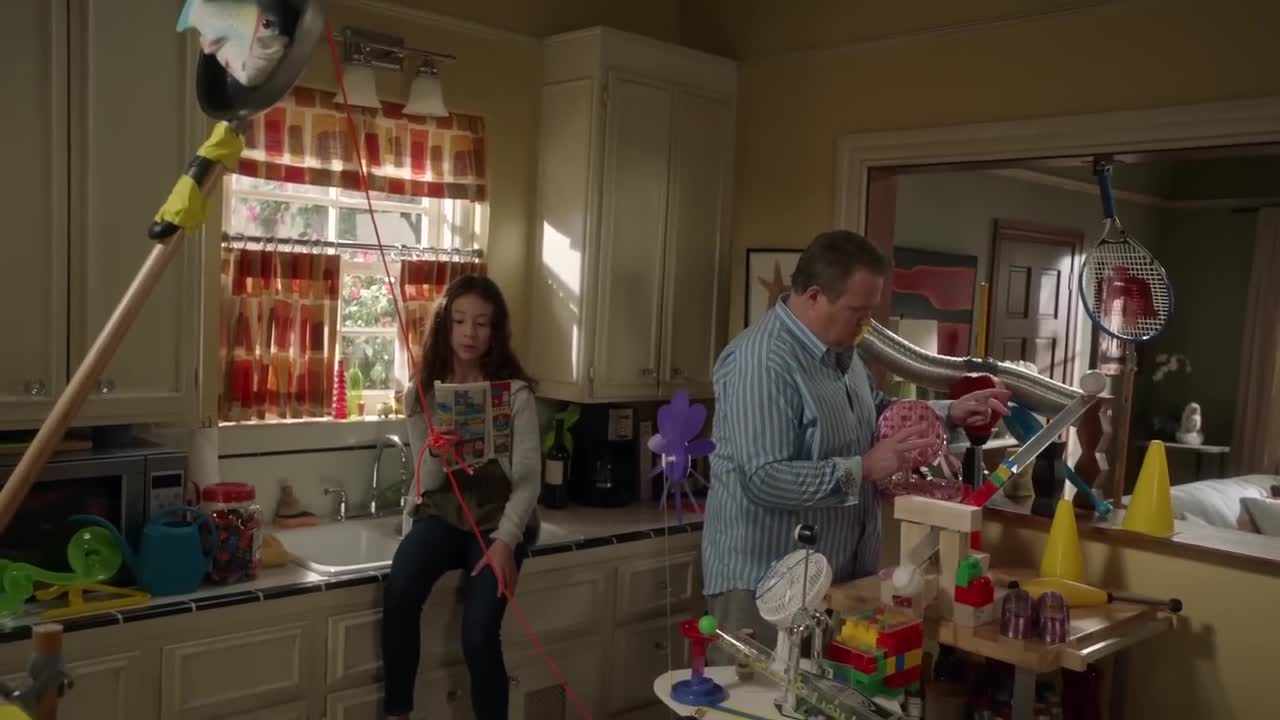
[The Chaos of Parental Collaboration: A Science Fair Debacle]-[Lily's Science Fair Project - Modern Family 8x13]
📋 Summary
The Illusion of Parental Help: A Science Fair Case Study
The Premise: High Stakes and Low Contributions
The transcript captures a quintessential moment of modern parenting: the high-pressure environment of a child’s science fair project. The opening line, "If I don't win the science fair with this thing you built me, it's rigged," immediately establishes the shift in agency. The project, ostensibly meant to be a student’s academic endeavor, has morphed into a collaborative effort dominated by parental figures, specifically the father, Mitchell. The underlying tension suggests that the project has transitioned from a learning experience into a competitive showcase of adult craftsmanship.
The Friction of Mechanical Ego
A recurring theme in this dialogue is the struggle for control over the construction process. Mitchell’s attempt to refine the project is met with skepticism, leading to a direct confrontation regarding competence. When Mitchell suggests, "you can make it better if you just add it," he is met with a defensive reaction. The dialogue reveals a power struggle where the father asserts, "I'm the more mechanically inclined daddy," highlighting a sense of superiority that creates friction with the other adult present. This "mechanically inclined" framing serves as a justification for his intrusion into the project, yet it simultaneously undermines the child’s opportunity for independent problem-solving.
The Failure of Pedagogical Intent
Despite the adult claims that the child is "supposed to be learning from this," the reality of the situation is starkly different. The child’s contributions are limited to peripheral experiences: "I learned a new swear word" and "I got a splinter." These comments serve as ironic markers of the failure of the pedagogical process. Instead of gaining scientific insight or engineering skills, the child is left as a bystander to a chaotic assembly process. The adult focus on the hardware—the "thing you built me"—completely eclipses the educational value, rendering the project a testament to parental anxiety rather than student achievement.
The Climax: When Ambition Overwhelms Utility
The scene reaches its zenith when Mitchell attempts a final "little adjustment." The transition from a controlled building environment to total chaos—marked by the exclamation "Watch out!" and the subsequent "Oh, my god!"—symbolizes the fragility of the entire endeavor. When the resulting explosion or failure occurs, the response, "That's not part of it," underscores the absurdity of the situation. The project, which was meant to demonstrate scientific prowess, concludes with a physical failure that mirrors the failure of the collaborative process itself.
Conclusion: The Rigged Nature of Expectations
Ultimately, the transcript serves as a satirical look at the "rigged" nature of school projects where parental ego becomes the primary driver. By emphasizing the desire for the project to be "simplistic" versus the reality of a complex, dangerous, and poorly executed build, the participants demonstrate how the pursuit of excellence can lead to total disaster. The project was never truly the child’s; it was a battleground for adult validation, resulting in nothing more than splinters, frustration, and a catastrophic mechanical failure.

Deep Learning with ListenLeap


