What if superhero suits could give you real -life strength?
In China, exoskeletons are bringing that dream to life, transforming industries and daily life.
How soon before everyone gets their own Iron Man upgrade?
And who knew so many people struggled with opening doors of electric vehicles?
If you asked me, maybe car companies could innovate in other areas.
Considering how challenging it is to locate the door handle, why do EV manufacturers keep pushing for more elusive designs?
Coming to you from Beijing, this is Roundtable, I'm He Young.
For today's program, I'm joined by Steve Hatherly and Yu Shan.
First on today's show… What if putting on a suit could instantly make you stronger, faster, and able to do more?
That's what exoskeleton technology is doing in China right now, and it's not just for Tony Stark anymore.
These wearable robotic devices could transform everyday lives, making hard labor easier and even helping people recover from injuries.
But as exciting as that sounds, experts say we're only scratching the surface.
Big breakthroughs are still needed to unlock their full potential.
So what exactly is an exoskeleton, and how does it work?
Well, by definition, exoskeleton or robotic exoskeletons are exoskeletal structures worn on limbs that serve to enhance or sense the physical capabilities of its user.
So this technology has been under study ever since as early as the 1960s and first for military applications.
And the core advantage of exoskeleton technology is that it seamlessly integrates human movements, sensation, and cognition with machine capabilities, which provides you with support on doing daily tasks such as lifting things or basic movements such as walking or going on steep hills etc.
And nowadays, exoskeletons can be classified by their purpose and functionalities.
The most widely applied case is for medical if not rehabilitation usage such as helping people undergoing surgery or with disabilities to regain physical mobility.
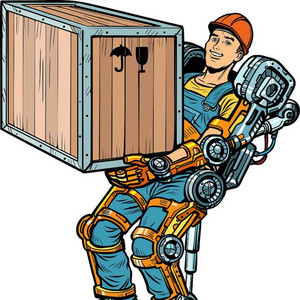
As simple as that. And another popular application of it lies in the manufacturing and logistics scenarios such as people working in airport or warehouses where they need to lift heavy boxes or suitcases.
That's for them to support their limbs for lifting heavy weights.
This all sounds just very futuristic, I think, for most people because we don't necessarily see this in the streets or if they're still mostly in labs, right?
Yeah, you don't you don't encounter it when you walk down the street.
Yeah, it does sound very futuristic and it does sound very sci fi.
Do you remember the movie, the Tom Cruise movie?
I think it's called The Day After Tomorrow, where the day just keeps replaying and replaying and he has to figure out how to get out of it.
Anyway, within the movie, he's in the military and they wear exoskeletons and those exoskeletons allow them to jump high, run fast, and they're also equipped with weapons and things like that.
That's in the movies.
These are not that we're talking about today are not equipped with weapons, but the kind of concept still applies here.
I watched a couple of videos about where and how people were using these.
And you, Shan, you alluded to one use where factory workers will wear these things on their bodies and it helps them to it takes a lot of the pressure off of their backs.
The exoskeleton itself will support a certain amount of the weight, and that's important for factory workers because they're often bending over and picking up heavy things and carrying them to another location.
The exoskeleton itself, for that case, looks like something that you wear around your waist, like a band around your waist.
It also looks like you're wearing a backpack, too.
And then there are lines that come down and they wrap around your quad area of your leg, just above your knee, and that supports your legs.
It's really quite an incredible thing.
It does look a little odd.
It looks like you're wearing something futuristic.
But for factory workers, and there's other examples we'll talk about, but for factory workers, this is such an incredible advancement.
It really makes their job a whole lot easier.
Yes, we'll get into the usage a little bit later in greater detail, but also just to sort of get people to understand this a little bit better.
There's one analogy being made here that is, oh, just consider, well, look at the three of us.
Two of us are wearing glasses.
And nowadays, that's just a common thing.
So many people do it.
Also in China, apparently 90 percent of our classroom students in elementary school or middle school are wearing glasses, and nobody bats an eye against that.
So yeah, exoskeleton is, in theory, kind of just like having another device to enhance your certain kind of impairment or inability or something like that.
Yeah, I mean, in essence, exoskeleton is actually categorized as one type of humanoid robot that we have discussed in previous shows as well.
We talked about that show on how humanoid robots or a human shaped robot could trigger a bit of concern of just existing in their house and doing work for you.
But this one, the exoskeleton, it's such a wearable device to the fact that it helps you to just do things and make movements that you are still the commander of the device itself, just like wearing glasses.
Like you said, Huyang, maybe one day people tend to forget that they're wearing such devices, just like how we sometimes forget that we're wearing glasses nowadays.
Yeah, I think it's important to note, though, that it's not just for people with disabilities or things like that.
There are medical applications of these exoskeletons that do really incredible work.
But this could be for somebody who's an avid hiker or a trekker and you put on a device like this and it can increase the speed at which you run and it can take the weight off of your back if you're carrying a heavy backpack like trekkers often do.
It's not just for people with disabilities.
It's this can be for anyone.
Yeah. And also just considering how cheap getting a pair of glasses it is these days.
But remember back hundreds of years ago, it's like a super luxury to have.
I still remember in the movie The Last Emperor when The Last Emperor in China finally got his first pair of glasses.
Well, truly, it was like life changing for him.
But not every day people could get it.
But, you know, you see the price comparison there.
Good point bringing up price.
These things aren't cheap, are they?
No, it's not cheap at all.
Because the price for exoskeleton suits start at around five thousand US dollars.
And that is just for the more basic model types.
And that price can easily reach as much as 50 ,000 to 70 ,000 US dollars or even more, depending on which area of support or how big the set of exoskeleton it's we're talking about.
And one brand called the Exo Indigo Exoskeleton can be used for therapy as a gate training tool.
And it has been available in Europe since a few years ago.
And the initial price is already 80 ,000 US dollars.
So I would assume if we want to make this wearable device more accessible to the general public, then one thing that we need to hit as a start is to knock down the price.
Well, I found a Chinese startup company, actually, it's called Hyper Shell.
And this is really cool.
This was unveiled at CES 2024, the Consumer Electronics Show.
It's called their their product is called the Pro X, the Hyper Shell Pro X.
And they refer to it as an e -assist for your legs.
It's for hikers. I was talking a moment ago about it, hikers and trekkers and runners.
And again, it goes around this particular one is quite small and not that heavy.
As a matter of fact, it goes around your waist like a band.
Then there are lines that come down the side of your legs.
And again, they wrap around your quads.
And it's pretty convenient, I would say, to wear.
You determine the assist level, like how much of the weight it's going to carry for you or how much extra boost it's going to give your legs.
And it allows a person.
This is really impressive.
So the average jogging speed is six to nine kilometers per hour.
With this Hyper Shell Pro X, you can run up to 19 .9 kilometers per hour.
You can run more than triple the average jogging speed, which is really cool.
How it provides you one horsepower.
So, you know, when we talk horsepower, we're talking about engines, right?
Cars, motorcycles. This gives you, it gives you the power of one horse.
One horsepower. Pretty cool, right?
It offsets 29 .9 kilograms of carried weight.
So it takes a lot of the pressure off there.
In America, it was available for preorder in January, which was available for $799.
That's about 5 ,600 yuan.
It's not cheap, but it's also not $80 ,000.
Um, so they are pretty expensive, but probably in the future they'll get more affordable.
I mean, despite the high price, it's still very much welcomed all around the world, in the global communities.
And the U .S., Germany, China, South Korea, and Japan are the regions adopting exoskeletons the most, accounting for 75 % of global revenues.
And that is $673 million in the year 2023.
And it's estimated that by 2030, that number will go down to 68 % of global revenue as later adopters in some other countries cut into the market share and start to develop their own moto -types as well.
Yeah, increasing their own market share, thereby decreasing the market share of the countries that you just mentioned before.
That's right. And it seems like there's a lot of potential in the Chinese market and the manufacturing sector in bringing costs down.
Apparently Professor Liu Xiaoshan from the Shenzhen artificial intelligence research institute says that China really stands out in producing key components for robots, and it's a massive market to sell them.
Yeah, during my interview with some of these experts, I hear that the whole market in China nowadays starts from the lower stream of the manufacturing of the components and the parts of these exoskeletons all the way up to the consumption needs, which is the ultimate goal of how they're trying to develop
these models into. They are to become products or commodities that's shoppable and accessible to people in the near future, if not already by now.
So what's missing for China in this whole process is the middle part, which is the key technology of the chips, of the central motion control and the AI technology and everything which China has been working on in the past decade as well.
So based on our huge manufacturing potentials, we can help to lower the price by just making those components ourselves.
And in the meantime, assemble all those components with the chips that are domestically made, which will just bring this whole lowering price future one step closer.
I was on Dao Bao earlier today.
I wanted to know. Looking up this?
I would know the one I was just talking about, the one that was available for preorder in January.
It's a Chinese startup.
Right. So I thought, oh, maybe I can get this on Jing Dong or something.
But now it's not there just yet.
We have to wait more for that.
I wasn't on Dao Bao as a matter of fact.
I was as I was interviewing one of the company leaders that are investing in making such exoskeleton models that I had the honor of trying on one of those upper sets for lifting your arms.
So based on my experience of wearing it, the feel it gives you is that it helps you to lift up the elbow area, which back then I was handling like a heavy camera holder that could wait quite a bit for a female journalist or a female reporter as the same size as mine.
But with the support that's provided by the exoskeleton suit that I was wearing, it actually helped you to move swifter as if you are putting your elbows on a table or a platform or something.
Did you feel it? Sorry, did you feel anything in your arms or did you feel like was it the machine carrying your arm as opposed to your arm being the motor and making the strength?
That's the tricky part.
You know, sometimes I feel like I am being controlled by the fact that my arms are lifted because of the fact that I'm wearing the suit.
And sometimes it's not even that compatible with my body, as in I guess the moto type is designed for maybe taller or stronger users.
So yeah, it's big for me to put on that size and still be able to move around super flexibly.
But for that experience, I just feel I was supported, even though my arms still have to use some strength to hold the thing because I was going to say, how did you put it on?
Oh, that's the funny part.
I couldn't put it on myself because it's like you said, it's a backpack thing.
And once you put it on, there's different joints that you have to put that you have to clip on on your waist, on your shoulder and some on your arms, too.
So I had a professional helping me to put it on and helping me to adjust the level of support that they want me to try.
So the higher the support it gives, the less strength you need to pull up from your own limbs.
And that's all adjustable.
But for me as a first time user of such device, I was kind of confused at the beginning.
So yeah, I had to have a professional to help me to put that on as well.
And yeah, so that's really interesting.
I suppose that could be used in manufacturing, in everyday tasks as such.
But how are exoskeletons currently being used in industries such as healthcare, logistics and manufacturing?
Do we have some case studies that we can offer to people?
Yeah, I mentioned before I watched a couple of videos.
One was about a factory worker.
Another was about kind of a warehouse, home appliance center employee who was using it to help him lift and carry different things.
The news report, he lifted and carried the news reporter who had sat down in a chair and they wanted to show how easy it was.
This guy walked over.
This was an average size guy.
He walked over and picked up the chair like she weighed about one kilogram.
It was really quite impressive.
The other video I saw was from a hospital.
And this is one of the more fascinating applications of these exoskeletons.
And I'm assuming these would be the ones that cost around $80 ,000 American.
These suits are different.
These go from your head down to your toe.
And these are for people who are paraplegic.
They have no movement or no feeling in the lower half of their body.
So the suit starts at the top of your head.
It goes all the way down your back, all the way to your feet and even your feet.
There are platforms for your feet to stand on as well.
And that's where we're seeing these applications in the medical industry is that for people who don't have the ability to move, don't have the ability to walk, these exoskeletons are helping them achieve that goal.
And the people who have tried out these exoskeletons, the people who don't have mobility are saying this is just they never thought that they would be able to do it again, be able to walk again.
And with the assistance of this, they're getting they're getting that help.
Yeah. And the set that I tried on is from the company named ULS Robotics.
It's a Shanghai company who is trying to collaborate with some local hospitals and rehabilitation centers as well in order to put their devices and exoskeleton modal types into the real time application for the rehabilitation center for them to use these devices to help people with lower limb impairments
or who need special help in lifting their limbs or recovering their strength to actually do such rehabilitation without a therapist aside or without human assistance, which could cost quite a bit.
And so far, I think it's already being applied in Shanghai and they're trying to make that more general acceptable to the wider public as well.
Yes. And Zheng Hua, chief marketing officer of ULS Robotics, explains that their devices are helping stroke survivors regain physical function.
Let's hear from Zheng Hua in his own words.
Just a moment. Previously, patients relied on physical therapists to guide their recovery with axoskeleton robots that can now do rehabilitation exercises at home.
Yeah, I mean, that's an incredible thing for patients to be able to do these rehabilitation exercises on their own at home and also China's population.
Just like some other countries around the world, the population is rapidly aging and elderly care that's emerging as a new area where axoskeletons can make a significant impact as well.
Let's hear a comment on that.
Many older adults don't have medical conditions, but as they age, their leg strength decreases.
Climbing stairs becomes difficult, let alone going out.
Our variable robots can help them walk and climb stairs.
Yes. Yeah, potentially this could make such a difference for those who you might argue are able persons as well as those who need an extra lift.
Sure. Walking upstairs is a great example.
For the elderly, that can be a really huge task.
So an exoskeleton could help out.
Zheng also talked about the fact that these will get cheaper in the future.
They will get smarter in the future.
And as AI comes along, they'll make them even more responsive and more attuned to each user's individual needs.
So that we're in the beginning stages now, these are going to get better and better and better and better.
Yes, for sure. And what advantages do exoskeletons offer over traditional methods of heavy lifting or on logistics or also manufacturing?
Well, one major real time scenario for applications over those sectors lies in the airport baggage handling sectors.
Heavy lifting job. It has been a long physically demanding job requiring those workers to load and unload countless suitcases for us, for us travelers in cramped airport cargo holds under tight time constraints.
So usually for an airport staff of this type of work, it was reported that their service time lasts around one to two years before their lower back start to have some sort of injuries that might cause them to stop working.
So here I was looking at a previous CGTN interview where an airplane baggage handling personnel wears such a smart exoskeleton device on his back.
And it's roughly again, the size of a backpack and he could easily lift up a 20 kilogram suitcase with ease.
And in theory, that one should be able to provide him a third of the support that makes him feel that the suitcase is lighter.
And the worker said practically that it feels like, quote unquote, as if someone is pulling from behind and protects my lower back from the lifting.
I saw it described the way that it works as almost like pulling on a bow and arrow.
When you release that arrow, that tension is released.
So that's how the exoskeleton functions, is that it propels you when you go down, it helps to propel you back up.
So a 20 kilogram suitcase would feel like six or seven kilograms.
You're still required to do the moving.
Um, but it's just, it's an assistant.
Again, it's an E assist for, for people.
And that's for people who can do this work themselves anyway, but what about for the folks who are paralyzed or they're, they lack mobility and it seems like there's some kind of sensory connection, maybe via Bluetooth or something along the lines of such that empowers them to achieve movement.
And I think that's kind of exoskeleton in a whole other ballpark.
It's like, they're still exoskeletons by definition, but we're talking about completely different products here.
Yes. And guys, do you think there will be ethical concerns or regulations needed when exoskeleton technology in the future?
We don't know how far it will be, becomes mainstream.
I mean, some general social concerns relate to the personal and psychological impact on disabled individuals upon using such devices, like how do they truly feel?
Are they happy to be able to walk again?
Or does this burden them psychologically?
This is a realm that I fail to understand, but I think it's something that's concerning the general public out there and this issue are not only limited to our regular daily interactions, but also arise in sports.
Say, is this going to change the roles for Paralympics in the future?
We don't know yet. And also the prospects of argumenting otherwise healthy individuals.
That's as in distinct from treatment focused on achieving or sustaining or restoring health.
So for general publics, healthy individuals, that raises further ethical concerns relating to human enhancement.
Yeah, and Steve, I wonder how you feel about this now, maybe in the, well, not now yet in the future.
Could it be that the rich, not only do they already enjoy better healthcare because they could afford it, but they could become stronger physically every day if they want to.
I mean, I can't help but see this as a very good thing.
I'll reference a story from England, from the BBC, a woman by the name of Sophie Shuttleworth, she's 32 years old.
She's from the town of Newport, and she was put into an induced coma after developing her illness in the year 2022.
She's been in a wheelchair ever since.
And her quote after using the exoskeleton, it's very nice to be active again.
When we see those types of medical applications, it's absolutely wonderful.
And then we'll see things in industrial healthcare, rehabilitation, military defense, business, and economy.
Canada just approved a company and it seems like they're coming and they're going to be here for a while.
Hmm. Exoskeleton technology is possibly more than just a marvel of engineering.
It's a glimpse into a future where physical limitations can be overcome.
By blending the lines between man and machine, these devices could redefine our workplace and improve the quality of life for so many people.
But in my humble opinion, how it's going to be utilized?
Is it going to create more inequalities?
I mean, there are some really subtle, ethnic issues that will definitely arise and needs our attention.