Life mastery level up your life, wisdom, growth, embracing life.
Second half.
That's the topic of our English speaking practice.
Let's jump right into it.
All right.
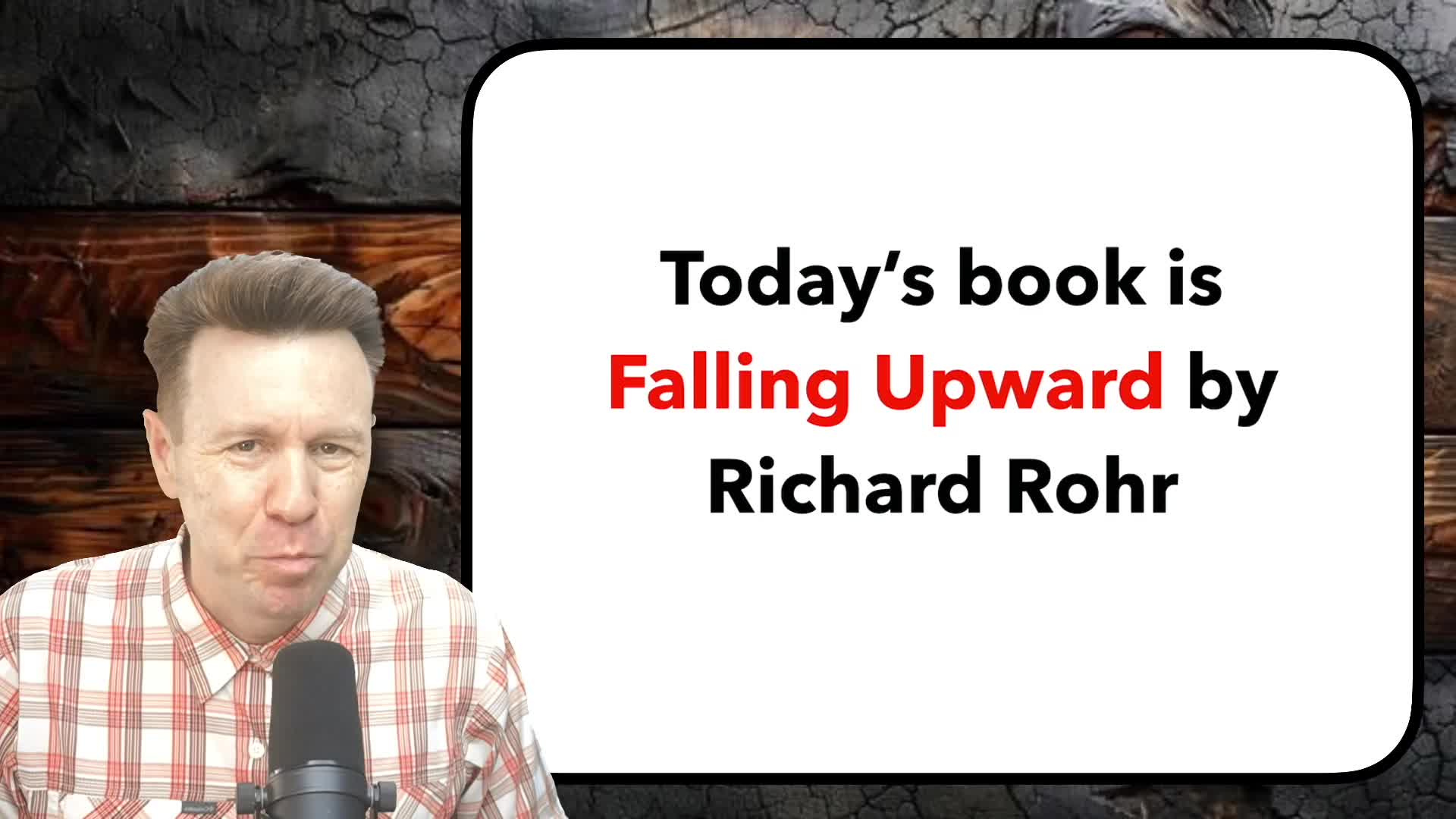
Today's book is falling upward.
Falling Upward?
That's a strange title.
It's very interesting.
By Richard Rohr.
Rohr, like a lion roars.
All right, let's see what this book's about.
This book offers a profound exploration of say it.
This book offers a profound exploration of what, a profound exploration of how life's challenges and setbacks serve as invitations to Serve, as invitations to what?
To attain deeper wisdom.
To get deeper understanding, wisdom.
Find purpose and experience spiritual growth.
All right, all together from the top.
This book offers a profound exploration of how life's challenges and setbacks serve as invitations to attain deeper wisdom, find purpose and experience spiritual growth.
One more time.
This book offers a profound exploration of how life's challenges and setbacks serve as invitations to attain deeper wisdom, find purpose and experience spiritual growth.
Wow, that is a long sentence.
Yes, it is.
All right.
Here's a short sentence.
I like that.
Life can be viewed in two halves.
Two halves.
First half, second half, two halves.
When you cut something in two, you have it.
You cut it into two halves.
Life can be viewed in two halves.
Halves.
That L's kind of silent, huh?
All right.
The first half focuses on shaping our identity, achieving success, and establishing security.
The first half of our life focuses on shaping our identity, achieving success and establishing security.
Yeah, I agree.
I am currently in the second half of my life.
I'm 55 years old.
The first half of my life, I spent it shaping my identity, chasing success, trying so hard to be successful, establishing security for me and my family, and now i am in the second half of my life.
The second half however, is centered around discovering deeper meaning and purpose.
I 100 agree with this author.
The second half however, is centered around discovering deeper meaning and purpose.
Failure should not be seen as an opening rather than a dead end.
Hmm, did I catch that right?
I don't know if my flow was good.
Failure should not be seen as an opening rather than a dead end.
Should be seen...
I was throwing in a not, wasn't I?
I don't know why I did that.
That is so weird.
Failure should be seen as an opening.
I was saying not.
I was confusing myself.
I'm like, this sentence does not make sense.
What is happening?
And then I realized I was adding a not.
But there is no not.
Failure should be seen as an opening rather than a dead end.
You understand it means failure should be viewed as a beginning.
An opening would be like a beginning, the start of something.
You open it.
It starts a beginning rather than A dead end.
An end.
Rather than everything is over.
Okay.
Let's do better, Chad.
Let's do better.
Our struggles, like right now I'm struggling, our struggles are not merely obstacles.
They are essential for us to grow into our true selves.
Okay, I'm going to say that twice.
I want you to shadow me.
Our struggles are not merely obstacles.
They are essential for us to grow into our true selves.
Grow into our true selves.
Grow into our true selves.
All right, from the top.
Our struggles are not merely obstacles.
They are essential for us to grow into our true selves.
It's important to release our grip on ego and control.
It's important to release our grip on ego and control.
It's crucial to let go of our attachment to ego, our grip, our attachment on ego.
Ego, sorry, ego, what is ego?
That's hard to describe.
It's like self-importance.
You think you are very important.
You are very self-important.
That's your ego.
So it's important to release our grip on ego and control.
Gotta let go.
Gotta let go.
The latter part of life, the later, the ladder, ladder, that's a D sound, ladder, ladder.
The latter part of life isn't about proving anything.
It's about embracing humility. and committing to service.
Mmm, that hits deep for me.
The latter part of life isn't about proving anything.
I used to want to prove that I was a great English teacher, that I could be successful.
But it isn't about proving that.
It's about embracing humility.
Nowadays, I'm so humble.
I'm the most humble person on earth.
And committing to service.
I'm trying to serve and serve more and more.
Instead of chasing after success, I'm trying to be of a service.
Anyways, let's go ahead and say that together.
The latter part of life isn't about proving anything.
It's about embracing humility and committing to service.
Again, the later part of life isn't about proving anything.
It's about embracing humility and committing to service.
Genuine wisdom stems from lived experiences.
True wisdom comes from real life experiences.
I've had a lot of real life experiences, so i've gained a lot of genuine wisdom.
Genuine wisdom stems from that means, it comes from lived experiences, real life experiences.
Knowledge by itself, knowledge alone, isn't sufficient, isn't enough.
Real understanding, true understanding, comes from what we've endured, comes from what we've gone through.
What we've gone through, what we've endured.
Knowledge by itself isn't sufficient.
Real understanding comes from what we've endured.
Knowledge alone isn't enough.
True understanding comes from what we've gone through.
Spiritual maturity... involves surrender.
True peace arises not from clinging tightly, but from trusting and letting go.
Clinging is holding on.
Let's see, what else do we got there?
Spiritual maturity involves surrender, letting go.
True peace arises, arises means comes from.
It arises not from clinging tightly, but from trusting and letting go.
Let's read that through without stopping.
Spiritual maturity involves surrender.
True peace arises not from clinging tightly, but from trusting and letting go.
In the second half of life, the focus shifts from climbing higher to delving deeper.
Going deeper, delving.
In the second half of life, the focus shifts from climbing higher to delving deeper.
So in the first half, we try to climb as high as we can.
In the second half, we try to go as deep as we can.
That's deep.
How can I fully embrace my journey today?
That's the question I want to ask myself now.
How can I fully embrace my journey today and tomorrow and the next day and so on?
All right, that's our text for today.
I want to go nonstop now, shadowing portion.
Are you ready?
Here we go.
Today's book is Falling Upward by Richard Rohr.
This book offers a profound exploration of how life's challenges and setbacks serve as invitations to attain deeper wisdom, find purpose and experience spiritual growth.
Life can be viewed in two halves.
The first half focuses on shaping our identity, achieving success, and establishing security.
The second half, however, is centered around discovering deeper meaning and purpose.
Failure should be seen as an opening rather than a dead end.
Our struggles are not merely obstacles.
They are essential for us to grow into our true selves.
It's important to release our grip on ego and control.
The latter part of life isn't about proving anything.
It's about embracing humility and committing to service.
Genuine wisdom stems from lived experiences.
Knowledge by itself isn't sufficient.
Real understanding comes from what we've endured.
Spiritual maturity involves surrender.
True peace arises not from clinging tightly, but from trusting and letting go.
In the second half of life, the focus shifts from climbing higher to delving deeper.
How can I fully embrace my journey today?
Boom.
Good workout.
Way to go.
Nice, deep philosophical book for me to think about the second half of my life and what I want to do.
Let's just keep moving forward together one step at a time.
Let's see what this wonderful life brings us.
And I'll see you in the next English speaking practice video.