
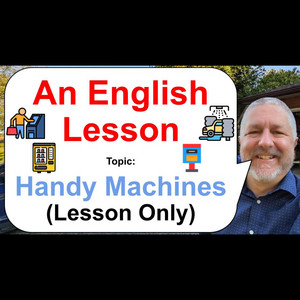
[A Guide to Handy Machines in Everyday Life]-[Let's Learn English! Topic: Handy Machines! 🤖🏧💦]
📋 Summary
Everyday Handy Machines: A Comprehensive Overview
In our modern lives, we interact with a vast array of "handy machines"—devices designed to make tasks more convenient, helpful, or efficient. This summary explores the various machines we encounter in public spaces and our homes, highlighting their functions and the evolving terminology used to describe them.
Public Convenience and Service Machines
- Vending and Ticket Machines: These are staples of public spaces like schools and arenas. A standard vending machine allows users to purchase snacks or drinks via cash, card, or phone. Similarly, ticket vending machines allow travelers to purchase physical tickets for transport, such as the GO train to Toronto.
- The Reverse Vending Machine: A fascinating innovation that promotes sustainability. Unlike standard vending machines, a reverse vending machine allows users to return empty bottles in exchange for a voucher. This encourages recycling rather than throwing waste into the garbage, proving to be a "very, very handy" tool for environmental protection.
- Car Washes and Air Pumps: Automatic car washes use soap nozzles and spinning fabric brushes to clean vehicles on a track. For maintenance, gas stations provide air pumps (or air compressors) to inflate tires. Maintaining the correct pressure—measured in PSI (pounds per square inch) in Canada—is essential for vehicle safety.
- Financial and Service Kiosks: While ATMs (automatic teller machines) remain common, their usage is declining as society becomes increasingly "cashless." In the retail and food industry, self-service kiosks have become prevalent at fast-food restaurants. Interestingly, the terminology for these screens is still evolving, with many simply referring to them as "the screen."
Automated Infrastructure
- Self-Checkout: Once rare, self-checkouts are now standard in most grocery stores. They are highly convenient for smaller purchases, though shoppers with full carts often prefer the traditional checkout for efficiency.
- Access and Movement: Automatic doors utilize sensors or motion detectors to provide accessibility. Similarly, garage door openers provide a "handy" way to enter a home without exiting the vehicle. For vertical movement, escalators—essentially "moving stairs"—are essential in large shopping centers.
- Photo Booths: These machines provide a fun way to create memories, automatically capturing and printing a strip of photos within minutes.
Smart Home Technology
Our homes are becoming progressively "smarter" through interconnected devices:
- Smart Plugs and Switches: These devices allow users to control appliances or lighting remotely via a phone. A smart switch can even replace traditional wall switches to manage brightness (dimming) or set schedules.
- Smart Thermostats: These intelligent systems learn a household's schedule to optimize temperature control and save money on heating or cooling.
- Robotic Assistants: Robot vacuums (like the popular "Roomba") navigate floors to clean autonomously. Similarly, robot lawnmowers are becoming more common; these autonomous machines handle yard work on a schedule. As these technologies mature, they are becoming increasingly "rugged"—durable and reliable enough to handle daily wear and tear.
Specialized Utility Machines
- Water Systems: In workplaces, the water cooler remains a classic site for social interaction. Modern alternatives include water fountains and water fill stations, which are designed for refilling personal bottles.
- Pet Care: An automatic pet feeder is a machine that "dispenses" food on a set schedule, ensuring pets are fed even when owners are away.
- Sewing Machines: A traditional yet essential tool, the sewing machine automates the process of connecting fabric, allowing for the creation or repair of items like pillows, blankets, and clothing.
A Note on Non-Handy Machines
It is important to distinguish between "handy" machines and those that are not. The author notes that slot machines fall into the latter category. With a very "slim" chance of winning, these machines are often a poor investment compared to an "interest-bearing savings account," serving as a reminder that not all machines are designed for user convenience.
Deep Learning with ListenLeap
✓
Listen Sentence by Sentence
✓
AI Q&A
✓
Word Favorites



🎯Key Sentences
1
It's kind of cool.
2
I think you'll enjoy this English lesson.
3
It's just a handy way to buy a snack or buy something to drink.
4
It doesn't give you money, but it gives you a little voucher that you can use in the store.
5
Very very cool.
📝Key Phrases
1
each and every day
2
pay a little extra
3
make a purchase
4
the chance of winning is slim
5
interest-bearing
📖 Transcript
Well, hello and welcome to this English lesson about handy machines.
The other day I saw a news article about something called a reverse vending machine.
A vending machine is a machine you put money in and it gives you a snack or something to drink.
A reverse vending machine is where you put empty bottles in and it gives you money.
It's kind of cool.
So I thought hey, I should do an English lesson about all of the handy machines that that we use each and every day.
ListenLeap Brings You Into Real Context Learning
🎨
Interesting Content
🌍
Real Materials
📱
Listen Anytime