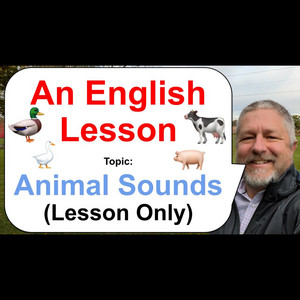
Well, hello and welcome to this English lesson about animal sounds.
As you may well know, animals make interesting and unique sounds and we have words in English and you have words in your own language to describe those sounds.
You'll see here there is a cow.
A cow goes moo.
And I will probably be looking at about 26 different animals.
And I will teach you the word we use in English to describe the sound that they make.
And you will get a nice picture of the animal as well.
So, even though this might seem like a relatively simple lesson, I think it will still be fun as we go through the lesson and maybe review the names of the animals, as well as familiarize yourself with the sounds that they make.
So once again.
Welcome to this English lesson about animal sounds.
Dog.
So when we talk about the sound that a dog makes, there's actually three.
Bark and woof are both kind of the normal sound like woo woo.
Woo woo.
That does not sound like a dog, does it? but when Walter barks, that's how it sounds.
When Oscar barks, it's more like I should have put rough on there as well, shouldn't I?
But bark or woof are two of the common sounds a dog makes.
Um but we also have growl.
When a dog is angry, a dog will be like Oscar will growl at people when they come on our property.
If he doesn't know them, our dog Oscar, he will be like And I did want to tell you that's the verb we use when we talk about the sounds that dogs make.
In the past we would say you know, a stranger came on the property and Oscar went and Walter went.
That's probably a better bark.
Anyways.
I'm failing a little bit on the sound effects.
I think they might get better.
A cat.
So a cat will either meow.
So a cat meowing sounds like... Like it actually sounds like the word.
I don't think a cat says the M.
Like I don't think it's meow.
I think it's more like meow, meow.
And then a cat will purr.
If you pet a cat and if the cat is very, very happy, the cat will start to purr.
I'm trying to watch my mic levels here so I don't do the sound effects too loud.
So a dog will bark, a cat will meow, and if a cat is happy, a cat will purr.
A cow.
So I grew up on a farm.
The cows would moo when they were hungry.
And when a cow moos, it's kind of a It's kind of an interesting sound.
Sorry, I don't have a sore throat.
I just should have drank a little bit more water before I started.
So, anyways, in...
If you see a cartoon, like a kid's show, the cow goes moo, moo.
The real sound of a cow is more like this, like moo, moo.
Like when cows are really hungry, you can hear them from far away.
So the nice subtle sound.
That's probably a good sound for a cow.
I think I did a pretty good job on that.
One a pig.
So we say that a pig goes oink.
So when you hear a bunch of pigs you might think you're going to hear a nice sound like oink.
But the real sound of pigs is more like this like To me.
That is the sound I've heard when I see pigs.
It's more like a snort.
I've never really heard pigs go oink, oink.
Now little pigs will squeal and that might sound a little more like an oink, but definitely My memory of pigs when we didn't have pigs when I was a kid, but my memory of pigs when visiting other farms is you would hear them kind of like.
To me, that's the that's the pig sound.
I don't think I'm doing a good job on that one, but that's pretty close sheep.
So when sheep make a noise they go bah, so it really sounds like bah, bah.
So we used to have sheep, now we just have goats, and But when we had sheeps you would literally hear that sound from the field.
And it did do that little sound when they were doing it.
And normally the sheep would baa when they were hungry, or the mother sheep would baa if their lambs were far away, and then the lambs would bleat.
And I'm not going to try this sound effect.
My voice doesn't go high enough, but a lamb will make like a, well, should I try it?
Like, nah, I can't really do it.
My voice is far too low for me to be able to make a bleating sound, but a lamb will bleat, and a sheep if it's a mom.
If it's a mother, sheep will bah to try and find her lambs.
And then a horse will nay or winnie.
Um, we did not have horses when I was a kid, but my grandpa had a horse and I think, if I can do this, let me see if I can do this, like that's my best horse impression.
I thought I would enjoy this more, but I'm actually nervous trying to make the animal sounds.
I was practicing them yesterday when I was driving and my daughter thought that was a little strange.
But a horse will neigh or whinny.
So...
That might be a little high, but that to me, would be a good approximation of the sound that a horse makes.
And then a duck.
So a duck will quack.
Now, the sound that a duck makes does kind of sound like the word quack.
A duck makes a sound like quack, quack, quack, quack, quack, quack.
So you can hear I'm almost saying the word like quack, quack, quack, quack, quack, quack.
I'm not sure the duck totally pronounces it as quack, quack, quack.
But I think you will hear quack, quack, quack, quack, quack, quack.
That's the sound that I have heard.
When I see ducks.
So a friend of Jen's who also grows flowers has ducks.
And when we go to their place, we see the ducks and we hear a lot of, as the ducks swim around and walk around.
Chicken.
So we had chickens when I was a kid.
We have chickens now.
And chickens cluck.
But I think this word doesn't actually describe the sound they make.
Because it's more like...
That's the sound I hear.
I think sometimes we say chickens go pock, pock, pock.
That's probably a closer description of the sound they actually make.
But if I go to the field right now, you will hear...
And then baby chickens are called chicks and they go cheap or peep.
So like I can't make that sound very well.
But when we get really really little chickens, when we get chicks, You will hear them cheep and peep when they are in their little, we usually have a little pen with a heat lamp to keep them warm for the first few weeks.
And that is the sound that they make.
A rooster.
So a rooster is known for crowing.
A rooster will crow.
A rooster, by the way, does make the same sound as a chicken as well, but it's also known in the morning for going.
I could do it better yesterday.
It's not coming out as good.
We do not have a rooster.
When I was a kid, we did usually have a rooster, and you would sometimes hear the rooster early in the morning.
When the sun would rise, you would hear, and then you would wake up.
A typical farm kid memory, I think, of the rooster crowing.
Turkey, I can't make this sound.
Gobble, gobble, gobble, gobble, gobble, gobble, gobble.
I've never actually heard a turkey go gobble, gobble, gobble, gobble.
But that's the word we use to describe the sound of a turkey.
A turkey will gobble.
So, by the way, we also use the word gobble to talk about eating food really fast.
Like he...
He gobbled his food.
It means you ate your food fast.
But a turkey will gobble.
It will make a gobbling sound.
Turkeys, by the way, they kind of scare me.
They're really, really big.
And they have these big feathers and they I don't know.
I always feel like they're going to try and peck me or something.
But anyways, the sound of a turkey, a turkey will gobble.
A dove.
So we have a type of dove here called a morning dove.
And it kind of makes a coo.
It makes a cooing sound like...
Often we'll see a dove sitting on the electrical wires and they'll sit on the electrical wires and you'll just hear.
And a pigeon makes a similar sound.
This is a, I think this is a morning dove.
Kind of looks like a pigeon though, doesn't it?
Maybe I got the wrong picture.
Anyways, a dove will coo.
That is the sound it will make.
Frog.
A frog will ribbit or a frog will croak.
When I walk along the river, sometimes you actually hear like ribbit, ribbit.
Like it's a they don't say the R that much, but you do hear like the sound coming from the river.
And then I think it's more at night.
Sometimes you'll hear croaking and it's kind of a strange sound.
I can't make the sound very well.
Like it's like.
I think sometimes in movies, when people are walking around in the dark, they'll add a sound effect of frogs croaking to make it seem a little bit scarier.
So a frog will ribbit, ribbit, ribbit, or a frog will croak.
Sometimes at night, I should record it sometimes.
Sometimes it must be during a certain season, maybe mating season.
The frogs will really be croaking loudly at night.
I should go out sometime and make a video of that.
A bee will buzz.
So a fly will buzz.
A mosquito will buzz.
A bee will buzz.
It's basically the sound of wings going really, really quickly.
So sometimes you'll be sitting outside.
Maybe you're eating some watermelon or drinking something sweet like soda.
And the bees will be flying around because I think they can sense the sugar.
So you'll just hear bees.
It's a bit of an annoying sound and it's a little bit frightening, because you do not want to get stung by a bee.
A bird.
A bird will chirp.
A bird will sing.
A bird will caw.
A bird will... I think those are the three major ones.
I think I have caw later on when I talk about crows.
But you often will hear a bird like... And it sounds a little bit like singing.
So often in the morning, when Jen and I go outside to collect the eggs and to do other work, we will hear birds singing.
I think they sing more in the morning than during the rest of the day.
And you'll hear this also in my English lessons sometimes.
I sometimes will stop and say, oh, you can really hear the birds chirping this morning.
You can really hear the birds singing.
So two words, chirp and sing, to describe the sound that birds make.
A snake will hiss, so hiss.
That's a hiss sound.
I'm trying not to do things too close to the microphone.
Again, I do not like snakes.
I don't know how some of you live in places where there are lots of snakes.
I would be afraid to live there.
Here there is one little snake. as I mentioned, called a gardener snake and it's not dangerous.
Um, it doesn't like humans.
You hardly ever see them.
Um, but I still don't like them.
So a snake will hiss like, I don't even know if you hear the sound of a snake hissing.
It probably depends on the type of snake.
That would be, my guess, an owl.
So an owl will hoot, so you'll hear I don't know if I'm doing the exact.
We don't have a lot of owls around here.
But that's the word we use.
An owl will hoot.
So you don't actually hear like hoot.
Hoot.
But you hear like hoo.
Hoo.
It's more like the English word hoo.
I think sometimes.
So.
This is an owl.
If you want to hear an owl hoot though, you probably will need to go outside at night, because owls are often active at night and they will hoot.
So a donkey.
A donkey will bray. although that's not a very common word in English.
A donkey will also hee-haw.
So it's like ee-haw, ee-haw, ee-haw.
So it's kind of two sounds.
There's no hard use of the H, I think, when the donkey says hee-haw.
I think it's more like ee-haw, ee-haw that's the sound you will hear with a donkey or a mule.
Donkeys and mules um, they're not the same animal, but they're just.
They're small.
Both are smaller than a horse and often used on farms for pulling carts Or plows or things like that.
Or even just carrying things.
That's a tough one.
I think I was doing a better job yesterday when I was practicing it.
An elephant will trumpet.
So that's more like, I don't know.
I have to do the hand motion for something like.
I guess I don't have to do the hand motion, but it lets you realize that an elephant will raise its trunk.
And you will hear... That wasn't right.
I don't know what happened there.
I guess I didn't do the hand motion correctly.
Anyways, the sound that an elephant makes is an elephant will trumpet.
And it does kind of sound... like a trumpet, like there is a musical instrument, right?
Like that you can play that makes a similar sound.
So an elephant will trumpet, a mouse will squeak.
I cannot make this sound, but you'll just hear, More you will hear mice scurrying.
So I went plural there.
Wait, mouse, mice, mouse, mice.
Mice will scurry.
You'll hear them scurrying along the floor, which is like, you'll hear that sound.
But when they make a sound, they will squeak.
Especially if a mouse gets caught in a mouse trap, you'll hear the mouse start to squeak.
A wolf will howl, so howl.
Oh, that would be the sound of a wolf.
We also have coyotes near us and you will also hear them howl.
It's a little bit.
It's different than the sound of a wolf, but a wolf will definitely make a sound that you can hear from far away.
Oh, And then I think you hear that sound if you watch a movie that has werewolves in it or something like that.
A werewolf is a wolf that can turn into a human or a human that turns into a wolf.
I don't know all the details but a wolf will howl.
And then a goose.
So there are a number of different kinds of geese in the world and they will honk.
When the geese fly overhead, we literally hear like, we just hear a honking sound from them.
I'll try to capture them. in a video at some point.
Sometimes they fly over and honk so loud I get annoyed if I'm trying to make an English lesson on the farm and I just hear them honking as they go by.
It's very, very, very, very annoying.
I was saying coyotes.
So should I have said coyotes?
There's two different pronunciations.
So we say coyotes here in Ontario, Canada.
Some people might say coyotes.
I should look this up.
There might be two different pronunciations.
So there you go.
I was just seeing that in the chat from Hafiez.
A crow will caw.
So it actually sounds like the word caw.
We sometimes have crows here and they're very large, ugly, black birds, not a very nice bird.
Some birds are beautiful.
I actually don't think crows are very beautiful, but they will caw.
A lion will roar.
I'm not going to make a roaring sound, but I think we've all heard the roar, the big, deep roar that a lion will make.
I think there's one movie studio where, at the beginning, the lion roars in the logo of the studio.
I forget which one it is, but a lion will roar and it's a very deep, loud sound from the lion And, as I mentioned, a fly will buzz.
Sometimes a fly will buzz around your head.
Sometimes a fly will buzz and land on your head.
The other day at school there was a fly in my room when I was trying to teach and it was buzzing around my head.
So I'm using the word to describe the sound.
The fly was buzzing, but also the action.
So a fly can like buzz around your head.
So that means it's flying, but also making that sound.