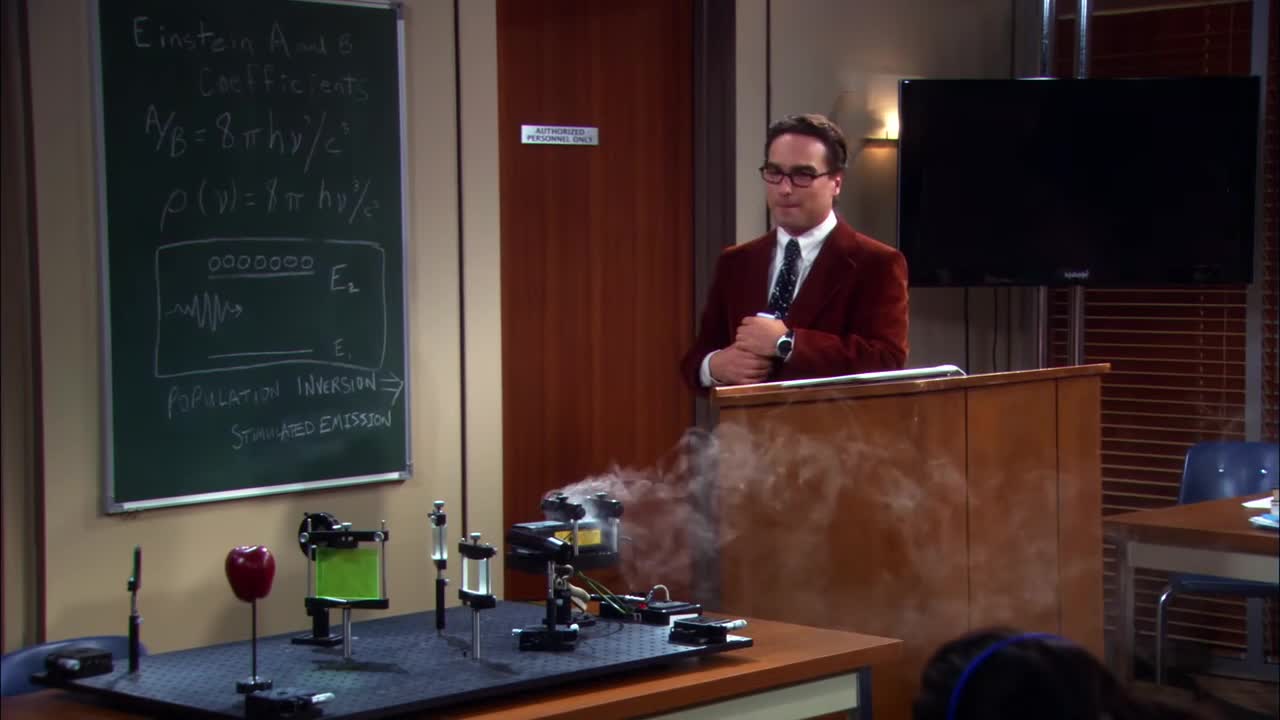
So if any of you are considering going into experimental physics, my door is always open.
Once again, I'm sorry that the demonstration didn't quite work out, but now we know what happens when you accidentally spill Pete Snapple into a helium neon laser.
Short answer is don't.
And now to tell you about the theoretical physics department is Dr. Sheldon Cooper.
Dr. Cooper, forget it.
Excuse me.
Sheldon, we both agreed to do this.
It's a waste of time.
I might as well explain the laws of thermodynamics to a bunch of labradoodles.
If you don't do this, I won't take you to the comic book store.
Hello.
Nice work with the laser, by the way.
Looking out at your fresh, young faces, I remember when I too was deciding my academic future as a lowly graduate student.
Of course, I was 14.
And I already achieved more than most of you could ever hope to, despite my nine o'clock bedtime.
Now there may be one or two of you in this room who has what it takes to succeed in theoretical physics, although it's more likely that you will spend your scientific careers teaching fifth graders how to make papier-mâché volcanoes of baking soda lava.
Oh, good God.
In short, anyone who told you that you would someday be able to make any significant contribution to physics played a cruel trick on you, a cruel trick indeed.
Any questions?
Of course not.
I weep for the future of science.
Now if you'll excuse me, the latest issue of Batman is out.
Come, Leonard.
Laser demonstrations looking pretty good now, huh?
How is Bernadette handling bed rest?
She lies around all day eating Malamars and hollering at me, so her transformation from my wife to my mother is complete.
Congratulations.
I know that's what you were hoping for.
Hey, Sheldon.
You left your jacket in my office last night.
No, I didn't.
That's not my jacket.
Then why does it say, property of S. Cooper, stop touching it?
It sounds like someone named Scooper doesn't want you touching his jacket.
Are you guys working together on the meteorite project?
Yes, fine.
You found me out.
I'm doing geology.
Just please don't tell anyone.
Are you embarrassed of me?
Oh, no, no, no, not you.
No, just the work that you've devoted your entire life to.
If you're ashamed to be working with me, then I don't want to work with you.
Eldon, that was pretty rude.
What do you expect?
He's a geologist.
So, Mr. Cooper, you're looking for a job.
A menial job.
Like yours.
Why, thank you for noticing.
Do you have a particular field in mind?
I do.
For thousands of years, the lowest classes of the human race have spent their lives laboring to erect monuments under the lash of their betters, until finally they dropped down and became one with the dust through which they trudged.
Do you have anything like that?
No.
Shouldn't you check your database?
You didn't really type.
I didn't really have to.
So how about construction?
Oh, that would be good.
Sawing hammering, eating out of a lunch pail, as my working class fellows and I sit perched precariously on a girder high above the metropolis.
No, no, this is putting up sheetrock at a housing project in Rosemead.
I could do that.
One question.
Yes?
What's sheet rock?
Moving on.
How about doing deliveries for a florist?
That seems acceptable.
Do you have your own car?
I don't drive.
Of course you don't.
Mr. Cooper, let me just ask you a question.
What was your last job?
Senior theoretical particle physicist at Caltech focusing on M-theory or, in layman's terms, string theory.
I see.
Just give me a second.
Doesn't bug you when they go out on dates?
They're not dating.
They're just two friends who went out to dinner.
And then went back to the home they share, where they probably fell asleep in the matching pajamas.
She got them because they both just love penguins.
Lots of people wear matching pajamas who aren't dating.
Like who?
Like you and your dog.
Don't rule out the dating.
Fine.
It bothers me.
You happy?
You think you've got problems?
The gibbon is the only member of the ape family not classified as a great ape.
How is this helpful?
All the non-human apes are classified as great apes except one.
That means Taxonomous created the entire category of lesser ape just to single out the poor gibbon as the weird kid on the playground.
Now, there's a hairy little fellow with a genuine beef.
But the gibbon doesn't know what it's categorized as.
It doesn't even know it's called a gibbon.
True.
Sorry, kids, you got it worse than a gibbon.
In conclusion, the data show that at temperatures approaching absolute zero, the moment of inertia changes and the solid becomes a super solid, which clearly appears to be a previously unknown state of matter.
Are there any questions?
Yeah.
What the hell was that?
Any other questions?
Dr. Sheldon Cooper here.
I am the lead author of this particular paper.
Thank you.
And you sir, you have completely skipped over the part where I was walking through the park and I saw these children on a merry-go-round, which started me thinking about the moment of inertia in gases like helium at temperatures approaching absolute zero.
I didn't skip it.
It's just an anecdote.
It's not science.
Oh, oh, I see.
It was the apple falling on Newton's head.
Was that just an anecdote?
You are not Isaac Newton.
No, no, that's true.
Gravity would have been apparent to me without the apple. possibly be that arrogant.
You continue to underestimate me, my good man.
Look, if you weren't happy with my presentation, then maybe you should have given it with me.
As I've explained repeatedly, unlike you, I don't need validation from lesser minds.
No offense.
Really?
So why did you come?
Because I knew you'd screw this up.
I didn't screw it up.
Oh, please.
I admit, that spherical chicken joke, that was hilarious.
But it was straight downhill from there.
You know what?
I've had enough of your condescension.
Maybe I didn't go to college when I was 11 like you.
Maybe I got my doctorate at 24 instead of 16.
But you are not the only person who is smarter than everyone else in this room.
No offense.
And I am clearly not the only person who is tormented by insecurity and has an ego in need of constant validation.
So you admit you're an egotist?
Yes.
My name is Dr Leonard Hofstetter and I could never please my parents, so I need to get all my self-esteem from strangers like you.
But he's worse.
Okay, that is it.
Stop it.
You cannot blow up my head with your mind.
Then I'll settle for an aneurysm.
Stop it.
You hit me.
You saw that.
He hit me.
I'm trying to blow up my head.
So it was working.
It wasn't.
It was not.
You are a nutcase.
Oh, see about that.
Heads up, you people in the front row.
This is a splash zone.
Stop it.
Quit it.
Is this usually how these physics things go?
More often than you think.
And action.
Please don't shut me out.
Go away.
Just go away.
I swear I will find a way to turn you back.
What gave you the right to mix my DNA with that of a killer gorilla?
I was trying to save your life.
Life?
What life?
Look at me.
I'm a monster.
And now I have blood on my hands.
Or paws.
I don't know.
You can't give up.
I love you.
I love you, too.
But I'm afraid I love killing more.
And it's like one day I might actually try and kill you.
And cut.
All right, let's set up for the next scene.
Actually, you know what?
Can we do one more?
I think I could do it better.
Let's just move on.
No one cares.
Well, I care.
I mean, look, if we're going to do this, why not try and make it something we're actually proud of?
Look, sweetie, this movie is garbage, but you should be happy about that because if it was a good movie, you wouldn't be in it.
Hang on.
There's no need to insult her.
And who are you?
I'm her boyfriend.
Isn't she too hot for you?
A little, yeah.
Well, boyfriend, get off my set.
You can't do that.
He's with me.
You know what?
You can get off my set, too.
You're fired.
What?
You can't fire me.
I'm the star.
I'm a girl that goes bananas.
It says so on the poster.
Yeah, but we just shot the last scene where we see your face.
So from now on, the star of the movie is whoever wears this.
Hey, if you're gonna fire her, then you gotta fire me too.
Wow, that fell apart really fast.
Excuse me.
Hello, this is Dr. Hofstadter.
Okay.
All right, thank you.
That's weird, getting called into human resources.
What did you do?
I don't know.
I just got called in to Human Resources.
Why?
I don't know.
That is so strange.
Human Resources wants to talk to me tomorrow.
Could you stop licking your ass for two minutes?
I have a problem here.
Do you really think you should be drinking right now?
How else am I supposed to talk to the human resources lady?
I don't know.
Seek professional help.
I did.
The guy at the liquor store said this stuff tastes great in coffee.
You got called in too?
What is going on?
Sheldon threw us all under the bus.
I feel like I've been called down to the principal's office.
Although I wouldn't mind if brown sugar suspended me.
From a sex swing, this may have been a mistake.
Relax, everything's gonna be fine.
Before I met Bernadette, I was in here every other day.
And little tip, turn off your I Like Big Butts ringtone before you go in.
This is all your fault.
Well, this is my fault.
If you weren't screwing around with Sheldon's assistant, none of this would be happening.
I wasn't screwing around with anyone.
Oh, of course not.
She was just sniffing around your goods because she was hunting for truffles.
Oh, Mr. Wallowitz, it's been a while.
Hey, Janine.
How are Tom and the kids?
Fine.
You must be Dr. Hofstetter.
Yes, but I think this is all a big misunderstanding.
Yeah, me too.
I didn't do anything.
Is that alcohol on your breath?
Howard built a sex robot.
That is not true.
All I did was build a robot.
Did it have six breasts?
I'm sorry, I'm a feminist.
I don't notice things like how many breasts a robot has.
Well, hello.
What are you doing here?
Actually, I came to speak to Mrs. Davis.
And I'm a little busy right now.
Yeah, but I came to file a complaint.
Somebody has made me feel uncomfortable in the workplace by using language of an inappropriate and sexual nature.
And who is that?
Well, you, you dirty birdie.
I thought about the things you said to me yesterday, and I realize I'm deeply offended.
Now, be a deer and get me one of those complaint forms.
That's it, all of you in my office now.
Thanks to you, I know better than to ask if you're menstruating.
And based on your behavior, I don't have to.
Has your assistant said anything about me?
No, in fact, she has.
Her exact words were, what is that guy's problem?
I'm in her head.
Let the dance begin.
Here's your frozen yogurt, Dr. Cooper.
This should be fun.
Half chocolate, half vanilla, side by side, not swirled.
Yes.
Half a teaspoon of sprinkles.
Rainbow, not chocolate.
Two cherries.
One on top, one on the bottom.
Stems removed.
Top one, yes.
I didn't check the one on the bottom.
Oh.
I'm so sorry, Dr. Cooper.
It's all right, Alex.
I'm not mad at you.
I'm just disappointed.
Wait, Alex, do you want to join us?
Um... Alex, a moment.
I need a word with Dr. Hofstadter.
Do you think it's appropriate for her to sit with us, given her station?
Given her what?
If I've learned anything from British television shows on PBS, it's that servants dine downstairs with their own kind.
What?
It's a kindness, Leonard.
Otherwise, you're cruelly tempting them with a glimpse of a world that's just beyond their sustained fingertips.
Oh, sure.
Please join us.
Oh, okay.
Thank you.
Hello, Alex.
What's the topic of your dissertation?
I'm looking for Trojan asteroids at Earth's L5 Lagrange point.
Oh, that happens to be Dr. Koothrapali's field of expertise.
You two have a lot to talk about.
Is that true?
You all right?
No.
But compared to your boss, he's the poster boy for Santa.
It's OK.
I've been around scientists all my life.
My dad's an astronomer at SETI.
Oh, SETI, the Search for Extraterrestrial Intelligence.
You should introduce him to Sheldon.
The search is over.
So what kind of research are you doing?
High-energy lasers.
Ooh, military?
Not yet, but I can remove unwanted hair from two miles away.
You were right.
I had nothing to worry about.
That skank's your problem, not mine.
You're very funny, Dr. Hofstadter.
Oh, thank you.
Cherries dip!
Cherries dip!
Leonard, where do you stand on the anthropic principle?
Interesting question.
On the one hand, I always thought- You don't even know what it is, do you?
The anthropic principle states that if we wish to explain why our universe exists the way it does, the answer is that it must have qualities that allow intelligent creatures to arise who are capable of asking the question, as I am doing so eloquently right now.
I know what the anthropic principle is.
Of course, I just explained it to you.
Where do you stand on it?
Where do you stand on it?
Strongly pro.
And I believe that God created the world in six days, and on the seventh, he made you to annoy me.
Hey, guys.
Hey.
Raj, where do you stand on the anthropic principle?
I'm all for it.
Gatta boy.
Hang on.
Why do you believe that he knows what it is and I don't?
Oh, Leonard, let's not take a saw to the branch we're sitting on, shall we?
Hey, if you guys are free.
Tonight I heard about a spa where you soak your feet in a pool full of little fish that eat all the dead skin right off them.
I don't need to tell you, in Los Angeles, sandal season is year-round.
Actually, I'm hanging out with Penny.
Oh, okay.
Sounds like it's me and you, Sheldon.
How about we stick some guppies on those puppies?
As I've stated before on numerous occasions, the only sea creature I would even consider being eaten by is the Kraken, because the last words I would hear are release the Kraken.
That never gets old.
Release the Kraken.
Oh, chills.
Besides, I'm having dinner with Amy.
Oh, okay.
I'll just go home and be alone, which is cool.
I eat alone, I sleep alone, I cry alone.
So, cool.
Darn.
If you weren't busy, I'd ask you to join us.
Really?
I can come?
Thanks.
Sheldon, are you sure you want to be bringing Raj on your date night with Amy?
Oh, absolutely.
I have a contractual obligation to provide Amy with conversation and casual physical contact, but nowhere is it specified that I can't outsource that to an Indian.
Hey, what if I took your class?
Why would you do that?
Yeah, why would you do that?
What's wrong with you?
I'm thinking about getting my doctorate and he wants to teach, why not?
Oh, Howard, I appreciate the gesture, but this is a graduate level physics class.
I don't think you'd understand a single thing I was talking about.
Ask why not again, I've got an answer.
Sheldon, I'm more than smart enough to take your class.
No.
Yes.
How would you determine the ground state of a quantum system with no exact solution?
I would guess a wave function and then vary its parameters until I found the lowest energy solution.
Do you know how to integrate x squared times e to the minus x without looking it up?
I use Feynman's trick, differentiate under the integral sign.
Okay.
What is the correct interpretation of quantum mechanics?
Since every interpretation gives exactly the same answer to every measurement, they are all equally correct.
However, I know you believe in the many worlds interpretation, so I'll say that.
Now, do you think I'm smart enough? for a couple more years than me, but guess what?
Engineers are just as smart as physicists.
You take that back!
No.
I was asked to be a part of a magazine article about the 50 sexiest female scientists in California.
Isn't that cool?
I think it's awful.
Why would you say that?
Bernadette is a successful microbiologist.
She should be celebrated for her achievements, not her looks.
I mean, what kind of message does that send?
I think the message is check out the rack on that scientist.
Why can't someone be thought of as both smart and pretty?
I just don't think a professional woman should have to flaunt her sexuality in order to get ahead.
Okay, what's the big deal?
Look, if it helps you make a sale with a physician, I don't think it hurts to flirt a little.
I mean laugh at their joke, touch their arm, maybe crank up the AC in the car beforehand, you know, to wake up the girls.
Maybe it's different in the world of sales, but it's already hard enough for women to be taken seriously in science.
I was kind of excited about the article, but now you're making me feel bad.
I think you should do whatever you want.
You know, maybe if fashion magazines had female scientists in them, I would have become a theoretical physicist.
Stop smirking at each other!
So, how was work today?
It was fine.
But you'll be happy to know they pulled the sexy scientist article.
What happened?
I don't know.
They just canceled a photo shoot and said they're rethinking it.
I'm really sorry, but I think it's for the best.
You want people focusing on your achievements, not staring at your breasts in some magazine.
I guess.
It's really not that important.
Hey, up here.
Sorry, we were just talking about them.
So...
Look, I wasn't going to say anything, but since you seem to be okay with the article being canceled, I have a little confession.
I'm the reason it was pulled.
What?
How?
I sent the editors of the magazine a pretty scathing email.
Amy, what did you say?
I simply pointed out that they would never consider doing an article ranking male scientists on their sexuality, let alone showing them in various stages of undress.
Because no one wants to see Neil deGrasse Tyson in a wet t-shirt bent over the hood of a pool.
It doesn't make a difference, because they agreed it was in bad taste and now you agree, so Amy saves the day.
No, what happened was you got jealous, so you took away a chance for me to get some publicity.
But it was bad publicity.
That's for me to decide, not you.
I disagree.
As a female scientist, I think what you do affects all of us.
And I think you don't like people expressing their sexuality because no one wants you to express yours.
Oh, Amy, I'm so sorry.
That was over the line.
You have a nice night.
Please don't go.
Up until my vicious attack, you were the one in the wrong.
So what's your news?
Remember that little planetary object I spotted beyond the Kuiper Belt?
Oh, yeah.
2008 NQ sub-17.
Or as I call it, Planet Bollywood.
Anyway, because of my discovery, People Magazine is naming me one of the 30 under 30 to watch.
Congratulations.
That's incredible.
Excuse me, the 30 what under 30 what to watch what?
30 visionaries under 30 years of age to watch as they challenge the preconceptions of the fields.
If I had a million guesses, I never would have gotten that.
It's pretty cool.
They've got me in with a guy who's doing something about hunger in Indonesia and a psychotherapist who's using dolphins to rehabilitate prisoners, and Ellen Page, star of the charming independent film Juno.
Oh, I'd so do her.
You'd do the dolphins.
Do I get an honorable mention for designing the telescope camera mounting bracket you used?
Sorry, it's not part of my heartwarming and personal narrative in which a humble boy from New Delhi overcame poverty and prejudice and journeyed to America to reach for the stars.
Poverty?
Your father's a gynecologist.
He drives a Bentley.
It's a lease.
I'm confused.
Is there some sort of peer review committee to determine which scientists would be included?
Peer review?
It's People magazine.
People picked me.
What people?
The people from People.
Yeah, but exactly who are these people?
What are their credentials?
How are they qualified?
What makes accidentally noticing a hunk of rock that's been traipsing around the solar system for billions of years more noteworthy than any other scientific accomplishment made by someone under 30?
Boy, I bet Ellen Page's friends aren't giving her this kind of crap.
You proud of yourself?
In general, yes.
Let's go over our emotional responses one last time.
Okay.
Professor Tupperman is dead, and that makes us... Sad.
The fact that there are so many people here tonight doesn't make us cranky and claustrophobic.
It makes us... Glad.
Giving Mrs. Davis the box set of roots was... Bad.
However, you're fine.
Bad.
Unbelievable.
You have some nerve showing up here just to schmooze with the tenure committee.
You're here.
Excuse me.
I'm here to pay my respects to Professor Tupperware, or whatever his name is.
So am I. His passing makes me feel bad.
Well, well, well, Sheldon.
Fancy meeting you here.
I guess the train store in Glendale wasn't having a cotillion after all.
And you, you said you weren't coming here either.
I would take action.
You don't know what I said.
I'd like to know why Penny's here.
I'm here to support my man, just like you.
What are you going to do?
Take people's drink orders and get them wrong?
Do it.
What, does she do it yet?
She plans on flirting with members of the tenure committee to further Leonard's cause.
Well, that's a fine how-do-you-do.
Don't just stand there, take your breaths out.
Ooh, mere cat fight.
You're all wasting your time.
Sheldon is the most qualified for the job and no amount of gravity-defying bosom's gonna change that.
Seriously, is that tape?
Like, how are they staying up like that?
Way to hit him with both barrels.
You two should be ashamed of yourselves using women to advance your cause with sexuality and whatever Amy plans on doing.
Are you implying that my girlfriend has no sexuality to exploit?
Yes.
Okay, because that was not clear.
Sheldon!
That was ambiguous.
Well, now it's big-uous.
What are you gonna do about it?
You can talk some smack about his mother.
Yes, of course.
He wouldn't like that at all.
Last night, I was feeling in need of sexual release when I happened to come across your mother.
Okay, okay, guys, what are we doing here?
I don't know what you're doing, but I was about to insinuate that I had coitus with Raj's mother for a dollar.
You know, you do what you want, but I don't want to lose my friends over tenure.
Friends are forever.
So is tenure.
I'm just gonna go home and let my work speak for itself.
You're right.
This is beneath me.
Like your mother was last night.
How about it, Sheldon?
What do you think I should do?
Well, you'll always be an academic success, seriously question whether you'll make any more friends.
Well, I don't want any more of it.
Let's go.
Are you kidding?
I would love to babysit for you.
I could not ask you to do that.
Nonsense.
Children love me.
Something about me just makes them laugh and wow.
No, we cannot lose to that jerk.
Yeah, screw it.
I'm going in.
Hold on.
I believe screw it, I'm going in is what I said to your mother last night.
Don't worry, I didn't really say that.
I find the concept of coitus ridiculous and off-putting.
Should have taken my breasts out while I had the chance.
Mrs. Davis?
Mrs. Davis.
Mrs. Davis.
I know you're in there.
I saw your car in the parking lot.
What?
I just found out that you recommended myself, Dr Hofstadter and Dr Kutharpali to be on the shortlist for tenure.
Well, despite your quirks, the three of you are very accomplished in your respective fields.
I don't know what you mean by quirks, but, um...
I do want to express my gratitude.
You didn't bring another gift, did you?
No, no.
No, I learned my lesson.
I understand that was inappropriate.
Good.
Anyway, thank you.
You're welcome.
So I read a study that says a man with a dog is three times more likely to get a woman's phone number.
Is it true even when the man lets his dog lick peanut butter off his tongue?
I don't see why not.
If you're really desperate to meet women and like having food eaten out of your mouth, I can set you up with my mom.
Why is that funny?
That's just unhygienic.
That's a joke.
I don't think so.
I believe that a joke is a brief oral narrative with a climactic humorous twist.
For example, Wallowitz's mother is so fat that she decided to go on a diet or exercise or both.
You see, the twist is that people don't usually change.
Well, they don't.
You guys, don't forget, my episode's on TV tomorrow night.
We'll be there.
Can we bring anything?
Oh, that's so sweet of you, but I was gonna steal food from here.
You know, my treat.
Wait, if Howard's mother is coming, then you should also steal marbles.
Because she's obese and hippos are obese and in the popular board game Hungry Hungry Hippos, they eat marbles.
Maybe I need to dumb these down for you.
Oh, man, did you see this post from Raj?
What?
Is it another video of him and his dog Lady and the Tramping some spaghetti?
No, he can't afford his apartment, and he's asking if anyone knows of a cheap place to live.
I want to say India, but it seems mean.
That's so funny.
Raj is looking for a cheap place to live, and I wrote India.
Don't post that.
Be supportive.
Maybe you should be supportive of my hilarious jokes.
Fine, what should we do?
We're smart.
I'm sure we can think of something.
You want to let him live here?
Oh, we're smart enough.
I know our apartment's small, but I think we could make room.
No, Sheldon.
We're not getting a life-size Spider-Man statue.
We do have Sheldon's old room.
If he really needs a place to stay, I guess we should offer it to him.
You're a good friend.
Am I still a good friend if I wait and hope that Howard offers him a place to live first?
You're an even better husband.
I know if the roles were reversed, he would do it for me.
Where would he stay?
We already have Stuart.
Well, we can make some space in the garage.
Maybe put a cot out there, get him a space heater, maybe a hot plate.
That sounds awful.
Let's hope he thinks so, too.
For the last time, no Hulk, no Batman, no life-size statues.
I'm starting to think you didn't mean it when you said you wanted to spruce up the place.
Hey, the cashier.
Sheldon Cooper?
Good morning, Your Honor.
Dr. Sheldon Cooper, appearing in pro se.
That is to say, representing himself.
I know what it means.
I went to law school.
And yet you wound up in traffic court.
Anyway, if it would please the court, I'd like to begin with an opening statement.
The court would advise you to make it quick, as the court had a dicey-looking breakfast burrito this morning and just took an Imodium.
Very well.
A quick opening statement.
Like a milking stool, my case rests on three legs.
I will demonstrate that I was improperly instructed in driving by a woman whose lack of respect for society borders on the sociopathic.
I will argue that the emergency met the legal doctrine of quod est necessarium est licitum, that which is necessary is legal.
But first, I will raise a Sixth Amendment issue.
I am unable to confront my accuser, a non-human entity, to wit, a camera.
So, to sum up improper instruction quod est necessarium est licitum.
Sixth Amendment my milk stool is complete.
Impressive.
Thank you.
Guilty.
Pay the cashier.
I object.
You're completely ignoring the law.
No, I'm following the law.
I'm ignoring you.
Really?
I would point out that I am at the top of my profession, while you preside over the kiddie table of yours.
Dr Cooper, before I find you in contempt and throw you in jail, I'm going to give you a chance to apologize for that last remark.
I'm a scientist.
I never apologize for the truth.
That's my spot.
Gentlemen, I put it to you.
The worst tapioca pudding is better than the best pudding of any other flavor.
First off, that is axiomatically wrong because the best pudding is chocolate.
Secondly, the organic structure of tapioca makes it a jiggling bowl of potential death.
It is extracted from the plant... Hey, I'm thinking of growing a mustache.
No kidding.
Fu Manchu?
A handlebar?
Pencil?
It's extracted from the plant... You know, George Clooney has one.
Really?
I once saw him shopping at Ralph's.
He was buying tequila.
You think a guy like that would have some kind of booze lackey?
All right, this is cruel.
We better let him finish before his head explodes.
All right, Sheldon.
Why is Tapioca- Tapioca is extracted from the root of the plant Monohod Escalenta.
Due to a high concentration of cyanide.
It is poisonous in its raw form and lethal if prepared improperly.
Feel better now is also indigenous to Brazil, as is the cocoa bean from which we get chocolate, the best pudding.
You promised you wouldn't do that anymore.
Hey, Hofstadter.
Hey, Kripke.
Heard about your latest anti-proton decay experiment?
20,000 data ones and no statistically significant results.
Very impressive.
What a jerk.
Don't feel bad, Leonard.
Negative results are still results.
Even 20,000 of them?
Please don't cheer me up anymore.
Come on, don't let him get to you.
It's Kripke.
Yeah, he's a ginormous knob.
That's why he eats by himself instead of sitting here at the cool table.
For shizzle.
It's true, Kripke lacks the basic social skills that we take for granted.
But he also controls the new open science grid computer that I need to use to run some simulations of structure formation in the early universe.
Well, good luck getting time on it.
The only people he lets use it are his friends.
Well then, the solution is simple.
I shall befriend him.
Cricky!
Yeah?
What would you say to the idea of you and I becoming friends?
I would say, I have no interest in becoming your friend.
Really?
That seems rather short-sighted coming from someone who is generally considered altogether unlikable.
Why don't you take some time to reconsider?
Yeah, I'll do that.
Well, I think we're off to a terrific start.
You're improving.
Thank you.
It helps when I get to practice with a real woman.
Hey, listen, Saturday my sister's getting married.
I want you to come with me.
It's black tie.
Yeah, gee, I'd really rather not.
Why not?
When I go to weddings, it's to scam on chunky bridesmaids.
I don't know what I would do with a date.
Oh, all right.
I understand.
Thanks.
Hey, I'm really sorry about that Geneva trip.
Oh, didn't you hear?
I had to reduce the number of people going, and you didn't make the cut.
When did that happen?
About 12 seconds ago.
Hold on.
Are you saying if I don't go to the wedding, I can't go to Geneva?
Well, actually, I'm trying not to say it.
Okay, I'm sorry, but that makes me a little uncomfortable.
How so?
Because it's like you're controlling me with new equipment and research trips.
Well, if I weren't controlling you with new equipment and research trips, then I'd be uncomfortable.
How so?
Because then we'd be in like a real relationship with feelings and all that crap.
So bottom line, I'm just a bought and paid for sex toy.
No.
No, no, not at all.
You're also arm candy.
So, what do you think?
Hey Ma, you gotta rent me a tux!
Right now?
What kind of sex are you having up there?
Alex, check my schedule.
What does my afternoon look like?
I think it's pretty wide open.
Oh, wait, here's something at 4 o'clock.
Give Alex a talking to?
Well, that snuck up on us, didn't it?
Is there a problem?
Let's not call it a problem.
Let's call it an opportunity to solve a serious problem.
What did I do?
You don't know?
Oh, you poor dear.
Your ovaries are squirting so much goofy juice into your brains you don't even know which way is up.
You made an inappropriate sexual advance towards Dr. Hofstadter.
What?
I didn't make a sexual advance on anybody.
Now, there's no need to get defensive.
I'm not unsympathetic to your plight.
My father used to say that a woman is like an egg salad sandwich on a warm Texas day.
What?
Full of eggs and only appealing for a short time.
This conversation is making me uncomfortable.
Yeah, you and me both, sister.
Please understand, I don't hold you responsible for your behavior.
You see, from an evolutionary standpoint, you're a slave to your desire to reproduce.
But during the workday, when you feel possessed by amorous intent, may I suggest that you suppress it by leafing through this illustrated book of sexually transmitted diseases.
Oh yes, check out this oozy doozy.
I have to go.
So does this fellow, but he can't without it burning like hot soup.
The more I told him about my lab, the pissier he got.
You know what he said to me?
He said, I hope all your correlations turn out to be specious.
Is that your face?
What a dick.
No.
If you're a successful woman, you should be able to brag about your accomplishments once in a while.
So should you.
I mean, the guys are never shy about bragging.
Tell me about it.
How he texts me every time his dog levels up in Warcraft.
Has he ever called you to tell you he found three peanuts in one shell?
Because Sheldon has.
We should be able to do that too.
I guess we can brag to each other.
Great idea.
Damn right it is.
I came up with it.
That felt good.
You know, there's so much money in pharmaceuticals, we don't even wash out our test tubes.
We just throw them out and get new ones.
I just got a brand-new, state-of-the-art fMRI machine.
Oh, those things are so expensive.
I know.
Sometimes I just lie down in there and take a nap.
It's like a million dollar bunk bed.
At the office, I have two assistants.
I don't even know their names.
I just call them Thing One and Thing Two.
That's great.
I don't have assistants.
I guess that's one of the benefits of being in the private sector.
That and all the money I make.
Yeah, you've got that.
I've got my integrity.
Hard to say which is better without making you feel bad.
I may not make as much money as you, but at least I know that I'm actually doing something that makes people's lives better.
Hey, my work makes people's lives better, especially if you have moderate to severe eczema, and don't mind if you lose teeth.
You're right.
We both do important work.
I'm trying to map the structures of the brain and you're trying to convince people that itchy hair is a real thing.
It is a real thing.
It happens to be a side effect of our cholesterol drug.
I'm just saying that my research may actually change the world forever.
I hope it does, because I'm going to see that world from a yacht so big you can land a helicopter on it.
Here it comes.
You tried to take care of me when I was sick and I was mean to you.
There's no excuse for that and I'm truly sorry.
Thank you.
I appreciate that.
And I want you to know that that is sincere.
I do feel bad.
I'm not just saying it to be included on your trip.
Appreciate that too.
Terrific.
Now all this left is for you to invite me to come me to ask are you sure you to say absolutely and then me to bring it home with how could I say no to that face?
I'm still not coming.
I apologize, and I meant it.
I know that we don't play this game very often, but you're doing it wrong.
Sheldon, I accept your apology, but you upset a lot of people while you were sick.
I'm not in a position to just say you can come.
All right.
What if I apologize to all of them?
Fine.
If you apologize to everyone, they all say it's okay, then yes, you can come.
Challenge accepted.
Sounds like it's time for the Sheldon Cooper apology tour.
Howard and Bernadette, you tried to comfort me when I was ill and I treated you terribly.
I'm sorry.
Wow.
I'm impressed.
No, wait, I'm not done.
Allow me to underscore my sentiment with a haunting rendition of Brenda Lee's I'm Sorry, played on the pan flute.
The apology accepted.
We all right.
That's eight hours of practice down the drain.
And to memorialize this occasion, here are your commemorative t-shirts.
Sheldon Cooper apologized to me.
And he made it all better.
All you did was offer maternal care and affection, and all you received in return was rude and insensitive behavior.
Can this wait?
I'm afraid it can't.
The trip is tomorrow and I have more apologies to make.
Okay, fine.
I accept your apology.
Now get out.
Wonderful, now would you mind holding up this shirt while i you brought me my comic books when i wasn't feeling well, that that was thoughtful and i was insensitive, i'm sorry.
Thank you, sheldon.
I appreciate that, and then i want you to know that i mean it.
This isn't me just wanting to go on the trip to las vegas what trip to las vegas?
The one everyone's taking this weekend on the party bus.
Of course, I wasn't invited.
That would be my understanding.
On a less painful subject, what size t-shirt do you take?
Raj, you were being a good friend, and my illness was no excuse for my behavior.
I hope that you can accept my apology.
Of course I do.
And Emily, I'm sorry for saying dermatologists aren't real doctors.
I'm sure you're tired of hearing that.
Do you honestly think I hear that a lot?
Well, I would imagine when your job is popping zits and squirting Botox into old lady faces.
Okay, the point is that we accept your apology.
Maybe you do.
He just insulted me again.
But he doesn't mean it.
Why are you defending him?
I believe I can answer that.
Like me, Raj is demonstrating empathy.
Now, why don't you accept my apology, receive your free t-shirt.
I hope extra small is okay.
For some reason, Wolowitz took a medium.
Well, I don't accept your apology.
What are you doing?
It's called standing up for myself.
You should try it sometime.
Fine.
How about this?
You're making me uncomfortable by prolonging this ridiculous fight, and I wish you'd stop.
You want me to stop?
No problem.
No, come on.
No, please don't leave.
Point of clarification, are you still going on the trip?
Because if not... Don't worry, you're good.
Is she okay?
Yeah, I calmed her down, but she's not going to Vegas if he's going.
Wait, that's an option?
I didn't know that was an option.
Well, that is fine, because I've decided that I won't be joining you.
I've realized that the most genuine way to demonstrate the remorse I feel is to let you have this weekend to yourselves.
That's very mature of you.
Well, I've been on a little trip myself recently.
Not to Sin City, but to Sincere City.
Where instead of genital warts, the only growth you'll come back with is personal growth.
And there's your next t-shirt.