Public media counts on your support to ensure that the reporting and programs you depend on thrive.
Make a recurring donation today to get special access to more than 20 NPR podcasts.
Perks like sponsor free listening, bonus episodes, early access and more.
So start supporting what you love today at plus.npr.org.
You're listening to shortwave.
From NPR.
And liftoff.
Liftoff of the 25th Space Shuttle mission and it has cleared the tower.
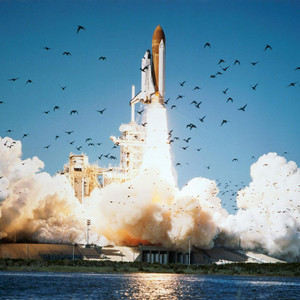
On January 28 1986, the 25th Space Shuttle mission Challenger left the launch pad in Cape Canaveral.
There's a crowd of people watching and you can hear them clapping and cheering as the shuttle leaves the pad.
And then, 73 seconds into flight... The shuttle disintegrates.
That's Adam Higginbotham, a journalist who spent years reporting on the Challenger disaster.
And he says that, even as the people watched the shuttle burst into flames, There are still a lot of people in the crowd who are still clapping and cheering.
Because they think, or they want to think, that this is part of a normal launch process.
And at the same time, you can hear Steve Nesbitt, who was the commentator from NASA, who was sitting in mission control in Houston, continuing to read out the data about the speed of the shuttle and its altitude.
Even as the shuttle itself has already disappeared into this blossoming orange cloud of burning rocket fuel.
And then, static.
We have a report from the flight dynamics officer that the vehicle has exploded.
Flight director confirms that we are looking at checking with the recovery forces to see what can be done at this point.
In his book Challenger, a true story of heroism and disaster on the edge of space.
Adam pieces together stories from key officials, engineers and the families of those killed in the explosion.
Today on the show the 40th anniversary of the Challenger disaster, lessons from the space shuttle program and why space travel may never be routine.
I'm Regina Barber, and you're listening to Shortwave, the science podcast from NPR.
This message comes from Wix.
Nothing beats seeing your ideas turn into cold hard cash.
Well, if you use Wix Harmony, you better get used to it.
Wix Harmony makes it unbelievably easy to create a fancy new website that's built to sell.
Get the perfect blend of AI and drag-and-drop tools that puts you in control of every detail, plus an AI agent to help you every step of the way.
Try it for free at wix.com slash harmony.
Valentine's Day is coming up and the perfect gift for the NPR lover in your life is waiting at the NPR shop.
From cozy sweaters and mugs made for slow mornings to our tiny desk hoodie, there's something for every NPR fan.
Each purchase supports public media and the journalism you love.
Find something meaningful at shopnpr.org.
So Adam, some of our listeners may not have been alive during the explosion or have even witnessed it.
I was actually four, so I think I witnessed it, but I don't remember it.
Can you take us through the moments right before and after the launch on January 28th?
Right.
Well, I mean, the most important piece of background to the Challenger launch is to understand that that it had been delayed several times before the morning of January the 28th.
Not only that, but the launch before of the shuttle mission before Challenger had been delayed a record number of times for NASA.
And by the beginning of 1986 NASA had made it clear that The shuttle was supposed to be a true spaceship.
It was supposed to operate on this launch schedule, where it was going to launch once a month or twice a month and ultimately as frequently as once a week.
Really?
Yes.
Wow.
And the teacher in space mission.
The Challenger mission had been deliberately engineered to attract as much publicity as possible.
The whole idea for NASA of the teacher in space mission was that it would rekindle flagging public interest in the program.
And this meant that, you know, hundreds of journalists descended on Cape Canaveral for the launch.
So there was a huge amount of attention focused on the launch and then on the delays.
And the delays were additionally embarrassing because they seem to be happening for kind of foolish reasons.
So one of the problems with the explosion the Challenger explosion involved rubber O-rings that sealed the joints between different segments of boosters.
And the engineers who built the rocket boosters at Morton Bacall in Utah were working on fixing those.
Well, Almost since the beginning of the shuttle program, since the first launch in 1981, they'd been finding that these joints did not work as designed.
And so if you got a leak that was even the width of a pencil through one of these joints.
You know that wouldn't be a sort of slow leak that you wouldn't need to worry about for the two minutes the rocket's burned.
It would be a leak that quickly, in a matter of seconds, developed in a way that would cut straight through the steel casing of the rocket, destroying the rocket and then destroying the external fuel tank of the shuttle and then taking the shuttle with it.
And based on previous launches, they thought those problems were related to cold weather.
And fast forward to the day of the Challenger launch, and it's cold.
There's been this cold snap.
Yes.
And as a result of that they call a meeting of the engineers at Thiokol and they unanimously agree that they have to go back to NASA and say we cannot recommend the launch.
You need to postpone the launch until the weather warms up.
And if you don't do that, we fear there's going to be a catastrophe.
They present this argument.
And then the NASA engineers at the Marshall Space Flight Center and the NASA engineers overseeing the program.
They don't actually say we're not going to take your recommendation.
In fact, what they do say is you know, if you continue to recommend against launch, of course we will not proceed.
But they make it very clear in the way they talk to them that they do not want to hear any recommendation against launching.
And they really put them under a huge amount of pressure to reverse that recommendation.
So do they reverse it?
Well, the important thing is that Morton Thiokol, the contractor, you know this for them is the one thing that keeps this arm of the company financially viable.
So they couldn't be more acutely aware of how they really don't want to be upsetting their most valuable customer at this point in time.
So what happens is that they ask for a five-minute recess to get off the call and discuss it amongst themselves.
And during the recess, which eventually stretches to 30 minutes or more, the executives in the room say that they are going to change their minds against the recommendation of their own engineers, who are sitting there in the room with them.
And they eventually vote to say yeah.
Yeah, we'll just go back to them and say that we changed our minds and we're going to go from a no-go for launch to a go for launch.
The launch happens anyway.
Yeah.
Oof.
So then after the Challenger explodes, there was an investigation.
Like, what were the conclusions of that investigation?
The conclusions of the investigation were utterly damning.
You know, the report charts a path to the launch pad that day that was just festooned with red flags going back years.
That the organization as a whole had had plenty of information about problems with the solid rockets.
That went back before the first launch of the shuttle ever took place.
That the designs of these joints had never worked as it was intended.
That although individual engineers over the years brought to their superiors' attention the fact that there were problems and these problems could be serious and needed to be addressed, no really serious effort to do that had started until it was too late.
They found that there were appalling failures of communication in the run-up to the launch.
That although these individual engineers at Morton Thiokol had clearly flagged their concerns and said you know we're worried there's going to be catastrophe, these reports had never been passed up the launch decision chain.
So the most senior NASA managers said, of Kate Canaveral on the day of the launch.
Never got to hear about this.
And really all of this was done in this pursuit of we talked about earlier this like kind of regular space travel, kind of like air travel.
Also to like really be for it to pay for itself, because maybe we're bringing other cargo up into space for companies.
And what represented this everyday flight was getting this teacher to go on the Challenger.
Krista Mikulov.
Yeah.
What did she represent for the Space Shuttle Program?
Well, she was intended to be the first citizen astronaut.
So the whole idea of it was that this was making spaceflight accessible to just people like you and me, regular people who, once you'd been told how to use the escape hatch and the space toilet, then your instruction was at an end.
So they organized this program to interview candidates to be the first civilian in space, the first teacher in space.
And Krista McAuliffe was selected from around 11,000 applicants from all across the United States.
And...
You know, she proved to be just a fantastic candidate for this.
She was extremely charismatic.
She was a fantastic communicator and a really gifted educator who can communicate the ideas inherent in spaceflight to an audience of children and to adults.
You know extremely clearly, you know Challenger wasn't the last space shuttle tragedy.
In 2003, another shuttle, Columbia, launched.
I do remember this explosion.
It was after this shuttle was coming back in and over Texas.
You know, seven astronauts on board died.
What do you make of the fact that this happened like two decades after Challenger?
Well, the accident investigation after the loss of Columbia concluded that you know what lessons had been learned after the Challenger accident had been forgotten or never successfully learned in the first place, because the Columbia accident happened for extremely similar reasons to the reasons that led to the Challenger disaster.
Did this event the Columbia disaster, this one in 2003 did it really lead to the end of the shuttle program?
Yes.
Flat out.
Yes, it did.
Yeah.
How are you thinking about the legacy of this program?
Well, I mean, one of the reasons that I wanted to write the book was because I realized, when I began reading more deeply about what had happened, that that those two accidents, the Challenger accident and the Columbia accident, have come to overshadow the story of the shuttle program.
I mean quite understandably, but in such a way that people now don't really realize what an amazing achievement it was, not merely to get the space shuttle into orbit in the first place in 1981, But then to do all the amazing things they did with it in the years before Challenger and then, once it began returning to flight, in the years before the Columbia accident.
But it's the image I think that's really seared into people's minds is that of the disintegration of Challenger.
And that supplanted the way in which people thought of the shuttle program as just a symbol of people's confidence in the promise of technology in the future.
I think that the Challenger accident really represented a sort of loss of innocence in the way that Americans especially think of the promise of high technology.
And that's one reason why, for me, there was time before the Challenger accident and time after the Challenger accident.
And these are two very different epochs.
Is there going to be a third epoch?
I don't know.
I mean earlier this week I was down in Houston and had dinner with some retired shuttle program astronauts and technicians and engineers from the program.
And a few of them were just sitting around and said you know, people have got to understand that this is spaceflight, is really dangerous.
You cannot treat it as if it's something that's just like getting on an airplane.
And no matter how far technology advances, it's always going to be really dangerous.
And it's a mistake to think of it otherwise.
Adam, it has been wonderful to talk to you about space travels, the space shuttle.
Thank you for coming on our show.
Thank you for having me.
If you liked this episode, follow us on the NPR app or whatever podcasting app you're listening from.
Also, you might want to check out our episode where we hear from an astronaut while she's in space.
We'll link to that episode in our show notes.
I'm Regina Barber.
Thank you for listening to ShoreWave from NPR.
This week on.
Consider This ICE agents in Minnesota now reporting to Tom Homan, the architect of the president's family separation policy.
Who does Homan report to?
Up until now it's been Stephen Miller, but I think the administration is seeing how much trouble listening to Miller has gotten them in when it comes to public opinion.
This week on Consider This, listen on the NPR app or wherever you get your podcasts.
This week on the NPR Politics Podcast.
For months, the president's immigration strategy has been on full display.
Now some Republicans are having a hard time defending it.
Yeah, I think that's a good weather vane for where the politics are headed in all of this.
Cracks in the MAGA coalition.
This week on the NPR Politics Podcast.
Listen on the NPR app or wherever you get your podcasts.