Welcome to Spotlight.
I'm Roger Bassack.
And I'm Gillian Woodward.
Spotlight uses a special English method of broadcasting.
It is easier for people to understand, no matter where in the world they live.
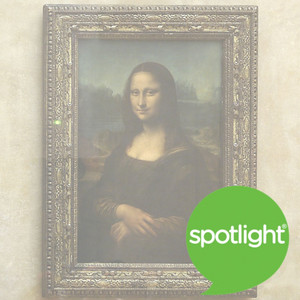
Imagine a painting.
A young brown-haired woman peers out at us.
Her expression is subtle.
It is difficult to tell if she is smiling or not.
Behind her is a foggy land filled with hills and mountains.
Like the woman's smile, these landforms are unclear.
They do not seem to fit in any one place on this earth.
They could just as well belong in a dream.
The background of this painting makes the woman even more mysterious.
She looks out from the painting as if she has a secret to tell.
This is the Mona Lisa by Leonardo da Vinci.
It is one of the most famous pieces in all of Western art.
Though mostly known for his paintings, Leonardo's interests included everything from the human body to engineering.
These interests were not always useful.
He did not gain much from his interests in many different subjects, but these diverse interests made him one of the most important talents the world has ever known.
Today's Spotlight is on Leonardo da Vinci.
Leonardo was born in 1452 in Vinci, near the Italian city of Florence.
He was his father's firstborn son.
But his birth was not considered legitimate.
His father and mother were not married, nor would they ever be.
Leonardo would not get the same rights as his brothers, who were from his father's wife.
He would not be part of the family business.
This may have saved Leonardo's work.
The family's business in law and property made the family wealthy, but it would not have let him follow his interests.
Even at a young age, Leonardo had many of these.
He watched birds to understand how they flew.
He painted.
He made things out of sticky clay.
He studied how water flows in streams and rivers.
He observed how the muscles of horses worked together to create movement.
When he was 12, Leonardo moved to Florence, a center of art and learning.
His father got him a chance to learn with Andrea del Verrocchio, a well-known artist.
This special kind of schooling fit Leonardo well.
He did not learn well from books.
Verrocchio would teach Leonardo how to paint.
He would give the boy real experience and train him as a craftsman and artist.
But Verrocchio taught Leonardo more than just painting.
He taught the young man how to observe.
He believed a person needed to understand something in order to paint it.
It was not enough just to paint a person.
You needed to understand how the body moved.
You needed to understand the relationship between light and darkness.
Verrocchio and his students studied life to make their paintings appear more lifelike.
Leonardo took this teaching to heart.
His notebooks, collected at the end of his life, show a huge array of interests.
Some contain paintings of animals and plants he found in the city.
Others show his interest in the human body.
He even cut up several dead bodies to see how bones and muscles connected and to know the internal parts of the body.
The paintings and drawings he made of these bodies are very true to life.
His studies gave him a better understanding of how and why people moved.
By the time he was 20, most people in Florence recognized that Leonardo was a great artist in his own right.
He opened up his own workshop.
He began making his own paintings.
He would move many times to work in different cities.
But this workshop marked the beginning of Leonardo's most famous paintings.
One of the most famous of these paintings is The Last Supper.
This painting shows a story from the Christian Bible.
In this story, Jesus, who Christians believe is the Son of God, invites his friends to a meal.
He tells his friends that he is going to die the next day.
But Jesus knows how these men will act.
He even knows the man who will betray him.
But he forgives them and tells them they will be saved by trusting him.
This is a very important story for Christians.
It describes a tradition called Communion.
It shows them that their God is a loving God for all people.
Leonardo's painting tries to show all of this in a single image.
Jesus sits in the very center of the painting.
His face is calm.
He has accepted what is going to happen to him.
But his friends are anything but calm.
Each of them is frozen in a different state of emotion.
Some show anger, some fear.
One, named Judas, seems guilty.
Leonardo created their faces using real people in the city as his models.
This gives the painting a lifelike quality that was shocking at the time.
Kenneth Clark was a British historian.
He said, You cannot look long at The Last Supper before you stop thinking about it as a painting.
You start speaking about it like theatre.
Leonardo saw no real difference between science and art.
He made medical discoveries while he studied for his paintings.
He painted ideas that appeared to be plans for inventions.
His interests were deep.
He followed these interests wherever they took him.
These scientific interests were important for his inner process of creating art.
But Leonardo was sometimes difficult to work with.
He was interested in almost everything.
But he had a hard time finishing his work.
He left many of his great paintings half done.
Many he did not consider finished, even when most people would.
Leonardo worked on the Mona Lisa itself for 16 years.
Even then, he did not consider it done.
Ludovico Sforza was the ruler of Milan, a kingdom in modern Italy.
He paid Leonardo to paint the Last Supper.
Once Sforza protested his timeliness.
Leonardo told him, Men of great talent sometimes do the most when they work the least.
Their minds are occupied with their ideas and making them perfect.
Afterward, they give these ideas form.
Leonardo's talents often seemed aimless.
He did not always produce what others wanted from him.
But his interest in observing everything around him led him to projects outside the world of art.
When he was in Milan, he designed new water pipes for the city.
He designed a machine to take water out of a wetland.
On another occasion, he created machines for theatre.
His notebooks are full of inventions, like flying machines, futuristic weapons, and even a car.
Many of these inventions were never built.
Some were too modern for their time.
They were not realistic.
But Leonardo was the first person to think of them.
Walter Isaacson is a history writer.
In his book on Leonardo da Vinci, he said, The things Leonardo saw for the future often happened.
It took a few centuries.
Machines to breathe under the water.
Flying machines and helicopters now exist.
Pumps now empty wetlands.
Sometimes dreams lead to reality.
Leonardo da Vinci died in 1519.
He was 67 years old.
Today, art historians consider him one of the most important painters in history.
He invented hundreds of machines and explored ideas others would consider impossible.
In his lifetime, he was known for the beauty of his work.
Today, we also recognize him for the beauty of his mind.
It was a mind that imagined wildly, that explored everything it touched.
It was a mind that has led some historians to call him the most interested man in the world.
Leonardo was a master of many areas.
Is this mastery of so many different subjects still possible for someone today?
You can leave a comment on our website at wwwspotlightenglishcom.
You can also find us on YouTube Facebook, TikTok and X.
You can also get our programmes delivered directly to your Android or Apple device through our free official Spotlight English app.
The writer and producer of this program was Dan Christman.
The voices you heard were from the United States and the United Kingdom.
All quotes were adapted for this program and voiced by Spotlight.
This program is called Leonardo da Vinci, the most interested man in the world.
We hope you can join us again for the next Spotlight program.
Goodbye.