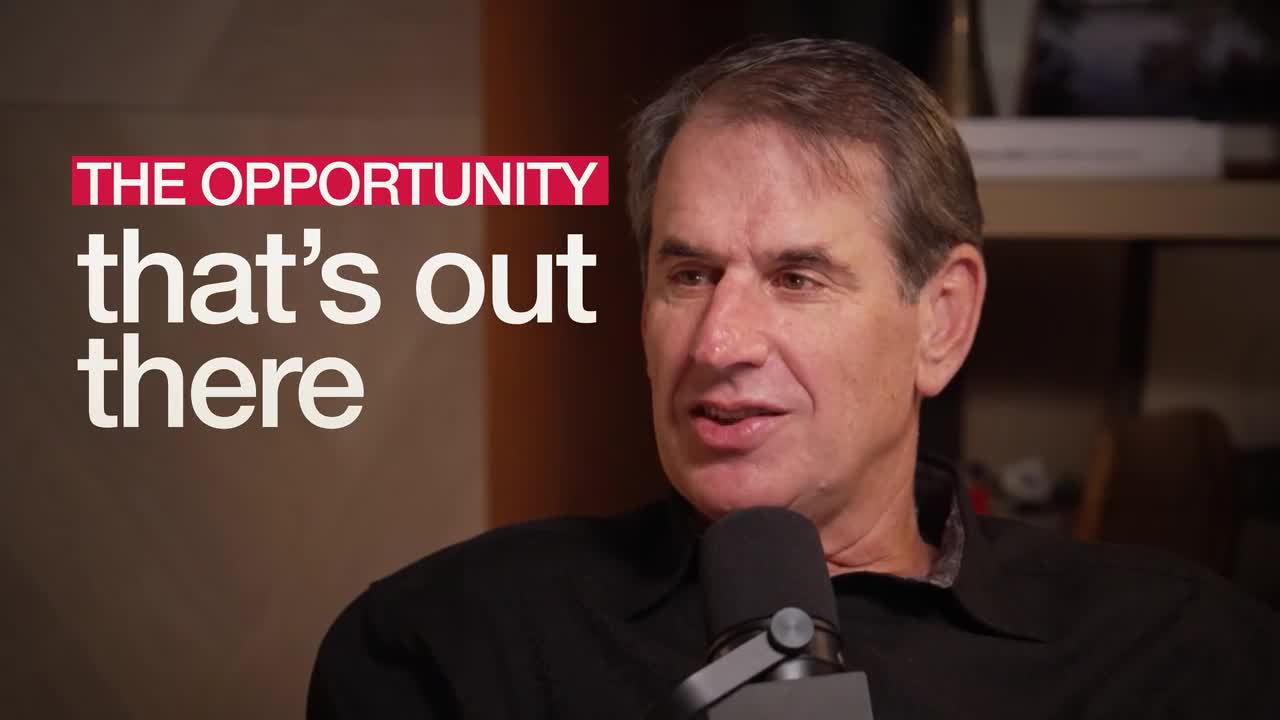
What do you see in founders who are winners or losers?
I borrowed this one from Jeff Bezos.
He said, I only look for one thing, determinism that's unbridled.
Bill Gurley is a legendary venture capitalist, early investor in Uber, DoorDash, Asana, eBay, Snap.
And today we're breaking down who will actually survive in an AI-dominated world and the skill stack that makes you anti-fragile instead of obsolete kind of want to go to AI.
I think AI is a superpower.
There's never been a better time in the history of the world.
It's insane the opportunity that's out there for you.
Kobe Bryant, after winning his fourth championship, asked if he could come to Houston to learn Hakeem's footwork in the post.
It's a powerful statement that someone with that much success was trying to find an area where they could improve.
I ask anyone who's chasing any career, are you like?
The question I have for you is like what do you see in founders who are winners or losers?
One element of being a great founder, and we're talking about people that can not just start a small company, but one that can grow it into a much bigger company.
One element is salesmanship.
And it's not something that you hear a lot of people talk about.
But in order to grow a company to a very large size, obviously you have to sell customers, but you also have to sell employees and you have to sell partnerships and you have to sell incremental investors.
And you're just out and you own the brand of the company, which you're likely promoting.
And if you're not good at that, it'll be very difficult to outrun the other company you know that may be competing for that.
So that's one.
It took me probably my entire 25 years to come to terms with this.
But you do, I think you really need to be great at product.
Like you just have to be.
And I used to think I used to try and convince myself that wasn't true.
And I learned the lesson the hard way a couple of times.
And the really great founders have this instinct, not just for the best practices for products today, but but where those are going to go when the new technologies allow them to shift to the next place.
And that really matters.
Um many great startups have a go-to-market advantage.
They've figured out some hack to get to customers faster, and so that's another element that could be important.
Um, and then i borrowed this from from jeff bezos.
He i asked him once how in the world do you do so many amazing angel investments while you're running amazon?
And he said i only look for one thing, which is that this person's gonna go do this thing they claim they wanna go do come hell or high water.
Like whether I'm involved or not, like this kind of determinism that's unbridled.
There's nothing that's gonna stop me from doing this.
And he has a way of sensing that.
So that's another good tip perhaps.
Do you have a way of sensing if somebody is just going to stay in it until they either do it or they break them?
There's a couple of things you can look for.
Like, did they fall into it, um, opportunistically?
Cause then they might not, it might not be there, you know?
Um and some people I remember.
I remember when we did the first Uber investment um Travis his his first couple of companies.
One of them, I think, ended up in bankruptcy.
The other one they like got money back, but It was pretty obvious he hadn't touched the brass ring and really really, really wanted to.
And he could sense that this thing was going to work like way bigger than the first two he was on.
And I could just tell he wasn't going to, you know, he wasn't going to not lean in as hard as he possibly could.
You could feel it.
Yeah, it's funny, we have a founder I won't say his name, but he's a stud but he now has a company.
It's worth multiple, multiple billion dollars.
And we jokingly say he's either gonna be a trillionaire or he's gonna go to prison.
He's so determined.
Yeah, there's just no way.
Josh Wolf of Lux Capital has a saying chips on shoulders, put chips in pockets.
Yeah yeah, just this.
And that it's a little bit of a of a pivot from the like umbrella determinism.
But but kind of this, like the chip on a shoulder thing is, is another example of that determinism.
Like i got something to prove.
I really have something to prove yeah.
What is the opposite of this?
You had a blog post I loved.
And, by the way, a lot of that stuff I mentioned.
Nowhere in there did I mention the idea or the specific business.
And we've seen incredible businesses built by great founders who have pivoted 180 degrees from the original idea discords that way, for example,
And, you know, Slack was famously that way.
So the person matters more than the concept.
How did they know when to give up on discord, france?
Or how do you know when to give up on an idea?
I think you can reach a point where none of the math works.
You know, the team that built nextdoor originally had built a website for sports enthusiasts and it was out there.
It had a million users, but based on ad rates and everything and the growth rate it needed to be a hundred X bigger.
And that looked impossible, you know, and you tilt and tilt and tilt and tilt.
Yeah.
So you don't want to get tied to the idea.
You want to get tied to an outcome.
Like I was fortunate to be at a place at benchmark capital, where we were, and they still are, competing to be the best in the business.
And the game's a little different at that level because you're looking for the grand slam home run outcomes and you're not.
You know it's not a game of IRR.
It's not a game of.
It's more like a mid-market PE where you need.
You know you can only have one failure.
The winners are so big at that level, you could have 80% of your portfolio fail.
So it's a game that's a lot riskier and you're searching for the really big outcomes.
So some of the decision-making's different.
Yeah, it's really important to say.
Yeah. yet you don't need to have, because most people don't want that life.
Most people actually want, and I imagine it's pretty miserable.
I mean, we run a couple of pretty big companies from our standards and it ain't easy.
I've shared two thoughts with founders that relate to what you're saying.
One.
I had the unfortunate position of telling founders when they achieve some level of success that it only gets harder going up and like it just keeps getting harder.
And if you think growing a hundred million dollar company's hard, try growing a billion dollar company and the expectations go up in the number of people whose um livelihood are counting on you, the employee base goes up and it just gets harder.
And um the only solace i have for him i always tell him, if you're going to look up the ladder, make sure you look down the ladder.
You know it's just like make sure you celebrate how far you've moved.
Because i i talked to a lot of uh people who are probably in the top two percentile of all startups and they're pretty stressed about not being, you know, above themselves.
And the other thing i tell a lot of founders which i think may really relate with your audience is you know, venture capital.
It may not be a good fit for your business and Um.
Very oftentimes in venture capital especially if you're partnering with a firm like I just described, where they're trying to have these massive outcomes you know a series a quickly becomes a series B, quickly becomes a series C And before you know it, the founder's equity is down around 10 or lower.
And you know if you can self fund your business.
You know you can exit at 30 to 50 million and make lifetime wealth.
But if you start down this path and get down to 10, you now need to sell for half a billion to get that same outcome, which is a lot harder to achieve.
And so like, just make sure that that's what you need, you know, and make sure that that's what you want.
I actually think that there are far more companies that want to do tuck in 30 to 50 million acquisitions that want to do, then want to do, you know, half a billion.
Like it's probably 100x easier to get that type of deal done.
It's a really good point.
You kind of have had this history of saying some of the hard things.
That's not consensus in VC continuously.
I was going through your old blog that you've had for what, 30 years?
Last couple of years maybe a little bit less, but there were- Definitely less.
There were like two blog posts I really, really loved.
And one I remember when it came out was, it was actually about red flags and companies.
And it came out like two weeks after FTX, basically.
So it was like incredible timing.
And you basically talked about all the reasons why.
And I had like, God, I have a quote in here from it that I just want to read.
It was.
I have over 40 years of legal and restructuring experience.
Never in my career seen such a complete failure of corporate controls and such a complete absence of trustworthy financial information, as occurred here.
And so what I would love to know from you is like, what are the biggest red flags in business?
And what did you see in that deal that you were like, guys, how did you miss this?
Well, by the way, it's tricky because I just told you that there are firms out there that want to find the biggest grand slam home runs they possibly can.
And so Um, the best way to make sure you have exposure to as many of those as you can is to be and look as founder friendly as you possibly can.
And and so, if you combine hyper competition at the investor level, from the time I entered the venture career to the time I left, competition only went in one direction it increased and it's more competitive today than ever.
And if you have that hyper competition and if the best way to ingratiate yourself to a founder and potentially get a new deal is to be as friendly as possible, you create a scenario where this is very likely to happen, like super likely to happen.
And so um, I don't know that there's a way around it because um, The option is, I think that the competitive level is so high that you're gonna test this boundary constantly.
You're just gonna test the boundary and some look, some of the best founders um, are very determined.
We use the word deterministic and aren't looking for constraints, and so it's, it's kind of ripe for this to happen, you know, that's true, but but, but it gets rationalized, you know.
And so i was actually at a dinner with some of the ftx investors about two months before it blew up.
And I said and I ask all the questions that are in the red flags, and they were aware of all of those risks.
Um, but you know, didn't, didn't have a way to manage it.
Fascinating.
Yeah.
Yeah.
You know, on the other end of the spectrum.
But it's okay.
I mean, look it's, it's.
Uh, you know, everyone's wearing their what would you say big boy underwear in this game.
And so not to.
I hope that's not gender bias, but like this is one of the reasons why there's a number of people that wanna push to have everyday retail investors be able to invest in these types of companies.
And this is one of the reasons why I'm somewhat like cynical about that idea, because the people that are doing this kind of know the risks they're taking, but I'm not sure that everyone would understand, including the failure rate issue.
I completely agree with you.
These pass-the-hat SPVs that are happening everywhere special purpose vehicles.
You're probably aware of this.
People are going to get Why don't you explain a special purpose vehicle and how somebody might say they invested in SpaceX, but ridiculous fees and at a wild valuation.
So let me back up for just a minute because I think it's important to frame it.
In a venture capital fund.
So this is a fund that limited partners are going to invest in, which are traditionally university endowments fellowships, that kind of thing uh, foundations.
Um, that venture capital firm will have an agreement with these investors that include something called a look back.
And what the look back says is if you take money from the first three winners and then don't return anything else a bunch of losers you owe us back what was in those losers.
So there's a, there's an investment agreement that kind of looks at the fund and the portfolio holistically.
An SPV special purpose vehicle is when a investor is representing a group of other investors for a single investment and it doesn't have a look back and there's no portfolio.
And so they'll take fees not always, but sometimes they'll take management fees and a rake, some some form of carry um on this single investment.
And if any vc could strike a deal with their lps where every single investment was a spv, they would do it.
But they don't do it and that's kind of the point and um.
There's a concept in gambling in vegas called a free roll, And I often think about from the GP's perspective, the person underwriting the SPV, the one trying to talk you into investing in it.
I think they got a free roll.
Cause if it works, they make money.
If it doesn't work and they got fees, they still make money.
Um, and they got nothing in it.
Like you know, and so the only way I would ever consider an SPV is if the the underwriter is putting 50 of the money in or more.
But they're probably not at all.
And so, and these have become particularly popular in the last year or two.
And I would just like it's funny this whole AI thing, like the ups and downs that have happened.
The funny thing is the best bet all along has just been the index, like the SP index, because you were exposed to AI, because Nvidia became such a large part of it.
Or now Apple with hardware.
Yeah, you had all these big companies that were already overweighted in the index, that were AI exposed.
And here now, where we have the fear of AI starting to cause valuations to crumble, the S and P is has performed pretty well.
And if you're sitting there loading a holding a basket of of like high-tech new companies, uh you, you got wiped out in the past three months.
You know I was looking at the numbers like a couple days ago and you know we've seen massive January layoffs.
We've seen like some of the worst jobs numbers since 2009.
We've seen like decreasing non-farm payroll numbers since basically 2022.
We've seen like, you know, decrease in overall job creation in the US.
And so I think people right now are saying, oh my God, forget doing what I want for a living.
Am I going to have a job?
And you have such a history with these tech companies.
Like one, I guess I would say, how could somebody find a career right now that is safe?
Is there a way even?
So, if you look before AI, there was a Gallup poll in 2023 and it's only 23 of people identified as engaging and satisfied at work.
59% did not.
And the other 19 are like actively unhappy at work.
And I think that's interesting, you know?
And I look at what we've done with the traditional career path And we've created this conveyor belt from it starts really early.
I think it starts about sixth grade, where parents start worrying about their kid's college application.
And Jonathan Haight calls it the resume arms race.
And we just start packing it full of extra credit classes and cello lessons and lacrosse lessons and all this stuff.
And you know, when I was younger, like our parents would let us like roam the city for days, you know and not know where we were.
It's just a totally different time.
But these kids are so pushed into this pressure cooker and then they get into college and then you got to get a job.
And I think well-intentioned parents are pushing kids towards these safe jobs.
I've raised three children and I can tell you the intuition to do that is really strong.
It's just built into your DNA.
I don't think it's no malintent whatsoever.
You just want them to be okay.
You want them to be fine.
And so over the past 30 years, that's been make them a banker, make them a computer scientist, make them a consultant.
And these jobs happen to be under AI threat.
But I think people weren't happy before that.
And I'd like to, if you'd allow me, because I think the AI thing is super interesting I'd like to juxtapose two things for you.
One if you are accepting this kind of conveyor belt process where you're going to go exactly in line with how you're told, how everybody else is doing it.
You're going to go be a computer scientist at the best school.
You're going to interview with the companies that come there.
So you're doing what you're told and you're following where they've told you to go.
I think those people AI is a huge threat because they're like they don't really know why they're there.
They just showed up and they were told to do this.
And there's a hundred other people around them that look just like them.
And they're all interviewing for the same job and they're not differentiated.
And it's scary as all get out.
Now I want to juxtapose that with, let's say, you're somebody that has an immense passion for something that's very bespoke, where they're out running in their own lane and trying to chart their own course.
For that individual, is AI a threat or is it a jet pack?
I actually think it's a jet pack, because now I can go learn about anything I want.
I can go study about anything I want.
It's never been easier to learn faster because of this tool called AI.
I can build things with less people.
I can write code, I can do videos.
And so if you're your own champion and you're in your own lane, I think AI is a superpower.
But it's an interesting juxtaposition, right?
Like, is it a threat or is it a help?
And I think it's kind of dependent on the game you're playing.
I actually haven't thought about it that way, but it makes all the sense in the world.
You can almost feel the people who are excited by AI because they want to practically apply it right now immediately, to something.
And the people who just think, oh Lord, I used to do X task.
Now somebody else is going to do the task.
There's a funny story that I think is relevant, which I think it was Bjorn Borg.
There was a tennis player who retired very early.
I think it was Bjorn Borg.
And when he retired was the day, the kind of final years of the wooden tennis racket.
And he decided to make a comeback.
I hope it was him.
I hope I got the name right.
And about five years later, and everyone had switched to these big graphite rackets and he refused to use one because he was used to the tool he had.
And he got obliterated, like, wasn't even close.
And you know we, there are many anthropologists that have studied the fact that humans evolve with their tools.
And so you could, you know who's more fit.
You know someone in Naked and Afraid, or someone you know with a bulldozer and a calculator and a computer, like it's pretty obvious, right.
And this tool has come along very quickly AI and it has capabilities that really matter To make a human more fit, more kind of evolutionarily fit.
And if you don't lean into it and figure out how it can most impact the career you're in, you're more likely to be susceptible to being displaced.
Yeah.
Like the best anecdote is to run at it, like to play with it all the time.
I liked that line you have.
I think you had a line basically at that, like you have to become the most aggressive user of AI in your field.
Run at it, because that's how you keep evolving.
No doubt.
Which I love.
And by the way, that'll be true of the next disruptive technology as well.
This doesn't feel like you've seen every technology that has probably felt this way to the masses over the last 30 years.
Does this feel different to you?
It feels a little different, I think, because it threatens white collar workers so fast.
I think a lot of the ways before.
I mean you go way back to just automation and factories.
The agriculture what happened to agriculture with the rise of machines and?
And look to you know we used, I think in the the us used to be 98 agriculture at the top and it's like less than 2 now.
So we've survived these things like they happen, but this one, this one's unique, I think.
And that's why it's created so much anxiety.
I love Bill's takes on how to find our best careers because I just read this crazy statistic that by 2030, up to 30% of current jobs could be automated.
McKinsey says as many as 375 million workers may need to switch occupations.
And Goldman says AI could impact 300 million full-time roles.
Here's what no one wants to admit.
It's not the robots that win, it's the owners of attention.
So when distribution gets automated, when content gets generated, when noise goes infinite, the scarce asset isn't actually skill, it's taste and audience.
If you don't own your audience, you rent your income and rent goes up.
That's why I've been thinking a lot about email lately.
Not the boring kind, the kind that turns ideas into movements, which brings me to something I've been using behind the scenes Beehive.
Beehive is this all-in-one platform for building, growing, making money on your newsletter.
But here's what actually matters.
It's built for people who already create, so you can publish.
You can grow with built-in referral tools and recommendations.
You can monetize from day one, like ads subscriptions boosts, without stitching together five different tools.
You own the audience, no algorithms deciding whether your work gets seen and whether those closest to you actually hear from you.
Solo creators are turning newsletters into six and seven figure businesses.
I turned mine into, some ways you could say, a nine figure business.
If ai is going to commoditize content, then the move is obvious build the list, own the relationship.
If you're already creating, or you know you should be, you can actually go to Beehivecom.
I asked them for a code for us.
It's B-E-E-H-I-I-V.com.
And then you can use code CODY30 for 30% off for three months.
I don't think we should wait for the future.
We should own something.
What are the skills you need to have to win in the age of AI?
In your mind, immense curiosity, because you have to play with this thing and you've got to get over the skepticism.
I've met some really intelligent people, some of the top academics that I happen to have relationships with, who are just doubters.
They get it to hallucinate once, and then they run around and tell everybody about how it gave them the wrong answer.
And boy, that's dangerous.
It's just so dangerous to walk around being skeptical in that way.
I think it's far too powerful to be that way.
But I see it.
I see it a lot.
Yeah, Greg Brockman, I think, had a tweet today that I liked which just said that like, taste is now a real skill.
And I feel that a little bit.
I saw this graph.
I should have brought it for you that I thought was really good.
But it was basically like a little, you know, fourplex.
And in the bottom it was like bad judgment, good judgment and then non-AI use, AI use or high AI use.
And then it said basically if you have bad judgment and AI use, slop cannon.
You create a lot of really bad things.
Good judgment, lot of AI use, sort of superhuman.
You create incredible things.
And I've been thinking about that lately because I felt it.
We did this job posting, Bill and I was like we're hiring, you know we're hiring sort of vibe coders.
We're hiring them in every single department.
We're hiring engineers as well, but we already have engineers that we've been hiring.
I've never hired this person that's just like AI curious.
And we get thousands of applications for it, right?
But then, as I'm going through it, I'm like wow, people have built a lot of stuff, but a lot of it is a questionable choice of what you are building and how and why.
And that product is actually really terrible from a UI perspective, right?
So I'd be curious for you, like in this world it does seem like you have to really have taste about what you build and why too.
Do you think that's true?
And if so, how do you tell if somebody has it or not?
Yeah, I mean.
It may be that both relationships and taste become even more important because of the volume of information that can be created, could create more noise.
One thing I would really tell people and you've probably been down this path yourself, but like The more you use AI, the more you understand and intuitively have a feel for what it's capable of.
And then the more you push it and into places you might not have thought about before.
And I'm surprised, I was surprised yesterday.
You know, like, oh, wow.
You know, it, it figured that out.
And if you're not, once again, if you're not playing with it every day, not only do you not know what it's capable of, but you're not developing your skills to get it to be as good as it can possibly be for you.
Like there is an element.
People use the phrase prompt engineering before, but I think it's more than that.
I think it's having awareness of when it might help you. and knowing you can go to it more often.
Yeah, that's a good point.
Yeah, I guess it's almost like you'll see an expert with all the ways they know how to utilize a tool, any type of tool.
No doubt, no doubt.
And the stuff that came out in the past two weeks which I haven't played with yet, or even more of that.
That's my existential dread.
I haven't built a claw bite yet, but probably should.
My president just did, and he came in wild-eyed yesterday.
He's like, I've been working on it for the fourth day.
I didn't sleep last night.
I love that.
But me too.
And you know what?
He's the former president of Mr. Beast.
He's a super successful guy.
He makes a ton of money.
He's built a lot of companies.
And yet even he is so curious about what's happening.
Yeah, and you were asking about the elements of a great company. like that part's in there.
You know they can't stand.
They have immense FOMO about new technologies, immense FOMO about new technologies.
Great line.
You know, Chris Sacca had said something really interesting about you, totally off the AI subject.
But Chris Sacca said that when you are in a meeting, you will be sitting there silent for most of the meeting.
And then you'll say like 10 poignant words that will change the trajectory of the entire meeting.
And you're a humble guy and you didn't even want to write like a memoir.
You wanted to write something to help people.
So I'm sure you hear that quote and you're like, whatever, Chris.
No, that's not my act.
Go ahead and finish the question.
But my question is, you're in rooms with these power players all over the world.
You're in rooms with other big investors, all your partners at Benchmark.
How do you make your words count?
How do you get heard by people?
By the way, that thing Chris described is a evolved skill, not something that came naturally.
And if you read you know the stories of the elders, the great early venture capitalists, you'll find a mention of that precise technique.
And I probably read those early on, you know, and it's hard, like it's super hard, like like the human wants to blurt out the best answer first.
And you, you know, there's this sales tool, um gong, that they use to record sales people.
And then see, i wish every board meeting had a gong recorder and then immediately posted a pie chart of who talked the most.
I wish i've never said that out loud before.
That's a great feature, but I would love to see that because I think it would encourage more people to do what you just described.
And it's super effective.
It's just very hard to do.
It's very hard to bite your tongue.
And the other benefit of waiting till the end is you're going to have more information.
You're gonna synthesize while you prepare to say what you're gonna say.
And it's gonna be more efficient, obviously, if you say less.
It turns out it's also more impactful for the reasons you just described.
Yeah, well, we were talking about Rick Rubin before we started.
And I'm obsessed with this one line of his, which is that he is not a producer, he's a reducer.
He's always trying to get it down to the core.
And that reminds me of you in this way in Medians.
And I know you met, you said you spent time with Rick.
What did you take away from him?
Was there a story that you were like, God, this is so good, I want to go home and tell my wife?
I was kind of on on pins and needles going in because i um, i hold rick in this really special place in my brain because of how unique an individual he is and how different he is and i'm a huge music fan and all the different genres he's touched and made magic with it.
Uh, it's clear there's something special there.
And then you read his book.
It's not written like any other book that's ever been written.
Um it's uh, it's Yoda-esque, it's.
It's really small words put together that are profound but not um, not obvious in how to interpret.
And, you know, some people have told me they've read Rick's book like a fourth time.
Like, I think it may need that like to soak in.
So I, and so I just I was so thrilled to be there and um I'd watched the documentary about the studio.
There's a four part documentary.
And so just being there was, uh, super special to me.
And I, I was so in awe.
Maybe I uh, you know, the whole thing felt like the answer to your question was every single second of being being around him.
I'm that much of a fan boy, but, uh, it was, it was great.
Um, he's, uh, he was so prepared.
I was.
So I, when I was writing the book I um, I was very curious why I did the podcast because um, you know, here's a guy that's remarkably successful in his field, probably arguably the best of all time, but certainly top five producer of all time.
And um, he does a podcast, not just with music, people or even hollywood, it's much broader than that and i remember listening to him talk to jay badacharya and i'm like this is insane, like like this is amazing.
And i asked him why do you do it?
And he he, he said it's all about curiosity, like just just scratching itches and learning as a hobby, and i think that's profound, like i really do.
I think that the best and the brightest
You know, there's a recent podcast I forget who did it with him uh, with toby of shopify, and i, if toby talks, you know, anywhere publicly, i consume it within 24 hours.
I just find him so wonderful and so fascinating and in this particular one, someone asked him like what's the easiest life hack of all?
And he said read like read read read read read, read.
Like don't stop reading.
He goes people write down stuff that they've learned over a lifetime and you can consume it in a day.
Like, that's so easy.
You should do it all the time.
And Buffett has said similar things.
It's profound.
The learning tools are unlike they've ever been.
And that's why I go back to...
Um, what I said earlier, if you're on a self-directed path, where you're trying to be, I have a phrase in the book a candidate of one where you want to look like a individual and you know how you, you know the lane you're in, you know what, where you're headed toward, and you want to to add to your yourself more learning about where you're headed.
There's never been a better time.
Like in the history of the world, there's never been a better time.
It's insane, the opportunity that's out there for you.
Well, I loved a lot of what you said in the book about finding mentors.
So that's a question.
You know anybody who's on the internet.
A lot people ask how do you find mentors?
It's a big question.
I've actually never thought about it.
Have you ever called anybody your mentor?
Yes, and and like.
Did you ask them?
Were they like?
Were you like?
No, i don't think it went down in that way.
I didn't say will you be my mentor?
Is that a good question to ask?
Should somebody ask somebody?
Probably not like, i don't think you should use it.
It's a very heavy sounding ask, you know, i think, and and so i'll give you, i'll give, i'll give your listeners a cheek.
I still hope they buy the book, but i'll give them like.
My first thing on mentors is um take, take.
People overshoot, they try and go too high.
And so take all.
I think it's awesome to identify the people in the field you're gonna go after that you hold in highest regard and respect the most.
Call those your aspirational mentors.
Create a file in whatever digital folder type thing you like to use Notion or Google Docs or whatever.
Create a file for each one of them and study them relentlessly.
Find every podcast they've been on.
Find every YouTube any interview you can.
Find anything they've written.
Put it in the file.
Like keep, keep it like a, like a little journal of yours for each one of them.
One day you may meet them and the fact that you've done all that work will make you much more likely to be able to engage with them.
But you're going to learn so much along that way, so so, the ones you thought you were going to cold call, don't do that, do that, do what i just said, and then, for the ones you're going to actually try and meet, just go down a few levels.
Like, if you go down a few levels, you're going to be asking someone for advice that's never been asked for advice before, and they're going to be flattered that you're doing it, that you know who they are, that you found who they were and that you respect what they've achieved.
You're going to be the first person that's asked them that.
And because of that, they're going to be responsive.
And so people overshoot, that's a great way to kind of divide the world into two parts.
And one day, who knows?
You know, the first profile in my book is Danny Meyer, who's a close personal friend and one of the most wonderful humans I've ever met.
For those that don't know, Danny's one of the top restaurateurs in New York maybe the top most people would say.
And he created Shake Shack.
That's how most listeners would probably know him.
But when Danny decided and he had this intent, and it was in a single moment, at a dinner one night to go be a restaurateur, he made a list of the 10 people he respected most that were changing the restaurant industry.
And he did exactly what i said.
He studied him, he kept a folder on him and um, when i was preparing to give the talk at the university of texas that was the precursor to this book i called danny i because i had i just thought about this before i was about to go give this speech.
I said did you ever meet any of those 10 people?
And he sent me the 100 emoji.
So he had met.
He ended up meeting all of them um, which is awesome.
Right.
And um, as someone who climbed the ladder in their field, I will tell you like meeting or perhaps even impressing those people that you put on that initial list is is a truly amazing, fulfilling life experience.
Like it's really cool.
Uh, when that happens, you know?
It's incredible advice and I don't think it's given enough.
I have this other thing in the book that I feel compelled to share.
That gives me goosebumps the first time I saw it.
When Anthony Hopkins watched Breaking Bad, he sent Bryan Kranz in this letter about how impressed he was.
And I don't know if enough people do that enough, but I can't imagine that any Oscar or Emmy felt as good as getting that letter from Sir Anthony Hopkins.
You know what I'm saying?
Oh, that's a great point.
It just the weight that must carry to have someone at the top of your field tell you that you did something amazing.
Yeah.
And it costs nothing, right?
No, but it's so important because I think these days what I see a lot of people doing is everybody.
When they try to get mentors, they go really wide.
They try to go talk to everybody who's famous or well-known or at the top of the game, but they're really narrow in what they know about them.
And you're saying, do the opposite, go really deep with few.
And then on top of that, it's kind of like job searching.
It's like, try to go get every job in the world, apply a thousand times.
You see that on X they'll say well, I've been out of a job for six months and I've applied to a thousand places.
But it seems to me like going deeper and more.
Sniper rifle, as opposed to shotgun, works better in most things in life.
And you could even maybe.
I loved the story you told about Bob Dylan and his mentor even, and what he did to track down one guy.
And this is Bob Dylan.
Like if Bob Dylan has to do it, what do we have to do?
And, by the way, this is another area where, if you're playing around with AI, you're going to learn everything it's capable of.
And if you're meeting any human and you haven't done a pro search of everything that's possibly out there on them so you can know as much about them before you meet them, you're just not doing it right.
It's true.
But you know what's crazy?
Don't you find most people still don't?
Yeah, I think most people don't.
But I think in the future you will listen to a podcast on your way to work where your AI is telling you everything you possibly need to know about everyone you're going to meet that day.
I think that certainly will happen.
I talk a lot about owning stuff, businesses, assets, your time, but owning your privacy matters too.
So right now your personal info is being bought and sold online without you ever opting in.
Old addresses, family names, phone numbers, it's all floating around.
That's not great, especially if you're building something or simply don't want random people knowing where you live.
That's why I like Incogni.
They reach out to data brokers and get your personal info removed.
And they keep doing it because new sites pop up all the time.
It's super simple.
You sign up, you say what you want removed, they take care of it.
And if there's something specific you want off the internet, custom removals covers that too.
My rule is pretty simple.
If I wouldn't give it to a stranger, I don't want it online.
They can't harm you if they can't find you.
So check it out at incogni.com slash big deal.
I want some Bill Gurley predictions.
Like what do we think?
What do you think?
What are some crazy spiky predictions you have for the next year or two about tech and just the world?
I think this I think everyone is finally now.
I think Clawbot actually helped finally push us towards this kind of personal assistant concept, this AI thing that's like your running buddy that I really think most people want.
And there's all kinds of questions about privacy and how much you share and whether they get shared beyond like I get it.
But I think people are gonna want this so bad.
I missed it.
I was late to a meeting yesterday because I i tried to call like three or four people and they said oh, today's a holiday, and so i just got lulled into thinking there was nothing on my calendar and and then i was late to this thing and i was thinking this morning like someone should have started pinging any channel i have, you know, especially like if i'm not moving, like if i'm not moving, like like someone should know if i'm not moving, i'm going to be late to this thing, like and it could ping me and tell me and It will, like that's coming, like that's gonna happen, like for sure.
I totally agree.
Okay, so we're gonna have relentless little AI reminders and assistance.
I think so.
What else do you think?
I mean, it's so hard to see the future right now because of everything's possible and anything's possible.
And uh, you know, I think there will be vertical models that get really good in very specific places.
Um health.
I mean, the ones people are leaning on the hardest are legal and health and coding right now, but I think it will happen in many many, many fields, as people figure out what's capable, what's possible.
Um, You know, I think fixing certain industries will not go as fast as you would want because of things like regulatory capture that make it very hard for innovation to thrive.
Healthcare's a good example of that.
What else do you think that other people might disagree with you about?
What else do you like?
Oh, I can give you an easy one on that.
There's a... competitive dynamic in China right now on AI models that includes open source.
And I don't think the world, especially the politicians, understand how unbelievably powerful open source is as a weapon, like is a competitive weapon.
And if you have 10 companies all doing open source, The minute an idea is shared it's available to the other 10 and they absorb it immediately.
And it just creates this dynamic that's hyper-competitive.
It doesn't mean when I say it's hyper-competitive, that also means it's less likely to create wealth, because?
But it's a form.
There's a phrase in economics called pure competition that you can look up on Wikipedia or whatever and you'll study it if you'd get a finance degree.
But in pure competition no one has an edge.
Marginal cost moves to marginal price.
It's great for consumers.
Consumers end up with the lowest price point.
And some would argue it's the ideal, the ideal uh, goal of capitalism you know to to get the lowest price to the lowest, you know, for the consumer and prosperity thrives.
I actually agree with that.
But open source is hyper competitive compared to a situation where people only playing with proprietary models, and so, you know, people say we're six months ahead or three months ahead.
I think the odds that that you know, the U?
S with two, you know, proprietary models can stay ahead of China with 10 open source ones is very low.
Fascinating.
So what do we do about that?
Well, I here's what I fear we're gonna do about.
It is uh, this is really off the subject, but what I fear we're gonna do is the two leading players will recognize the threat and weaponize regulation, which It's what they started doing three years ago, but no one's funding more lobbyists begging for AI regulation than Anthropic themselves.
And they'll use that to try and deal with the threat.
What's really going to be interesting is the rest of the world.
So for the past hundred years, I think, the U?
S has considered rest of the world their, their market.
Like, and that's true in industrial type products, but it's certainly true in technology.
And if you look at the internet um, you know, China kind of had a fence around it and the rest of the world used the U S products.
They use Google and Amazon and Uber and, you know, all these things.
And if we pull up this huge regulatory wall, it may be the US that has the fence around at this time.
It's gonna be really interesting.
Copyright's a super fascinating thing.
Like if the Chinese models don't protect copyright and the US ones are forced to, what does the rest of the world do?
You know, do we go to the EU and say you can't use Chinese models?
They don't respect copyright.
And how will the EU respond?
I don't know.
It's fascinating because I did see some of your tweets on even IP and no patents, no copyrights and how, in some ways, that would be better for the world.
I think it would be.
This is very controversial, by the way, but I do.
Well, explain why it's controversial.
And even like you could steel man it.
Like Walt Disney would be like, hey, Bill, fuck you.
Yeah, I think copyright lands harder in people's brain because they think about it as an artist, individual creativity and that hits people emotionally.
Patents in the US have been systematically abused and you could just go talk to AI about it.
How do pharma companies use rolling innovation to extend patent life way beyond what the original intent was?
And it happens constantly.
And people will say, oh, but if you don't have patents, you won't have innovation.
And I just don't believe it, partially because you know our firm was lucky enough to be an investor in Red Hat.
So we've been investing in open source companies for 25 years.
And you know there are plenty of people who want to innovate, who don't need the government protecting their innovation.
You know, tesla has famously open sourced all their patents, you know, as an example, and i'm fairly certain that elon agrees with me on this point.
But we may be.
I think we're pretty.
We're two pretty lone wolves on on on this topic.
But what about like name and likeness?
And you know that in the age of AI,
Because so much of AI is just trained on art, you know, let's say.
Look, I recognize the copyright thing, you know, really gets people's skin up.
And I would just say, you know, a 17 year patent is way too far.
Like we need to dial it back.
Um, I think that we will innovate faster without it.
Um, but the other way you get there is hyper competition that pushes you to open source.
And, um, it's fascinating.
I I I've Visited China in August and I was doing research for that trip and I went back and the previous five-year plan.
China notoriously publishes these five-year plans that are pushed to the provinces to encourage them.
Here's the things that the higher-ups are interested in.
And open source was in the one five years ago.
I think that China has been accused of being a IP thief for a long time, so it's very natural that they would see open source as a great place to run towards, and they have.
And I think people may be making a mistake and not understanding why that might actually be the right perspective for a country to want to embrace.
You told a story that i thought was fascinating about and, by the way you know, i think you end up in a better position globally from a competitive standpoint because that hyper innovation that comes from all those open source sharing um, just moves your products faster forward, and i'm not convinced we're getting into really uh, esoteric concepts.
That's good.
I'm not convinced that, that having large market cap companies is necessarily a massive advantage, you know Yeah well, I think that's- And it could be a sign of monopoly, right?
I think that's very reasonable.
I have a question on that.
One of the things that I love in your book and what you've talked about and really some of the ethos in Silicon Valley, is collaboration instead of competition.
I come from a private equity background where we just steamrolled everybody and we competed with everybody and it was a lot of zero sum games.
I buy this company or you buy this company and you lose if I win.
And then I had to lose that sort of when we started investing in venture.
And I definitely had to lose that when I got on the internet, because it's like I've realized, collaboration works a lot more.
But I'm curious, you're still a competitive guy.
Like you're a former basketball player.
You're competing in deals.
So like, should you try to crush your competition or should you work with them?
Well the the, the advice in the book, most of it that gets into this topic you're you're hitting on, is in a chapter called embrace your peers.
And it's probably my favorite, um, principle in the book.
Um, but mainly because I think it's the most unique of all the of all the points that I that I make.
And um, I I've found.
I found some amazing stories that that I share in the book that you can go read.
But, like I found that far too often humans and I'm not talking about companies, I'm not saying companies need to have friends, but they probably do but humans, when they're out trying to climb up the ladder, would do themselves a massive advantage if they would embrace a group of peers.
So finding five to 10 other people who are climbing the same ladder you are and share, collaborate and support one another.
And the number you learn faster.
Your network is bigger because it's not just your network, it's the group's network.
If it's authentic, they will be there for you on the hard days.
And that will really matter.
That will really really matter in ways that's, If you haven't been through it, it's really hard to say how big a deal that is.
And you'll have fun.
One way to know if you're really doing it right, when they win, you're sincerely happy for them.
Like you really are.
And if you can get in touch with that emotion one, your odds of success are gonna go way up.
But I think you're gonna enjoy the journey a lot more too.
I really do.
And in most fields like not downhill ski racing, but in most every other field there are a lot of winners.
There just are a lot of winners.
Supporting this other person isn't crowding out a position for you.
But I think a lot of us are taught to think that way.
It's a good way to, because I think, even as I've climbed to whatever level I'm at, you also know the people who are anti-collaborative and who aren't actually wishing you the best.
I'd stay away from those people.
I'd be outspoken.
There are sharp-elbowed people in this world and you can feel them a mile away and let them be them.
I don't think you need to be antagonistic or do anything about it.
Don't let them in your peer group.
Don't even invite them.
Yeah, which kind of goes to show that if you are the collaborative one, you might win even more than the really good competitive one.
Yes.
Because they don't want to let them in.
Yeah.
And look, think I'm all about competing and winning and thriving like I I don't want it to sound like I'm not, but but you, your odds of getting to from the bottom rung to the top rung go way up if you, if you're willing to share the ride and and share your best ideas.
That's the other thing.
And one thing I definitely have learned over 30 years of working in business this thought that you have this unique idea in your head that no one else does is far-fetched.
It really is.
And walking around thinking that is not helpful.
What's the worst thing somebody can say in a pitch to you?
That was a bit of a orthogonal question.
My thought process was- Yeah, tell me that, that'll be helpful.
You hear ideas every day and I hear you, I bet you often hear, this is revolutionary.
You've never heard this before.
Let me tell you this idea for this business.
And you're like well, that was the 42nd pitch I've heard on this same idea, which is probably why you come to think that no ideas are unique.
Yes, yes, that's for sure.
And I've also watched Founders kind of get really bogged down in a ditch, thinking someone invaded their space and stole their stuff.
And I don't think it's helpful to them moving forward.
And I don't even think it's true, I think.
It's pretty some, some like it, here's a great example.
Do you think there'll be a new age CRM built around AI that won't?
That'll start from zero, uh code and like and zero and and will be better than than salesforcecom.
And it won't evolve from all those fields, but it'll evolve in a different way.
A hundred percent.
And there's probably 20 founders doing it.
Right.
I don't know which one to win, but but but the odds that like oh, I thought of that first is, is like that's silly.
Like it's silly to walk around with that notion.
Yeah.
Um, It's funny with the thing that I thought of when you asked about the founders.
I was watching American Idol last night.
I've watched it since season one.
It's like my guilty pleasure.
It's like my Hallmark channel.
But they've really gotten into over-dramatizing these journeys that they have.
And some founders have started putting that in the front of their pitch.
You know, my mom almost died and that's the reason i'm starting this thing and it gets a little cringy.
You know that's not the worst thing, but you can really.
I think you really start the meeting off poorly if that seems insincere, especially if you're telling a story that's that heavy and then, and so i started an accounting software practice, like you know what i'm saying.
No, I'm just saying they're not connected.
That's amazing.
Be authentic.
Be authentic.
Don't be inauthentic.
You know, you have a lot of stories, I think, that kind of show how most of these people who win are authentically obsessed with whatever it is they're doing.
And you told the story about.
There was like a Steve Jobs of China and a ridiculous thing he did with Post-it notes on his employees' cars.
Can you tell that story?
Because I was like, that is a perfect example of obsession.
Yeah, you're talking about Lei Jun.
So Lei Jun is the founder of Xiaomi.
And as I go into the story, I'm going to share with you something a famous and very successful Chinese venture capitalist told me on my last trip.
He said, every single founder and venture capitalist in China studies the US relentlessly.
They watch the YouTube interviews.
They listen to the podcast.
They study them like crazy.
He said, founders and VCs in America don't study Chinese.
And I said, oh, that's a profound statement, right?
Like just even thinking about that, it's pretty profound.
So, in that spirit, I would encourage everyone to go watch the I think it's the 2024 2025 Le Jun State of the Union on Xiaomi, which is translated on YouTube.
Because that's where I got this data from.
But it's worth watching because he's as good as is toby and i.
You know.
I fortunately met him about 20 years ago and he's this is his third company since then.
But um, about 10 years ago he decided to build a phone um, which isn't easy, And it's now the third best-selling handset in the world Xiaomi.
And then, about five years ago, when Apple was thinking about building a car, he decided to build a car.
And that car is now in production, sold out.
There are some amazing reviews online of Americans who have gotten a hold of the car including uh, the ceo of ford, so you can go watch those and read those to get it, to get a sense of this guy.
But in that state of the union he tells the story you talked about, where once he decided to build a car, he took a first shot at it and realized it wasn't special.
And then he backed up and some of this talk comes from the backup and and re-approach it But he decided that he wanted to drive every car he possibly could to get experience.
And because he had been driven around by a driver, which is very common in China.
And so he went through the parking lot of his employees and there was a car he had never driven before.
He put a Post-it note on it that said I want you to tell me the three things you like about your car and the three things you hate, and I want you to let me drive it.
And he claims he did this for like 250 cars in his parking lot.
Um, and when you hear a story like that, you know you could.
You could be cynical and say well, maybe he made that up.
Like it's a founding story and it like is super compelling, but maybe he actually did it.
Like, and maybe he went, was a first principle learner, like going after this new thing.
And the irony is that's an activity that anyone at GM or Ford or Chrysler or whatever could have done and probably haven't.
No chance.
Like this kind of base rate start at zero kind of thing.
And when you see that there's a notion that I get accused of being like an agent of the CCP, sometimes just because I try and be eyes wide open.
I'm not trying to be on anybody's side.
But when you meet someone like Lei Jun and see that, and then you hear this idea oh, the Chinese are just copycats, they're not innovator, it's just not true.
It's just flat out, not true.
I haven't been to china.
See these reviews of this car and you see the founding principles that work inside of leijun's head.
He's special, you know.
He's very, very special, every bit as special as toby or steve jobs or jeff bezos, and it's valuable to know that like, as opposed to sticking your head in the sand and not knowing that like, Of course.
And also I mean if you haven't been to China, but once you've been there, I mean I remember I first went there like probably, like 15 years ago.
And I remember back then thinking the light shows were crazy, that they had over there was the whatever.
The main thing is in Shanghai where they have like the kind of it's European.
Right.
It's European on one side and the Bund is on the other.
And I had to live there for a few months.
It was not my favorite place to live 15 years ago.
It was really polluted back then.
It's very different today.
Yeah.
But even then, I remember thinking, no, no, no, this isn't copying.
I mean, this thing's different here, just in the same way you feel, I think, if you go into Japan for different reasons,
No doubt.
But it kind of has this idea that I really liked from you too, which is have you ever seen the?
I can't remember.
I can't remember who said it, but that was a basketball player.
And he was like, you don't get paid for the game.
You get paid to practice.
Like the game is the reward.
The practice is what the pay is for.
And then you have a quote in here, which is that the will to win is not nearly as important as the will to prepare to win.
From Bobby Knight.
Yeah.
And so I want your take on preparation.
Like how important is it?
Do most people do it?
And how should you prepare to win?
You know, there's an anecdote in the book that Kobe Bryant, after winning, I think, his fourth championship and third MVP I'm probably getting those wrong, it might be a different number, but some ungodly level of success in that off season reached out to Hakeem Olajuwon and asked if he could come to Houston.
So not only did he ask, but I'm coming to you to learn Hakeem's footwork in the post.
So this is a guy unbelievable, you know, unbelievable forward, you know, easily could be a point guard, but he's now going to add to his game the ability to do these post moves.
And he went down there and did it.
And um, and you know, the press showed up and they interviewed Lajuan about it and all.
But it's a.
It's a.
It's a powerful statement that someone with that much success was trying to find an area of where they could improve and was willing to kind of go to that length to go figure it out.
And, um, I ask anyone who's chasing any career, Are you like that?
Do you go home and learn on your own time in your field?
And I think a lot of young adults who go through this system, which I don't like and I think has gotten Um.
Do you learn at home on your own time?
And I don't think the answer is yes.
And I think it's partially because they've been through such a pressure cooker and grinder that they want to believe, oh it's over man, i'm glad that's over.
Like oh, i'm gonna go get a job.
You know that learning's over and when learning feels forced, it's not fun and it is a grind um.
We had a chance, working on the book, to talk to angela duckworth and 10 years after she released grit, which said it's 50 percent um perseverance and 50 passion.
She said, if she could do it over again, she'd weight passion way more highly than perseverance, because we've taught young adults to grind.
We've taught them how to grind.
They're the Eagle Scout and 1500 plus SAT and they just achievement achievement volunteer, volunteer.
But we didn't allow.
We took away the opportunity to explore and learn and discover and find what they love.
And when you love something, Like I got to believe Kobe did playing basketball.
That decision to go do the Lodge One thing didn't feel like work.
And I'm coming back to your point about will to practice.
Like if you adore something like Danny does restaurants.
We talked to Danny last year, finishing up the book.
I was working with a co-writer and researcher.
That's why I keep saying we.
And he was just coming back from a trip to Europe with all his top chefs.
They went and went to all the new top Michelin places and took copious notes and a learning journey.
He's still doing it.
And I don't think that's possible if you don't adore the field you're in.
Like if you don't have this immense emotional connection to what it is, you don't study it at home.
And one of the things that became quite aware to me, especially when we translated this from just a video presentation, a book and did a whole bunch of research.
We probably read a hundred more biographies.
The people that are wildly successful.
They do this like intuitively, like they're just out learning constantly about what's new in their field, and it doesn't feel like work, it feels like fun and the other thing i would say that's also um, something we discovered in the book a lot of people turn hobbies into careers, like because that's the thing, the hobby's, the thing they're studying for fun.
And, and one thing I hope with this book is that it gives more people the permission to go do the crazy thing they love, because I think the system doesn't want to support that for well-intentioned purposes.
But I think they're going to be more fulfilled and they're going to impact more people if, if they go.
Give that a shot.
I really do.
That's so good.
It's also so contagious when you feel another obsessed person.
No doubt.
And for some reason we were sold this lie that, oh, why don't you just take some time off?
Why don't you have work-life balance?
Why don't you go do something not related to what you do?
Well, if you're actually really into what you do, that sounds so uninteresting to me.
You know what I find so uninteresting?
Just any movie, anything on Netflix, going out and drinking and partying because I want to forget my life and what reality is.
It's so uninteresting.
But if I didn't get lucky enough in many ways to do things that I love to do, I bet I would find all those things really interesting.
Yeah.
Well look, I mean, I kind of have two reactions to this one.
I don't want to condemn people like the.
It may be that you just have this perfect family life, this incredible church community you, you may truly love those things so much and feel that that that's not a career and that you're you're gonna do your best in your job and then get home and love those things, and I don't want to condemn that path.
I really don't um, but I think Um, far too few people look at their career as something they could love.
Yeah.
Like, and so that's, that's what I'm after.
Like if any, if you have that an inkling, like if you just have this suspicion, maybe I should be doing something else.
Try my book.
Like I wanna offer an alternative door for you to think about, you know?
But don't you also?
I think we also have to be honest with people about like, have you ever met somebody that was semi curious and not obsessed, but one in huge huge, three standard deviation ways?
No.
So it's like you're not condemning it at all by saying live a beautiful life where work isn't the center of it, no problem.
But don't assume you're gonna go become a world changer.
No, you should assume that this other person we're describing is competing with you.
That's scary.
That's what you should assume.
Yeah, this study, you mentioned watching Netflix.
I think it's a really interesting test of whether you've identified this thing you should go chase.
Would you study it instead of binge watching Breaking Bad?
Does it compete with that on that level?
For the person in your shop that played with Clawbot until all night, the answer's obviously yes.
And so it's a great way to test whether you've found, and that's the first principle in the book.
It's the hardest part, like just knowing what it is.
I think it's the hardest part.
I only have a few more questions, but one of them I have.
Like we hear a lot this idea of like the young.
I mean gosh, you were in a movie about it.
It was like, you know, young founder, crazy, out to change the world.
And sometimes I think people feel like it's too late.
What if there's somebody listening right now that's like, I'm mid-career.
I don't know if I can just go do what I love, Bill.
Must be nice you and Cody talking about this.
Not for me.
What would you say?
Well, I have two reactions to it.
One, Daniel Pink wrote this great book about regrets.
And one thing that he has studied academically, and not just in the US, across tons of different geographies people, as they get older, the thing that causes them the most rumination and anxiety is regrets of inaction.
They don't regret the mistakes.
Humans are remarkably forgiving to themselves.
Oh, took a wrong turn, learned a lesson, never do that again.
Like they don't dwell on it.
But the thing they never tried, they dwell on.
And the older they get, he has this great graph, the older they get, the more it weighs on them.
So, if you can keep that in your brain, there's a great video you can go see of Bezos talking about being in Central Park, thinking about whether he should go start this online bookstore or not.
And he came up with what he said it was nerdy, but he admitted it anyway called the regret minimization framework, where he imagined himself being 80 and used that to reflect on the decision.
And I think it's awesome.
One of the ways I walked away from two successful jobs in pursuit of my dream job was saying to myself do I want to be doing this 30 years from now?
So that's my first thing i would tell them maybe go read daniel's book and like get in touch with are you, are you sure you don't ever want to do this?
And then the second thing i would say is um, there's a special chapter in the book for these people, called never too late.
And i walk through.
I give an example of about 20 people that that started really late in life, but i walked through four Examples, including our fellow Austinite, Mr Bert Beveridge, better known as Tito, that had been a seismologist and a mortgage broker and started thinking about launching a spirit company at the age of 40.
And is the most successful spirit in North America today.
I have a bunch of friends that are friends with him.
I'm not friends with him.
But they just say he's an incredible human.
He's super obsessed with his craft to this day, even though he sold, didn't he?
No, no.
No, he still owns it.
Not only did he not sell, this would be great for your audience, he's 100% of the equity cap table.
Oh, I do love that.
I do love that.
And I've never raised capital for this company.
And the other day somebody asked me, why?
You know, we get approached, whatever.
And somebody asked me why?
And I said like, I have my friend Dino who runs a company called Saronic.
They're building ports and autonomous ships.
Of course he's got to go raise a bunch of capital because he is building these huge things that could change, you know, infrastructure trajectory.
The cool thing about media companies is this is just another type of leverage.
And so I could put capital leverage on top of what we're doing, but all the infrastructure's already built.
I don't have to build a port.
Zuckerberg built it for me, all these other people did.
And then I get to plug our little ships into the infrastructure that already exists.
And so you don't always have to go raise capital.
And in fact, I love a venture capitalist that says, hey, you actually, we're not for everybody.
And most people shouldn't.
And I invest in startups.
So like, I want the best ones to win too.
But I also want people to keep their company as much as they fucking can as a founder.
No doubt.
100%.
I guess that's where I wanna kinda end maybe here.
I loved one of the articles you did back in the day about the business model of giving away a dollar and getting paid 85 cents.
And I'm curious for you today what do you see in this atmosphere of venture capital today that you're like we gotta be careful on this?
Because you've been a canary in a coal mine a few times.
Yeah, so in the AI space, There's so much hyper competition.
Well, first of all, the venture capital world, via this competition I talked about, has evolved to a place where the biggest funds now proactively knock on the doors of the companies they want to invest in and offer them money.
So the the the, the days when the company would run out of money or get close to running out and decide oh, we're going to go raise now, is over.
Like the it's preemptive.
It's a hundred percent preemptive.
And so you get a phone call that says, we wanna put 300, 400, 500 million into your company.
And you may be like, well, I've got all the capital I need, no thanks.
But then they say, okay, we're gonna go put it in your competitor.
And so there's this global arms race.
I lived it in the Uber lift thing, but now it's true in every single sector.
And the reason this gets to your question is, once you're in that place and I would say AI coding is in this place right now, no one prices to cost anymore, because they're they're they're definitely afraid of losing market share more than anything.
So the price to get market share, they don't price to cost.
Now, one day they'll have to price to cost one day, and it will be a messy journey from here to there.
And I fear that that's a reality in almost every sector at this moment in time.
The venture industry used to get reset every 10 or 15 years.
It'd just get walloped on the head and the number of firms would get cut in half and everyone would learn their lessons.
And we were supposed to have a reset when AI came along.
It had kind of started.
And then this huge disruption, everyone gets excited, money flows back in, and we never had it.
And so I can't predict when it will happen.
It will probably be a long time from now, but it will happen.
There will be a correction.
It'll be messy.
And that's why I would stay away from SPVs.
To circle it all up.
I love that.
You've essentially done a scary thing, I think, that a lot of people probably couldn't even understand, which is you take your money plus other people's money, you're the fiduciary of this money, and then you give it to somebody else And you have some controls, but not all the controls.
And especially in startup land, it's not like private equity where we can kind of run the show.
Which is good and bad.
It's wildly different.
So I'm just curious, how do you manage that?
How do you manage being so trying to be founder-friendly and trying to tell these young people go for the moon, hit the stars while talking to you Timco, about the fact that you're gonna fiduciary their capital?
I think it's really hard.
I used to use this metaphor, which I don't think makes sense to anybody, but I'll use it anyway.
When I was young and I'm almost 60 sometimes a friend of yours had a bicycle that that was a little old and rickety and not all together, and the, the handlebars weren't in perfect connection with the front wheel, there was slop in it, and so you, you would, you you kind of thought you were steering, but you, you just had to oversteer a lot and you kind of went down the road in a janky way And it's a lot like that.
You don't have the steering wheel and your ability to influence is limited.
Um, and so you do everything you can to earn the respect of the founder, and and respect is a different word than affection, I think.
And it's hard, like it's super hard and the great ones have figured out how to do it.
Um.
And, by the way, it's even harder with sycophants living in the later stage investment rounds, because they come in and say everything the founder wants to hear.
And that makes it even harder because here's somebody with a lot of money showing up.
Who's not doing what you're doing, you know?
And so it's a craft for sure.
Was that wild when the movie came out about Uber and you and Travis and you were managing this bicycle in so many ways.
Yeah, it was weird.
It missed some points.
I imagine.
Like in the very first scene, they're in this super fancy office.
I can assure you Uber started in the dingiest, you know smallest of offices, like most startups do, and i already talked about how determined travis was.
He's one of the smartest people i've ever met.
He's one of the hardest working people i've ever met, and i don't think the film captured that element.
It was more uh, a vilification kind of thing.
So part of the reason it wasn't um, overly weird, is it?
It wasn't um, it wasn't so accurate, and that allowed me to like view it in a different way, if you would.
Yeah, that's actually kind of helpful.
Yeah.
Cause I think I I know I've never been at the.
I've been in the center of some things online, but it whenever I have been.
I don't know that our brain can actually disassociate what is really happening in real life versus when everybody's talking about you online.
I thought the WeWork film did a much better job of capturing some of the nuances like around Masa.
Yeah.
Like and how.
Masa putting money in causes randomization and craziness.
You know Leto in the character and Leto did a ton of work for that role.
I actually talked to him and, and, uh, I don't know how they didn't win awards.
Yeah, I agree.
They were so good in that.
But the character's screaming, Masa wants me to be crazier.
And that was real.
That's how it really was.
Well, and also, you know what I took away from that one? he was so brilliant in so many ways too.
Like, and so many people- Adam's the force of nature.
I've never this.
Maybe we can end with this anecdote, but I remember where I was when he presented to us.
Now keep in mind, Benchmark's never done a real estate transaction in the history of the firm.
And we're about 30 minutes into the presentation.
This is series A, right?
So there's almost nothing there.
And I knew we were going to do the Like without even talking to the partners because, I mentioned, when we started, we talked about salesmanship and he has a level of salesmanship that I had never seen before.
Never seen like unit of one.
And so you take the flyer, like you have to take the flyer.
This is similar to that.
But what I took away also was like, I think his wife is portrayed kind of in a gnarly way sometimes.
But there were a couple moments where I was like yeah, maybe not the best advice, but also fucking brilliant.
And she seemed to push him to be better too.
So it almost seems like these founders, and maybe the people around them, have to be on this edge between the two.
Yeah, I'm not going to name any names, but there are some very successful founders that eventually reigned it in and got it together.
But where you could have easily seen them going over the edge, you know, at different points along the way that didn't.
But I think you're right.
You may you being on that edge may be important.
Bill Gurley, this is so amazing.
I so enjoyed.
Dave and I have been reading your book.
We have all these notes on it, and I also think it's really cool.
At first I called Tim Ferriss, our mutual friend, and I was like Tim I want more stories from Bill.
I was like, I want Bill to tell me about this and this.
He said two really lovely things about you, which is one he was like he's like a pretty humble guy so he doesn't like, he's really not gonna like.
Quote unquote spill the beans on all this stuff.
And then two, he was like, he's so smart, so we'll talk about whatever you want.
But he goes, think about it for a second.
When one person has been really successful in one thing that they've done for 30 years.
How many chapters are in that book?
And I was like I think it's really cool that you put a bunch of chapters in this book and that you talk about something that can really help the next generation not even the superheroes, but like everyone.
So thanks for writing the book.
Thank you for being on the podcast.
It was so useful.
Appreciate it.