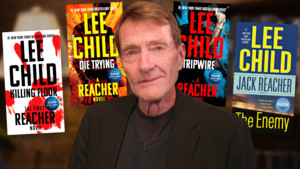
Lee Child, the man behind the Jack Reacher series, a series that sold more than 200 million books the best selling series of all time on Amazon in the UK.
Yeah, more than Harry Potter, which is crazy.
And also a series where a new book is sold on average every nine seconds.
So how does he do it?
How does he write it?
How does he come up with the ideas?
Well, here be answers.
You know, where I want to start the interview is creating a sense of place.
Like obviously you're English in England when you got fired and then you're like Hey, let's go base a story in America.
So first of all, why'd you do that?
But also how do you make that real and vivid?
I did it because for a bunch of reasons that all pushed in the same direction.
One was that As you say, I'd just been fired.
And it was a kind of political thing whereby the TV industry in Britain was being altered externally in order to give Rupert Murdoch a foothold for his satellite business.
So that I was just annoyed, you know, really just pissed off with what had happened.
So in a lot of ways, I wanted to escape.
I was done with it.
I wanted to get out.
And if I couldn't do that yet physically, at least I could do it in my head in terms of narrative.
And I had when I started out writing, and this is something that a lot of readers don't want to hear.
But writing is not just the muse.
You know, you don't sit down compelled to just write.
It's a job.
And especially because I'd been fired, it was a serious thing.
I had to make a living.
And in order to approach it that way, you've got to start thinking about it in a rather commercial and strategic way.
And British thriller and crime fiction, I love.
I've got nothing negative to say about it, but it is very tight and very internal and very psychological.
A little bit like the island itself.
This is a small country, very densely packed.
And if you look at the great crime fiction that I was reading out of Britain at the time Barbara Vine, who was that's a pen name for Ruth Rendell
And it was a certain kind of fiction she was doing very much in a couple of streets in North London.
You know, that was the world.
You look at Ian Rankin, another great British crime writer.
That's literally like a couple of square miles in Edinburgh.
It was very internal in the heads, very small geography.
And I thought my heart wasn't in that.
I wanted something that was a lot more related to myth and legend from the past.
The idea of the mysterious stranger, the noble loner. who shows up here and there.
And for that, you need a gigantic geography to make it plausible.
The idea that a stranger can wander miles into a community that is effectively isolated and cut off and has mystery and intrigue going on unbeknownst to the rest of the world.
That is not plausible in Britain.
Everybody knows everybody else's business.
Everybody lives cheek by jowl.
You needed that frontier field.
So it really had to be America from the narrative point of view.
And I had been a lot.
I first went to the US more than 50 years ago now.
And I eventually, in 1974, I eventually emigrated in 1998, which was 24 years later.
And part of the immigration procedure if you do it legally is to apply in numerous forms to fill out.
And one of them is you've got to list every previous visit you've made to the U.S.
So it, I guess.
So they can check with police departments here and there that you're not some kind of murderer or something.
And so I had to go back through all my old passports.
And in those 24 years, I'd visited the U.S. exactly 100 times.
Whoa.
Because my wife is from there.
And so every trip we took.
She's from where?
She's from New York.
Okay.
So I felt I knew the country well enough to write about it, with the advantage of doing it with an outsider's eye, which I think is huge.
I think that you run the risk of getting details wrong.
You run the risk of sort of not quite connecting with the culture, but there's an enormous advantage in you're seeing things fresh.
You're seeing things that Americans no longer see because they're so familiar.
And as you go about creating a sense of place, what are the things that you're thinking about?
I mean, I don't know.
There's different instruments you can play.
You could play the instrument of sound.
You could play the instrument of sight.
You could play the instrument of light.
You could play the instrument of color of the way the sun sets and rises in the morning, whatever it is.
How do you think about bringing a sense of place into life?
That's a good question.
And for me, I would say mostly it's temperature.
Uh, you know, I never heat versus cool temperature.
Yeah.
Hard versus soft, hot versus cold.
Things like that.
I don't plan.
I never have a, you know I don't.
I'm not one of these guys that has a list of the next eight plots, you know, with a little index card saying you know set, set this one in Maine, or something.
I don't do that.
What I do and this sounds terribly pretentious, but if you were a composer and writing music, you start with a concept of the key that you want.
You know, G major is a cheerful upbeat key.
E flat minor is the opposite, you know, down and rather melancholy key.
So what I do as a writer is I have just a vague idea.
I want this to be hard and cold, or I want this to be hot.
And then you pick a location that you have been familiar with.
I never do research specifically for that book.
It always draws on impressions formed over the years from previous visits to places.
You know, do you want it to be the west of Texas where it is baking hot and arid?
Do you want it to be on the Atlantic coast of Maine in April where it's gray and cold and misty?
So that's how I start with the sense of place.
And then it's just constructing it around that.
In a way, the place and the temperature kind of dictates the story in a way.
Almost as if they're like the driving factors.
Yeah, or it gives you a stage on which certain action is inevitable and certain is implausible.
Like almost sets the physics of the story?
I think it does.
Yeah, you know, is it mostly an indoor story?
Is it an outdoor story with wandering?
Is it just the flavor of it?
I'm absolutely not a planner and I never have a preconception really of what.
Why do you say that with such emphasis?
Because a lot of people assume that a book needs planning.
They assume that you write out an outline or at least a hit list of plot points, some kind of a synopsis or outline or plan.
And I've never, ever done that.
Because for me, writing per se, making it with words is not really the issue for me.
It's the story that I want.
And if I were to plan a story and I've got friends who do huge outlines, you know 300 page outlines.
Even if I did a two page outline with you know, two lines per proposed chapter, then I've told myself the story and I'm bored with it at that point.
I want the next story.
So I can't afford to tell myself the story ahead of time.
I have to just improvise it as I go along.
So it's about starting somewhere, which is defined by location, and then see what happens.
It really is that simple.
In your life, who are the writers who you've made a point to read everything they've written?
Oh, lots and lots of them.
I mean there was a British Scottish actually thriller writer called Alastair Maclean who was huge when I was a kid and really appealed to me.
I read everything of his.
What'd you take from him?
I took from him actually something I've used, two things I took from him actually.
Number one was He had a real skill of having a hero.
That was so good that he was almost the cartoon character.
He was almost falling off the edge of being ludicrous and yet never did.
He just kept in the right side of plausibility.
And I learned that.
The other thing I learned was a completely negative thing that he got drunk and lazy and bored after about eight books and fell off a cliff in terms of quality.
So I learned to avoid that if you can.
John D McDonald, who was a Florida writer, did 21 books in the Travis McGee series, which is really one of the most magnificent series, and pulls up a trick that I cannot explain.
There was 21 books, as I says, and only one of them Only one of them has anything happen on page one, and the other 20 nothing happens on page one.
Nothing really happens on page two, but you cannot put them down.
Now explain that to me.
I can't.
What happens in the first few pages?
Just two guys hanging out chatting or whatever you know, and uh, somehow it's too.
It's so compelling.
One of them they're sitting in a boat.
Page one they're sitting at night fishing in a boat on a canal in South Florida.
You know they're chatting for half a page and then all of a sudden somebody throws a body off the bridge and it lands in their boat.
That's the only story where something happens on page one.
And yet all of them are utterly addictive.
You literally kind of put them down.
How do you think your career, your writing, unfolded differently by virtue of having one character who you brought in over and over again versus hey, I'm going to do this story with all these characters, this story with all those characters.
Yeah, it's a great question.
And again, I think an awful lot of it depends on what turns you on as a reader.
I think you can't get away from that.
I think that if you find a guy who has enjoyed reading a certain genre or a certain style within a genre, that is what they've got to write really.
And again from the audience's point of view.
Everything I do, I try to remember how I felt as a reader.
What really turned me on as a reader?
How did I feel as a reader?
And with a series with a strong recurring character, there's a kind of pre-approval amongst the readers if they've tried one and liked it.
Then they're very happy that the same guy comes back in the second book.
And then they understand it's turning into a series where he's going to keep on coming back.
So every year they get the new book and it is pre-approved in their mind.
They know they're going to like it.
They know they want to read it.
Certainly they want a different plot.
They want a different context, all that kind of thing.
But they really want the familiarity and the comfort of their old friend coming to visit for a couple of days, hanging out with the guy for a couple of days.
They'd love that.
So to me, series were always super appealing as a reader.
So naturally I wanted to write a series.
And I think it works really well that you know I've got A lot of other writers are like Stephen King, for instance.
Now, Stephen, he's a great writer, terrific guy, great writer.
I mean, literally America's greatest living novelist, I think, at this point.
I think so.
But Stephen King comes out with a new book.
You're never quite sure what it's going to be.
Is it this?
Is it that?
Is it horror?
Is it supernatural?
Is it some other thing?
You don't know.
You buy it because you love Stephen King.
You don't buy it because you know you're going to love the story, because the story could be anything at that point.
Obviously, you famously start your books on September 1st.
And so what is how do you sort of structure the year?
How do you structure the days in terms of where that imagination comes into play, where the actual work of writing comes into play and how those things come together?
It's uh, i get yeah, i do, i i start on a on a regular day, which is kind of necessary, i think, because if you're going to publish a book a year, clearly you've got to write a book a year, and you have got to have a certain discipline and structure to you to do that.
So it's totally convenient to pick start first of september, deliver sometime in march or april.
That is the way to do it.
And um, Funny what you say though, about imagination, because you know I do a book.
Let's say I'm finishing it in March or April.
Done.
Fantastic.
Happy with it.
And then I suffer a kind of self-doubt.
Well, not really.
It's not that I'm sitting there wracked with doubt, but I just it kind of fades away.
I've done that book.
I know it's some months before I have to start the next one, and kind of July august, beginning of august, i'm thinking i've got to start in six weeks or whatever, and i'm just bereft, no ideas.
I thought i every year, i think this is it, i'm washed up.
Now it was the previous 20 years was just luck, you know, i've got nothing to do, nothing to say, i've got no idea and i feel a little despondent about it.
And then, sure as eggs are eggs, towards the end of august i'm thinking, oh well, you know i could yeah, this might be cool or, and then toward again, a few days later i have a first line suddenly pops into my head.
So by september the first i'm up and running again.
But the imagination somehow is biddable it.
You can quiet it down and you can crank it up, depending on when you need to.
Before we started recording, you're like yeah, i don't walk much, don't work out love smoke, cigarettes and all that.
And how do you think that what you've produced is downstream of how you've lived your life?
Because that is unique, like it's.
This funny combination of when you said that i was Reminds me of a very dear friend.
He's just like, I'm just the laziest guy.
And he's super creative.
He just kind of like sits on the couch.
He sort of just like mopes around a little bit.
But then there's that contrast.
And you had been to the United States a hundred times in 24 years, which feels like the antithesis of that.
Yeah, I mean, I travel for fun.
I travel, for I mean, I guess I do not do anything that could conventionally be labeled virtuous right, you know, like taking exercise.
I just don't.
I mean, I grew up in a dull and very boring, repressive family environment where there seemed to be an unspoken target of just living as long as you possibly could, you know, taking care of yourself so that you live to a grand old age.
And I remember associating that with the boringness of it.
And I remember, literally at the age of eight, literally the age of eight, I thought to myself I'm not going to do that.
I'm just going to do whatever the hell I want.
And I don't care what the result will be.
My target is to have more fun in 60 years than the rest of them would have in 100.
So I've always done that.
I live recklessly.
I do whatever I want to do.
I pay no attention to consequence or health or anything like that.
And it's an antidote, I think, to the repression and that uptight kind of upbringing that I had.
Absolutely, in my family, smoking was regarded as just awful, terrible thing to do.
I don't think, you know, my parents were kind of before the era of exercise.
I mean, nobody in that generation, nobody thought of taking exercise.
But you did naturally, I suppose, because maybe you didn't have a car so you had to walk to work or whatever.
But yeah, anything worthy, anything virtuous, anything like that, I turned my face against.
I didn't want to participate in that kind of scheme.
I just wanted to live for pleasure.
And I was also very aware that I was a very lucky generation.
My micro generation, my birth year, maybe a couple of years before, maybe a couple of years afterward was probably the luckiest generation in all of human history, especially being born in Britain.
We didn't even have Vietnam.
Yeah, we were born to a stable post-war European democracy with national health service that worked back then, with a welfare state that worked back then.
We had free education completely.
All the major dread diseases were conquered, we never had to go to war, we never had a bomb dropped on our house, we never had the secret police knocking on the door at four in the morning.
All those horrors that had existed very recently no longer applied to us.
And the creativity that you saw exploding in britain in the 60s, for instance you know all those great bands and and the great artists and photographers and fashion design, all that stuff was because that was the first free generation.
It wasn't that they suddenly developed all that talent.
All that talent had been around in every generation, except it had been disallowed.
They had to go work in the factory.
They had to go to war.
They had to do whatever.
And now the conditions were right.
The conditions were right.
We didn't have to do that stuff.
So it did explode.
You know what?
The word that came to mind was just kind of unapologetic, because there's the unapologetic in terms of yeah, you're supposed to do this.
You're supposed to do that.
I don't really do the things that I'm supposed to do.
But then the other thing is just the unapologetic decision to write in a commercial fashion to say Hey, this is my job.
Like a lot of writers like, Oh, don't do that.
And it's funny.
You wouldn't walk into a hedge fund or an investment firm and say Hey, Don't try to make as much money as you can.
But somehow you get into a library, a writer's room, and it's like, oh, don't say that.
In a way, it was because I started out in the theater.
That was my first enthusiasm, my first love.
This before TV.
Yeah, theater before TV.
And I remember that, say 1971, 72, that kind of time in theater.
There was some great stuff.
But there was also some ridiculous crap.
And a lot of the ridiculous crap was kind of boasted about.
And people would say, you know, people would put on terrible shows and get zero audience.
And they would be kind of proud of it.
Oh, you know, people don't understand art and all that kind of thing.
But I saw it as a Zen proposition.
If you put on a show... and nobody comes to see it, have you actually put on a show?
I'm not saying nakedly commercial transaction, but the transactional aspect of it was vital.
It was integral.
You put on a show, somebody has to watch it before it exists.
If you write a book and nobody reads it, have you written a book?
You've got to include the audience in the calculation.
So that I wasn't...
It wasn't like a sort of naked meretricious thing where I was trying to make a living, although I was trying to make a living.
But that wasn't forefront in my mind.
It was that if I'm doing something, I want people to enjoy it.
And if you want people to enjoy it, you may as well have the maximum number of people enjoy it.
But of course there's a technicality about books and readership is that readership is absolutely not monolithic.
It is far more like The Rings of Saturn.
Even my books, any commercial writer's books are consumed at the center of that universe by very skilled, habitual readers.
And I've got all kinds of high-grade, high-level fans.
Um, but in order to sell a lot of books, you've got to push the boundary outward, to the outer rings of Saturn, where the audience of people that read one book a year, possibly two books a year.
And you've got to satisfy the habitual skillful literate readers in the center at the same time as satisfying the people on the outskirts that are not habitual readers.
And so that is a skill in itself to make a multi-level proposition.
And how does that play out?
How do you actually think about structurally doing that?
I think structurally, what you've got to do is you've got to have a style that is both palatable and somewhat enjoyable to the habitual readers in the center, but that is also useful to the people on the outside.
And that's inevitably, that style needs to be therefore propulsive.
I do a lot of it instinctively, but I spend a lot of time concentrating on rhythm, the rhythm of a sentence.
Because a book is, however many thousand sentences in a row, and you've got to make it so that each sentence has a rhythm, and that rhythm must always be tripping forward forward, forward.
So this rhythm is less artistic?
And much more about that word that you came back to.
Propulsion, like the rhythm of movement and progress and pace.
Absolutely.
And momentum.
It's about propulsion.
It's as if I'm creating a style that the experienced reader in the center appreciates as a style.
Call it whatever you want, faux naïve or this or that.
They'll find a word for it.
But the people on the outskirts, the non-habitual readers, it's like I have my hand gently on their back, just pushing them through.
They don't notice.
They're not aware of it.
But I am just easing them through the process.
And you know one of the most heartfelt compliments that you get.
I've had dozens, hundreds of people say to me oh, I loved your book.
I finished it.
It is such an achievement for some you know, not habitual readers, some unfamiliar, unaccustomed readers to finish a book.
It's a sense of achievement, self-esteem, and so on.
And you do that by helping them finish the book.
You push them gradually through.
They don't notice, but you're driving them through it.
And you do that by propulsion, and you do the propulsion by sentence structure, so that The beat is always tipping forward forward, forward.
It's like a great pop song.
If you look at a great pop song back in the days before all this electronic stuff came along, the rhythm will speed up through the song very very, very subtly.
Look at a Beatles song, especially live.
You know, Ringo will be driving that tempo, and it always ends up a little faster than it begins.
Nobody notices, but it's there.
And that's what you've got to do on the page.
You've got to make it so that it's a little bit like a carnival ride.
You know where they're slipping down this polished tube, you know, and there's no getting out of it.
Once they're in it, they can't get out.
And now tell me more about that sense of propulsion, because there you're talking about sentences.
But then there's the sense of propulsion of opening a question at the beginning, keeping that question open, answering at the end.
There's the sense of propulsion that comes at the end of a chapter, of hey, we're going to have a cliffhanger.
Television does this.
And in the next episode, you're going to learn something like that.
Yeah, well, that's and that's really where I got it from.
I did 40,000 hours of television of every kind, and it kind of bakes it into your DNA.
Ending a chapter to me is never thought about.
It is always utterly sort of instinctively obvious.
When you say that, do you mean that the book begins to reveal itself that hey, this is where it should be, or is it something else?
Yeah, exactly.
And even the end of a book.
I remember one of my books, The Hard Way, I think it was that book where I remember...
Finishing a chapter very late on, I'm thinking, great, you know, I'm almost done.
I've just got to kind of do, I don't know, maybe a chapter and a half to wrap it up.
And then I suddenly realized, no, this is the end of the book.
This is done now.
Because you just know.
It's all about asking the question.
And TV had a thing, there was a situation in 1980. that changed completely by 1990.
By 1990, people had something that they did not have in 1980, and it utterly changed the business.
And you see, now you are thinking, why?
What is he talking about?
What did they not have in 1980 that they did have in 1990?
I've implied a question there, and you now want the answer.
And The answer is remote control.
In 1980, people actually physically had to get up off the sofa and change the channel.
In 1990, they could do it with the push of a button, and that utterly changed the business.
And because you could rely on a certain amount of laziness in 1980.
You could rely that if they finish one program they're going to stick around through the commercial break for the next one.
By 1990, absolutely all bets were off.
They could jump around at the press of a finger and that utterly changed it.
And so how did we react to that?
We reacted to it by something that has largely disappeared now, but you still see, for instance, in baseball or certain sports where you know, in baseball you get to the sort of fourth inning and it's pretty clear maybe, which way the game's going, and so on.
And so they usually have a trivia question that they'll tell you the answer at the end of the break when they return to the game.
And it's incredibly powerful that humans are hardwired to want to know the answer, even if they're not interested in the subject.
You know, if it's a movie show or something you might say, who was the first choice for Dirty Harry in terms of casting?
We'll tell you after the break.
And people are like, whoa, who was the first choice?
Wasn't Clint Eastwood the first choice?
And they want to know.
Even if they do know, they want to stick around for the gratification of being proved right.
That's why people have Jeopardy.
Yeah.
And the answer to who was first choice, believe it or not, for Dirty Harry was Frank Sinatra.
He turned down the part.
So we learned that humans are hardwired to want the answer to a question.
And I think actually that is the easiest part of constructing a novel.
Absolutely the easiest part.
You imply a question, doesn't matter what it is, doesn't matter how important it is.
People will stick around to find out the answer.
And so that really plotting in that sense is way overestimated in terms of difficulty.
Plotting is really pretty easy and now, as a writer, do you feel like you're going on an adventure yourself, kind of like, oh yeah, fingers are following the story or something?
Yeah, i mean absolutely.
Again, i try and replicate.
What i want is this feeling that i have as a reader and you know this, when you, when you've got a really great book on the go, you're really angry if you have to put it down and you just cannot wait to get back to it.
You know, let's say you've got to do a chore or an errand or something or go to work, and then you get back and you pick up the book and you're like ah, what's going to happen next?
Yeah.
I need that feeling as a writer.
It's incredibly strong as a reader.
I remember one Christmas day I was.
Our daughter was working in a cinema and she was doing the day shift on Christmas day.
And therefore our Christmas was going to start when she finished work and got back, which was maybe, I don't know six o'clock or something.
So I was reading a book that afternoon.
It was a great book.
I was just loving it.
And I was thinking I was hoping that There would be a big snowstorm and she couldn't get there, or something like that.
I was hoping that she wouldn't arrive so that I could keep on reading the book.
And that's the power of story.
And I want to feel that power when I'm writing it as well as reading it.
Well, you were talking about needing to know the answer to the question, kind of being pulled along.
The other word that came to mind for me was just the feeling of being absorbed absorbed in another world, absorbed in a pattern of language, absorbed in characters and scenes.
Absolutely immersed, I call it.
And that is such a subtle thing.
I mean, how do you do it?
Nobody knows.
Nobody knows.
It absolutely happens or it doesn't happen.
You know that's one of the strange things of all kinds.
There cliches or jokes about how to write a book.
People say a thriller, it needs just two things.
Unfortunately, nobody knows what they are.
And that's kind of true.
I was so excited for you to tell me what they were.
Exactly.
It's a mystery.
Sometimes it grabs you and sometimes it doesn't.
Is that individual to the reader?
Is it general?
Can you trust it for a large population as opposed to individual readers?
I don't know.
I think certain books appeal to different people in different ways.
But yeah, either you are immediately sucked into the world.
And I think probably the way to do that is not try too hard.
I think that is absolutely true of practically every aspect of writing.
Don't try too hard.
There's a great, great quote by David Mamet, a screenwriter.
He was talking about actors in this particular quote, but really it can be about book characters or anything.
And he said essentially, an actor steps onto the stage or steps onto the screen and he says hey, I'm the main character.
And the audience says, are we going to like you?
The worst possible answer is to say, yes, you are, and I'll tell you why.
That's the worst possible answer.
The best possible answer, are we going to like you?
I don't know, and I don't care.
That kind of insouciance, self-confidence is the way to do it.
He was talking about that generation of actors that had come out of the korean war people like gene hackman and lee marvin and people like that they had a certain kind of self-confidence they were not needy they were just there take me or leave me they weren't trying too hard and that in a strange roundabout way the less you worry about are they going to like you the more they do like you so help me reconcile a few things so On one hand, what I'm hearing is this sort of don't try too hard.
And then, on the other side, it's a real sense of discipline, of treating your writing like a job, showing up every day.
Help me work that out.
Well, it is.
I mean, it is.
But writing is a strange thing in that you have got to believe two things 100%, both of them.
It's not believing one 50%, the other 50%.
You believe them both 100%, which is mathematically impossible, but you've got to do it.
You've got to believe.
It's artistic, it's creative, it is noble, it's part of a great tradition that stretches back a few centuries now writing novels.
You've also got to believe it is a job that your family's income depends on, that you have responsibilities to publishers and retailers.
You've got to believe both things 100%.
And so you do need structure.
You do need discipline.
Ultimately, you owe it to the reader.
And that is what has been the driving force for me.
Initially, I'd lost my job.
I was broke.
I was out of work.
And initially, the implied contract was purely financial.
Could I keep a roof over my head?
Could I pay the bills?
And then when that turned out to be yeah, you know, happily that happened, then it became an emotional contract with the reader.
The reader has loved these books.
The reader has bought these books, enthused about them, talked about them, enjoyed them.
So my, my obligation from that point on was never to let them down.
And part of that, of course, is actually showing up with the product, because if the reader Not just me, of course, but hundreds of series writers publish a new installment every year,
If you miss one, the reader is really disappointed about that.
Okay, so we're talking about how do you get your writing done.
And if you're thinking about work and how you can be more productive there well, I recommend a tool called Basecamp.
Basecamp is a project management tool and it's different from the other ones, which are loud and noisy and cluttered.
They're feature bloat.
Basecamp says, no, no, no, no, no.
We're going to keep things simple so that you can focus on what actually matters, which is just getting the work done, you know.
Now, for us, Basecamp is a place where we can track what we're doing with how I write, when episodes are being recorded, where we're recording them, the publishing day, all those sorts of things in one place for our entire team to look at.
And I had the founder of Basecamp, Jason Freed.
He came on the show and I noticed that he really cares about writing.
He cares about manifestos.
He cares about great copy.
He cares about telling a great story.
And him and his co-founder, they've written five books.
And I can tell you that they bring the same care and attention to detail to their books as they do their software.
So if you're thinking about work and you're asking, hey, how can I be more productive?
How can I make my team more cohesive? well, then I recommend Basecamp.
All right, back to the episode.
And tell me about what goes into making a main character, because you were talking about likability, and is that important in a main character?
When is it good?
Hey, should we like the main character?
Should we hate the main character?
Should we think they're funny?
I don't think that you can have a character that you hate uh, a main character that you hate or a character well obviously, a character you know, a despicable bad guy or a henchman or something like that.
You can absolutely hate them, but in terms of the main character or the the implied main character, hannibal lecter, for instance, would be as close as you could get to a character that you should hate, but there is something compelling.
You can have characters that you ought to hate but you kind of don't, in which you're breaking bad Yeah, all that noir style.
There's something about them that makes them likable, even though you shouldn't.
You absolutely can't have a character designed to be hated.
You absolutely equally cannot have a character that's designed to be liked, because the more you design it, the worse it gets, and You've just got to have an honest, authentic portrayal and then you've got to hope for the best.
You know when I'd start.
I did the first Reacher book.
I thought and there's a clue in what I'm going to say
I thought, I'm happy with this.
I love this.
You know, this is 100% what I wanted it to be, obviously.
Otherwise, I would have done it differently.
This was exactly what I wanted.
But I thought, ah, nobody else is going to like this.
The guy is a filthy, dirty barbarian.
He shoots people in the back.
He lies.
He cheats.
He steals.
He never changes his clothes.
Nobody's going to like this guy.
And then I thought, well, maybe some men will like him, but women won't or whatever.
But the clue is I liked him.
Now I am obviously a unique individual, just like you are, just like everybody else is, but we're not that unique.
We all share quite a lot of culture together.
And so if I like him, the chances are that many, many other people will like him too.
The only unknown at that point is how many exactly.
You know, is it going to be thousands?
Is it going to be hundreds of thousands?
Is it going to be millions?
You don't know that yet.
But if you like it, a substantial proportion of other people will like it too.
What matters?
Let's bring together two themes.
We've been talking about rhythm propulsion.
And I think there we've been talking about a kind of truth, right?
You're saying if you don't, if you plan it, it's not going to kind of feel real.
There's something about the following the roller coaster that actually makes it feel real.
So bringing together the propulsion, the truth, what matters in dialogue, as you're writing dialogue bringing that to life.
Yeah, I mean, dialogue is the ultimate kind of illusion thing.
In fact, I once, I think, won a competition prize or won some literary prize.
I think it was from, it was years ago.
I think it was the Fort Worth Evening Telegraph or something in Texas.
I won the prize for natural dialogue.
And honestly written dialogue in a book.
There is nothing less natural than that.
It's really instructive to actually seriously really listen to how people speak.
Yeah, in a real dialogue exchange where people are talking, you know, go on the train and eavesdrop the seat next to you or whatever.
Listen to how people really talk.
It is incoherent, it is stop start, it was.
It's absolutely full of placeholders.
You know all this kind of stuff it's people all jump from one subject to another.
There are long gaps.
It's utterly, utterly unlike anything you will ever see written down.
In a book.
It is utterly unnatural that people talk in a structured way and actually exchange information.
ABAB like that.
It absolutely never happens in real life, except you can do it in a way that makes people think it's utterly natural.
One of the greatest illusions in entertainment.
Again, rhythm is important because dialogue when you listen to people talk, they put emphasis on words that vary throughout the sentence.
And how do you do that on the page?
In Extremis, you can use italics, I suppose, for the emphasized word.
I prefer not to because otherwise you've got italics peppered over the entire page in random spots.
You don't really want to do that, but you've got to construct the rhythm in such a way that the emphasis is thrown onto that word as opposed to any other words.
So that you go, duh, duh, duh.
Somehow the rhythm lands you on the important word.
And that is, I think, it's partly an innate skill.
It comes from reading a lot.
It comes from listening a lot.
And it comes from... Listening a lot.
How do you do that?
Like listen to people chat?
Listen to real people talk.
Listen to movies.
Listen to TV.
I mean, there's a lot of great dialogue on TV.
There's a lot of great dialogue in the movies.
Just immerse yourself in it.
Listen, listen, listen.
And you pick it up how to do it.
Man.
I was on the train last night coming back from Gatwick and there was a woman sitting next to me, an Indian woman.
She was with her husband.
And something had happened where she had lost a bunch of money and she was in a financial struggle.
And the way that she kept on emphasizing the word money, I need my money.
I lost my money and just the tension of it.
It was just this, this, you talk about listening, like there's a story there, you know?
Absolutely.
And you know, you've laid it out very well there that you use a little bit of repetition.
I need my money.
I have lost my money. that creates it to a large extent.
The repeated words kind of dissolve in the air and you've got need money, lost money.
The emphasis automatically ends up on those words.
Yeah.
You know, it's funny now that you're saying it back to me.
In moments of anger, there's a great simplicity in language.
I need my money.
I lost my money.
There's no room for the highfalutin, whatever.
You are in a primal state.
You are, and you also tend to use that emphatic repetition of certain words that almost then relates it to song, in a way.
It's like lines in the chorus of a song.
Let's venture back into prehistory.
What was the first ever art form had to be singing.
We already had expressive voices because of the development of syntactical language in our evolution.
So obviously the first music was sung.
And singing depends on rhythm and repetition to a large extent.
So we revert to it when we are in an excess of emotion.
That's a great story.
I can absolutely picture that woman.
I can hear what she's saying.
And I would know how to write it. beginnings, endings, what matters as you're writing those?
You know, one of the beginnings and endings, let's talk about beginnings and endings.
First of all, for you as a writer, when should you begin?
When should you end?
And I find it very difficult to to.
I get invited to, let's say, a college somewhere, or even a high school um, to talk about writing, and there's all these people keen on being writers and really the only valid message to them is don't.
Don't do it now.
Um, wait too young, too young.
Read for 20 years and then do it because There's a lot of enthusiasm, a lot of talent amongst young people, but there's no content yet.
They haven't lived.
They haven't seen things.
They don't know much.
You need to know when to start and you need to know when to finish your career as well, before you get worn out and boring.
That's the macro sense.
In terms of the book, where do you start and where do you finish?
You don't start when the earth cooled.
That is what a lot of a lot of beginning writers get wrong.
They give you the backstory.
You've got, let's say, you have a great line of dialogue.
Your character has a great line of dialogue.
They feel they need to tell us about where you grew up, where you went to school, who your parents were, what formed you all that kind of stuff.
Do not start when the earth cooled.
Start with the action right now.
There's a Latin phrase in media res, meaning in the middle of things.
Start in the middle of things.
Don't give all the explanation yet.
Just start with something intriguing and see where it goes.
And where do you end it?
You end it when the story's over.
How do you know when the story's over?
You just got to judge that on a gut level instinctively.
Hmm.
One thing that does not work.
I've tried this.
You know I've done a long series and so I've had room to experiment a little bit.
We had a thing in television.
So television developed over the years a tremendous amount.
The television used to be what you would call a series activity, that you would concentrate on TV before you did whatever was next in your day.
You know you would, and your grandma still does it.
She sits and watches her show right, but most people don't do that.
It develops into a parallel activity in as much as now you watch the show while you're on the phone to your mother, while you're cooking dinner.
Yeah, in other words, And we went through, we had to cope with that.
And so what we would do, we had this sort of shorthand way of saying it.
We would tell you that we're going to tell you.
Then we would tell you.
Then we would tell you that we told you.
In order to help people who were very distracted And I wondered was I doing that a little bit too much in the books?
And so I thought, I'm going to try and experiment where I don't explain everything.
I will give the information.
The information will be there, hiding in plain sight.
But I will not pull it together and make the conclusion.
I'll leave that up to the reader.
That happened in one book very explicitly.
In another earlier book there was quite a fascinating minor character, quite a brave woman whose husband was in trouble and she was brave about it, and so on.
And I left it completely unstated what happened to her, thinking that this character would live on in the reader's mind and the reader would decide for themselves what had happened to her.
In both cases, readers hated it.
They wanted all the loose ends tied up and they wanted situations explained so that you You can't leave it too unexplained.
The readers want your version rather than, it's not like a writing prompt.
If you were at college during an MFA, the professor probably gives you a writing prompt and then you tell the story.
Readers don't like that.
Readers want you to do the work and tell them the story.
You were talking about writing being a second half of your life kind of thing, right?
The first half is about more indexed towards collecting, reading, and picking up life experiences.
And then the writing comes a little bit later.
How do you think that varies across genres?
Because intuitively, I'd be like, hey, you're making up stories.
Why do you need to know stuff?
But no, no, no.
Clearly, I'm missing something in that assumption.
Yeah, I think what you need to...
And nothing is ever all one thing or all the other.
Sure, sure.
I mean, I know that in my genre virtually everybody that's successful is doing it as a second phase career.
Having done something prior.
That often does require an audience.
Either they're a journalist or they're a lawyer with a jury in mind, or something like that, and then they go on to be a writer.
There have been a couple of people that have started fresh in their 20s early or mid-20s that have made a success, but it's very much the minority.
And even though you might be inventing an entirely new genre because an old guy like me, there's all kinds of stuff, you know vampire fiction this that, the other, that I have just no concept of what it's about.
But It's about something and it's about structure in a sense.
And so what you do have to have is enough reading.
I think that you have internalized the idea that there must be a structure, and what structure is?
People are very skeptical when I say I never make a plan.
I never make an outline.
Every single line is improvised on the spot.
And that is absolutely true.
But it is not quite as naked as it sounds. because I've read tens of thousands of books.
So, in fact, I have an enormous internal database of virtually every available plot, virtually every type of character, virtually every type of cliffhanger or structure or whatever.
I've got it in there somewhere.
So actually, I have a monster plan and outline.
Yeah, I've been going down the rabbit hole of, just all sorts of different creatives.
And what you realize is that the bank of how much they've consumed is just so much greater than people would realize.
Martin Scorsese used to watch a movie every single night.
You look at someone like Ralph Lauren, people say hey, you know what was it like talking to him in the early days.
He just knew every single thing about the different kinds of ties.
Talking to a musician.
Musician was saying hey, the way that you can remember how things look, I can remember how things sound.
So I can tell you how Oman sounds versus how Israel sounds versus how China sounds.
And you just realize that when you're talking to great creatives, it is this process of constant consumption.
But there's even more this very naturally created filing bank that somehow you're pulling from without even realizing the process of creation.
That is very well put and very well diagnosed.
And that is exactly what happens.
That you, I mean, for instance, I remember that the first, uh Jack Reacher movie with with Tom Cruise, directed by Chris McQuarrie uh McQuarrie, I mean man, that movie crews work hard.
You know it's 12, 14 hour day, maybe up at five in the morning or whatever work all day.
Incredible.
And then what would happen?
Macquarie invites everybody to his suite and they watch a movie, because it's not that it's like a duty to top up their knowledge.
It is their enthusiasm.
But they end up, they work all day making a movie, then they watch a movie.
And that internal database gets bigger and bigger and bigger, more and more passionately analyzed.
And you're absolutely right.
Whoever it is, interior designer, they know this stuff because it's their life.
And writers are like that.
We're total consumers, actually.
We're not We're not predominantly a writer.
We're predominantly a reader.
You know, you write one book a year, you read hundreds.
And so you're much more of a reader than a writer.
So your internal supply of reference and stimulation is, by the time you get halfway through your life, enormous by that point.
Violence. making it feel real, the purpose of it, what matters with violence?
I think making it feel real is again.
It's a bit of an illusion, a bit like dialogue, in as much as most violence in the real world is over really quickly.
And most violence has got very bad medium term effects.
I mean the thing that you see in the movies where, or in a regular story where uh, you know, somebody is hit hard and they stagger back and then they come back at you and swing at you and back and forth, back and forth.
That does not happen in real life.
If you get hit in the head, you are sick and dizzy for a week.
You know, you're just out of action.
Yeah.
Also, if you watch the average bar fight, it's just so lame.
It is.
It's just swiping and brawling.
There's no style to it.
There's no technique to it.
So again, violence is something that is nowhere near realistic.
Um, and why do we, it's a really interesting question.
Why do we want it in a story?
Why do we like it?
And uh, The answer to that, I think, is paradoxical because, generally speaking, out of the population as a whole, people who read books are the most thoughtful, probably the most educated, the most in some way, what you would call not virtuous, but they're on one side of the divide.
Why do they want violence in the book?
And I think it is because they know That in a civilized society, you shouldn't have it.
You should have law.
You should have due process.
You should have rights for the accused.
People know that.
That's the price of civilization.
That's how we organize ourselves.
They get that.
They understand it.
They approve of it.
They would not like to see the real world any different.
But man, is it frustrating.
If somebody has stolen your car...
You just want to smash them in the face.
Oh, yeah.
You don't want to go through all that stuff.
Big old red hook.
Yeah.
You know, so that the real world that they're committed to, that they feel like they need to have and support in a good solid, liberal way.
And I don't mean liberal politically necessarily.
Lower case L. Yeah.
I just mean in terms of modern civilization.
They know that we need these rules and safeguards.
But it is terribly frustrating.
And so...
They love the consolation of being in a fictional universe.
They know it's fictional, but they love to see it happen as a release, as a consolation.
So then, as you're writing violence, and we're talking about the illusion and bringing that to life, what matters there?
And do you feel like it's the same sort of thing?
We're pulling from a reference bank of violent stories that you've read?
Yeah largely, and also lived, you know, because I grew up in a very It was a huge manufacturing city and it was very inarticulate emotionally.
Everything was... Every dispute was about a fight and numerous little triggers constantly.
You know, I was a smart kid.
I did well in school and that was a trigger.
You know people hate you, they think you're above yourself, you think they think you're a class traitor if you're doing well.
So i'm experienced at it and i'm good at it.
So in a way it was kind of remembering the ballet moves, as it were, for that.
But mainly it's about tuning into uh, people's secret, hidden desires and i, when i did bookstore events or public events, i I used to have a line.
I said, the reason why you like Richard is that, even though you are good citizens, you are civilized people, you are all of the good things, even though you all have a list of 10 people you would cheerfully shoot in the head.
And they do, you know, and they see it happen on the page and it is a release.
It is uh, it is getting the satisfaction without actually see, without actually having it in real life.
Clothing, clothing is your writing.
How, how does clothing inform character?
I think it is a symbol.
You know, it's a very quick way of of describing a type of person, um that you, we all, have a kind of internal comparative database of.
Uh, You know, if you see an old, an old, old guy with a long gray ponytail and double denim, you kind of know who that person is.
Yeah.
You see a guy wearing, you know, lace up Oxfords and pleated chinos or something like that.
You know who that guy is.
They are quick references, I think.
Like teeth as well.
I once had a fan who was a dental hygienist and she would write in about every reference to the appearance of people's teeth in books.
And I found that fascinating because I realized I was doing that instinctively.
Again, kind of trying to sum up a character through a quick visual reference.
You know a snaggletooth person, a person with missing teeth, a person with wolf-like teeth or something like that.
She was obviously a professional and very interested in it and was picking up on everything.
And I wasn't really realizing I was doing it.
It was a shorthand way of describing people.
All right.
You're invited to a university.
You're given a semester to teach a class on writing, a seminar on writing.
How do you structure the curriculum?
What are the core things that you're trying to tell people?
I would turn down that gig.
I absolutely would.
I don't think I'm good as a teacher.
I'm pretty sure that writing is not teachable.
I think plenty of shortcuts within the business of writing are totally teachable.
You know how to get a good agent, what pitfalls to avoid, how to relate to a publisher, how to do this or that.
I think absolutely that can be taught based on experience of what has worked and what hasn't.
But actually how to write, I'm not sure can be taught.
When you say not teachable, does that also mean not learnable?
Or can something be, yes, you can learn how to do it, but that doesn't mean that it can be taught?
I think you absolutely can learn to do it.
And I would allow possibly the possibility that something that might take you 10 years of reading before you figure it out for yourself could be explained a little faster.
But that's probably a rare occurrence.
And it's probably only very partial.
I don't think you could take completely untutored person.
You know, let's say you've got an intelligent person who is capable of lots of different things.
I don't think there's any any process by which you could turn that person into an accomplished novelist.
You either are or you're not.
It's again a bit like being a musician.
You you've either got those pathways in your brain Or you don't.
I've got musician friends.
In fact, I made a CD with a couple of musician friends.
They did the music.
I did the lyrics.
Oh, cool.
Totally cool.
Just the best fun ever.
And hanging out with them.
You know structurally biologically, our brains are all the same, obviously.
But it's almost like they're little tubes.
That in my brain, some of them are big and fat and can let things through.
Others are collapsed, you know, like flat tires that nothing will get through.
And their brains are different.
They've got different tubes open and different tubes closed.
And it just, if you are a musician, you are.
And if you're not, you never will be.
Last question.
You're English.
Why has so much good writing come from Scotland, from England, from Ireland?
What is it about this part of the world?
I think it's a different answer for each of those different countries.
I think Scotland is.
I mean, England is the center of the UK and all the power lies exactly where we are right now, in London.
I think scottish people feel neglected and resentful of that, and so they build up a an alternative culture that's theirs.
I think in ireland it's very clear in ireland i love ireland for this reason that if you go there, uh they, they give you a chance.
Whoever you are even you're not a writer, you're just some guy you're in the pub with a bunch of friends, you start to tell a joke, or you start to tell a story or whatever they will give you a chance.
Maybe it's only five seconds, maybe it's only 10 seconds, but you've got the stage to state your case and they will listen to you.
And I think that's huge that people grow up feeling that they will be heard not for long if they're crap, but they will give you the chance to be heard.
I think that's huge.
You know, that reminds me of a bunch of Irish friends, a bunch of Irish friends.
I was trying to think about how were they different from my American friends.
And the way that they're the same is that, you know, they're pretty career oriented.
But the way that they're different is all of them to a T. They know how to tell a joke.
They know how to tell a story.
Exactly.
And one of the things I noticed that when I was in Ireland is like if you could go to the pub and you can tell a good story and you can keep people engaged, you can make people laugh, you can.
You can just hook them in and keep them there.
You're part of the squad.
Right.
You are.
And you get to be that because they give you the chance.
If you seize it, then you have the space.
You have the table.
You have the platform.
And I think that encourages them.
It certainly emboldens people.
It encourages them.
And they think, yeah, I can do this.
Well, you are welcome on How I Write anytime.
This was so fun.
It was great to meet you.
Good to meet you too.
And thank you very much for the opportunity.
Yeah.