This is the TED Radio Hour.
Each week, groundbreaking TED Talks.
Our job now is to dream big.
Delivered at TED conferences.
To bring about the future we want to see.
Around the world. To understand who we are.
From those talks, we bring you speakers and ideas that will surprise you.
You just don't know what you're going to find.
Challenge you. We truly have to ask ourselves, like, why is it noteworthy?
And even change you.
I literally feel like I'm a different person.
Yes. Do you feel that way?
Ideas worth spreading.
From TED and NPR. I'm Anoush Zamorodi.
And we are starting in a beautiful part of Spain.
The mountainous region of Eragon.
Up near the Pyrenees.
Near where the border with France is basically.
It's fertile and smells delicious too.
Rosemary and thyme and oregano, like oh, growing it like naturally out here is phenomenal.
And all these like olive trees, all sorts of amazing stuff.
This is paleoanthropologist Genevieve von Petzinger.
And the day before we spoke, Genevieve had been hiking to find a cave here, dating back 30 ,000 years.
It's called Fuente del Truccio.
Like the rock here is this wonderful yellowy, very pale yellowy brown color.
And so all you can see from this great distance, from the top of the canyon, I could see down the canyon, across the ravine and a little bit up the other side, this wonderful big sort of rock shelter cave mouth.
Just inviting me to come to it.
And then as you get to the entrance, you're looking in.
But you can't actually see inside of it.
So you can sort of see where it goes dark.
And so in this case, there was enough light that we were able to enter just kind of by crouching down and going in.
But you have to be so careful because you cannot brush like any surfaces.
And then we got into a place where we could actually stand up in there.
So, you know, then we're bringing up the lights and then suddenly boom.
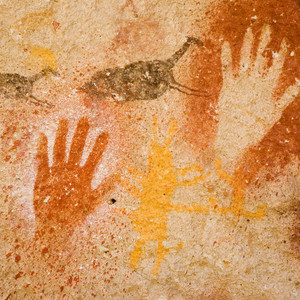
We're like surrounded by all these red negative hands.
Negative hands. Tell me what that is.
Yeah. So a negative hand is when you put the paint into your mouth.
Been there, done that.
But you stick it in your mouth and you mix it with like water often or sometimes blood, sometimes other things.
And then you put your hand flat on the wall and you spray it out of your mouth, almost the equivalent of like a spray can.
This was like the paleo spray can, basically.
And then when you remove your hand, it leaves the negative outline of the hand print with that wonderful kind of sprayed halo around it.
And this site has almost 100 of them.
You know, it almost brought tears to my eyes.
There are little person hands in this cave.
There was one hand they think is like that of a four year old.
It's so tiny. I have a five year old son.
So of course, I'm like, Oh my gosh, it's like my boy.
Wow. It's like they're reaching out to you through the ages.
Isn't that incredible?
And it's too high. Like the four year old was not standing.
Somebody had to lift them up.
It's on the ceiling.
So like this wasn't just a kid fooling around.
This was very purposeful and very deliberate what they did.
We don't know why they were doing it, but I mean, one of the ideas is even just maybe this was a way that everybody in the tribe was sort of made their mark.
Right. You know, I was here.
This is us. And I think that's what truly fascinates me in a way.
Because like, what do you need to survive?
You need shelter, warmth, and you need food.
Once you get past that, it's non utilitarian.
It's not required. And yet our ancestors put a heck of a lot of time and energy into making art.
And so what was it about it that was so useful for them about this?
Humans have left behind evidence of their existence for tens of thousands of years, from cave markings to libraries.
We've been capturing and collecting our stories and thoughts and preserving them for future generations.
But how do we know if we're accurately interpreting what's been passed on to us?
And what if the archives we're compiling right now are incomplete?
Today on the show, leaving a mark.
Ideas about capturing the ephemeral human experience in an artifact.
Genevieve von Petzinger has spent more than a decade studying ancient paintings left behind by early humans.
But she says while handprints and animal depictions get the most attention, she is drawn to the more abstract markings.
You know, there's little lines and there's dots and there's triangles and there's zigzags and there's rectangles with other dots inside of them.
And she believes these little shapes aren't just random.
So that was really where my research started, was just this genuine interest in trying to understand what, you know, what are they?
Her theory is that these shapes are actually symbols, possibly forms of communication left long before the first written languages.
And the question to her is, what do they say?
Here she is on the TED stage.
Barring a handful of outliers, there are only 32 geometric signs, only 32 signs across a 30 ,000 year time span, and the entire continent of Europe.
That is a very small number.
Now, if these were random doodles or decorations, we would expect to see a lot more variation, but instead what we find are the same signs repeating across both space and time.
Things like lines, rectangles, triangles, ovals, and circles.
And while certain signs span thousands of kilometers, other signs had much more restricted distribution patterns, with some being limited to a single territory, like these divided rectangles that are only found in northern Spain, and which some researchers have speculated could be some sort of family
or clan signs. There is a surprising degree of similarity in the earliest rock art found all the way from France and Spain to Indonesia and Australia.
With many of the same signs appearing in such far -flung places, especially in that 30 ,000 to 40 ,000 year range, it is starting to seem increasingly likely that this invention actually traces back to a common point of origin in Africa.
There could be no doubt that these signs were meaningful to their creators.
We might not know what they meant, but the people of that time certainly did.
The repetition of the same signs for so long and at so many sites tells us that the artists were making intentional choices.
If we are talking about geometric shapes with specific, culturally recognized, agreed upon meanings, then we could very well be looking at one of the oldest systems of communication in the world.
I mean, it's incredible.
32 symbols, only 32 symbols across all these regions.
And you're saying that the message that they're leaving behind is more than just, I was here.
It's actually perhaps the first way for early humans to leave each other notes.
And this is honestly where this is where some of my research is going now as well, is I'm trying to find those first marks because I want to know what they were and I want to know why, like, why did they start doing this?
And in order to kind of improve my perspective for part of my PhD, I got to go and study linguistics and I got to look at proto languages.
So what came before Egyptian hieroglyphs?
What came before Kineya form?
What came before, you know, early Chinese writing?
Because that's the thing is that they don't come out of nowhere.
They're the end product of a long tradition of graphic communication.
And we never really sort of were making that connection before in a funny way.
And so this is where I've been sort of saying, okay, well, how can we link this backwards?
All of these systems start with two things.
They start with counting marks and they start with iconic images.
And when I say iconic image, I mean something that looks like what it represents.
Do you have a favorite?
We talked about the negative hands.
I saw there's also one that kind of looks like a hashtag, which is like, whoa, we still use that one.
Isn't that funny? What are your favorites?
Okay, probably my ultimate favorite sign is the lowly dot.
I think dots are just fascinating because A, I suspect they're probably one of the absolute oldest things around.
And also that we can use them in so many different places in so many different contexts.
So there are places and caves where they find isolated dots, which seem to be there to indicate which passageway to go down.
They're acting almost as path markers.
We also see dots on the side of animals in a way that suggests that they might represent some sort of wound as though they're bleeding.
Maybe this is part of a hunting scene.
We also see dots in rows and sometimes they look like maybe they're meant to represent something even maybe from the landscape or I've also seen dots used in a context that makes me think that maybe they were counting something.
And then the really fun one, which again, totally speculative at this point, but I have some real faith in AI that maybe we might be able to do some cool pattern recognition.
And what we're looking at there is maybe some of them could even be like a constellation or something like that that we could be talking about stars.
So this episode is about leaving a mark.
And obviously we've been talking about how humans have left a mark.
But my understanding is that you're currently trying to figure out if anyone else may have left these markings.
Oh, yeah, totally. So it's just about five years ago now.
Some colleagues in our field did this fantastic study where they were scraping these wonderful little calcite deposits that were put on after the art was made.
And these little white calcite deposits dated to 65 ,000 years ago, which means the art has to be older than 65 ,000 years.
There was no humans in Europe 65 ,000 years ago.
There was only Neanderthals.
And so this really opens up some very interesting questions about well, if there's no humans around then who made this art?
I mean think about what we use Neanderthals as an insult, right?
There's the sense of like, well, they're not like us.
We're the only ones that are like this group of people.
But slowly but surely Neanderthals have been checking all the boxes.
Like we're running out of things that separate us from Neanderthals really.
And art is one of the last bastions.
But I mean I personally think we've already crossed, we've already crossed over on that one too.
So I have a new project that I'm just putting together with some wonderful colleagues in Spain.
Remember before I was talking about spit painting, right?
And the fact that you can put a hand on a wall and you put pigment in your mouth and then you swish it with some water and you spit it on the wall.
So other than water and pigment, what is in your mouth?
What is in your mouth is genetic material.
And if we're talking about genetic material, we're talking about potentially being able to actually rebuild DNA out of spit from 40 plus thousand years ago.
So we're gonna totally try.
So this is gonna be probably in the next year or so.
And if we have Neanderthal DNA in a painting, like I mean that is the mic drop, right?
Like at that point we're like, and they made art.
That is so wild. You know, I happen to think I have basically the best job in the world.
I get to really work in this really exciting time in our field too.
Like it feels like we're just learning so much about our own origins and about like our relationships with like our close relatives and like their capacity.
I should like totally disclose the fact that I am 100 % team Neanderthal.
So I feel like I need a t -shirt.
I should totally get one made.
So yeah, I'm expanding out into the world.
I'm trying to fill in the blank spots on the map.
That's like my new mission.
That's Genevieve von Petzinger.
She's the author of the book, The First Signs, Unlocking the Mysteries of the World's Oldest Symbols.
You can see her full talk at TED .com on the show today leaving a mark.
I'm Anousha Zamorodi and you're listening to the TED Radio Hour from NPR.
We'll be right back.
Support for this podcast and the following message come from Lumen.
Have you ever wondered how your metabolism works?
Lumen is a metabolic device that measures your metabolism and gives you personalized nutrition insights so you can take control of your health.
All you have to do is breathe into your Lumen and you'll know what's going on with your metabolism through the app.
Visit Lumen .me slash radio hour.
That's L -U -M -E -N dot M -E slash radio hour and use the code radio hour to save 15 % off your Lumen today.
Hey, before we get back to the show, I want to let you know about my newsletter, which is about my own expertise.
How to live better with our technology for our mental and physical health.
The newsletter is called Body Electric and it builds on the podcast series we did last year.
Please join me and more than 40 ,000 other readers at npr .org slash Body Electric newsletter.
It's the TED Radio Hour from NPR.
I'm Anousha Zamorodi.
And on the show today, Ideas About Leaving a Mark.
How we tell our history, what we save, whose stories get told, and who's don't.
So this is one of the lookout points in the museum.
So we're on the fourth floor and you have the Washington Monument to your left.
You have the Lincoln Memorial straight ahead of you and just taking in all of the different views on the National Mall from this level.
That's Arianna Curtis.
She's the curator of Latinx studies at the Smithsonian's National Museum of African -American History and Culture in Washington, D .C.
And a few weeks back, she gave us a tour of the massive museum, which has about 40 ,000 artifacts in its collection.
So this is always nice, like especially when we're super crowded.
I think they were thoughtful about how they created the museum so that even when you're waiting, there's something for you to see and to take in, especially with all of the glass and.
The museum has many famous pieces like Harriet Tubman's shawl and a Tuskegee airplane.
There are also artifacts from America's painful and violent past, like the casket of Emmett Till.
But as important as those pieces are, Arianna wanted to show us something else.
A simple, curved, wooden seat.
So this is one of my favorite objects in the entire museum.
And so this is a concave boat seat.
It's kind of on its side here, but it has two legs.
This belonged to Deborah Naserano.
She was the grandmother of Juan Garcia Salazar, an Afro -Equidorian oral historian.
Women like Deborah used these seats while traveling along the rivers of Ecuador.
But she would also take this seat and put it in her home, right, because it was her.
So she would sit on it and tell stories to her grandson, Juan Garcia Salazar.
So the boat seat is etched, it's carved with a spiderweb and a spider right in the center of it.
And that spider represents a Nancy spider, a trickster character.
So originating in West Africa, these were stories that were told folklore.
And so they obviously traveled with people throughout the transatlantic slave trade.
And we know of a Nancy stories in Jamaica, in the United States, in other places in Latin America.
And through this seat, we know that a Nancy stories are also popular in Ecuador.
So generations later, right, like black culture persists in this intangible way.
And so one of the things that I love about we walked past other artifacts, seemingly objects of everyday life, preserved and put on display quilts, hairpicks, you know, something that almost anybody would have had in the 50s and 60s and 70s, ballet shoes that had been painted by a dancer to match her
skin. So she actually had to use black opal makeup to color her shoes because they only came in that standard issue pink.
And she is a dark skinned black woman.
And so we may not be familiar with the people who own these objects.
The objects themselves are very familiar.
And that's kind of the whole point.
Yeah, I mean, history has to resonate, right?
I mean, at the heart of what we do is storytelling and just thinking about, you know, time as a continuum.
And I know that in this museum, we nerd out about that, you know, that the history is never really past.
But I think that's so true.
And when you tell stories in that way, visitors are able to understand why it matters to them.
So as we say, we tell American history through an African -American lens.
And not just African -American history.
So people who do not consider themselves African -American understand how this is also their story, too.
You know, what happens to you affects me.
What happens there affects me here.
And so that's the way in which we're trying to tell these stories.
And I think, you know, obviously we have our first and famous.
But when we also are buttressing that with just the everyday ways that people not just create history, but create culture, that people really do see themselves and see their families in these stories.
This kind of representation is somewhat new in the world of museums and archives.
Ariana Curtis explains more from the TED stage.
Representation matters.
Authentic representations of women matter.
I think that too often, our public representations of women are enveloped in the language of the extraordinary.
The first American woman to become a self -made millionaire, Madam C .J.
Walker. The dresses of the First Ladies of the United States.
Shirley Chisholm, the first woman to seek the U .S.
Democratic Party's presidential nomination.
As a museum curator, I understand why these stories are so seductive.
Exceptional women are inspiring and aspirational.
But those stories are limiting.
By definition, being extraordinary is nonrepresentative.
It's atypical. Those stories do not create a broad base for incorporating women's history, and they don't reflect our daily realities.
If we can collectively apply that radical notion that women are people, it becomes easier to show women as people are.
Familiar, diverse, present, in everyone's everyday throughout history.
Women exist positively, not as a matter of interpretation, but as a matter of fact.
And beyond a more accurate representation of human life, including women, considers the quotidian experiences of the almost 3 .8 billion people identified as female on this planet.
Demands for the increase in women's representation does not automatically include Afro -Latinas like me, or immigrant women, or Asian women, or Native women, or trans women, or undocumented women, or women over 65, or girls.
The list can go on and on and on.
But museums can literally change how hundreds of millions of people see women and which women they see.
So rather than always the first or the famous, it's also our responsibility to show everyday women whose stories have been knowingly omitted from our national and global histories.
Okay, so we should talk about the Smithsonian Ariana, because it is the largest network of museums and research centers in the world.
It's been around for more than 150 years, but really you and others have been pushing the institution to shift its focus.
Absolutely. I mean, who's telling these stories matters.
Museums are human -made.
There are biases, there are perspectives.
And for a long time I don't think we were honest about that.
You know, that there was always this shroud of objectivity.
And that's just not true.
And so now that we're understanding better who tells the story matters, like what is the source data from which we're telling these stories that matters.
What kind of knowledge are we valuing in these spaces and how are we showing people that this is what matters.
Museums are not halls of fame.
They can serve a different kind of purpose.
I think especially Black museums have always existed kind of as this counter -narrative, you know, that again is talking about community, talking about experts are not the only people who know things.
They're not the only people who experience things.
They're not the only people who value things.
You know, there's all of these different kinds of ways of knowing and multiple people who can talk and speak to those experiences.
I guess part of me is also like, oh, these are not stories of a particular person.
These are stories of, could be anyone almost.
There's a connection there that feels more possible.
Like, you know, if you see someone super famous, you're like, well, they're an extraordinary person, but this could be anyone, right?
Right. And that it is everyone.
It is us, you know, and I think that more than anything, that's what we want people to take from the museum.
And I think most, I don't want to speak for all museums, you know, but many museums want people to feel like this is connected to their personal story.
You know, whether it's a source of inspiration for what comes or an acknowledgement of undertold histories.
One of the things you said in your talk that really struck me was like there are generations of women who would never be included in a museum.
But what we risk is forgetting that they existed, forgetting that they deserve to leave a mark just as much as somebody who's considered special or worthy of being in a Hall of Fame.
Yeah, absolutely. I mean, when I was talking about the boat seat, that was really a turning point for me, even in just how I talk about objects at the museum, because it was that boat seat was donated by Juan Garcia Salazar, who's a well -known intellectual giant in Ecuador.
He passed away, unfortunately, before the museum opened.
But that seat belonged to his grandmother, Deborah Nacareno.
And so being able to make sure that we say her name, that we have her name correct in our own records.
And when we went to Ecuador in 2019 to just find out more about the boat seat, about this community, about Juan's life, and sitting with Black women talking about these seats, so many of them were just laughing and telling stories like, yes, my mom and my grandmother used to sit on their seats as they
did my hair, just thinking about all of these different ways in which things are used, the ways in which culture is passed down and the spaces in which that happens.
Women are so central to these stories.
And so the small thing I can do is make sure that women's names are known in our records and their stories told in our museums.
And that's what I'll do.
Back at the museum, Ariana led us into a quiet room showcasing a striking portrait by the artist Amy Sherald.
It's a portrait of Brianna Taylor, the young woman who was killed in her home by police in Louisville, Kentucky in 2020.
So you can see in this exhibition that she is lit up.
It's kind of like a memorial to her.
So she's standing in a blue dress.
She has one hand on her hip, one hand down to her side.
And Amy Sherald talked about the small details that she wanted to put in.
So one, just the fact that she's dressed up.
She was a medical worker.
So I think a lot of pictures circulating were her in her uniform.
But when she talked to her mom, her mom said that she was always dressed to the nine.
She was always put together.
And so she wanted to make sure to represent her in that way.
You see the small, there's a small gold cross around her neck, but there's also an engagement ring on her hand.
So she wasn't engaged at the time of her death.
Her boyfriend had purchased a ring and Amy Sherald wanted to represent that.
Some of the future that was taken from her, you know, but also to me, what I see in that is, you know, for her to know that she was loved and we know that she was loved.
But she's looking right at you.
Her hair is down. I think in a lot of the pictures you see her hair up, I think by nature of her job.
But her hair is down and kind of flowing and she has this flowy dress on.
And just the blues of her dress against the light blue of the background kind of creates a monochromatic look that makes her really pop.
You know, when you're looking at this, you see her and her gaze first and foremost.
It makes me so sad, though, that that's the reason why she is included in this museum.
Like, wouldn't it be wonderful if this was just a painting of a woman in her 20s who was trying to live to her full potential and there was no good reason that she had this beautiful portrait made of her.
But I think those things can still be true, that it is a portrait of a woman in her 20s who was trying to live to her full potential.
This is part of an exhibition that opened in fall 2021.
They redid our visual arts gallery.
And so the exhibition is now called Reckoning, Protest Defiance Resilience.
And so it really is bringing these struggles for racial justice, for equality and freedom from history through today.
So it's completely appropriate, obviously, that she's included in this.
But I love that she is in this gallery with artists like Jean -Michel Basquiat and Beetha Butler and Elizabeth Catlett.
You know, that the company that she's in, the space that she's in, really does reaffirm her dignity in that way.
I can only assume that by virtue of the fact that you work for a national institution, you are entering these artifacts into American history, into perpetuity.
Long after you are gone, they will remain part of the collection.
Do you think about that, that you are almost changing American history by choosing the items that you choose?
All the time. And not to seem like arrogant in that.
But I think that is the beauty of what we do, is understanding that we're building a history of the future.
You know, the work that we're doing now will only enrich, you know, people who have our positions 50, 100 years from now.
People ask if this is my dream job, but I could not have dreamed that there would be a curatorial position dedicated to Latinx and Latin American studies in an African -American museum, right, that just had never happened before.
And so I hope that just the reality of this and the reality of this that an institution like the Smithsonian inspires other people and organizations and curators to tell history and tell the stories in the ways that they know it needs to be told and beyond the ways in which institutions are currently
constructed. This is for everyone.
It's not just a US story.
It's not just a Black story.
We don't live in enclaves, right?
All of our history is interconnected.
And so it's important for us to really understand and examine all of the different perspectives that make up these histories.
Ariana Curtis is the curator of Latinx studies at the National Museum of African -American History and Culture.
You can see her full talk at TED .com.
Today on the show, leaving a mark.
Or in this next case, leaving a sound.
Do you recognize this band?
I can pretty much guarantee that you don't.
The band is super obscure.
There's one song of theirs on YouTube and it maybe has 323 plays.
And that's pretty much all that you can find about them.
This is Alexis Charpentier.
He's a music curator who travels around the world searching for forgotten records like this one by a punk band called Black Citron.
It's a group from Switzerland in the late 80s.
And I was just geeking out with a friend from Montreal.
His name was Phil. And he tells me about this record and then I start looking out for it.
And then a couple of months later, I managed to score a copy.
And then it was really love at first sight when I put the needle on.
It's a very unique sound and a unique record.
So we started to figure out who was in this band.
What were their names?
And tried to find some of them on Facebook.
And then say, hey, where are these two guys from Montreal?
We love your record.
We're not weird. We're good people.
And what would you say about talking about giving this record a second chance?
Alexis, I assume that most people who go digging for records hope that they're going to find something, pay two bucks for it and then turn around and sell it on eBay for $100.
And that's the second chance.
But how would you describe your intentions if it's not about resale?
Yeah, my intention is connecting with the artist if the artist is still alive and to figure out to find out more about the context, there is a bit of that detective work.
And I have this reverence and respect for when I hold a record in my hands, I can kind of have a feeling of who were the people behind it.
The true beauty is to save art from oblivion.
Alexis Charpentier picks up from the TED stage.
The work of a good record digger is a constant loop of three phases.
The first thing we do is hunt.
We spend hours, days, years of our lives rummaging through dirty and dusty record bins.
So what we are is music archaeologists.
But then the next thing we do is we gather.
We choose carefully which records to save.
We then try and find out every little thing we can about that record.
The artist, the label, and super vital information like who's that playing trumpet on track three?
Then we follow them.
We contextualize them and we keep them safe.
We are music archivists.
And the last thing we do to close the loop is we share and elevate the artist through an album reissue, a web article, a radio show.
We give records back to the rightful place in music history.
But I think we also do it because it serves the human need to pass along cultural knowledge.
When we come back more deep cuts with Alexis Charpentier, including one forgotten album that he just found in Estonia on the show today, leaving a mark.
I'm Manoush Zamarodi and you're listening to The Ted Radio Hour from NPR.
Stay with us. It's The Ted Radio Hour from NPR.
I'm Manoush Zamarodi.
Before the break, we were talking to music curator Alexis Charpentier about his work discovering rare and overlooked records from around the world.
And when we spoke, Alexis was on a mission in Estonia hunting for Soviet era albums featuring songs like this.
A cover of Dusty Springfield's Spooky in Czech from the 70s.
And I'll start by playing that.
The name of the group is Flamingo.
And under the Soviet USSR era, everything only came out on one record label, which is quite unusual.
No other countries, I mean, to my knowledge, has ever had that.
So for a span of, like, I don't know, maybe 50 or 60 years, every single record, no matter the genre, no matter what came out on one record label, which was called Melodia.
So that makes it even more difficult because you can't go, like, if I'm, for example, digging jazz records in America or anywhere else in the world, I might, you know, be like, okay, Blue Note, okay, let me every time I see a Blue Note record, I know that, okay, I should listen to it, I should give
it a try. But on Melodia, you can't do that.
There's like 50 ,000 releases that, you know, ranging from traditional to folk music, folk lore music, to, you know, nature sounds, to the records that I might be more interested in.
So basically it becomes really, really, you know, looking for good records is always a needle in a haystack, but looking for Soviet records, it's a hundred times that.
So you share all these unusual versions and original songs from all over the world on your website and on Spotify.
But I am guessing that there's a lot of amazing music that is just locked away in record collections in people's basements in their living rooms.
Yeah, to be honest, the preservation of records scares me less than the preservation of modern music in digital formats, which may seem a weird thing to say.
But just an example, like a few years ago, someone at MySpace made a mistake on their server and accidentally deleted every single piece of music on MySpace.
And there was, let me tell you, there was tons of amazing, amazing music on MySpace.
So basically we're very good at preserving and archiving culture of the past, but right now we're in the present and we tend to not really care about the records that are out now.
Right? So yeah, I think it's going to be very interesting.
In the future, there's going to be a lot of music that probably came out in 2002, 2005, whatever, that no one can find, because it just doesn't really exist anymore because the server, someone forgot to pay the domain name, the website doesn't exist.
You know, digital data and internet data is actually way more fragile than we think.
So in addition to finding and then sharing records, sometimes, Alexis, you actually reissue or re -release an album with the artists.
If you can find them, you try to bring the music back to life, which brings us back to your story about that Swiss punk band, Black Citron.
Okay. You've said they were only together for a few years in the 80s, but then you managed to track down the band members, including the singer, Evelyn Schumacher.
Yes. And what happened?
What did she say? So what was really fun, we got in touch with the lead singer.
We started kind of like telling our story, telling why we love it.
And this record is what was called the Private Press record, which means that it was done completely outside of the record label system.
Right. It was done completely 100 % independent.
And then 30 years later, someone just hits you up out of nowhere and is like, this record is incredible.
We want to do something with this.
What do you say? So thankfully, they weren't they weren't creeped out.
And we even brought the lead singer to Montreal for her first show to perform the first time this music in 25 years.
So we organised like a makeshift band of musicians in Montreal and we taught them the Black Citron songs and we brought her over to perform the songs.
So it was quite it was quite magical.
So really, when you ask me what what drives me in this world of record collecting, it's really stories like that.
It's really connecting with the artist and giving art a second life.
That's Alexis Charpentier.
He's a music curator.
You can see his full talk at TED .com.
Oh, and the re -release of Black Citron's album is currently in production.
You can hear more of their music at Alexis's website.
Music is my sanctuary .com.
So to end our show today, we're heading to Oslo, Norway.
You take the Metro in Oslo to one of the last stops and then you walk around 30 minutes or so into the woods and you can sit among the trees.
This is artist Katie Patterson.
We've had a lot of people kind of take pilgrimages to sit amongst these little trees.
They actually aren't so little anymore.
They're a couple of feet now.
These trees are part of Katie's ongoing project called The Future Library.
So basically I'm growing a forest which in 100 years the trees are going to be cut down and pulped and made into paper and a book is going to be made from this forest that nobody can read until the century has passed until the trees are fully grown.
Basically, the idea is that every year for 100 years an author is invited to write something for the library.
They can write anything they want, as many words as they like.
So it's a real surprise to us as well when they arrive with their manuscript.
Katie launched The Future Library in 2014 and the authors that have been selected so far are pretty impressive.
Their first author was Margaret Atwood.
We've had David Mitchell and Joan and Ella Shafak and Han Kang and Carlo Wieckweiskard and Tsitsi Dangaremba.
After a special handover ceremony in the forest, the manuscript is sent back to Oslo where it's sealed in a special room at the public library and where it remains.
Nobody will read the words until the forest has grown.
That's when the trees will be harvested and used to print all the manuscripts as an anthology in 2114.
It's a project that goes beyond my life, that goes beyond the lives of many of us alive right now.
It sounds completely bananas.
Can we just say it out loud straight away?
Well it is bananas.
So, yeah. So let's go back to the genesis of the idea for The Future Library, Katie.
How on earth did you come up with it?
And why did you want to preserve words, literature?
Right. I think from the first moment of visualizing this project, it was the materiality of trees.
I mean it's such a simple connection to make but the books are trees and forests are libraries in a way.
You know, they're just kind of waiting to be transformed into one another.
It was by looking and drawing tree rings and those kind of growth rings that mark out time that I saw chapters and then words, you know, are just so timeless.
And I think there's a restriction in a way that it is only words, but then again it's so open as to what you can do with those words and what kind of languages people will be reading and, you know, will that change?
Will there be different symbols?
So I think the idea of preserving language is important in the artwork but also this idea that books are trees.
Can we talk about the authors?
Why do you think they accept your invitation?
They're not going to get paid for it.
And I mean, as you get closer to the completion of the project, those authors will be around to get feedback.
But right now, why do you think they want to do it?
Is it about sending a message to future generations?
Well, it's so interesting.
They've all responded really quite differently.
So Margaret Atwood said, yes, really quickly.
She just like got it and went, yes, I'm going to do this.
In fact, she compared it to being asked to donate a kidney.
You either say yes or you say no.
It's really fast. I'm so happy you said yes.
And the other authors, you know, David Mitchell has really spoken about it.
To decide, but he said that he preferred the person that said yes than the person that said no.
And so I think it's kind of a legacy idea, but also it's kind of saying yes to something that's hopeful, that's full of trust and that's, you know, going beyond our own lives.
This annual handover ceremony, I'm picturing like people playing lute and skipping through the forest.
It actually is a bit like that.
Oh, OK. Yeah. No, it feels really special because we're taking this journey together and it's a group of people.
Anybody can come. It's free.
It's open to everybody.
We just walk together through the forest.
It's just an ordinary forest, you know, we arrive in the clearing.
We're surrounded by these little trees that, of course, are changing rapidly year on year.
And then the author is able to come up with what they want to happen in the forest.
We've had a golden harp in the forest.
So that was a bit of a challenge.
And then Vietnamese monks.
To do a sound performance and to do a chant in the forest.
We have a minute silence as well where we can just listen to the sound of the trees.
I just want to clarify, you have no idea what's in the manuscripts that you receive, right?
Absolutely no idea.
No, absolutely no idea at all.
And I'm so careful about that.
In fact, I really don't want to look at it.
I feel like if I tried to take a look at you, it kind of breaks the whole spell and breaks everything that I've been trying to do.
Katie, not to be morbid, but you will never get to read them.
You are not going to be alive.
Neither will I when this project is complete.
Oh, I'm definitely not going to be alive.
So, yeah, it's a project that's like, I suppose, like planting seeds.
You know, when you plant trees, you're aware that it's something that's going to outlive you.
And the whole project really is about this unborn generation and trying to kind of make a place for them.
I think most of us know somebody and care about somebody in our lives that is going to be alive then.
You know, my little young son, he's five now, but you know, he's pregnant in the forest and then he's been there every year.
And I feel like the kids, you know, especially the really the newborns of now that they're going to be part of this, I hope, that's way more important than me, you know, being around to see it through.
So, in a way, this project is really rooted in optimism and hope.
Yes, it really is. I mean, it's got hope.
It's core that, you know, we have to trust well, practical things that people in the future will cut down these trees, they'll pulp them, they'll make them into books.
And we're also really conscious that so many of the changes to come are so unpredictable.
You know, we've just been through and are still going through, of course, the corona pandemic for the project.
That was like one of the first big global challenges that we faced and we don't know what's still to come.
You know, we're not just leaving behind a kind of devastation and drought and all of these things, but we're leaving something hopeful.
I want to ask you about the significance of doing this project for a hundred years.
I think most of us hope we'll leave some legacy for future generations and a century sounds so long and grand, like such a significant amount of time.
But on the other hand, we hear every day that our planet is changing so exponentially fast and a hundred years in some ways feels like nothing, like not enough time.
Exactly, exactly. I mean, it's bridging this gap between us and, you know, a time just beyond the human life and thinking about our human life in relation to cosmic time.
And like you say, it's, you know, the changes that we've undergone in just even the last 10 years are phenomenal.
And in that time, you know, humans, we've become a geological force.
We've changed the entire planet.
And so I think that's why it's a hundred years.
It's quite striking.
It's close, it's far, but yet if we don't make the enormous changes that need to be done in this time, we're going to be facing a very, very different future.
But I think that is where our metaphors can help and or at least help bring us into space where we can think about time in a way that's intuitive, that's emotional even.
And I think that it's confronting and it's difficult, but it's really necessary to think beyond just our life.
Every year that the project builds, it becomes more and more important to try to create projects that do kind of reach out and go beyond the human time span.
And so it's a lot about preservation of words and of a language and kind of talking to these future generations through the trees and leaving something, you know, saying that we see you.
I feel like if I were to open a book that had a hundred kind of secret pieces of writing in it that had been written and left to me, I think I would be quite happy and grateful for that.
That's artist Katie Patterson.
You can see her talk at TED .com and check out the project at futurelibrary .no to see photos and videos of that forest of growing trees.
Thank you so much for listening to our show this week on leaving a park.
This episode was produced by Rachel Faulkner, Katie Montelione and Andrea Gutierrez with field production by Fiona Guren.
It was edited by Sanaz Meskinpour and me.
Our production staff at NPR also includes James De La Houssey, Matthew Cloutier and Catherine Seifer.
Our theme music was written by Romtine Arablui.
Our audio engineer was Ted Miebang.
Our partners at TED are Chris Anderson, Colin Helms, Anna Phelan, Michelle Quint, Jimmy Gutierrez and Daniela Ballorezzo.
I'm Manusz Zamorodi and you have been listening to the TED Radio Hour from NPR.
Thank you.