Hello, welcome to Roundtable, where we serve up piping hot debates on the issues that sizzle in China and beyond.
I'm Nyo Hong -lin. When you were a student, what was your favorite and least favorite subject?
Mathematics can sometimes be the answer of both questions for different students.
Now, what if I tell you some people struggle with math isn't just a lack of practice, and there literally is a doctor that can help with the math -phobia.
Is there more to learning challenges than we realize?
For this episode, I'm joined by Yuxuan and Steve Hathorly.
Now grab your virtual compass and follow us to the heart of the discussion.
In the vast ocean of knowledge, mathematics is often regarded as a beacon of intelligence.
Yet for some students, it seems shrouded in mist.
The newly established Mathematics Learning Difficulties Clinic at the Shanghai Children's Medical Center is like a small boat attempting to pierce through the fog, helping children find their way home.
However, the establishment of this clinic not only challenges our understanding of learning disabilities, but also provokes deep reflections on educational anxiety, family environment, and assessment standards.
So, can learning difficulties really be treated or is it really an illness?
To answer these questions, let's first take a look at what is happening and all of the details that we need to know about this very special mathematics learning difficulty clinic.
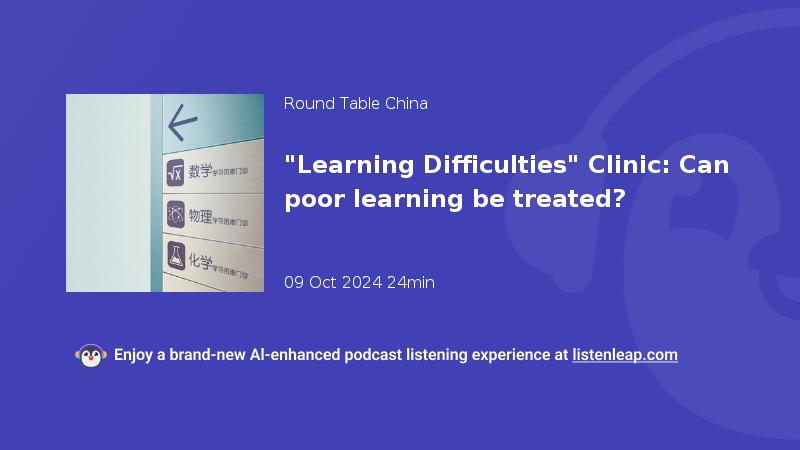
So, as you already revealed, the clinic's name is Spatial and Mathematics Learning Difficulties Clinic and it has sparked heated discussions on social media with appointments being in high demand.
So actually, this clinic is a collaboration between the Psychological Health Team at Shanghai Children's Medical Center affiliated with Shanghai Jiangsu University School of Medicine and the Psychology Department of Shanghai Jiaotung University.
So, it opened for the first time on October the 8th and operates every Tuesday with all appointments now already booked for the following three weeks.
Very popular. So, according to the information released on the hospital's official account, the clinic is classified as a specialty clinic with a registration fee of 360 Yuan.
Which is quite expensive considering the situation here in China because normally, if you want to get a registration number to see a doctor here, it's around 10 Yuan, 20 Yuan, 50 Yuan and the so -called specialty clinic is relatively expensive because you're into a certain kind of expert or you are receiving
relatively better service.
I mean, it's weird to use the word service in the environment or in the situation of a hospital, but well, that's the treatment.
This is different. It's different.
So, what I want to ask is, if I want to get a number to see a doctor in this special clinic, what happens next?
So, think about it.
If you have or if you're chosen to have any issue on learning mathematics, what would you treat them?
Buying them loads of practicing and textbooks so they can practice and so they cure their problems.
Yeah, get involved.
Try to help them out as best you can.
Maybe talk to the teacher and see if that can help.
By the way, you said 316 Yuan, that's around 45 US dollars.
That's just to see the doctor.
That you're not paying for any treatment or any testing or anything like that.
That's simply to see the doctor.
Yes and if you're diagnosed with actual learning difficulties, then if you need any medications, you need to pay extra for your medications.
And back to the process of this diagnosing, I think.
So, first of all, it is a collaborative assessment by multiple doctors.
I think that is why it is a bit more expensive.
Because instead of seeing one doctor, you're seeing multiple doctors.
A group of doctors.
And according to a parent who has experienced the learning difficulties clinic, the process includes an in -person consultation, similar to other medical appointments.
And after this consultation, doctors may order various tests, including, but not limited to, EEGs.
That's electron insufflow gram or something about your brain waves.
Yeah, that's a serious test, by the way.
To see the brain activity.
Yes, and also to see your trace elements and give you a lot of assessments, like intelligence assessments, personality tests, and daily living skills evaluation, and so on.
And aside from EEGs and trace elements, the other assessments typically involve answering questions and questionnaires or responding to prompts.
Personality tests included in that as well.
Well, if you're outgoing person and you constantly wanting to talk to the person sits next to you, you would miss sentences from the teachers.
I guess that's the reason.
Perhaps, perhaps not.
One, perhaps not. Another point that is quite important, I think, and that is worth to mention that the doctor emphasized that, you know, throughout the whole consultation, they closely observe the interaction and atmosphere between the parents and child, which is very meaningful for diagnosing the children's
condition. Okay, so who can make an appointment, who can go?
Just anybody? Is there a cutoff line?
I'm wondering what I mean by that is scores below 50 percent on on math test.
Is this only for math or are other subjects included as well?
So, actually, the hospital actually says that, you know, anybody who think that, you know, the students who find it challenging to learn subjects like mathematics, physics, and chemistry hard, you can go to the hospital to see it.
But it doesn't mean that these people have an issue on learning these subjects.
You know, the hospital also reminds that this issue is not limited to students under 18.
Adults can also experience challenges with spatial imagination abilities.
Yeah, right. It's not called the children's spatial and mathematics learning difficulties clinic.
It's called it's there's no reference to children.
So this is this is forever.
This is for everyone.
But so far, it seems that it's children parents who have made reservations for their children.
But most cases are parents believe, you know, their child has a learning issue.
So it's most likely going to be primary school students and the parents will take them to the hospital if they think, you know, they're not doing grades in mathematics.
Just math or math related subjects like physics or.
Yes, of course. Chemistry, things like that as well.
Well, when it comes to tweeting, learning disabilities or learning challenges as a kind of illness or as something that you can help in the environment of a hospital, this is not something new here in China.
For example, Beijing, Nanjing, Hanzhou and Wuhan have all children's hospitals with similar departments, though the names of the departments may vary a little bit slightly.
You have learning disorder clinics.
You have the kind of clinics that tweet the so -called school refusal, school phobia, the kids who do not want to go to schools.
And at the Capital Institute of Patriotic, the learning difficulty clinic has been open since May 2022, and it treats over 8000 patients each year.
The clinic aims to conduct comprehensive evaluations to find the causes of the learning difficulties and identify diseases affecting academic performances.
And it offers diagnosis for children or for conditions such as ADHD and learning disorders.
But definitely this is the first time that mathematics and spatial difficulties have been singled out.
So do we see such kind of learning difficulty centered clinics or subjects in overseas countries?
Yeah, we do. I looked at Canada, the country that I'm from.
In Toronto, they have a place called the Possibilities Clinic, and on their website, the assessment services that they provide are for psychiatric and psychological assessments, learning disabilities, ADD, ADHD testing.
Giftedness testing as well is on their list, which I thought was interesting.
Tick disorders, Tourette syndrome assessment, that's in Toronto.
In Washington, D .C., they have the National Centre for Learning Disabilities.
And their mission says we're working to improve the lives of individuals with learning disabilities and attention issues by empowering parents and young adults.
And in Europe, they have the European Agency for Special Needs and Inclusive Education.
I found information on those places, but what I couldn't find is a spot internationally that focused specifically on mathematical issues.
You mentioned spatial and spatial perception issues.
When we talk about math and math and difficulties in learning math, we hear that type of term a lot.
What exactly is that?
So, actually, when we are mentioning these, that's because the reason that they are setting up this clinic is that experts indicate that there is a significant correlation between spatial cognitive abilities and skills in subjects like mathematics.
So, you know, students with spatial perception issues, visual spatial impairments or calculation difficulties showing significant challenges when solving something like geometry problems or a task that involve three -dimensional spatial thinking.
And when students experiencing anxiety related to subjects like mathematics and physics are the scenes that, you know, they may think they have issues on understanding or, you know, the recognition of spatial things.
Yeah, mentally rotating shapes or visualizing patterns.
If children are good at this, it's important for math and geometry because it helps them develop, I guess, a deeper understanding of the subject and it allows them to understand different mathematical concepts like symmetry and measurement and things like that.
The spatial awareness is basic in simple terms.
It's your ability to understand your body's position in relation to your surroundings or another object's position in relation to its surroundings.
And for certain mathematical subjects, that's an important thing to be able to grasp.
This explains a lot.
When I was in middle school, I started to read a brief history of time and I realized after the first 40 percent, I started having problems visualize the kind of situation described in the book.
And I cannot really imagine what a four -dimensional world is like.
How is time intertwined and interact with space?
And now I realize it's not my problem.
It's just I do not have the ability to do that.
Maybe my brain does not have that function.
And here comes the question.
Some people are good at language.
Some people are good at mathematics.
Some people are really good at imagining different dimensions in their brain.
Is this really an illness that we can treat or we should treat?
Or is it just people are gifted in different ways?
That's exactly what I was thinking.
You know, when we're thinking about your imagination on all of these spatial items, or you can imagine a square in your mind and the six sides of this square.
And if you cannot, does that mean you are not good at these kind of spatial thinking?
So in simple terms, the experts say if a student's grades are very poor, but their intelligence level is normal, this may be related to, you know, physiological issues, such as brain function or psychological conditions.
And when we're talking about should we treat it or should we treat it as an issue, I was thinking about three -body problem.
People talk about, like, three -dimensional world or four -dimensional, five -dimensional world in the fiction.
And I cannot. You cannot realize it either.
I cannot. When you're saying that, okay, when you're seeing me in a five -dimensional world, you cannot, I am maybe a piece of paper or something like that, I just cannot imagine that kind of world.
But does that mean I am not good at imagining a, you know, spatial world or something like that?
So when we're treating these kind of issues as an issue, I think there is a basic line that is about, because we're living in a three -dimensional world and maybe the basic understanding on a square is that you can imagine a square, and then if you cannot, or maybe they have difficulties on, imagine
that. So if you're below average, maybe you can get help so that you can perform similarly with your peers.
But if you just feel like you cannot be exceptional, then accept that you are not exceptional at that front and be exceptional at some other areas.
That's what you're saying.
What's the goal here with this clinic?
Is it just assessment or is it assessment and treatment as well?
Of course, I think if the parents are bringing their children to these clinics, they would like to have some treatment.
But here's the thing.
The doctors are saying that not all of the students that come to this clinic have an issue.
They need a huge amount of assessments.
And then after that, to see if the students, maybe they're not good at mathematics or science subjects, if they are just not focusing enough or they're not doing much enough of exercise, or they actually biologically have an issue on these kind of spatial recognition.
So I guess then the goal or the intention behind establishing this clinic, which is very, very, it's brand new, by the way.
As far as I know, nothing like this has ever existed before.
So the goal behind this is not to improve academic performance directly in a hospital setting, right?
Patient privacy is going to be strictly protected during their consultations.
And if assessment reveals no related deficiencies, as you talked about, the doctors are saying not everyone who comes to the clinic is going to be diagnosed with a learning deficiency.
If they don't have any obstacles in their spatial cognitive abilities, then they may be advised to cancel their appointments as well.
So the goal here, from the doctor's point of view, from the clinic's point of view, is truly to help.
Yes. And we talked a little bit about other clinics looking to solve problems like learning difficulties and learning challenges.
And doctors in those clinics also said that they have actually started similar diagnosis and treatment in a specific clinic or department, called behavioral problem department.
And no, well, it was not that popular.
Parents would not take their kids to these places.
It's when they started to change the name, they attract more patients, more students to look into their issues, look into their learning disabilities, so that more diseases can be diagnosed and can be dealt with.
And I think that is actually a very smart move.
We talk about remove the stigma, remove the misconception about different psychological problems.
How do you remove a stigma when the name of your clinic is spatial and mathematics learning difficulties clinic?
No, the idea is that for some parents and some students, if the name of, if they are diagnosed with ADHD, it might be okay.
If they're diagnosed with, for example, Asberg, then they're treating it as a mental disease and they do not want to treat the mental disease, or some parents, maybe relatively small portion, but still some parents would refuse that their children have mental problems.
If you give them the chance to see a doctor to get diagnosed and to treat it, then they would change their conception about the disease and they go.
But if you just say it's a mental clinic, they would not take their kids to go.
Yeah, right. So that's the first, I think that's the first step of the progress.
Yeah, eliminating parents prejudices for sure.
This is a really tough one, isn't it?
You know, I see a number of potential problems here.
One is the cost, right?
It's more expensive than other places and I understand why.
But at the same time, that could be problematic because it's kind of related to private tutoring, in a sense, or institutes, and in the sense that those are only available for families that can afford it.
This would only be available for families that can afford it as well, by the sounds of things, unless I'm wrong, because it is more expensive than going to your typical hospital.
Then you have the problems, potentially with the students as well.
You know, when I was in an elementary school and middle school, I didn't like math.
It wasn't necessarily a learning difficulty or anything that I had wrong with me, air quotes wrong with me.
I just didn't like it.
I didn't have an interest.
So if parents are seeing that their kids don't have an interest in math or maybe they're just, you know, they're not as strong in that subject as they are in other subjects, the parents might panic and think, oh my goodness, my child has a learning disability, when that might not be the case at all.
That's a problem, potential problem.
Then from the child's, sorry, just from the child's point of view, we're going to take you to a learning disability clinic.
And then what does that do to the child's self -confidence?
Well, I think one thing I can imagine is that when the doctor doing all of the tests and stuff and tell the kids, you don't have a learning disability.
You don't have a learning problem.
Now you do not have an excuse of not doing your practices.
You are fine. That's fair.
And when the kid is actually suffering from something, they are, I'm pretty sure that the doctors would be, especially if we're talking about kids under the age of 10, which are the major patients, quote unquote, patients of these kind of clinics, the doctors would provide different types of so -called
treatment. Because when you think about a doctor, when you think about a hospital, you think about medicine, you think about injections of certain medicine, you think about the kind of treatment that is full of the smell of this centralizer in the hospital.
But actually that is not the major part.
It's why it's not even the major part of a treatment, even if it's not psychological problems.
We're not talking about just mental disease.
For example, if you are diagnosed with diabetes, yes, you would be given treatment in the sense of different medicine, but you would also be given constant reminders from the doctors that you need to change your lifestyle.
You need to do more exercise.
It's the same for this kind of so -called learning disabilities.
You would be given different exercises that you can do to improve your cognitive ability in terms of spatial.
You're absolutely right.
And this is from the Institute for Disability Research Policy and Practice.
They say that research has consistently demonstrated that early intervention can lead to improved cognitive language and motor development, reducing the need for more intensive special education or adult disability services later in life.
And that's why I said this is a tough one, because the things that I said before, I think are still true, but at the same time as a parent, if you recognize a potential problem with your child, then early intervention is the best course of action.
And for the reasons that I just stated is that if you find a problem early enough, then you can start to treat it early enough.
And also, I think to answer a question from the perspective of children, I think that also depends on the context.
When we're talking about these in English, it is called learning difficulties.
It sounds very difficult.
But in Chinese, it's called Or I think to a lot of children, that may sound like a clinic for, I don't want to go to school, I don't want to study mathematics.
It's not that serious.
It's not that serious.
The translation in English comes off more serious.
Yes, I think that is part of the reason that I think most of the parents would like to accept the truth that they are taking their children to this kind of clinics.
And also, that is also, according to some of the doctors saying that, it is one of the reasons they are setting up this kind of clinics to eliminating parents' prejudices.
And also, I was thinking, from the perspective of parents, or maybe from the perspective of doctors, because they are treating the parent and the child as a family or as a group to treat these kind of issues.
You know, I read a report about a young child who, after talking with the doctor, expressed that it wasn't that he didn't want to do his homework.
Rather, he finished it too quickly.
His parents would then assign him more work.
So, he intentionally procrastinated on his school assignment.
And then his parents took him to this learning difficulty clinic.
His plan backfired.
So, it's helping the parents learning better parenting skills as well.
And one final point I'd like to make here is that, now we have more and more technological tools to identify different, quote -unquote, problems, difficulties, specialties, special situations, when we compare our abilities with others.
And it actually somehow helped.
If you think about 200 years ago, several hundred years ago, we do not really have ADHD, or do not really understand the concept of ADHD.
But now, you see a lot of universities, different schools around the world, would even give people suffering from ADHD extra time to take tests, so that they can perform better.
Because it's not their intention to not focus on or concentrate on the problems.
It's a special disease or a special disability that they suffer.
It's like, medically.
So, if with more patients with more research done in this area, and we identify more of those rather physical problems, people are wired differently.
And if we find the difference that's wired in your brain, and we take that into consideration, maybe we do not even need to treat it.
We just need to give people different accommodations.
And what you mentioned before, that fear of school, that's called Scholionophobia.
This is from the Cleveland Clinic.
Experts, it's not a formal diagnosis, but experts treat it like a specific phobia, and it affects one in 20 students at some point during their school life.
Yes, so with certain help, they can actually perform better, and maybe understand themselves better, and have a better life.
And everybody wants that.
So maybe that's the direction and the purpose of this special clinic.