Takeaway Chinese, where you can take some Chinese away and experience progress day by day.
Take away Chinese, we will promise you a difference.
Thank you. 你好,欢迎收听随行汉语。 Welcome to Takeaway Chinese, I'm Niu Honglin.
And joining me today is Steve Hatterley.
Hello Steve! You learned something. I learned a sentence.
You learned a sentence. That's Milestone.
I was so happy that I was able to remember Remember like five, six words in a row. very correctly, repeated them.
For our listeners who didn't understand that, I think I said it's very nice to see. you.
Yes, you did. Question, but that is typically used with people when you meet them for the first time or Like it's nice to meet you or.
For the first time. Only for the first time.
Yes. So you can't use that, I mean, I think you can, but people kind of laugh at you because every time I go to the supermarket now When I see my favorite supermarket lady, I use this sentence and she always laughs at me.
Which means you're not using it perfectly correct.
But she knows I'm just practicing, so she's awesome about it.
But that's a good point to know. So when you meet somebody for the first time, you can use that sentence.
And that means it's really... Nice meeting you.
But it means it's really quite a strong meaning, isn't it?
Yes. Yeah. Because the reaction when you say that to people is quite they really smile when you say this to people.
Well, that's partly because of your face and the fact that you're speaking Chinese.
But like you said, it is supposed to be something that you say. when you meet someone for the first time.
Because for Chinese people, if you've seen each other for once, You already know each other You're friends You do not use the Nice to meet you 很高兴 认识你
Nice getting to know you phrase anymore.
I see. Okay, so then in English... If you meet somebody for the first time, you say it's nice to meet you.
When you see them. Again, every other time you can say, it's lovely to see you.
It's nice to see you. We do not have a phrase as fixed, as common, as much. used that universally as 很高兴认识你
But we do say long time no see. 好久不见。 No matter how many days you haven't seen each other, you still say 好久不见 because it feels like like a long time because I want to see you every day that kind of sentiment Oh, that's a good learning point because I know that sentence too.
好久不见,你好吗? Long time no see. How are you doing?
But even if it's only been a day or so, you can say that.
If you really want to stress, I really want to see you every day.
That's very good to know as well. Yeah. When it comes to language learning, you can always learn something new.
You can always learn a new phrase, a new word a new habit linguistically or culturally.
And you can always learn different connotation or like the color of the language, someone's personality has something to do, has a lot to do with the way they speak. the choice of words.
Sometimes it's personality, sometimes it's culture-based, though.
For example... In English and in Chinese, we would say...
Please and thank you, right? Especially thank you.
But in Korean, people don't really say thank you to the word.
They don't say the word. I think it's like, you're welcome.
But people usually say like, meaning like, no, no, no, no, no, no, no, no.
Meaning like, that's okay, no problem. Yes, that's... the thing if you're learning a language to start with the way people speak the exact choice of words would be different than you learn it if you're learning it in the country, in the society, compared to when you're learning it from the textbook.
That's the first thing. But that's the really great thing about different languages from different parts of the world.
We're all human, so we all kind of basically say the same thing.
In different ways. Our sentiment is always the same, but we just... go about it in a different kind of way.
Yes, and that is why Learning the language in the right environment or being able to immerse yourself in the environment of the language you're learning important.
And that is not the luxury that everybody has yet.
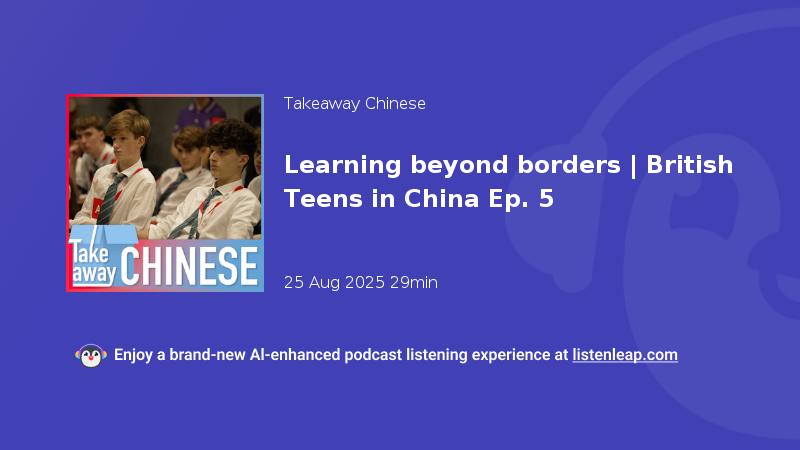
Over the course of several episodes, previous episodes, we know that these students from UK, they had the chance. to come to China, to go to Beijing language and culture to spend their study trip here in Beijing.
Amazing. Yes. And for today's episode, again, we still have the special treat for you.
We are taking you again back to the universe. to listen to the conversation between Yushun and some more students talking about their experiences learning the language so let's have a listen first First of all, can you introduce yourself?
Hi, I'm Amelia. I'm one of the UK exchange students for the intensive study in China.
Yeah, my name is Sophia and I'm 14 years old.
My name's Caspar. I live in Portsmouth, England.
I'm 14 years old. So my name is Ben, I'm 14 years old and I come from near Portsmouth in England?
So my name's Stanley. I'm 14 years old and I'm a Mandarin student at Beth's Grammar School in London.
I am Finlay, I'm 13, and I go to King's Academy Bay House.
How long have been learning Chinese? I've been learning Chinese for around three years.
So ever since year seven to year nine currently.
So we've been learning from year seven, we call it.
So I think it's grade seven here, so three years.
I've learned Mandarin for three years now.
I've been learning Chinese for three years.
And yeah, I really enjoy it. So I've been learning Chinese for about three years now, and I find it very enjoyable.
I've been learning Chinese for around three years now.
And can you tell us the reasons why you wanted to learn Chinese?
I have a very big interest in languages ever since I was young.
I'm born Polish, so I'm already in a family full of different languages.
And I'm the only child in my whole four generations who lives in England, speaks English, two or three languages and I also want to be a diplomat.
So if I really want to work in the UN, BCLU and the Mandarin Excellence Programme will really help me into getting my HSK 5 and 6. actually at first I was asked by my dad to give myself a challenge that was kind of it and I'll prove to myself that I'll that I can do hard things.
I've loved it, everything. I want to go into business when I'm older and I thought Mandarin would be a really good language to have when I'm older.
I wanted to learn Chinese as China is a country which is ever-growing and To have Mandarin will be a super useful skill in the future and especially in the workplace.
Because from my understanding, China is a very fast-growing economy.
And Chinese is a very well-spoken language across the world.
And having it's like a gift. that not many people in England get to have. because only the more privileged schools usually get to study it.
And I think that puts me Advantage in the future if I can speak Mandarin because it's a very good skill especially being able to communicate with China which will have much more importance in the future.
So about this trip, What do you think is the best part of this trip?
I think the best part is seeing all of the wonders of China right before your eyes. we went to the Great Wall, Forbidden City, Summer Palace and Temple of Heaven so far and I'd say those were the best things ever because I've only seen them in images and it like really helps me to like see what their history is like, what the traditions, the culture and it just really fascinates me.
I loved it. I'm doing a speech at the closing ceremony today.
In that speech, I speak about, you know, how much I'm going to miss it and things like because we had. an excursion day so we went to the Great Wall which was absolutely incredible.
It was so hard to get to the top, but once we did, it was so worth it.
The views were absolutely... amazing and it's not just the what you see and where you go.
I think it's about the connections that you make as well and meeting new people.
And being in such a diverse, different culture, it is so surreal to be here.
And I will really miss it. I've quite enjoyed going to a lot of tourist attractions. like the Great Wall of China and the Olympic Stadium, climb up. a lot of steps so it took quite a while and it was quite tiring but after that the views were very nice and It felt very surreal to be there.
And would you recommend this trip to others, like your classmates?
Yeah, definitely. It is a once in a lifetime opportunity, I think, definitely.
Of course I would, if like you're really interested in, learning new things learning about new people and learning a whole other like array of a country because for most likely not many people would be in Asia learning Chinese. most likely in Europe, you can really see the cultural difference between the two.
So have you experienced any culture shock so far?
Alipay is quite a shock to me because in England we have to use our physical credit cards a lot.
So being able to just scan things is a lot better I think.
I think the subway stations or the subway is a lot better than the ones in London.
It's just quite clean. Everyone's really friendly here.
Only not drinking the tap water. Okay. Other than that, do you see any like differences or similarities between like Chinese culture and British culture or something? something like um I did learn that like before we went we had a whole briefing and the fact that Bodily contact is quite common, especially in crowded areas.
Usually in Europe you'd have your own little bubble, so that you'd have your space.
But in China, that's the complete opposite.
I was on the subway and when we were going through, there was no such thing as a personal bubble.
So we just had to kind of smidgen through the subway and back.
Do you like it or not? Just get closer connection with people, that kind of thing.
Yeah, I'd say it's actually a little bit better because when you have your own little space, you just kind of... don't manage to get to know people as much as you usually would.
Because if you had your space, you'd have to go up to them and leave a bit of space.
But if you just bumped into someone and say, oh, how are you, sir? they like they'd be really kind back and then you just kind of have like a little bit of a connection for a second.
It's very different to any other country.
It's halfway across the world from where we live.
I think the squat toilets did give me a shot.
I didn't think that there'd be so many. I knew that there would be a couple, but I didn't realize there'd be everywhere.
I think that was one. And the food as well is very different. to how we eat and using chopsticks.
They're everywhere. Lizzie Susan's, it might sound like a weird thing, but we don't have many in England.
Wherever we went to restaurants and things like that, they've had them everywhere.
How's the food there, here? Here, I love it.
I really like Chinese food. We have Chinese food restaurants where we live.
And have you observed any similarities or differences between China and Britain?
I think some similarities. Everyone is very nice.
A lot of people in England, you know, they greet you with a nice smile nice to meet you things like that here they do too but a difference obviously when this was also a culture shock i'd just remembered but as soon as you walk past someone they like they stare at you but not obviously not in a bad way but you know they're asked to take pictures i've had about my friends have had like about Five people asked for them pictures in one day.
The heat, we don't get this much in England at all.
We don't, we just get rain and cloud and wind.
So what was your impression of China before you came here and did it change after a visit?
No, I didn't really have a difference in my impression.
I first thought of China as like it's quite clean in especially places like the underground And like the culture is like to be like very like full of manners and at least be a bit kind to people you don't know.
That didn't change at all. I actually heightened even more before we came here i was very like scared and i wasn't like very confident with it So I think that coming here has definitely made me feel a lot better.
I think my opinions changed a lot more. It looked very high tech, very advanced.
And I think it still does look like that.
It's definitely opened me up to a whole new culture, like a whole new, Honey World, to me, it feels like a different place and I feel like it should definitely be done more.
Do you know any Chinese folk tales? I know.
One of Chang'e, the moon goddess. I managed to learn that really young and I've been really obsessed with the moon ever since.
It's very beautiful. Yeah. So this project is more like a cultural exchange, right?
Do you think countries should do more cultural exchange like this? definitely you kind of see the differences and accept the differences and it gives you a wider view of what the country is like compared to what you've read online or like what you read in the textbook or what you've seen online even.
So I think that If there were more exchanges, things like that, then it would make... people more open-minded like myself and open-eyed to the diverse culture around them and not just stuck in one place and I think because we are majority of the time at our schools anyway so I think a lot of do need to provide more exchanges, things like that. to really like it would help the kids as well Thank you and I hope you had a great time here in China.
Thank you very much. Well, I hope you've enjoyed the stories as much as I have And their experiences, their struggles, their culture shocks. are quite common, quite representative to a lot of people.
Do you feel the same way, Steve? When you first came to China, do you feel similar culture?
As they talked about, like being too close to people, not being able to drink the tap water in those. so food.
Um, the food. Okay. Let me answer like this.
Yes, yes, yes. But that wasn't when I came to China for the first time that was when I came to Asia for the first time.
So I got used, is that true? I've gotten used to the the lack of a space barrier.
I don't think I have gotten used to it. in Canada I'm from Nova Scotia right when you're in Nova Scotia You're never in a situation where a stranger is literally right next to you unless you're in like a nightclub or Yeah, because your country is much less populated.
I know. I'm not saying it's better or worse.
I'm just saying that's why. When people come to China where 1.4 billion people live or somewhere else in Asia, they might experience that lack of distance.
So it's just a new thing that you have to get used to.
I'm gonna teach you this 几几 几几 means squeeze or to push very hard together.
And the thing, the scenario that you'll be able to use that word very often is This is hilarious.
When I hit the mall, sometimes for the ones that are really huge, yet with not enough lifts. sometimes when I'm inside the lift myself, people would go squeeze themselves in And, you know, when you're in the lift, you feel like you're the owner of it or you feel like you're the host and you can invite people in. but you can also say no to those who are trying to get in.
Just try to close the door quickly. Yeah, but I understand that's not the real situation.
I do not own the elevator, but once you're in, you're in, right?
So for those who are trying to get in and instead of those who are in the lift saying, squeeze a little bit, make more room so more people can come in.
It's usually those who are outside of the elevator saying, ZZZ, ZZZ. you're in a shopping mall you're not at work just wait for the next one.
Exactly. They're constantly coming and going. there are too many people in the shopping mall and people are in a hurry and they do not want to wait.
And you kind of get used to it without getting used to it.
You know people are doing this. And when everyone... finds it okay to squeeze a little bit you're kind of like Fine.
It's so funny. My friend from Chicago just moved to Chengdu as a matter of fact.
And in the months that he was getting ready to come, I was sending him pictures from Beijing saying, oh, you know, this type of food, you know. this type of environment.
Even though he wasn't coming to this city, to Beijing, I still wanted to kind of give him an idea of And I remember one day I sent him a picture from... I was at the Temple of Heaven, as a matter of fact.
And it was not crowded at all. Now, crowded by Chinese standards.
For me, it wasn't crowded at all. I sent him the picture.
He's like, ooh, busy day there, huh? Looks crazy crowded.
I said, bro. Your definition of crowded is about to be redefined.
He's like, oh, really? That's the thing about China.
Many of my friends from outside of the country say that You need to redefine a lot of concept once you're in China.
Redefine the level of 拥挤, crowdedness. redefine the scale of large. people, right?
Some places can be really huge. And also for some people, redefine the level of spiciness. it can also be quite different here in China.
I totally agree, yeah. But that's the fun.
Yeah, I mean, you're in a different part of the world.
Obviously, some things are going to be a little bit different, right?
For example... You know, my wife's from Korea and we were in Ottawa. the capital of Canada, and we were at a grocery store at a supermarket.
Now, I know that the supermarkets here can be crowded sometimes, sometimes not.
But anyway, just happened to be in that location.
Well, my wife just walked in front of a lady. who was looking at something and there was a cart like behind the lady.
So my wife couldn't walk behind her, so she had to walk in front of her, which interrupted her view of the aisle for a moment.
You know, no big deal if you do that in China or in Korea or in a maybe mega city.
I'm not sure, but this woman was appalled.
Oh my God. looked at her husband and I'm just observing from a distance, right?
I haven't acknowledged that that Person is my wife.
So I'm just kind of waiting to see if this is gonna escalate at all This woman looked at her husband.
It was like And my wife turned around and was like, oh, I'm sorry, sorry about that.
And then later she said to me like, what was her problem?
You were too close to her. We don't do that.
We kind of keep our distance. We don't really like that very much.
That is another thing. If you're in China longer. you would realize that people from different parts of the country also have different definition when it comes to whether or not we are strangers, whether or not we've been in the same room long enough talk to each other, how much help I should offer to total stranger standing next to me on the street.
For instance, people from the north and east 10 area of the country They are famous for being very, very welcome to everybody.
The idea is that if you are in the same restaurant for those who are from the southern part of the country, Maybe you're in the same restaurant and you're kind of still ordering and you want to know what is the specialty, what is the best dish from the restaurant. you would want to have a sneak peek into other tables and try to see what What are you eating?
Yeah, what is that one? You ask the server, what is that one?
I want what they want, which is also a good tip for those who are not fluent in Chinese speaking.
You can say, 我想要那个,我想要这个, so 这个 meaning this one, 那个 or 那个 meaning that one.
So you can use that tip to order if you do not know how to pronounce the dish name.
And but they will do it in a way that they do not want to destroy. those who are at the other dining tables.
Yet for those from Dongbei, the northeastern side of the country, They might be introducing their dish to you, telling you what's special about the dish maybe even offering you a bite right so see even again here in China even the same country people from different locations would have different level of intimacy with strangers or different definitions.
Even in Canada, that happens too, right?
Like if you're in... Toronto or maybe Montreal, then that, type of thing isn't going to happen.
But if you're in rural Nova Scotia... then it very well might happen, that exact same type of thing.
I just, I don't know what it is, right? It's just more of a countryside friendliness. culture that seems to exist in so many different countries around the world.
Yes. Besides that, we also learned that these young kids From UK high schools, they're learning Chinese and some of them already speak pretty good Chinese.
Yeah, it's really impressive, isn't it? And what a wonderful opportunity.
I mean, I'm sure they're having fun and I'm sure that they realize that this is kind of a special thing for them.
But I think when they get to be around like 25 or 30 and they look back at this time, they'll say like, Yeah, exactly, because it's just such a unique thing to do. for someone of that age to have the opportunity to travel to a different part of the world and Especially when they're already students of that language.
Wow, they're just really lucky that they got that chance.
Some of them talked about how surprising, shocking and happily. impressed by Chinese culture because of different activities they were able to engage themselves in. and the different experience they can have with not only modern Chinese culture, but traditional Chinese culture, which is something that not everyone, every kid in China is lucky enough to you know, have some hands on experience.
So do you think because you've been here long enough and I'm not really sure about your knowledge about traditional Chinese culture or ancient Chinese culture, but do you find it really different in the sense that, for example, if we only have half an hour, do you think it's possible for me to introduce that huge, that rich. background or mentality of traditional Chinese philosophy or culture or history. to you or to anybody who has no experience in China.
In a half an hour? No, I don't think so.
But you can definitely give people a taste. of what that means.
And I think when you have structures like the forbidden city or the temple of heaven, things like that.
That's kind of a nice gateway. But even that being said, if I said to... someone in Canada with no experience in Asia, no knowledge of Asia whatsoever, or China. said, Oh, do you know what the forbidden city is?
They would say, what's that? But if I said, do you know what the great wall is?
They would say, yeah, of course. This is one of the most recognized structures on this planet. to all the people on this planet, right?
So you have to kind of know that When we hear about China, when we hear things about China, we know about the food, of course, in the West and it's really famous. and we know it's delicious. but we see pictures of the Great Wall, we see it in documentaries and stuff, but it doesn't necessarily feel like it's real.
So... when you'd never been to the place and you don't learn anything about the place.
And this could be true for China. It could be. true for America.
It doesn't matter if you've never been there. then you don't know and it's hard to even though you hear about it in a textbook or watch it through a documentary it's still hard to to like hit home and really have that same level of impact.
And again, that's why I said for those kids.
And it's such a unique and special opportunity because not only they can get around here a little bit, because they speak the language a little bit, right?
So not only that... but they get to see the things firsthand that they've been hearing about for the last three years of their study.
Yes, if you've never had a bite of a banana, no matter how much.
Say about the taste of it. You would not know it's a perfect example I'm still very glad to see that almost all of them are very open-minded.
They are not, I'm rejecting any opportunities and they're not saying no to even stinky tofu. that's off record, but I also talked a little bit to them.
So they're trying new... food, they are opening themselves to new experiences and that's what I hope.
Well, maybe my kid or my friends or all of us could have that kind of mentality.
That is one we open ourselves to a new culture just you know try the new things maybe you'll fall in love with them without even knowing how much you were falling in love with them.
Well, when you don't know about something, there's two things, and this is just my opinion, When you don't know about something, there's two things that happen.
Number one, you're afraid of it. because you don't know about it.
And because you're afraid of it, there's a reluctance.
Sure. Right. There's something inside you that makes you nervous. or uncomfortable and it's just a fear of the unknown and we just assume, I don't know why human beings But we tend to assume make assumptions and it's so weird to me now I can say this and because I have the advantage of hindsight.
But it's so weird to me that people... can say I'm not interested in something, I don't like something or when they've never experienced it, right?
I remember you know my dad my dad my dad is you know he's an old canadian guy right He likes what he likes when it comes to food and stuff.
And when I brought him to Korea, I said, do you want some pork belly?
Now I could have said bacon, which is basically what it is it's kind of like a thicker version of bacon right but i said pork belly now To a Canadian, when you say to an older Canadian...
I love him very much. When you say pork belly, put those two words together, his immediate reaction was, nope, I don't want that.
I said, what is it, Dad? And he said, I don't know.
I said, well, how do you know you don't want it?
And he said, I know that I know that I don't want it.
That's enough. But do you see what I mean, though?
Yes. But I think and I apologize. I've been talking a lot.
I think with this younger generation of people...
There's a lot more curiosity about the world because of the internet and... technology and the ability to travel now, you know, for people, my parents' generation. traveling to this side of the world would have been inconceivable to them right back in the 1970s.
It's like, what? It wouldn't have happened, but now it's so common.
So when these young people can come and have a great experience and then go back and share experience with their friends who have never been here and their friends go somewhere else and come back and share that then the world becomes Much better place than flat.
Yes, exactly. Yes. So hopefully for those of you who are listening to these special episodes. if you find their experience fascinating, if you find it intriguing and make you want to have a taste of the Chinese language, food and culture, you are always, always welcome.
And that brings us to the end of today's Takeaway Chinese.
I'm Niu Honglin with... Steve in the studio.
For more episodes of the show, you can visit our website at radio.cgtn.com. and go to the column podcast.
You can also listen to the show and read the script there. find us wherever you listen to your favorite podcast just search for takeaway chinese Don't forget to leave your questions, comments and ratings 感谢收听 我们下次再见
Thank you so much. See you next time.