Hello.
Are you ready to learn some real life English?
Well, good, because today I am going to teach you some real life English by taking you with me on a normal day in my real life.
So it is morning right now.
Hey baby, what are you doing?
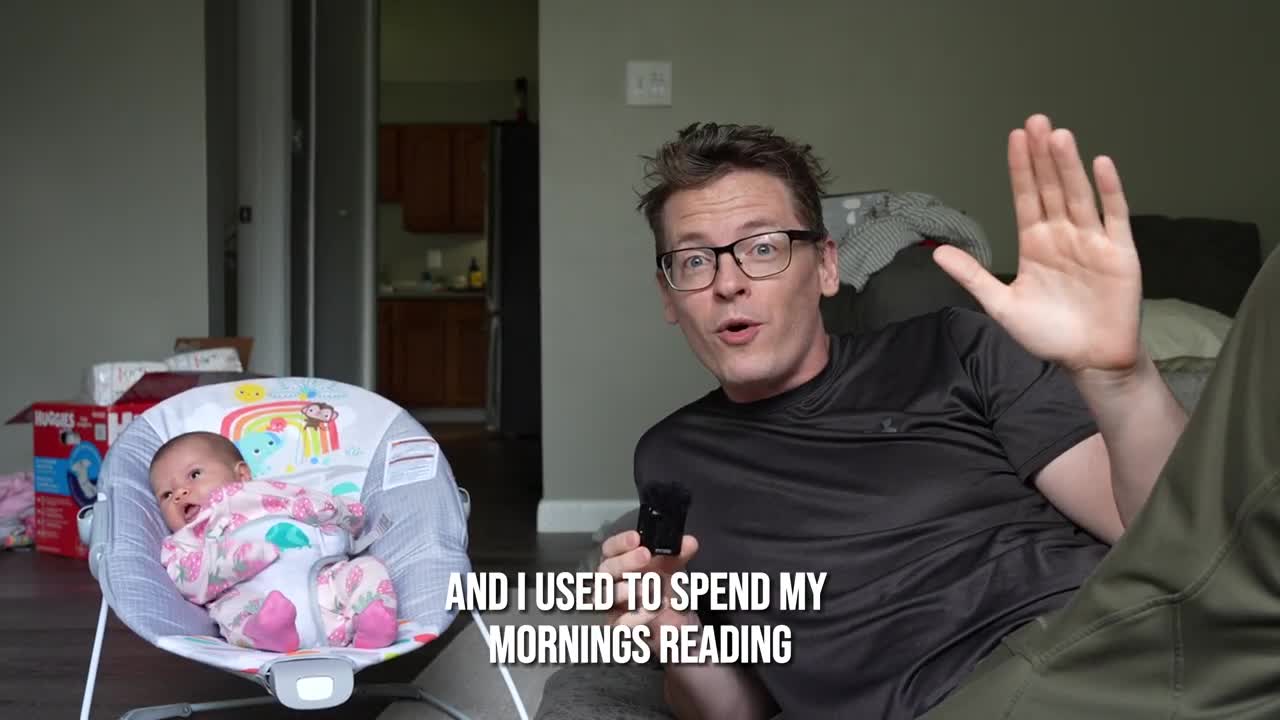
And I used to spend my mornings reading, watching videos on YouTube that I can learn with, but now I spend my mornings
With Abigail, taking care of my daughter, Abigail.
Maybe you'll hear a sound like zzz.
That is Abigail's chair.
Abigail's chair vibrates.
Because babies like that.
Babies like things that vibrate.
Bless you, baby.
She sneezed achoo and i said bless you because when people sneeze here in the u.s we say bless you now i know spanish speakers say salud
Tell me in the comments, in your country, in your language, when somebody sneezes, achoo, what do you say?
Do you say anything?
So guys, I'm taking care of Abigail right now while my wife sleeps.
But when my wife wakes up, I will.
Brush my hair and go do some things I need to do.
And I will take you guys with me and show you a normal day in my life.
And we will learn some great real life English.
I will see you in a little bit.
All right friends now we are in my car got my coffee my wife woke up and she is taking care of abigail so that i can run some errands
What does it mean to run some errands?
Well, running errands is when you leave your house to go and do things that you have to do.
Okay, you can go get some groceries, you can take your kids to school, go do laundry, things that you have to do that you have to leave your house to do.
That we say in English is running errands.
So I went in my car to run some errands.
So guys, the first errand that I am running, I'm going to the bank.
Now why am I going to the bank?
Because a miracle happened.
A miracle.
And what is a miracle?
Well, a miracle is when something happened that never happens, okay?
It should be impossible, but it happened.
And what miracle happened well guys yesterday i got some mail i got some mail and normally when you get mail the letter the letter
It says, you owe us money.
You have to give us money, okay?
So usually it's from a company like your phone company or car company if you make payments on your car.
And usually they are saying, hey, give us money.
But yesterday a miracle happened.
Yesterday I got a letter, a letter, and I was scared.
I thought they were going to tell me, give us money.
But they said,
Hey we owe you money we have to give you money and i said what it's a miracle oh thank you it's a miracle so guys i got a check a check in the mail for money
Now, years ago, years ago, seven or eight years ago, I had a lawyer, okay?
And you have to give a lawyer a bunch of money.
Seven or eight years later now this lawyer said hey you gave me too much money back then
Here is the rest of your money back that i owe you that is a miracle guys that's a miracle and it's a miracle because
Good things never come in the mail and it's a miracle because lawyers never give you money.
They only take money.
But yesterday a good thing came in the mail and this is how much.
You guys see that?
It's a miracle guys.
$698 came to me in the mail.
So now I have to go and put it into my bank account.
So let's do that.
All right guys this is an ATM an ATM and at an ATM you can get money out of your bank account or you can put money in
So today we are going to put money into my account and that is called making a deposit
So let's make a deposit into my bank account.
Now before you deposit a check, you have to sign it.
So I'm going to sign my name.
Signed my name.
Now I will deposit it into my account.
And the ATM is not working.
I guess i have to go inside all right guys for errand number two we are at walmart
I have to go in here and get some oil for my car i need to change the oil in my car
So walmart is a huge store in the us and
They have everything here, guys.
I'll see if I can show you something inside, but Walmart literally has everything.
And it's one of the cheapest places that you can buy things.
That's why I'm here for the oil in my car.
Alright, let's run this errand.
Hey guys, real quick, I have a couple of questions to ask you.
Can you understand my videos, but it's really difficult for you to understand other native English speakers?
Does it feel like other native English speakers are speaking so fast and you just get lost?
Well, for that reason, I created the native English starter kit.
And in the native English starter kit, I teach you exactly why it feels like native speaks so fast.
And teach you the tools you need to start understanding how we really speak
And i also have added two bonuses
When you buy the native english starter kit you also get the small talk master class where i show you how english speakers have everyday conversations how we talk to our friends our co-workers and
People we don't know
So next time somebody asks you what's up you'll be prepared
And something i'm even more excited about that i just added to the native english starter kit is the 30 day native english challenge and in this i've created a plan that you can follow for the next 30 days
I tell you exactly
What you need to do to stop studying English and start living in English.
Alright guys, back to the video.
Okay friends, I'm back home.
I'm done running errands.
So I went to Walmart.
I got oil for my Jeep, my car.
And I got...
And oil filter.
Now maybe you're thinking, why don't you take it to a mechanic?
They can do it.
It's easier.
You're going to get dirty.
Well guys, because these two things cost me about $40.
If I take it to the mechanic, it will cost me $100.
And I have the tools and I kind of like doing that stuff.
So I prefer to just do it myself.
Now, after I went to Walmart and got my oil, I went to another store that is very famous here in the United States called Costco.
What Costco is, is a giant store
A giant store where you can buy things in bulk.
Now, in bulk is a very good piece of vocabulary.
What does in bulk mean?
Well, in bulk means you can buy a lot of one thing.
So at a normal grocery store maybe you buy 12 eggs 12 what we call a dozen eggs but at costco you can buy five dozen eggs this is 60 eggs and my family eats a ton of eggs so i got 60 eggs
My family eats a lot of meat, so I got some beef here and we will probably cook this very slow and make sandwiches out of it or something.
And by the way, this is like eight pounds or two kilograms.
So what we do is we cut this and put them in bags, like two pounds in each bag and we will freeze them.
My wife usually does that.
We will freeze them so we can use them later.
But it's a lot cheaper when you buy big pieces like this instead of going to a normal store and buying one pound or two pounds.
So we've got beef, my favorite meat.
We have more beef, my favorite meat, but this one's already cut up and this one has more fat in it, okay?
So this will be great for making soup.
I use this
Kind of beef to make borscht.
I've used it to make beshbarmak and the other awesome recipes from around the world that you guys have seen me make.
And more meat, guess what kind?
My favorite kind, more beef.
But this beef is ground up, okay?
So this we can make tacos or meat and rice or pasta, meatballs.
There's all kinds of things you could do with this.
And I bought all these things.
I'll put some in the refrigerator and some in the freezer to use later.
All this will last us probably two weeks.
It doesn't last us that long because me, my beautiful wife,
And my handsome son, we all love to eat good food.
So guys, another example of buying in bulk, this is milk, okay?
And there are three in here.
So at the normal store, you would spend five or six dollars for one.
Costco at Costco you get three for the same price that you would pay for two of those so you save a lot of money if you go there often put my milk in the refrigerator
This is another thing that we really like to get from Costco and there's a bunch of them.
So you can see this is sausages in bulk.
These are chicken sausages and they're already cooked.
So these are super easy and fast.
All we have to do is heat them up and eat them.
And for Connor, my son Connor, I got probably the most popular food in the United States for children.
Chicken nuggets.
These are just little pieces of chicken and kids love to dip them in ketchup.
So we got these for Connor so he has something to eat when he's home.
So I will put those in the freezer and we can heat them up whenever Connor wants to eat them.
Then I got some coconut water for my lovely wife.
She's always listening.
And some mustard.
I like to use the mustard on the sausages and it's really good for cooking.
You can use it in a lot of sauces and things like that.
All right guys, I'm done with my errands.
I'm back home.
I'll talk to you guys in a little bit and show you what I'm gonna do next.
Alright guys, now we are going for a walk with Abigail and my beautiful wife Ingrid.
Some of you guys know her as camera wife and right now she is holding the camera.
So this is called a baby carrier because it helps you to carry your baby.
This guys is called a stroller
And you put your baby in here and you can push them around.
But this one's really cool because it also has a car seat that comes off and you just put this in the car or you put it right on the stroller.
So it's super easy and convenient.
And it was really expensive, but my wife said we just have to have it.
So you're lucky.
So guys, this is something that we really like to do as a family, come out here and go for walks, breathe some fresh air, get some exercise, and I love to hear the birds.
Maybe you guys can hear the birds right now.
But this is one of our favorite places to do it.
This is called a bike trail because people usually come here with their bikes, but we come here to walk pretty often and it's one of my favorite places.
I'm sure it'll be one of hers as she grows up too.
Okay guys, here's a little something I wanna show you.
And this is one of the reasons I like to walk outside instead of like in a gym.
You never know what you're going to see.
Before I show you what I'm going to show you, let me just say,
This is a family channel.
I never would tell people they should do something bad.
So I'm not even going to say what this is.
But if you know what this is, you will know what this is.
Guys, we're just walking on a trail where people come with their families.
And this is just growing here.
You better stay away from that.
Never even look at it.
You guys too.
Don't mess with that stuff.
That's garbage.
That won't help you with anything in your life.
All right guys, we had a nice little walk.
Now it's time to take Abby, which is what we call Abigail, Abby, take her out of the baby carrier, put her back in her car seat, and put her car seat in the car.
I got you baby.
I got you Abby.
I put her in her car seat.
Now I take the car seat off of the stroller.
That's the beautiful princess.
Now I put the car seat in the car.
And then we buckle her up with the seatbelt.
When you put on a seatbelt, in English we call that buckling up.
Now Abby is nice and safe.
We are ready to go home.
And have some dinner.
Let me show you guys one last thing before we end this video.
Look at this beautiful woman.
Does it look like she had a baby like three weeks ago?
No.
She says she has mom hair, but man, that's a pretty mom.
All right, my friends, thank you for joining us.
This was a normal day for me.
So I'll see you guys in the next video.
Appreciate you all.
Bye.