Squidward, we don't need television.
Not as long as we have our imagination.
Ah yeah, are you ready to learn with one of the most popular cartoons of all time?
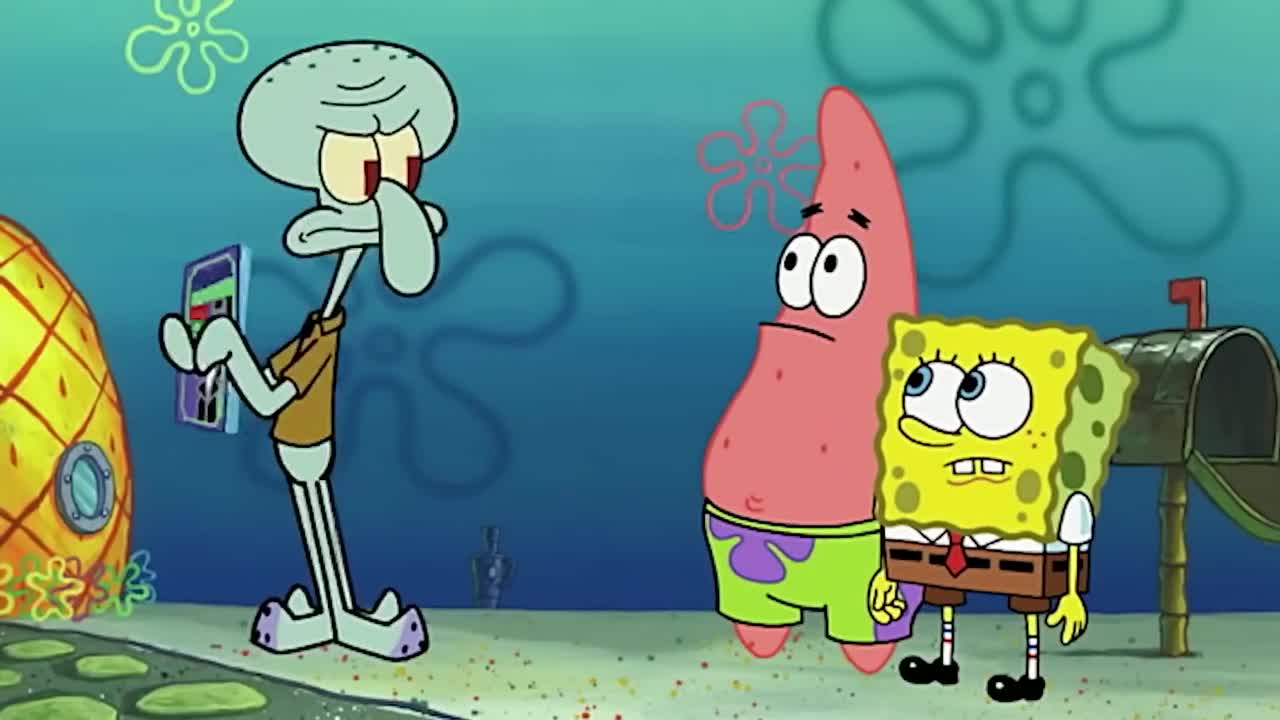
In today's lesson we go under the sea with SpongeBob, SquarePants and his friends Patrick Star and Squidward.
We will be learning with three clips from three different episodes which you might remember if you've ever watched this classic series.
So let's dive in.
Huh?
A brand new television?
Easy, easy.
Just when I thought they couldn't get any stupider.
Let me get this straight.
You two ordered a giant screen television just so you could play in the box?
Pretty smart, huh?
I thought it wouldn't work.
Yeah, that's quite a plan there.
Hey, just before we jump into learning with this clip, I wanted to let you know that, if you're new here, every single week we make fun lessons just like this one, so that you can learn to understand fast speaking natives without getting lost, without missing the jokes and without subtitles.
Just like Paula, who says that she's learning how English is really spoken, not how she learned at the academies.
And you will too.
All you have to do is hit that subscribe button and the bell down below, so you don't miss any of our new lessons.
Huh?
A brand new television?
If an object is brand new, it is completely new, meaning it was made or purchased very recently.
Guys, what in the world is in this?
No!
Claire, why is there a fully cooked turkey in the backpack we left at your house?
You know, this was a brand new backpack, and now it's got turkey juice all up in it!
SpongeBob here uses the word easy as an exclamation, which you can do for asking somebody else to act carefully, especially when they are performing some kind of risky task, like Patrick carrying the heavy TV.
It is a shorter way of saying the full expression.
Take it easy, meaning a request for somebody proceed calmly and in a relaxed manner.
Just when I thought they couldn't get any stupider.
Squidward means he didn't think SpongeBob and Patrick could be any more silly.
So he says just when he thought that they actually went beyond and became even more stupid or stupider.
Stupider is the comparative form of the adjective stupid.
It is an alternative to saying the words more stupid.
Stupid is one of the few adjectives where the comparative form can be said both ways.
Normally, comparative adjectives appear as one of these two options.
For short adjectives adjective plus er example cooler faster, smarter.
For long adjectives more plus adjective example more intelligent, more creative, more fascinating Let me get this straight.
Is an expression used in a conversation when somebody wants to make sure that their understanding is correct.
So, after saying it, the speaker usually explains what he or she was able to understand, while expecting the other person to confirm.
Check out this other example.
It can also be used when somebody doesn't fully believe what they've heard.
I'm sorry, it's not here.
Not there?
So Squidward says to SpongeBob and Patrick You two ordered a giant screen television just so you could play in the box.
The verb to order is normally used when requesting something to be made or delivered to you, normally as you buy that item.
For example, if you buy a TV on the internet from Amazon, you can also say you have ordered a TV on Amazon.
Or in this other scene from Spongebob, when talking about food in a restaurant.
May I please take your order?
I'll have a... a...
Patrick, if I could make a suggestion, why don't you just order a Krabby Patty?
Great idea, Squidward.
One Krabby Patty, please.
Is that for Hero to go?
Giant screen is a compound adjective made of two words describing something that has a giant screen.
In English, you can combine two words to create adjectives.
However, note that in these cases, they are connected by a hyphen.
That does not change anything in pronunciation, but it's definitely important to remember for writing.
So, for example, when talking about a document that has six pages, we can refer to it as a six-page document.
And a TV that has a giant screen is a giant screen TV.
Pretty is an informal way to emphasize an adjective, but not extremely.
Example I think it is so cool that you started your own law firm.
Wow, right now it's a pretty small practice.
I bet it's not that small.
Bro, it's pretty small.
If you say that an idea is quite a plan, you mean that you think it is a great or impressive plan.
So when we say quite a noun, we are indicating that we think the specified person or thing is particularly notable, remarkable or impressive.
It's quite a list.
I hate Krabby Patties.
Good one, Squidward.
Everyone loves Krabby Patties.
Yeah, well, not me.
You know what we say.
The only people who don't like a Krabby Patty have never tasted one.
That's me.
Never had one, never will.
A patty is a piece of food made into a disc shape that is then cooked.
Patties commonly go in burgers.
So, while the word crabby with the K is a made-up word, it is actually a play on words.
Crabby can refer to a crab, this animal which lives in the ocean.
Or it can refer to a person who gets easily annoyed.
He's a rather crabby old man, always complaining about everything.
I hate crabby patties!
Good one, Squidward!
If somebody intentionally said something funny like a joke, and you actually find it funny, you may tell them that it was a good one.
By the way, the name squidward has the word squid in it, which is how we called this animal that looks similar to an octopus.
So in these lines, we see the verbs taste and have being used to refer to the same thing, to eat.
So what is the difference between them?
To taste refers to feeling the sensation of flavor in the mouth and throat on contact with a substance.
While it probably means you also ate the food, it gives you more the idea of trying it.
Now, to have and eat can normally be used interchangeably.
That is, they have the same application.
However, there are some cases where you would prefer saying have.
For example, at a restaurant while making your order.
I'll have a cheeseburger.
Also, the verb have needs to be collocated with a food in order for it to have such a meaning.
Otherwise, you must always use the verb to eat.
That's me.
Never had one, never will.
If somebody is miserable, they are extremely unhappy, uncomfortable or in a very bad condition.
You can say the expression no wonder when you find out the reason for something that had been a mystery for you for some time.
And when you discover the reason, that fact is not so shocking or surprising to you anymore.
So SpongeBob just found out that Squidward has never had a Krabby Patty.
So he assumes that that is the reason why he has always seemed so unhappy.
Garbage is waste material or unwanted things that you throw away.
Trash.
Squidward means he thinks the Krabby Patty is so terrible or insignificant that he could throw it in the trash just like garbage.
Hey, the mail's here.
What'd you get?
That's funny.
I don't remember subscribing to Fancy Livin' Digest.
Look at these glossy depictions of a higher standard of living.
Give me that.
Stealing my mail, eh?
Hey, Squidward, how do the people in that magazine get all that money?
They're entrepreneurs.
They sell things to people.
Quick, Patrick, without thinking.
If you could have anything in the world right now, what would it be?
More time for thinking.
This is a good example of how natives actually speak, in comparison to how you would normally hear while learning English in school.
First, notice he silences the letter T in both the words what and get.
Now listen to how he pronounces the word did.
It actually got reduced to just a D, So when that happens, it's common for that letter D to sound like this, for example
However, if you listen closely to Patrick's line, you'll hear something slightly different from a D sound.
In fact, that is a J sound.
So instead of what did you, he simply says would you.
This happens because the letter D is followed by U And when combining a D plus a function word starting with Y, natives often do a J sound instead, resulting in the sound we hear from Patrick.
Let's listen again and now try to repeat after him.
Hey, the mail's here.
What'd you get?
What'd you get?
Check out these other examples with the TV series Friends.
So, uh, did you have fun at the bachelor party last night?
So, uh, did you have fun at the bachelor party last night?
Oh yeah, yeah.
Look what I got.
Look what I got.
Look what I got.
Look what I got.
Yeah, look what I got.
Look what I got.
Robert, could you pass me those cookies?
Could you pass me those cookies?
Robert, could you pass me those cookies?
So would you like to master how natives really speak, just like you did here with the morphing of the D plus the Y sound?
Well, the most fun way to do it is with our Fluent with Friends course.
In this 48-week course you will learn, alongside the first two seasons of the TV series, Friends plus, you get 20 plus page pdf, power lessons vocabulary, memorization software, access to our fluency circle, global community and so much more.
And you can try that for free right now with our three-part master class.
All you have to do is click up here or down in the description below and you can learn more and sign up for that right now.
If you subscribe to something like a magazine or newspaper, you are registering and paying money in order to receive it regularly.
In this case, a digest is a noun meaning a compilation or summary of material or information.
It's a word commonly used in names for magazines, as is the case for the one SpongeBob is holding.
As an adjective fancy defines something that is expensive, sophisticated or connected with an expensive way of life.
This is obviously a fake magazine that is humorously making fun of real magazines.
Here, SpongeBob uses a few more advanced words to describe what he sees in the magazine.
Which sounds funny, considering SpongeBob doesn't usually make use of this type of vocabulary.
Literally, glossy refers to looking shiny and smooth, especially in the context of beauty.
This is referring to the pages of the magazine.
While papers that you would print at home usually have a matte style, more expensive prints, such as those used for publications or photos, can be glossy.
This can give a sense of the prints being of higher quality.
Look at these glossy depictions of a higher standard of living.
A depiction is a representation of something.
In the books, Harry Potter is depicted as a brave teenager.
So, SpongeBob says that he sees glossy depictions of a higher standard of living.
Standard of living refers to how well or how poorly a person lives in terms of wealth.
So, a higher standard of living refers to being at a high level of wealth.
In other words, being rich.
An entrepreneur is someone who starts and manages their own business, usually with considerable initiative and risk.
For example, Elon Musk is a well-known entrepreneur, having started and managed many successful businesses in his life.
Hey, if you enjoy SpongeBob, then I bet you will also really love this lesson that we made with the anime classic Dragon Ball Z.
You can watch that after you finish this lesson by clicking up here.
Huh?
A brand new television? just when I thought they couldn't get any stupider.
Let me get this straight.
You two ordered a giant screen television just so you could play in the box?
Pretty smart, huh?
I thought it wouldn't work.
Yeah, that's quite a plan there.
I hate Krabby Patties.
Good one, Squidward.
Everyone loves Krabby Patties.
Yeah, well, not me.
You know what we say.
The only people who don't like a Krabby Patty have never tasted one.
That's me.
Never had one, never will.
Well, you've got to have one right now.
No wonder you're always so miserable.
Here, try this.
Get that garbage out of my face.
Hey, the mail's here.
What'd you get?
That's funny, I don't remember subscribing to Fancy Livin' Digest.
Whoa!
Look at these glossy depictions of a higher standard of living.
Give me that!
Stealing my mail, eh?
Hey Squidward, how do the people in that magazine get all that money?
They're entrepreneurs.
They're entrepreneurs.
They sell things to people.
Quick, Patrick, without thinking.
If you could have anything in the world right now, what would it be?
More time for thinking.
So if you enjoyed today's lesson with SpongeBob, remember to give us a like down below to let us know that you would like more lessons like this.
And you're doing a fantastic job.
So continue your English learning journey with one of the videos here.
And now it's time to go beyond the classroom and live your English.
Aww yeah!