Hello.
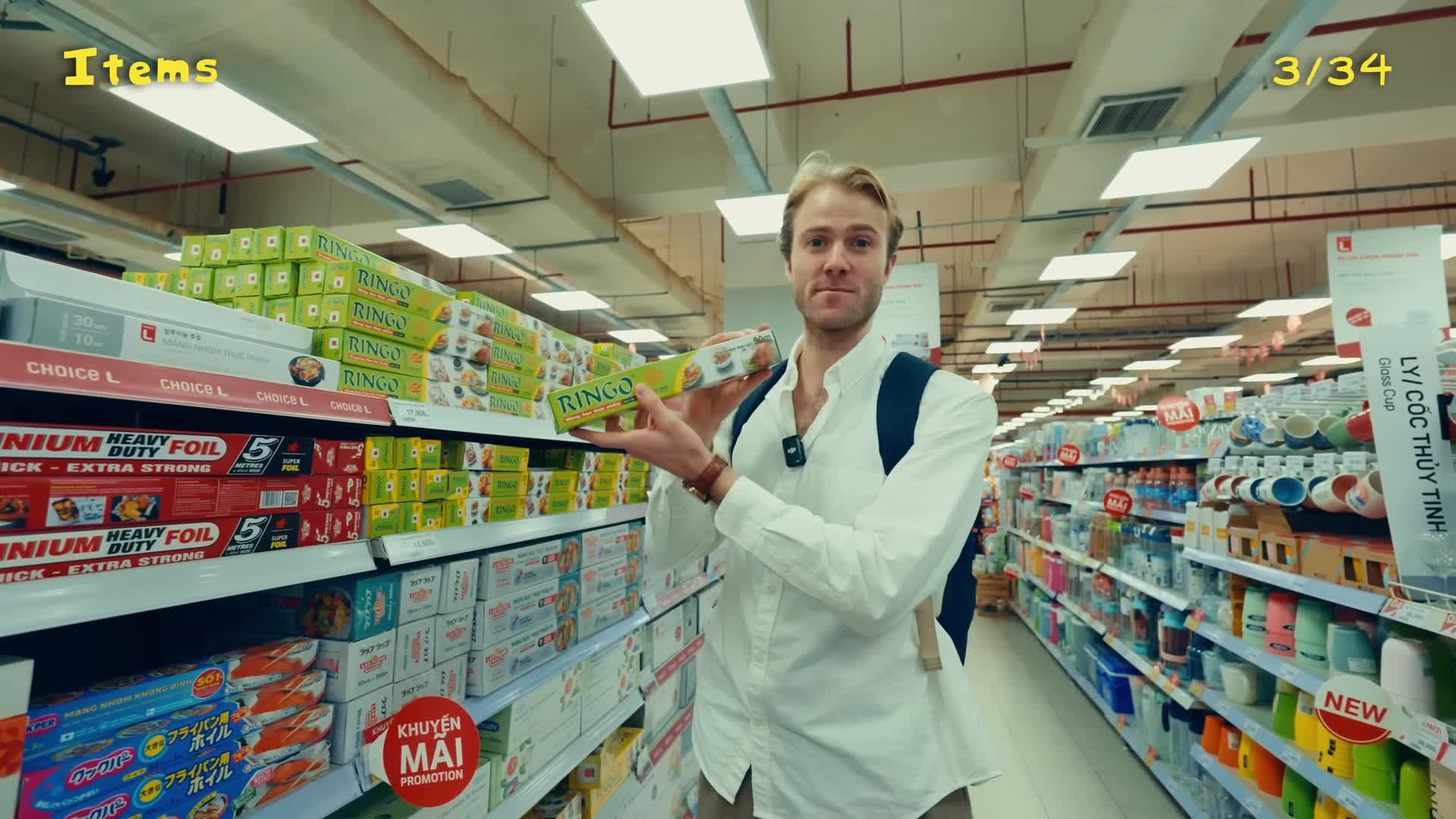
We are in the supermarket and learning English.
Ah, toilet roll.
I am walking down the aisle.
There are shelves.
On the shelves there are items, things, stuff.
Let's get some stuff.
So Chang is shopping for some deodorant.
We say deodorant, three syllables.
Chang is rubbing the deodorant on my armpit because I'm smelly.
These are roll-on deodorants and they are on sale.
This is a promotion.
A promotion is when something is cheaper than normal.
They're on sale.
The next thing on our list is kitchen roll.
This is a multi-pack of kitchen roll.
Kitchen roll is for the kitchen and toilet roll is for, well, you tell me.
Oh, this is useful.
So guys, this is a shopping basket.
It's called a basket because it has a handle and I carry it.
And this is a trolley.
Or in America, they would say a shopping cart.
Shopping cart.
In England, we say a trolley.
And you push the trolley on its wheels.
Now we are going to pay for our items and then go get some food.
Trolley's going back.
We've just done part one of the shop.
We just paid at the checkout counters.
We've got our items for home in these plastic bags.
Now I'm getting hungry.
Are you hungry?
Yeah, always hungry.
This is the restaurant side.
Chang is flicking through the menu.
Do we want to eat here?
Okay.
I've got a white shirt on and we're about to eat.
So I've been asked if I would like an apron.
Yes.
Thank you.
All right guys, this is an apron and you use it to not get food on your cell.
I'm gonna wear my apron.
My arms go here.
All right.
I feel like a kid again.
Korean number one soju.
If you're Korean and watching this, then thank you.
Wow.
My soup is absolutely bubbling.
It looks like a witch's cauldron.
If I drink that or eat that, I will scold my tongue.
Okay, Chang's food's arriving.
Wow, that is insanely hot.
All right guys, i've got my apron on, i'm ready.
We have our korean banquet, our buffet, our food.
We have some tofu, seafood soup, a plate of kimchi, we have some bean sprouts, some mashed potato it looks like and some sweet potato noodles with red, green and yellow peppers.
I'm holding a ladle for the soup.
This is kimbap.
Looks delicious.
Let's dig in.
One more language point before we eat.
When something is really, really, really hot, a liquid, we can say it's piping.
It's piping hot.
You can also say it's steaming hot.
This is absolutely piping, so I'm not going to eat it yet.
I think I'll take my chopsticks and take a piece of kimchi, fermented cabbage.
This food is delicious.
What do you think?
Yeah, it is.
Time to pay.
Going up the escalator What's this?
A man texting A family chatting, Two Grab drivers waiting.
Now, my friends, we are doing a food shop.
A food shop is a UK term for a grocery shop.
We're getting our food for the week.
Oh, eggs.
A box of a dozen eggs.
A dozen is 12.
This is the dairy section.
These products are in the fridge because they are made from milk.
I need Some Greek yogurt.
Ooh.
Pines.
Tomato ketchup.
Next, I need pasta, but we've got a traffic jam.
Can I get through?
Excuse me.
Come on.
Thank you.
I made it through the traffic jam to be met by another traffic jam.
But pasta.
Box of pasta.
Pasta sauce.
Ooh, an offer.
Oatside oat milk.
This milk is on offer.
It's discounted.
This oat milk was pretty cheap.
Cheap in English can have a negative meaning, a negative connotation.
It's better to say it's a bargain, it's a steal or a good deal.
It sounds more positive.
Look at this guy's mental.
It's bigger than you.
Looks stylish.
What do you think of Chang's new handbag?
Stylish, that's french and it means the cow that laughs or the laughing cow.
I actually became fluent in french using the method i use to teach you english.
You're here with me because you want to learn real life english and become fluent.
Watching videos like this one is the best way to do that.
You learn words naturally and in context.
This is a carton of peach juice.
I am only one week away from launching Sprout, the platform where you learn English using videos just like this one.
I'm very excited about this guys, and I'm also excited to share with you my loyal YouTube following a special surprise next Sunday.
While I'm very excited for Sprout, I'm also excited for A bag of blueberries.
Delicious.
At the end of the aisles, there are signs.
This sign is above me.
The signs tell us where certain items in the supermarket are.
So this sign says confectionery.
Confectionery is like chocolates and sweets.
Right guys?
Chang has taken the shopping trolley.
I'm free so i can teach you all right.
This is a packet of cookies, or packets of biscuits as we commonly say in england.
Over here we have crackers, ritz crackers.
What's the difference between biscuits and crackers?
Well, Biscuits are sweet.
Crackers are savory.
Savory is the opposite of sweet.
Got it?
Good.
All right, guys.
I'm on a mission to find the people who work in the supermarket.
They're called the staff.
And I think I've found them.
Here's the staff.
Now, what do the staff do?
Well, let me show you.
These are the shelves and the staff stock the shelves with items.
They also work at the checkout counters.
I've lost Chang and I always get a bit weird when I'm on my own.
So I'm gonna see if I can follow some people, film their clothes and describe what they're wearing.
It's all in the name of English.
Don't arrest me.
The baby is sitting in the trolley.
The woman is deciding which milk to buy.
The little boy is running after his dad, who is wheeling the shopping basket.
The woman is wearing white Wellington boots, or in the UK we say Wellies.
So far, no one has reported me to the police.
No one has noticed that I'm describing what they're wearing.
So, let's continue.
Over here, a woman is wearing a purple shirt and smelling flowers.
Oh, it's Chang.
Would you believe it?
She has three bunches of flowers.
One bunch, two bunches, three bunches.
A bunch of flowers is usually cheaper and it's for you to arrange when you get home.
A bouquet of flowers is already made up for you and it's usually a bit more expensive.
These are bunches of flowers.
You would need to go to a florist to buy a bouquet.
A florist is a shop that sells flowers.
Which colour do you like?
I like all three.
You like all three?
Yeah.
Can you decide?
No.
Right, she can't decide.
No surprise there.
What do you like?
I like the orange ones, and I think they go well with... They all go well.
They all go away together.
Let's get them all.
All right, so we're going to get three bunches of flowers and we are going to make them into a bouquet at home.
These are apples and the top of an apple is called the stem.
This was the part that was once connected to the tree.
These are tangerines.
A tangerine is like a small orange.
And here they are in a polystyrene tray. and wrapped in cling film.
This plastic wrapping is called cling film.
The outside of a fruit is usually called the skin.
And the verb you use with a tangerine or an orange is to peel.
You peel the fruit.
I'm not going to peel this now though.
These are bunches of grapes.
This is a bunch of grapes.
These are kiwi fruits. kiwi fruits.
And the outside of the kiwi is sometimes furry, hairy or fuzzy.
Fuzzy.
This one, the texture of the skin is a little bit fuzzy or furry.
These are passion fruits and again they are in a tray, a polystyrene tray.
That's the material.
Polystyrene is a type of plastic.
Cling film is this material which wraps around food to preserve it, to stop it from going off or going bad.
Passion fruits.
These passion fruits are whole.
They haven't been sliced.
I'm gonna take them home.
The texture of this passion fruit skin is wrinkly.
Wrinkly.
Just like my face when I get older.
These bad boys are, I think you know, ouch, durian.
And they are very spiky.
When something smells bad or strong, we say it's stinky.
That durian is stinky. and very spiky, so better not poke myself in the eye.
Over here, we have some very yellow melons.
And here is the cross section of the melon.
This is the sticker with the barcode on, which you scan.
Speaking of scanning barcodes, let's go pay.
So this is the checkout counter where you pay for your food.
Zhang is grabbing a bag for life.
A bag that you can use again and again and again and again and again and again and again.
She's scanning.
I am bagging up the items in the bag for life.
A jar.
A carton.
Almost done.
Don't you go anywhere.
Nice.
This is the till.
Thank you.
My card goes in my wallet.
My wallet goes in my pocket.
This is the receipt.
That goes in the bag.
And let's go learn the final word.
Oh, that's heavy.
Look at that.
The wheels are stuck.
Now it's time to go home.
But first, the final word of the day is...
So what's the final word?
This is a gift box.
Who's this for?
No way.