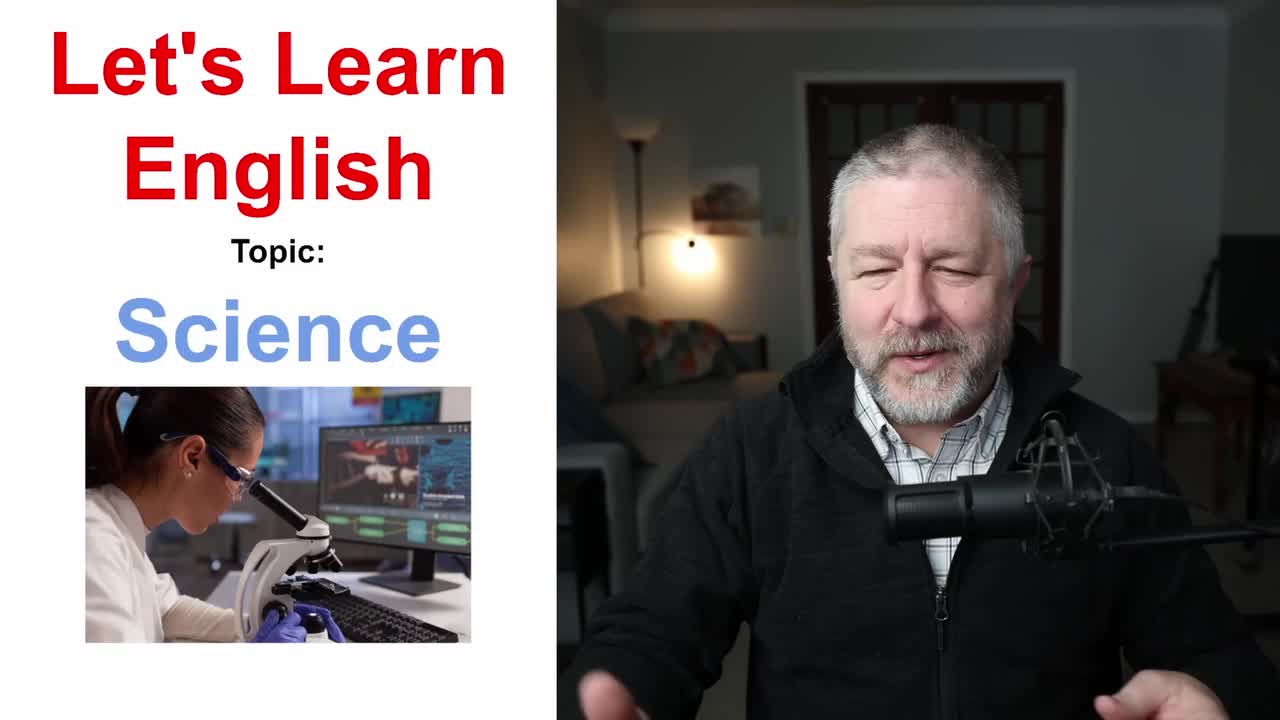
Well hello and welcome to this English lesson about science.
Now I do have to say I am not a scientist, am not an expert in the world of science, but I do know a thing or two about science.
I had science classes, obviously when I was really young in school, and I learned about all the fundamentals of the world of science.
So in this English lesson I think you will enjoy this.
It will probably bring back memories for you as well, of being in a science class and learning about the whole world around us and how it works.
So, welcome to this English lesson about science.
I think I have about 28 words to teach you today and I think they will be quite interesting.
I've prepared slides.
Every slide has a picture.
The word and then it has a definition.
So, I will show each slide.
Read the word, read the definition and then talk about it for a bit.
So, once again, welcome to this English lesson about science. experiment.
A test that is done to learn something new or see what happens.
So the basis of the scientific world is to try things to try and learn things.
I'm sure many, many years ago, someone decided to rub two pieces of wood together for a long period of time.
That was their experiment and then they fire started.
It's not that instant but something like that.
So they decided to do an experiment.
They decided to do a test to learn something new or to see what happens.
So if you know anyone who works in the world of science they are often doing experiments.
They are testing things and doing things to see what will happen, so that they can learn something.
Then we have a verb as well to experiment, to try something new, to see what happens or to learn.
So again, you might be wondering what's going on here?
Why do you have two slides?
Well, this is the verb.
I can experiment.
I can decide to experiment with wood by pushing hard and rubbing one piece of wood on another, because I want to see if something new will happen.
So I'm using the verb to experiment.
I have decided to experiment, do that.
Or you could say I decided to do an experiment which is the noun version.
So just two different ways of talking about how to try something new, to see what happens and to hopefully learn something.
Hypothesis.
So let me say that again.
Hypothesis.
An idea or guess that can be tested in an experiment.
So let me use the example of starting fire again.
I might be sitting there in my cave thinking I wonder what would happen if I rubbed two pieces of wood together, because I know already if I do it they get warm.
But what if I kept doing it?
I think if I kept doing it something else would happen.
Maybe I've seen fire when lightning hits a tree.
Maybe if I do this long enough fire will start.
That would be my hypothesis.
So it's an idea or a guess.
Then it can be tested in an experiment.
So then of course my experiment would be to try and recreate fire by rubbing two sticks together.
By the way have you ever tried to start a fire that way?
It's not very easy.
I have never successfully started a fire by rubbing two sticks together, but theoretically it should work conclusion.
What you learn from an experiment.
If I did that long enough and a fire started.
I could then tell all of my other cavemen friends hey, if you rub two sticks together long enough, you will have fire.
So I would do a little presentation on the cave wall. probably wouldn't look as spiffy as this guy.
And I would say ug and og look if you rub two stick together.
Oh I shouldn't use bad English.
Let's pretend the cavemen speak perfect English.
Ug and og.
If you rub two sticks together long enough, you will start fire, as you can see from my chart on the cave wall.
That is my conclusion.
That is what I was able to learn from the experiment. lab.
A room where people do science work and experiments.
So a lab is a unique kind of workplace.
It is the place where someone who is a scientist will work.
He or she will most likely if they are working in a medical field.
They will have test tubes and they will have a computer and they will have all kinds of equipment that they can use to do their experiments or to do their procedures.
When you walk into a hospital, there's an emergency room and there's doctor's offices and there's rooms for patients, but somewhere in the hospital there might also be a lab where they test blood to see what's in the blood, to see if you're healthy.
So a lab a room where people do science work and experiments.
And then, of course, if you want to be safe in the lab, you need to wear a lab coat and special coat worn in the lab to protect clothes and skin.
It's often a white coat and it's quite long, like it goes down, not to your knees, but probably halfway to your knees, and it usually has long sleeves because the reason you wear it is to protect your clothing, your normal clothes, but also to protect your skin.
Um, and you want to make sure that whatever you're doing with your experiment doesn't splash on you or spill on you, and if it does, you want it to get on your lab coat, not onto your skin or onto your clothing.
So a lab coat a special coat worn in the lab to protect clothes and skin.
Our science teachers wear lab coats when they teach science classes at school. safety goggles.
Another important thing to wear.
Special glasses worn to protect the eyes.
So, the difference between glasses and goggles is really the size.
So safety glasses would look a lot like reading glasses or the glasses that you wear because you need help with your vision, but goggles usually cover the area around the face as well.
So you can have ski goggles and you can have goggles that you wear when you play a sport, but these are safety goggles.
Special glasses worn to protect the eyes.
And I do want to mention something.
This is actually an AI image and I'm bit astounded at how good AI images are getting.
It's a little bit scary actually.
Because usually I don't use AI images cuz I like real photograph photographs.
But this was the only one that I could find that highlighted the goggles and I was kinda surprised it was made by AI.
But anyways, back to the lesson.
Safety goggles, special glasses worn to protect the eyes.
Scientist a person who studies science and does experiments.
So a scientist is usually someone who's trying to learn new things, but a scientist might also be someone who does things that are routine.
Here's a good example.
A scientist might test blood samples to see if someone is healthy.
A scientist might also look at developing a new drug to heal a disease.
So a scientist, a person who studies science and does experiments.
This is the person who works in the field.
You can see he even has looks like he has latex gloves on as well to protect his hands.
He has I think I would call those safety glasses, not goggles, and he's wearing a lab coat once again.
Scientist a man or woman who studies science and does experiments, of course, to learn new things.
Science teacher.
A person who teaches students about science.
Now here's what I will tell you about science teachers.
There are not enough of them in Ontario Canada.
If you are a science teacher and you want to move to Canada, I guarantee you, if your English is stellar, if your English is amazing and if you are certified, you will probably find a job as a science teacher.
Because science teachers.
They know enough to teach science, but they also know enough to work for a company.
And they will probably make more money than for a company.
More money than they would if they taught a high school science class.
But a science teacher is a person who teaches students about science.
I always really enjoyed my science classes as a student.
They were super fun and I'm just a very curious person, so it was fun to learn new things about the world around us.
Biology
The study of living things like plants, animals, and people.
I should have put a comment there after plants.
The study of living things like plants, animals, and people.
So, biology is one field of science.
There are many fields, but the simplest three, the ones that we teach at our schools, are biology, chemistry and physics.
Biology.
If you take a biology class, it is the study of living things plants animals people, anything that lives and breathes and grows on the earth.
You will study in a biology class.
You will learn about cells.
Uh you will learn about how things grow.
You will learn about photosynthesis.
Try to say that again.
Uh you will learn about the Krebs cycle and how we produce energy.
So Biology is a very cool class to take, and it's one of the three what I would consider the basic fields of science.
Chemistry is the study of substances and how they interact and or change.
I'm not sure if you've seen and slash or in a sentence before.
This is how we talk about when something might be included or might be separate.
So it could be that the things interact and change or they interact or change.
Maybe they don't interact but they still change. would be odd.
But anyways, chemistry.
The study of substances and how they interact and or change.
This is the classical image that people think of when they think of a scientist.
They usually think of someone who is doing chemistry.
They are mixing chemicals together and there are chemical reactions and they're trying to create something new.
Like the glue that goes on a post-it note that was discovered. physics.
The study of energy, motion, and how things work.
So, physics to me was very fascinating.
As a student, I really enjoyed biology.
Chemistry, not so much.
But physics, I found very very interesting.
The study of know.
If a ball is moving in space, it will just keep moving.
But if a ball is moving on Earth, there's friction and air resistance that will eventually slow the ball down.
So physics is the study of how the world works mechanically, but a visual level, but also at a level that we would say is a subatomic like, where you can't see it.
So physics the study of energy motion and how things work.
So once again in high school in Canada we grade nine and 10, you study science.
In grade 11 and 12, you choose to study biology, chemistry, and physics.
Usually, students study two of the three when they are in high school here.
Uh let's see here. microscope.
A tool that makes very small things look bigger.
Let me see where I am on my slides here.
Oh that's not the next one.
The next one is slide.
A thin piece of glass used to hold something for a microscope.
So a microscope is a very cool tool, has lenses, and those lenses allow you to look at something that's very, very tiny.
The first thing I ever looked at in a microscope was a human hair, and I was surprised to see how much detail there is about a human hair.
So again a microscope a tool that makes very small things look bigger.
Um, in fact, if I'm remembering right, I think we got a microscope as a gift from my uncle, or did my brother find it at my grandma's house?
I just know we were looking at human hair and then very quickly it progressed to looking at blood.
Blood is very cool to look at.
But under a microscope.
If you want to do that, you need to put that item on a slide, which is a thin piece of glass used to hold something for a microscope, and often you will put something between two slides and then you will put it under the microscope and you will look at it with one eye like a pirate.
Sorry that didn't have anything to do with the lesson, but it still made me giggle a magnifying glass.
So This is a handheld tool that makes things look bigger, so you can see details.
Now a kid.
You are more likely to first use a magnifying glass when you're really little and you're at school.
You might, in grade three or four or in the fourth or fifth grade, use a magnifying glass.
You might go outside and look at plants.
You might go outside and look at ants or little insects on the ground, because it's a very simple handheld tool and that you can use to make things a little bit bigger.
It's not as powerful as a microscope, but it is very portable and you can use it outside or wherever you are.
You can carry it around.
It's handheld.
So magnifying glass, a handheld tool that makes things look bigger so you can see details.
Here's what happens though when you give a group of children magnifying glasses.
Very quickly.
Some of the students will try.
To start fire is a lot easier with a magnifying glass than it is with two sticks.
If you hold a magnifying glass, like if the sun was coming down here, and I hold a magnifying glass, I can focus on sunlight into a small spot and that spot will very quickly if it's on something like a piece of wood start to smoke and you will very soon have fire.
Yep.
Definitely much easier than rubbing two sticks together.
A test tube.
A small glass tube used to hold and mix liquids.
So you are probably familiar with these because if you ever have your blood taken and that they can test it,
They usually take the blood and it goes into a little test tube.
We also might call it a vial.
And a test tube is really, really small.
We might just call it a vial, but that's where your blood will go and then they will take it and test it.
When I was in school, we would put things in a test tube and then sometimes we would heat it up to see if heat made something happen to it.
So test tube.
A small glass tube used to hold and mix liquids. beaker.
A glass container used to hold and mix liquids.
A flask.
A glass container with a narrow top used in experiments.
So these are just specific names for the kinds of things you will use when doing an experiment.
So again a test tube is long and narrow.
A beaker looks more like a cup like if this mug was made of glass, it would look a lot like a beaker and it's a glass container used to hold and mix liquids.
By the way, if you've ever watched the Muppets, there is a scientist on the Muppets called Doctor Benson Honeydew, I think, and his assistant is called Beaker, which is kind of a joke because this is a beaker and then his lab assistant is called Beaker, as well then a flask.
A glass container with a narrow top used in experiments.
Now what's unique about a flask is you can put a cork in the top.
They also have corks that allow you to put a pipe through the cork.
Um I'm not again a scientist but that is my understanding of a flask.
Why a flask is different than a beaker.
So you might say petri dish.
You might say petri dish.
I say petri dish.
And It's a small round dish made of glass, sometimes plastic, used to grow and study tiny living things like bacteria.
Guess is, back when we were in this the pandemic, if you got a swab taken, they would probably put that in a petri dish to see if you had COVID again.
I'm not a scientist and I don't really know exactly the details, but I do know if you watch a movie where there's a scientist and there's a plague or an outbreak, they usually have petri dishes and they're seeing what will grow to determine what's happening.
And Bunsen burner.
A tool that makes a flame to heat things in the lab.
This is another thing that I'm surprised that we have in schools.
Because anytime you allow students to start a fire it can be dangerous.
But we still use Bunsen burners at our school.
So you can use a Bunsen burner underneath a flask or a beaker to heat something up and can hold a test tube in the flame to heat up the contents of the test tube.
And I was going to look up why it's called a Bunsen burner.
I imagine it's named after the inventor but I'm not sure.
I will let that be your job and after this lesson.
I will let you look up what a Bunsen burner is.
But again, a Bunsen burner, a tool that makes a flame to heat things in the lab.
An eye dropper.
Now, this isn't something that is used just for science.
You can have one of these at home as well.
An eyedropper is a small tool used to move drops of liquid.
So if you squeeze the top and put it in liquid and then release, it will suck the liquid up into the little bottom glass piece.
And then when you squeeze it again the liquid will come out.
You might use an eyedropper to put drops in your eye.
Maybe you have a special medicine for your eyes and you use an eyedropper to put that in your eyes, or you might use it to put drops in your ear, but if you are working in a lab, you probably have ones that have measurements on them, like this thermometer.
A tool used to measure temperature.
Now my memory in the science lab is that the thermometers are really really long.
And you can actually clamp them and put them into something.
Uh like, if you have a beaker, you can put a thermometer in the beaker and it will sit there and it will measure the temperature of whatever you are doing.
A scale.
A tool used to measure weight.
So this we would call a digital scale. can probably set it to grams or ounces or pounds or kilograms or whatever you want and it will tell you what whatever you put on it weighs.
So a scale, a tool used to measure weight.
A balance, a tool used to compare or measure weight.
So with a balance, you could put a mug on one side and you could put a cup on the other side, and if it goes like this, then they are the same weight.
They weigh the same.
But you can also put a cup on one side, and then you could put little weights in the other side until it balances, and then you know how much the cup weighs.
So a balance a tool used to compare or measure weight.
That's why we have the ore there. scientific method.
A step-by-step way to do experiments and to learn by success and failure.
So here is one version of the scientific method.
You observe and question something.
So you might think to yourself why when lightning hits a tree does it start on fire?
And then you research the topic.
So you go and find trees that have been hit by lightning and you notice they're charred and you notice that they they smell like they were on fire.
Then you come up with a hypothesis, which is you know that the research part would be you just saw a tree get hit and you know it's warm, and then you're like, if I rub wood together it gets warm.
I will test this with an experiment.
So you do a bunch of experiments.
You analyze the data and you report your conclusions.
There are many versions of this.
Some have different titles.
But the basis is the same. do something.
You experiment.
You look at your conclusions.
You observe the result.
You come up with a new hypothesis.
You try something again and eventually you discover fire.
That's what happens.
Liquid solid gas.
These are the three states of matter.
So a liquid is, of course, a substance that flows like water.
A solid is a substance that keeps its shape, like a rock or ice.
And then a gas is a substance that spreads out and fills space like air.
Often gas is invisible which can make it dangerous.
But when you look at the world the will most likely see one of these three types of things.
You will probably see liquid.
Like water or tea or soda which really are just different forms of water if you didn't know.
Um you might see something that is solid like a rock or metal or ice.
A substance that keeps its shape like a rock. gas.
You may or may not see a gas.
When water is in its gas form, it is steam or vapor, and it's a substance that spreads out and fills space like air.