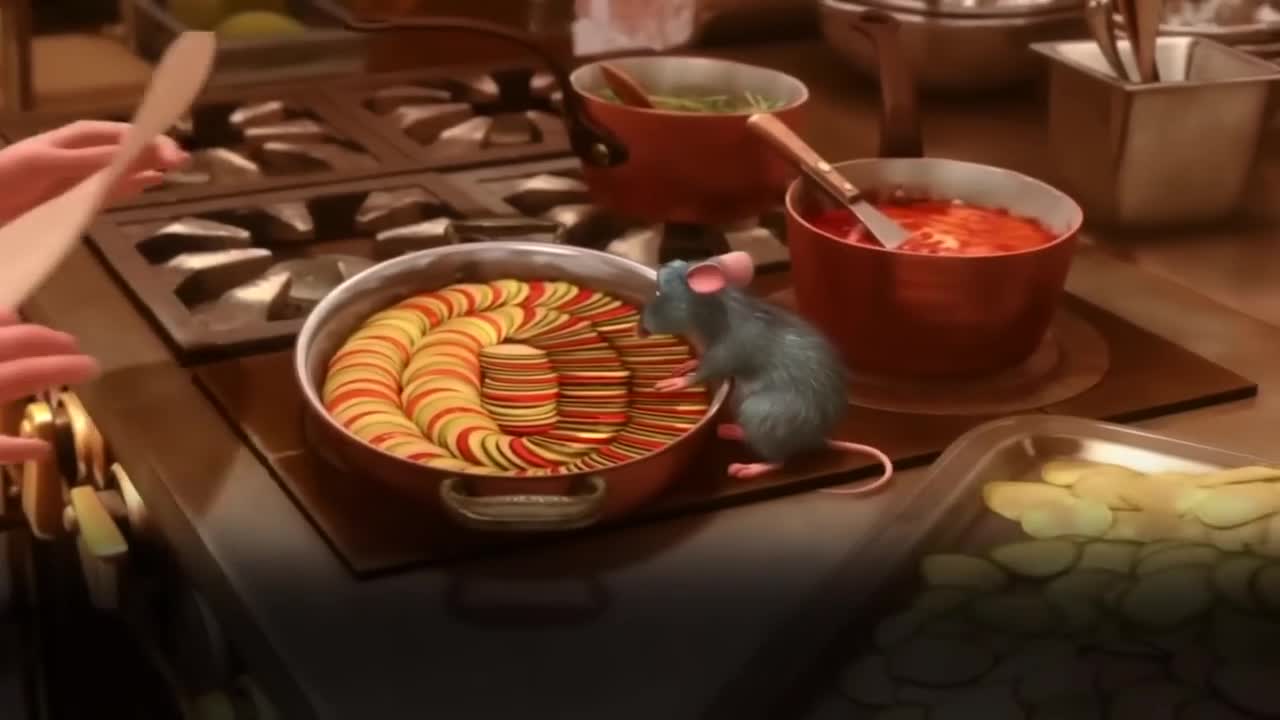
Ratatouille?
It's a peasant dish.
Are you sure you want to serve this to Eagle?
What?
I am making ratatouille.
Well, how would you prepare it?
Ratatouille?
They must be joking.
Let's learn English with one of my favorite Disney films all about cooking and Paris Ratatouille.
So the clips that we've chosen for you today are really great for learning English, to describe food and for use in formal situations.
So we're going to jump right into that, but quickly, before we do.
If you're new here, every single week we make fun lessons just like this one, so that you can understand fast speaking natives without getting lost, without missing the jokes and without subtitles.
Just like our friend Gills, who says that watching our videos every single day is helping him to improve his accent in English.
So we're going to help you improve your English a ton too.
It's really simple hit that subscribe button and the bell down below and you won't miss a single one of our new lessons.
Ah!
No, no, no, no, no!
Spit that out right now!
I have got to teach you about food.
Close your eyes.
Now, take a bite of this.
No, no, no!
Don't just hork it down.
Too late.
Here.
And chew it slowly.
Only think about the taste.
Creamy, salty, sweet, and oaky nuttiness.
You detect that?
Oh, I'm detecting nuttiness.
Close your eyes.
Now taste this.
A whole different thing, right?
Sweet, crisp, slight tang on the finish.
Okay.
Now, try them together.
Uh-huh.
It might be the nuttiness.
See?
It could be the tang.
That's it.
Now imagine every great taste in the world being combined into infinite combinations of tastes that no one has tried yet.
Discoveries to be made!
I think.
Uh-huh.
You lost me again.
Did you notice he said have got instead of just have?
This is just how some people say it, and there's no change in meaning.
What's more important is actually the tone used.
In speech, we often contract words.
Have got becomes gotta, cannot becomes can't.
However, when we are surprised, angry or have another emotion that makes us want to emphasize what we say, we normally don't use contracted forms.
So note the difference in you can't use your phone in class versus you cannot use your phone in class.
Same in, I gotta go now, versus, I have got to go now.
Now, take a bite of this.
No, no, no!
Don't just fork it down!
Do it.
In the phrase take a bite, we can see one instance of using take plus a plus a noun.
We use many of these phrases in everyday speech.
Now if you take a bite of something, you take a small piece of food into your mouth.
Maybe you want to try something your friend is eating.
Which of these would you use?
Can I take a bite of that?
Can I have a bite of that?
Can I bite that?
So here we change it from take to have.
Let's see some other examples where this happens.
Climb aboard boys!
Tappy will take us to the lower level and you can have a bite to eat!
To hork something down means to eat something really quickly.
So, Remy is saying that he should savor the flavors of the food, not just quickly swallow them.
When you eat, you chew your food several times before swallowing.
This meat is so tough I can hardly chew it.
The other word is taste.
We see this word being used as a noun and a verb in this clip.
Food has taste, meaning it has flavor.
To taste is the action of feeling that flavor.
Don't you think?
What would you call that flavor?
It's lightning-y!
Creamy, salty, sweet, and oaky nuttiness.
You detect that?
Oh, I'm detecting nuttiness.
Close your eyes.
When describing food, it's really common that we turn nouns into adjectives by adding a y at the end of the noun.
So something with cream is creamy, something with salt is salty.
Then, to describe these qualities of food as a noun, we add the suffix n-e-s-s to the end of some words.
We might say the creaminess and saltiness of cheese.
It's a bold flavor, fruity, a little earthy.
What do you think?
Fruity and delicious.
Then we have a joke here that you might have missed.
This is done with a play on words.
He says I'm detecting nuttiness.
To detect means to notice something.
The double entendre comes with the word nuttiness.
Literally, we can understand that he notices that nutty flavor.
However, the humor is that we say someone is nuts or nutty when we think they are crazy.
So he is joking that Remy seems crazy.
Which of the images below shows a food that is crispy?
Now, try them together!
In this movie, Remy is passionate about combining different flavors to create something new.
Oh, yeah.
Amazing.
Each flavor was totally unique.
But combine one flavor with another and something new was created.
No no no.
What?
Try this.
It's better.
We say you lost me to mean now I don't understand what you mean.
Which of the options below doesn't mean I understand?
Gotcha.
Copy that.
I'm following.
Right, all of these can be used as alternatives to I understand.
Now learning native expressions like this is crucial to being able to understand fast English.
Along with having correct pronunciation and knowing about connected speech, which is how natives cut and connect our words, and cultural context, which helps you to understand all the jokes.
Now in our three-part masterclass, we teach you about all three, so that you can understand natives at any speed.
So you can learn more and sign up for that by hanging up here or down in the description below, and it's absolutely free, so you have nothing to lose.
Now let's watch the next clip.
I can't remember the last time I asked a waiter to give my compliments to the chef.
And now I find myself in the extraordinary position of having my waiter be the chef.
Thanks, but I'm just your waiter tonight.
Then who do I thank for the meal?
Uh, excuse me a minute.
You must be the chef.
If you wish to meet the chef, you will have to wait until all the other customer have gone.
So be it.
At first, Ego thinks it's a joke, but as Linguini explains, Ego's smile disappears.
The following day, his review appears.
Last night, I experienced something new.
An extraordinary meal from a singularly unexpected source.
To say that both the meal and its maker have challenged my preconceptions about fine cooking is a gross understatement.
They have rocked me to my core in the past.
I have made no secret of my disdain for Chef Gusteau's famous motto, anyone can cook.
Not everyone can become a great artist.
But a great artist can come from anywhere.
It is difficult to imagine more humble origins than those of the genius now cooking at Gusteau's who is, in this critic's opinion, nothing less than the finest chef in France.
I will be returning to Gusteau's soon.
Hungry.
Although many associate the word ratatouille with the name of this movie, it actually comes from the name of a traditional French dish.
Making a play on words with the name of this recipe and the animal.
We say dish to refer to a food container, as in the picture, or a type of food that is cooked in a particular way and is served as a part of a meal.
Spaghetti al pomodoro is a traditional Italian dish, for example.
Peasant is a word that in past times was used to refer to poor families.
What she means here is that ratatouille is not a fine or sophisticated dish.
Rather, it is a food that people eat in context of poverty.
To serve means to give someone food or drink, especially as a part of a meal or in a restaurant bar, etc.
We say that someone must be joking when we're surprised about what someone is doing.
We'll see more about how the word must is used here in a few moments.
A compliment is a remark that shows you admire someone or something.
We commonly use this also as a verb.
Sure, I love this part!
He says it as a phrase, to give someone a compliment.
We also sometimes say to pay someone a compliment.
You probably know that must in a general way, could be used as a stronger version of have to, when talking about an obligation.
However, when you're very sure about something, especially because there's evidence, you can say must, as seen in this clip.
The character here is sure he is the chef.
Let's see two examples when must is used in this way.
This is an expression of acceptance or resignation makes andy angry.
So be it.
We have only one choice we must leave pride rock.
We're not going anywhere, then you have sentenced us to death?
Then so be it.
You can't do that.
I am a king.
I can do whatever i want.
If you were.
Last night i experienced something new an extraordinary meal from a singularly unexpected source.
He describes the meal as extraordinary.
This is another word for good which we included in this lesson, where we go through 50 different ways to say this adjective.
Now the critic here, Ego, is using many sophisticated words, and singularly is one of them.
We use this to mean something is in a way that is very noticeable or unusual.
He is singularly qualified for the job.
If something we say is an understatement, it means it is not strong enough to express how good bad impressive, etc.
Something really is.
Gross in this case intensifies the meaning of this word.
So we're actually going to do this?
Yes, we are.
Let me just give this guy my keys and we'll go.
Great.
Like in the clip, you can collocate this word with a sentence that starts with to say.
To say the movie was bad is an understatement.
Other terms for fine cooking or dining are gourmet food and high-class cuisine.
This would be the opposite of what was referred to earlier in the clips as a peasant dish or peasant food.
If something rocks you to your core, it affects you in a very profound way.
Or it provides a big revelation.
You can also say this to describe something that's very surprising to you.
Disdain is a formal synonym for dislike.
He says he's made no secret of that, meaning he's always said publicly that he didn't agree with Chef Gusteau's motto.
Governing is choosing, governing is prioritizing.
I made no secret of the fact the crime bill was my top priority.
Well then, congratulations.
It's only taken you three years to put together crime prevention legislation that has no hope of preventing crime.
A motto is a short sentence or phrase that expresses the belief of a person or gives a rule on how to behave.
The school's motto was work hard and play hard.
It is difficult to imagine more humble origins than those of the genius now cooking at Gusteau's who is, in this critic's opinion, nothing less than the finest chef in France.
I will be returning to Gusteau's soon, hungry for more.
By using the expression nothing less than, he's emphasizing how great a chef he is.
Another expression with a similar meaning is nothing short of which describes something extreme, either good or bad.
Example I will be returning to Gusto soon, hungry for more.
It was a great night, the happiest of my life.
But the only thing predictable about life is its unpredictability.
Well, we had to let Skinner and the health inspector loose, and of course they ratted us out.
The food didn't matter.
Once it got out, there were rats in the kitchen.
Oh man, the restaurant was closed and Ego lost his job and his credibility.
But don't feel too bad for him.
He's doing very well as a small business investor.
He seems very happy.
Many times some great pronunciation insights only require paying a little attention to get them.
So every now and then try listening for the subtle details of native speech.
Did you notice that the G in great isn't pronounced as such?
It was a great night.
It actually sounds like a K. In this example, the same happens.
Also, aspects of linking aren't always easy to notice.
But again, you need to focus a bit on how they're said in native speech.
In this case, notice the weakening of of, which sounds like a, and it connects with the preceding word.
Happiest of my life.
Well, we had to let Skinner and the health inspector loose and of course they ratted us out.
We use this expression all the time, but it's a funny choice for Remi.
To rat someone out means to tell someone in authority about something wrong that someone has done.
If a secret gets out, everybody suddenly knows about it.
It got out that the boss is dating one of the employees.
Close your eyes.
Now, take a bite of this.
No, no, no!
Don't just hork it down.
Chew it slowly.
Creamy, salty, sweet, an oaky nuttiness.
You detect that?
Oh, I'm detecting nuttiness.
Close your eyes.
Now, taste this.
Whole different thing, right?
Sweet, crisp, slight tang on the finish.
Okay.
I think I'm getting a little something there.
Uh-huh.
It might be the nuttiness.
See?
It could be the tang.
That's it.
Now imagine every great taste in the world being combined into infinite combinations of tastes that no one has tried yet.
Discoveries to be made!
I think.
Uh-huh.
You lost me again.
Ratatouille?
It's a peasant dish.
Are you sure you want to serve this to Eagle?
What?
I am making ratatouille.
Well, how would you prepare it?
Ratatouille?
They must be joking.
I can't remember the last time I asked a waiter to give my compliments to the chef.
Thanks, but I'm just your waiter tonight.
Then who do I thank for the meal?
Uh, excuse me a minute?
You must be the chef.
If you wish to meet the chef, you'll have to wait until all the other customers have gone.
So be it.
At first, Ego thinks it's a joke, but as Linguini explains, Ego's smile disappears.
The following day, his review appears.
Last night, I experienced something new.
An extraordinary meal from a singularly unexpected source.
To say that both the meal and its maker have challenged my preconceptions about fine cooking is a gross understatement.
They have rocked me to my core.
In the past, I have made no secret of my disdain for Chef Gusteau's famous motto, anyone can cook.
Anyone can cook, but I realize only now do I truly understand what he meant.
It is difficult to imagine more humble origins than those of the genius now cooking at Gusteau's who is, in this critic's opinion, nothing less than the finest chef in France.
I will be returning to Gusteau's soon, hungry for more.
It was a great night, but the only thing predictable about life is its unpredictability.
Well, we had to let Skinner and the health inspector loose, and of course they ratted us out.
Once it got out, there were rats in the kitchen.
Oh, man.
The restaurant was closed, and Ego lost his job and his credibility.
I feel too bad for him.
He's doing very well as a small business investor.
Come on, what did De La Cruz always say?
Seize your moment?
Show me what you got, muchacho.
I'll be your first audience.
Miguel!
Abuelita!
What are you doing here?
You leave my grandson alone.
Doña, please.
I was just getting a shine.
I know your tricks, mariachi.
What did he say to you?
He was just showing me his guitar.
You shaman.
My grandson, my sweet little angelito querido.