
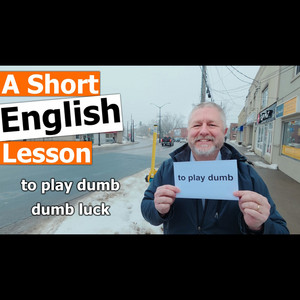
[Mastering English Idioms: 'Play Dumb' and 'Dumb Luck']-[Learn the English Phrases "to play dumb" and "dumb luck"]
📋 Summary
Exploring English Idioms: 'Play Dumb' and 'Dumb Luck'
In this educational session, the host provides a practical breakdown of two common English idioms: "to play dumb" and "dumb luck." By examining these phrases through real-world scenarios, learners can better understand their nuanced usage in everyday conversation.
Understanding 'To Play Dumb'
The phrase "to play dumb" is defined as the act of pretending one does not possess knowledge about a specific subject or event when, in reality, they are fully aware of it. The host highlights that this behavior is most frequently observed in defensive situations, particularly when an individual is "accused of doing something wrong."
- Criminal Context: The host illustrates this by referencing crime dramas, where a suspect might "play dumb" when confronted by law enforcement, claiming, "I don't know what you're talking about" or denying an action like "I didn't steal that car."
- Educational Context: As a teacher, the host notes that students often "play dumb" when caught misbehaving, choosing to "pretend that they didn't do what I saw them do" rather than admitting fault.
Defining 'Dumb Luck'
In contrast, the term "dumb luck" refers to experiencing a positive outcome that occurs entirely independent of one's own efforts or skills. It is a stroke of fortune that happens without any strategic intervention from the individual.
- Scenario-based Example: To clarify, the host describes a situation where a driver loses control of their vehicle in snowy conditions. If the driver manages to avoid a ditch without actually "steering properly" or taking corrective action, the success is attributed solely to "dumb luck." The key takeaway is that the favorable result is "not because of anything that you've done to make it happen."
Community Engagement and Language Nuance
The podcast also features a brief segment on community interaction, highlighting the idiom "you can say that again." This phrase is used to express strong agreement with a previous statement. When a viewer named Tammy used this expression in response to a discussion about minor expletives like "oh shoot," the host praised her, noting that it was a "great use of the phrase."
Observations on Environment and Lifestyle
Beyond the language lesson, the host provides a personal glimpse into his daily routine, filming during the "morning rush hour" in his local town. He shares candid reflections on the changing weather, noting that while he enjoys winter, it is "much nicer" to film when the temperatures rise. He observes that in warmer weather, people are more comfortable being "out and about" at a "slower pace," a stark contrast to the previous weeks when it was "far too cold" for leisure. This segment serves as a reminder that language learning is often best contextualized within the lived experience of the speaker.
Deep Learning with ListenLeap


