Welcome back to another video guys.
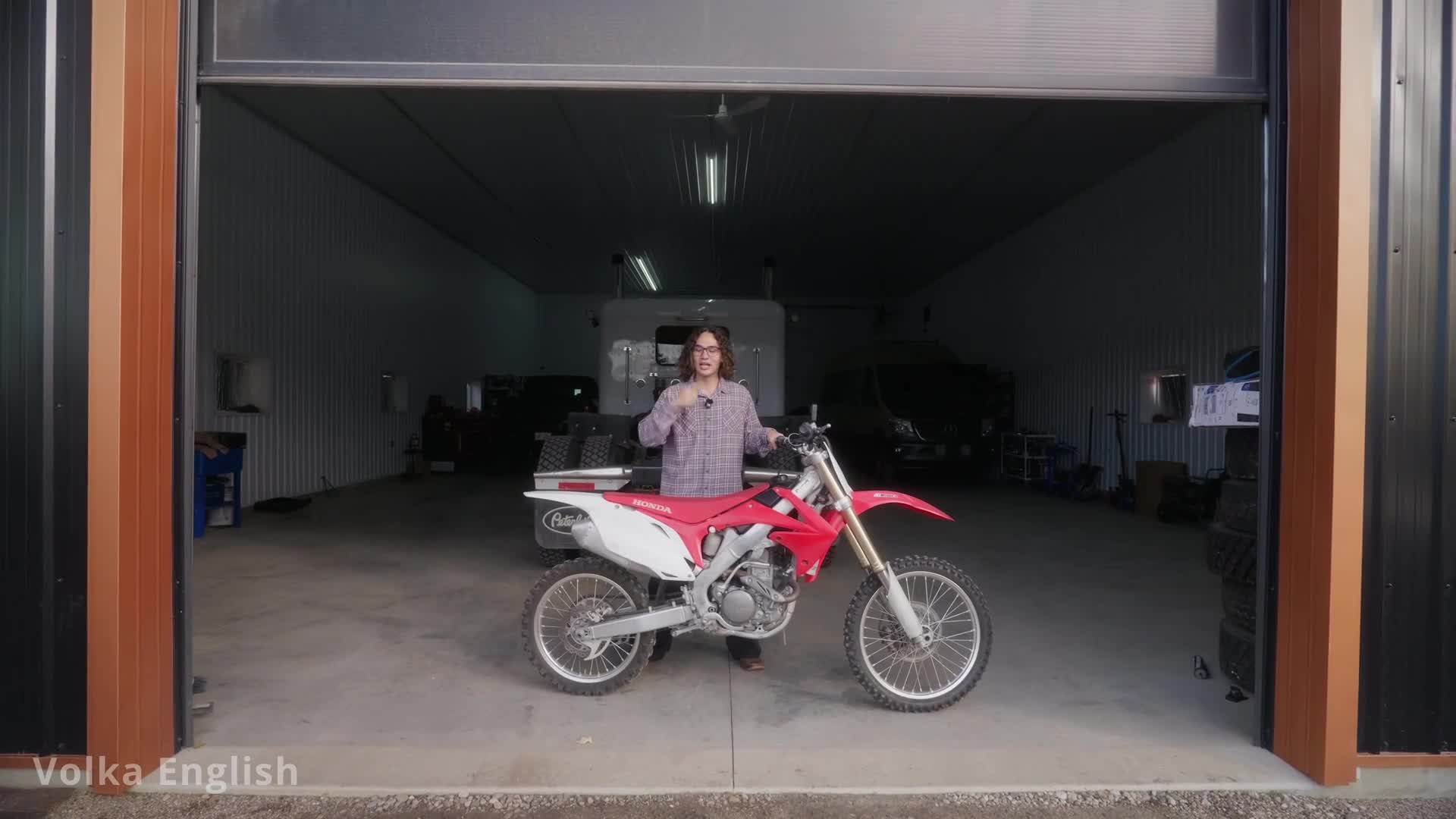
Today we're going to be learning daily life English around my house and as I ride my dirt bike.
The air filter.
So this right here guys is the throttle and you pull this back.
This is the dirt bike seat.
Right where you could put a passcode in.
You need a license.
These shoes are very worn.
This is an ostrich egg.
I want to defrost.
So start the word count and let's go.
So the first thing we need to do is start it.
We could warm up the engine and warm up the oil before we change the oil, because before i ride it i need to change the oil and the air filter.
So let's do that first.
So it's pretty cold, so i'm not sure if i'm going to be able to start it, but this right here is a kick starter and i have to kick it to be able to start it.
So okay, so we started the dirt bike.
This right here is a socket.
This is a 11 millimeter socket.
So this is a socket and this right here is a ratchet.
This is a ratchet.
These are tools.
So now Leon is installing the air filter.
He's installing the air filter and this right here, guys, this is a bolt.
This is a bolt and these bolts, and I have my ratchet set here and I have gloves on because it's dirty.
So now I'm gonna install the seat.
Okay, so I just installed the seat, now it's on there good, and now I have to change the oil.
Okay, so now the engine oil is warm so it'll be easier to flow out.
So now the oil is draining out here, draining out into the oil drain pan, and now i'm doing the same thing on the other side with the engine oil.
Okay guys, so we changed the oil and the transmission fluid and the air filter on the bike, so now we can start it and go for a little rip.
This right here, you guys.
This right here.
This is the hand brake.
This is the hand brake.
And this brake right here.
This is also another brake.
This controls the back brake.
So the front brake and the back brake.
This brake, I have to use my hand, my hand.
And this brake, I have to use my foot, my foot.
So this right here guys is the throttle and you pull this back to move forward.
So this is like similar to a gas pedal on a vehicle, the throttle.
On the other side here, This is the clutch.
The clutch, so you pull this in and then you shift gears.
So this right here is my gear shifter.
You have to pull the clutch in and then I could shift gears right here.
And what's the shift pattern?
So the shift pattern is one down, four up.
So there are five gears on this bike.
And right now I'm sitting on the seat.
This is the dirt bike seat.
This is not a chair.
It's not a chair.
That right there, you can call that a chair.
An office chair.
But this is a seat.
You call this a seat.
And how comfortable is it?
It's not very comfortable because it's very narrow.
The seat is very narrow.
And hard?
It's very narrow and hard.
It's hard.
It's not soft.
Like it's not soft.
It's very hard.
So it's not comfortable, but it's not made for comfort.
This right here.
This is my handlebar.
My handlebar. and I hold onto my handlebar.
Now we kind of have an idea of how this bike works.
So let's start it.
This right here is a Kickstarter, a Kickstarter.
And to start the bike, I have to kick it back.
So let's start.
So what's the bike doing right now, right after you started?
So right now, the bike is idling.
I'm letting the bike idle.
That just means it's just running.
And it's not going anywhere.
I'm not driving.
I'm not braking.
I'm just letting it idle.
So the engine has started, and it's just going.
The engine is going, but I'm not driving it.
So I'm just letting it idle.
The bike is idling.
And you have to do this to let the bike warm up.
Especially right now, you can see it's pretty cold out.
It's like, how cold is it?
It's like, what's the temperature?
I think it's five degrees today.
Five degrees Celsius.
That is the temperature today.
So this is just some information on the dirt bike.
It tells you the model and also the year.
It was made in Japan.
Shout out to all my Japanese viewers.
Let me know if you're in Japan.
Okay, so now I'm just going to do a little loop and head out.
So listening is super important for becoming fluent in english, but there's one thing people always overlook speaking.
Some even say speaking is more important.
But how can you practice speaking when you don't have anyone to talk to in real life?
That's why i decided to start making a whole series of exclusive videos, videos designed to help practice your speaking, your pronunciation, your rhythm and, most importantly, your confidence in English.
Inside you'll get 30 exclusive lessons immediately and I upload three to five new videos every week.
So you can train consistently and actually improve.
Now here's a sneak peek at what you'll get the moment you join.
Welcome back guys, to another shadowing lesson.
In this lesson i want you to shadow me.
What does that mean?
It means, after i say a sentence, pause the video.
I was floored.
I've never had a client have an issue with my weight.
I pushed and asked him if there had been any complaints.
Instead, when i found out, i was hurt, but i tried to let it go.
Add logan to the email invite for the next week's hangout.
He noticed he never got an invite and began to ask there are two cups.
I've heard a lot of people get it robbed here.
So or a coach bus when the sun sets, when the sun goes down, we are going to be learning english as i clean up my room to our area.
A few years ago she asked me to get her a job, so join today.
So now I'm going to turn the bike off, so I can say I'm going to turn the bike off, or I'm going to shut the bike off, or I'm going to kill the engine.
So there we go.
Bike is off and I'm going to. lean it up against this flagpole.
I just leaned the dirt bike against the flagpole.
This right here is a flagpole.
So me, my brother, and my dad, we hung this flag the other day.
And we also, you know, we did a lot of other things around the house.
It's as you can tell, it's fall right now.
You can see this tree right here.
All the leaves have fallen off.
So all the leaves are on the ground right now.
They have all fallen off the tree right here is another tree and you can see all the leaves are pretty much still on.
There's, of course, some leaves that have fallen off, but for the most part it's this tree still has all its leaves.
This building right here is called a shop.
So let's go into the shop.
So this is just a side door.
This right here is a keypad.
A keypad where you could put a passcode in.
A passcode.
A passcode is just like a password, but there's only numbers.
A passcode.
A password is similar, but a password, you could have letters and other symbols as well.
I'm not gonna close the shop door all the way.
I'll close it maybe half.
So this right here is the shop door.
It's a very big, big door.
I think right there, think that's good.
So this right here, you guys, we call this a semi truck.
This is a semi truck and it's a very big truck.
That right there you can also call a truck, but that is a pickup truck and this is a semi truck.
And you can see there are two semi trucks in here, a white one and a black one.
And this is the semi truck bumper.
It is huge.
It is huge like This is probably one of the biggest bumpers you'll see on a vehicle.
So can you drive a semi truck?
Can I drive a semi truck?
No.
And the reason is, is because you need a license.
So I don't have my wallet on me now, but you need a license, which is just something that says what vehicles you can drive.
And I don't have a license to drive this.
I just have a license to drive something like this, like a truck or a pickup truck or a car or a hatchback or SUV.
And what class of license is a regular vehicle?
I'm not sure if it's similar throughout the whole world, but I have a class five and that lets you drive vehicles like this.
And recently I got my class six license, which is motorcycles.
So now I could drive motorcycles legally.
And that is because I want to go to Vietnam and do the, what's that loop called in Northern Vietnam?
North of Hanoi?
How?
Oh, the Ha Giang loop.
Ha Giang.
I don't know if I'm saying that right.
I want to go on the Ha Giang loop.
Which is like a couple, how long, how many days is the Ha Giang loop?
Well, I did it and it was three days for me, but you can do shorter or longer.
Okay, so.
Like three to five days, I would say I wanna go and bike around the Ha Giang loop.
Apparently, it's very good.
It's like everyone's highlight, right?
Was it your highlight?
Yeah, it was really fun.
Was it the highlight of your trip?
Definitely the highlight of my trip to Vietnam.
Highlight is like the one, like the best part of the trip.
Like there's a lot of like good things about visiting a country, but the highlight is like what was your favorite?
What was your highlight?
And everyone has told me that So I want to do it because I went to Vietnam.
I spent one month in Vietnam, but I never did the bike loop.
Sucks.
Anyways.
Yo.
Can you give me a hand pushing this Jeep in?
Just right here?
I think we can get it in front of the van, no?
Yeah, I think it could fit here.
I'll just move this.
I tried starting it, but it's a little too cold to start it.
Okay.
You think we could push it?
Just the two of us?
Yeah.
It rolls pretty easily.
It's not too heavy.
Okay.
Okay.
So let's push the Jeep inside the shop then.
This right here, you guys, this, this is a jerry can.
This is a jerry can.
Do you guys know what you use a jerry can for?
It's used to hold fuel or to store fuel.
So you put fuel inside the jerry can and then you can carry it around.
So it's a very easy and portable way to carry your fuel around.
Oh yeah, that's easy.
Don't lose momentum though.
Cause I'm kinda in the chunkless.
How's it looking on that side?
Good, you have lots of room.
Oh, push hard, man.
We're gonna get over this hump.
So that is a car jack and it is used in situations like this where you need to lift up a vehicle.
So we're gonna work smarter, not harder, and pull the back end of the Jeep closer to the wall with the jack.
One thing about this vehicle, this Jeep, is that it's not very reliable.
It's not very reliable.
That just means you can't count on it or you can't trust the vehicle because, as you saw, we had to push it in because it wouldn't start.
It wouldn't start.
So it's not reliable.
A reliable vehicle will start every time, but this is not a reliable vehicle.
We're done in here.
We packed away the Jeep and the dirt bike.
Now let's go inside the house and teach you guys some more words.
So while I was editing this video, I realized I still want to improve how my stories flow and look on screen.
I started watching a Skillshare class called In Depth Cap Cut Video Editing Masterclass.
It has helped me cut faster, use better transitions and make each scene feel more cinematic and easier to follow.
What I like most about Skillshare is that the classes are taught by real working creatives.
These are filmmakers, designers and photographers sharing the same techniques they use every single day.
So you learn directly from people you admire.
You can take classes whenever you want and learn at your own pace.
I watch a short lesson Apply the technique right away and notice an instant difference in my edits.
If you want to learn editing design, photography or even English, this platform makes it easy to build a creative habit and actually finish projects you are proud of.
They also have English classes that range from pronunciation practice to advanced communication, so you can sound more natural when you speak.
The first 500 people to use my link in the description or my QR code will receive a one month free trial of Skillshare.
So get started today.
Thank you Skillshare for sponsoring this video.
And now you will see the results of what I learned in my class in the rest of this video.
So keep watching and tell me if you notice the difference.
So these shoes are very worn.
You can see it has deep creases right here, deep creases in the leather.
These shoes are leather.
Leather is the material, but they're pretty old and they're also stained.
Before this was all white.
Now it's stained.
There might be a chance I can restore these, but honestly I don't really see the need to restore these.
They were very good shoes when I got them and I bought these in Korea three years ago, over three years ago now.
But if you come this way, this is the kitchen.
I need to clean the kitchen.
It's a little dirty, but I want to dry my hands with this hand towel or this kitchen towel.
I'm just drying my hands here.
And this right here is the dishwasher.
And right now it is half filled with dirty dishes, dirty dishes.
So these are called racks, the upper rack or the top rack and the bottom rack.
So those are racks where you put your dishes.
So I need to clean the kitchen.
There are a couple pots and pans in the sink.
There are pans on the stove that I also need to clean. and there are some glasses on the counter.
This right here is paper towel.
This is paper towel.
Can you describe this paper towel for me?
This paper towel is white.
It has been used, also very soft.
The paper towel is soft and one of its properties is that it absorbs liquids very well.
One thing i want to show you guys something that i really really like, something that uh, it's just like a small luxury, it's like uh, something that's not necessary but it is really nice to have, and it's to do with this.
Can you guys guess what i'm gonna do with this bottle?
So right now, I'm filling up this bottle with this jug of water.
If you guys come around here, I will show you this right here.
This machine does magic.
It performs magic tricks.
So this is a magician.
So this is the magic it performs.
It turns regular, boring, still water.
But this is what it adds.
Listen to that.
It adds carbonation or you can just say it adds bubbles.
That's probably a way easier word to remember.
It adds bubbles to your water.
If you ordered this at the restaurant, you can ask for sparkling water, carbonated water but normally people ask for sparkling water, sparkling or still still.
All sodas and pops are are carbonated, so that's why I like drinking sodas or pops or something like that for its carbonation.
But uh, you guys can come around here.
So these blankets are drying.
So we wash the blankets in the washer but then we air dry them on the sofa.
So blanket sheets, these are drying And right in here.
I've honestly never really been in here, but there's a tea set in here.
I believe that is from South Africa.
I believe it was my grandma's originally.
My mom told me that the other day.
Oh, but this, this you guys.
Okay, this right here, this is an ostrich egg from South Africa.
This is an ostrich egg.
An ostrich is like the biggest bird species in the world.
Did you have anything in the city?
Yeah, I had some breakfast.
I had some Tim Hortons.
What did you get at Tim Hortons?
A double double.
A double double?
Does anyone that's not in Canada know what that means?
A double double is something that's like, i think, only canadian.
It's very, very canadian to say so.
If you guys are ever coming to canada and you want to sound canadian say, if you're getting coffee somewhere anywhere really any coffee shop or any place that sells coffee and you want two sugars and two creams, you just ask for a double, double.
Double just means like two.
So you say oh, can i get a double double?
That means two sugars and two creams.
So So this is a sponge and now I'm going to wash this pan.
I'm going to put some dish soap on my sponge, and now I'm going to lather up my sponge and now I'm going to scrub this.
I just cleaned the pot.
Hey guys, now I'm going to go and wipe the counters with this rag.
I am wiping the counters.
Or you can also say I am cleaning.
I am cleaning the counters.
I am cleaning the counters.
I just finished cleaning the kitchen.
It took me about like five, 10 minutes.
It didn't take too long.
So let's make dinner now.
As you can see right here, I'm running the chicken under this warm water.
I'm running the chicken under the water to defrost the chicken.
I want to defrost the chicken because it's still frozen.
Even though it's already one hour later, it's still frozen.
So we're going to defrost it with that warm water.
I was cooking.
So You can see the chicken and the bacon is on the baking sheet.
Turkey bacon.
Turkey bacon.
And it's on the upper rack.
This is a rack.
It's not on the bottom rack, but it's on the upper rack.
So the baking sheet is on the upper rack.
We'll be eating in about an hour.
So yeah, not too long.
Right now it's 6 p.m.
6 p.m.
So we're going to be eating in an hour.
My parents are no longer here.
So my mom usually cooks.
She usually does the cooking.
She's a very good cook.
Shout out to my mom.
But now we got to let Leon cook.
But Leon's a good cook too.
Not very good at cleaning though.
So Leon has the chicken cooking.
He's also put pierogies on the stove.
He's boiling those right now.
How are you gonna make those?
Are you gonna boil them and then fry them?
Yep.
So right now he's just boiling the pierogies on the stove because I assume they're frozen, right?
Yep.
Yeah, they're frozen.
So he's boiling them to cook them and then he'll fry them in a pan to make them crispy, crispy pierogies.
That's what he's making.
If you guys want to get the 3000 most common english words, it's in the description.
This was my favorite comment from last video and these were the top three countries you were from last video.
This right here is a socket.
This is a 11 millimeter socket installing the air filter.
This is a bolt.
So this right here guys, is the throttle and you pull this back to move forward.
This is the clutch.
This is the dirt bike seat.
So right now the bike is idling.
A keypad where you could put a passcode in.
So this right here, you guys, we call this a semi truck.
You need a license, which is just something that says what vehicles you can drive.
It's like everyone's highlight, right?
Was it your highlight?
This is a jerry can.
This is a jerry can.
So that is a car jack.
It's not very reliable.
These shoes are very worn.
You can see it has deep creases right here.
This right here is the dishwasher.
It adds bubbles.
That's probably a way easier word to remember.
You can ask for sparkling water.
There's a tea set in here.
This is an ostrich egg.
I want to defrost the chicken and the bacon is on the baking sheet.
And remember guys, you will become fluent in English.