
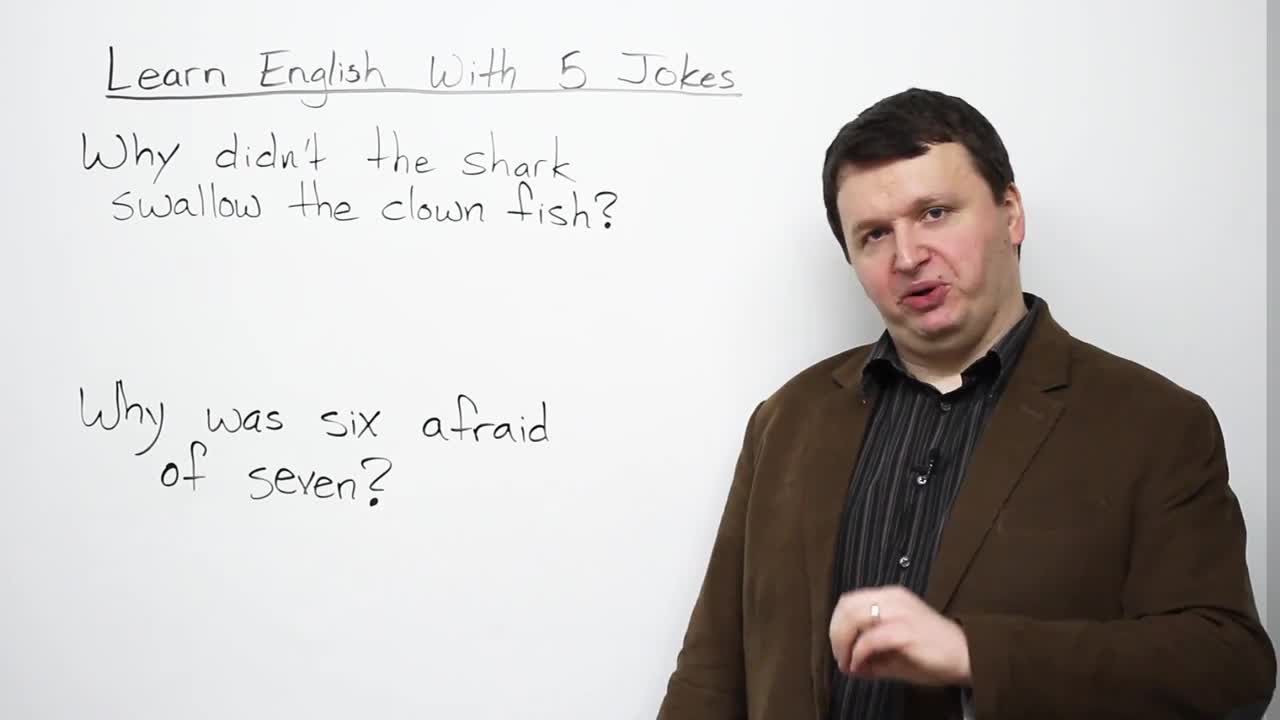
[Mastering English Humor: Understanding Wordplay and Double Meanings]-[Learn English with 5 Jokes]
📋 Summary
Mastering English Humor: The Power of Wordplay
For advanced English learners, grasping the nuances of humor is often the final hurdle to true fluency. English jokes frequently rely on linguistic ambiguity—specifically the use of double meanings—to create a humorous effect. By analyzing specific jokes, we can decode how these lexical layers function to challenge and improve our language proficiency.
1. The Chameleon Nature of Adjectives: 'Funny' and 'Bright'
Language is rarely static, and adjectives often carry multiple connotations depending on the context.
- The Clownfish Joke: "Why didn't the shark swallow the clownfish? Because it tasted funny." Here, the word "funny" acts as a pivot. In the context of a clownfish, the listener initially interprets "funny" as "ha-ha funny" (humorous). However, the punchline relies on the secondary definition: "strange" or "not normal," as one might describe food that has gone bad.
- The Teacher's Sunglasses: "Why did the teacher wear sunglasses to class? Because her students were so bright." The word "bright" is similarly dual-purpose. It denotes physical luminosity (like the sun, necessitating sunglasses) and intellectual brilliance (being highly intelligent). The humor arises from the teacher treating the students' intelligence as if it were a literal, blinding light source.
2. Phonetic Ambiguity: 'Nobody' vs. 'No Body'
English is full of phrases that sound identical but hold distinct meanings. The joke, "Why didn't the skeleton go to the party? Because he had no body to go with," illustrates this perfectly.
The phrase "no body" (referring to the physical anatomy of a skeleton, which is composed only of bones) sounds exactly like "nobody" (referring to the lack of a companion). The humor is derived from this phonetic overlap, allowing the skeleton to be both physically incomplete and socially isolated simultaneously.
3. Contextual Shifts: Verbs and Tense
Sometimes, humor is found by playing with verb forms and numbers.
- Numerical Predation: "Why was six afraid of seven? Because seven eight nine." This joke hinges on the homophone of the number "eight" and the past tense verb "ate." By framing the sequence of numbers as a predatory act, the joke transforms a simple mathematical progression into a narrative of survival.
4. Linguistic Meta-Humor: 'Contractions'
Perhaps the most sophisticated example involves grammatical terminology. "Why did the pregnant lady start yelling 'I’m, didn’t, can’t'? Because she was having contractions."
In this instance, the word "contractions" functions in two distinct domains:
- Medical: The involuntary, painful muscular tightening during labor.
- Grammatical: The shortened forms of words (e.g., "I am" becoming "I'm").
This is a classic example of meta-humor, where the punchline directly references the mechanics of the English language itself.
Conclusion
While these jokes may be simple, they serve as excellent diagnostic tools for language learners. If you can identify the double meaning behind terms like "bright," "contractions," or the pun on "eight/ate," you are demonstrating a high level of linguistic agility. Mastering these nuances allows learners to move beyond literal translations and begin to appreciate the clever, often playful, architecture of the English language.
Deep Learning with ListenLeap


