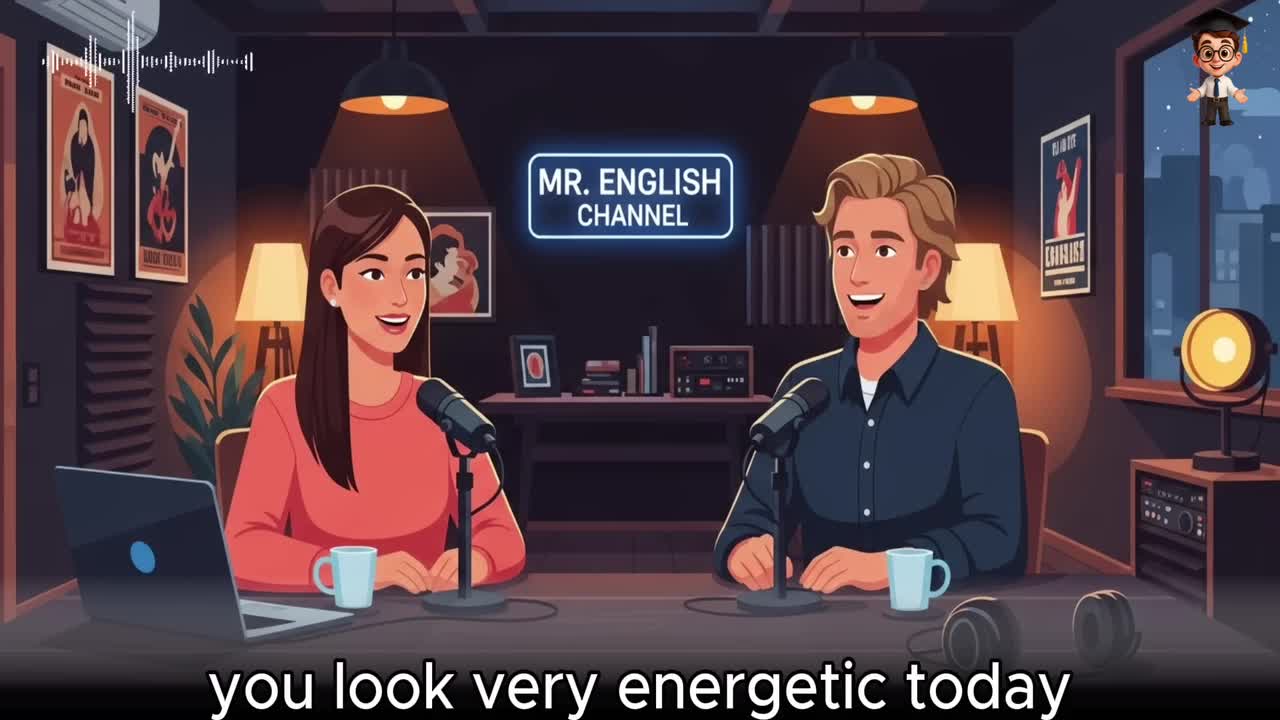
Hello everyone and welcome back to mr English Channel, where learning English is easy and fun.
I'm Emily.
Hi Emily hello, hello everyone.
It is so good to be here today.
I am feeling very, very happy to talk to all of you.
I am happy to Paul.
You look very energetic today.
Did you have a good morning?
I did.
I had a very productive morning.
I finished my tasks, I had a great breakfast, and now I am ready to talk.
How about you, Emily?
How was your day?
My day is wonderful.
I am drinking my favorite tea, and I am excited for our topic.
But first, Paul, we have to say something to our friends listening at home.
Oh yes, you are right.
Everyone, if you like our conversations, please click the like button right now.
It is a small thing, but it helps us a lot.
Yes, and please subscribe to Mr. English channel.
When you subscribe, you don't miss our new episodes.
We want to help you learn English every week.
And don't forget to share this podcast with your friends or your family.
If they are learning English, they can listen and learn with us.
Sharing is caring.
Yes, it is.
Okay, Paul, today we have a very important topic.
It is something people talk about every day.
Oh?
What is it?
Is it food?
Is it travel?
No, not today.
Today we are talking about jobs.
Ah jobs, work.
That is a very big topic.
Everyone asks what do you do or where do you work exactly?
When we meet someone new, we usually talk about our jobs.
It is a great way to start a conversation, I agree, but sometimes it is hard for beginners to find the right words.
They know, I am a teacher or I am a student, but they want to say more.
That's why we are here.
Let's start with the most common question.
Paul, what do people usually ask when they want to know about your job?
Well, the most common one is, what do you do?
It is short and simple.
Yes, what do you do is perfect.
Some people also say, what is your job?
Or what do you do for a living?
For a living?
That sounds very professional, Emily.
It just means, what is your work?
So, Paul, let's practice.
What do you do?
I am a podcast host.
I work here at Mr. English Channel.
I talk, I laugh, and I help people learn.
It is a great job.
And you, Emily, what do you do?
I am a podcast host too, but I also work as an English teacher.
I work with students from all over the world.
Wow, a teacher.
That is a very important job.
Do you work in a school or an office?
I work from home.
I have a small desk, a big computer, and many books.
I sit in my chair and I talk to my students on the screen.
Working from home is very popular now.
I like it because I can wear my comfortable socks.
Yes, me too.
But some people work in an office.
They have to travel to work every morning.
Paul, do you like working in an office or at home?
Hmm, that is a good question.
I like the office because I can see my colleagues.
A colleague is a person you work with, right?
Yes, exactly.
Colleagues or teammates.
It is nice to talk to people during a coffee break.
Yes, the coffee break is the best part of the day.
But when I work at home, it is very quiet.
I can focus.
Focus means to think very hard about one thing.
That is a great word, Paul.
Focus.
Now, let's think about the different places people work.
We said office and home.
What are some other places?
Well, a doctor works in a hospital.
A teacher works in a school.
A chef works in a kitchen or a restaurant.
And a shop assistant works in a store or a shop.
A pilot works on a plane.
Wow, a pilot.
That is an exciting job.
They see the clouds every day.
It is, but every job has a routine.
A routine is the things you do every day in the same order.
Paul, what is your work routine?
My routine?
Well, first, I check my emails.
I see many messages from our listeners.
Then, I prepare the script for the podcast.
After that, I talk to you, Emily.
That sounds like a busy morning.
Using words like first, then, and after that is very helpful when we describe our jobs.
You are right.
It helps the conversation flow.
For example, first I arrive at the office at 9 a.m.
Then I have a meeting with my boss.
After that, I eat lunch.
Perfect.
And meeting is another big work word.
A meeting is when people sit together to talk about work tasks.
I have many meetings.
Sometimes they are long and sometimes they are short.
Emily, do you like meetings?
Only if they are short.
If a meeting is too long, I get tired.
I want to go back to my desk and work.
Me too.
Now let's talk about how to describe our jobs, not just the title, but the tasks.
Tasks are the things we do at work.
Good idea.
If I am a doctor, my tasks are I help sick people or I give medicine.
If I am a chef, my task is I cook delicious food.
And if you are a manager, your task is, I lead a team or I organize projects.
Those are great examples.
What if someone has a job that is difficult?
How do they say that in English?
They can say, my job is challenging.
Challenging is a nice way to say hard, but in a positive way.
It means you have to work hard, but you learned a lot.
I like that.
My job is challenging but rewarding.
Rewarding means it makes you feel happy or proud.
Yes.
For example, being a teacher is rewarding because you see your students grow.
Exactly.
Now, Paul, let's imagine a conversation.
I am a new person you meet at a party.
Let's practice talking about jobs.
Okay.
I'm ready.
Hi, Paul.
It's nice to meet you.
What do you do?
Hi, Emily.
Nice to meet you too.
I am a journalist.
I work for a big newspaper.
Oh, a journalist.
That sounds interesting.
Do you write about sports or news?
I write about travel.
I visit different countries and I write stories about the people and the food.
Wow, you travel a lot.
Is your job busy?
Yes, it is very busy.
I often work on weekends, but i love it because i see the world.
What about you, emily?
What is your job?
I am an accountant.
I work with numbers all day.
I work in a large office in the city center.
An accountant is it difficult?
It is a bit repetitive, but i, like my colleagues, we have a lot of fun during lunch.
That was a great practice, Emily.
Repetitive is a good word, too.
It means you do the same thing again and again.
Yes.
Some jobs are repetitive and some are very different every day.
Paul, what is more important, a high salary or a fun job?
Hmm.
Salary is the money you get every month.
That is a difficult question.
I think a fun job is very important.
If you are happy at work, your life is better.
I agree.
But we need a salary to pay for our needs, like we talked about in our money episode.
Yes.
Food, rent, and maybe a new bicycle.
Exactly.
Now let's talk about the words job and work.
They are very similar, but we use them differently.
Oh, this is a good tip.
We say I have a job, but we say I am at work.
Yes, job is a noun.
You can have one job or two jobs, but work is often the activity or the place.
You don't say I have a work.
That is a common mistake.
Remember, everyone, I am looking for a job or I am going to work.
Very good, Paul.
And what about boss?
Everyone has a boss, right?
Almost everyone.
A boss is the person who tells you what to do.
My boss is very kind.
He listens to my ideas.
You are lucky.
A good boss makes work much easier.
Some people are their own boss.
We call them self-employed.
Self-employed, like a photographer or a writer who works for themselves.
That sounds like a lot of freedom, but also a lot of responsibility.
Yes, it is.
You have to do everything.
You are the boss, the worker, and the accountant.
That is too many jobs for me.
I like being part of a team.
Me too.
Teammates can help you when you have a problem.
Let's talk about the commute.
The commute is the journey from your house to your work.
Emily, do you have a commute?
Well, my commute is very short.
I walk from my bed to my desk.
It takes 10 seconds.
That is the best commute in the world.
My commute is longer.
I take the bus.
It takes 30 minutes.
I usually listen to music or a podcast during my commute.
That is a good way to use the time.
Many people use their commute to practice English.
Yes, if you are on the bus or in your car right now, hello, you are doing a great job practicing.
Yes, you are.
Paul, let's think about skills.
Skills are the things you are good at.
What skills do you need for your job?
For my job, I need communication skills.
I need to speak clearly and listen well.
I also need computer skills because I use a laptop every day.
Those are very important.
Some people need manual skills, like a mechanic who fixes cars with their hands, or creative skills like an artist.
I am good at is a great way to talk about skills.
I am good at talking to people.
I am good at solving problems.
Perfect.
These are great phrases for a job interview, too.
A job interview is when you talk to a company because you want to work there.
Interviews are scary.
I always get nervous.
My hands shake a little.
It's normal to be nervous, but if you practice your English phrases, you will feel more confident, just like we talked about in our confidence episode.
You are right.
Preparation is key.
Practice saying, I have experience in, or I am a hardworking person.
Hardworking.
That is a very positive word.
Bosses love hardworking people.
They do.
But it's also important to have a work-life balance.
Oh, that's a fancy term, Paul.
What does it mean?
It means you work, but you also have time for your family, your friends, and your hobbies.
You don't work all the time.
That is very important for our health.
We need to rest and have fun.
Yes.
On Friday afternoon, I say, have a big weekend to my colleagues.
Then I stop thinking about work.
I try to do that too.
But sometimes I think of a new idea for our podcast on Sunday.
That's because you love your job, Emily.
I do.
Okay, Paul, we have talked a lot about jobs today.
We learned many words.
Yes, we did.
We should remember the main points together.
It was a very good chat.
It was.
I remember we talked about the question, what do you do to ask about a person's job?
Yes.
And we talked about where we work, like in an office, a hospital, or from home.
Working from home is very comfortable.
It is.
And we used words like first, then and after that to talk about our daily routine and our tasks at work.
Right.
We also learned that job is the position you have and work is the activity you do.
And we talked about colleagues, the people we work with every day.
And don't forget the commute, the journey to work, whether it's a long bus ride or a short walk to your desk.
And finally, we talked about skills.
Being hardworking and having good communication skills is very important for any job.
Perfect recap, Paul.
I feel like a work expert now.
Me too.
I hope our listeners feel ready to talk about their jobs in English.
I hope so too.
Everyone, thank you so much for listening to us today.
We love having you here.
Yes, thank you.
Please don't forget to subscribe to Mr. English channel.
It really helps us grow and make more videos for you.
And give us a like if you enjoyed this episode.
Share it with your friends who want to practice their English.
And we have a question for you.
Please leave a comment below.
Tell us what do you do and do you like your job?
Oh, I can't wait to read the comments.
It is so interesting to hear about different jobs from all over the world.
Yes, it is.
Well, Emily, it's time to go back to work.
Yes, it is.
Goodbye, everyone.
See you in the next episode.
Bye-bye.
Have a great day at work or a great day resting.
Goodbye.