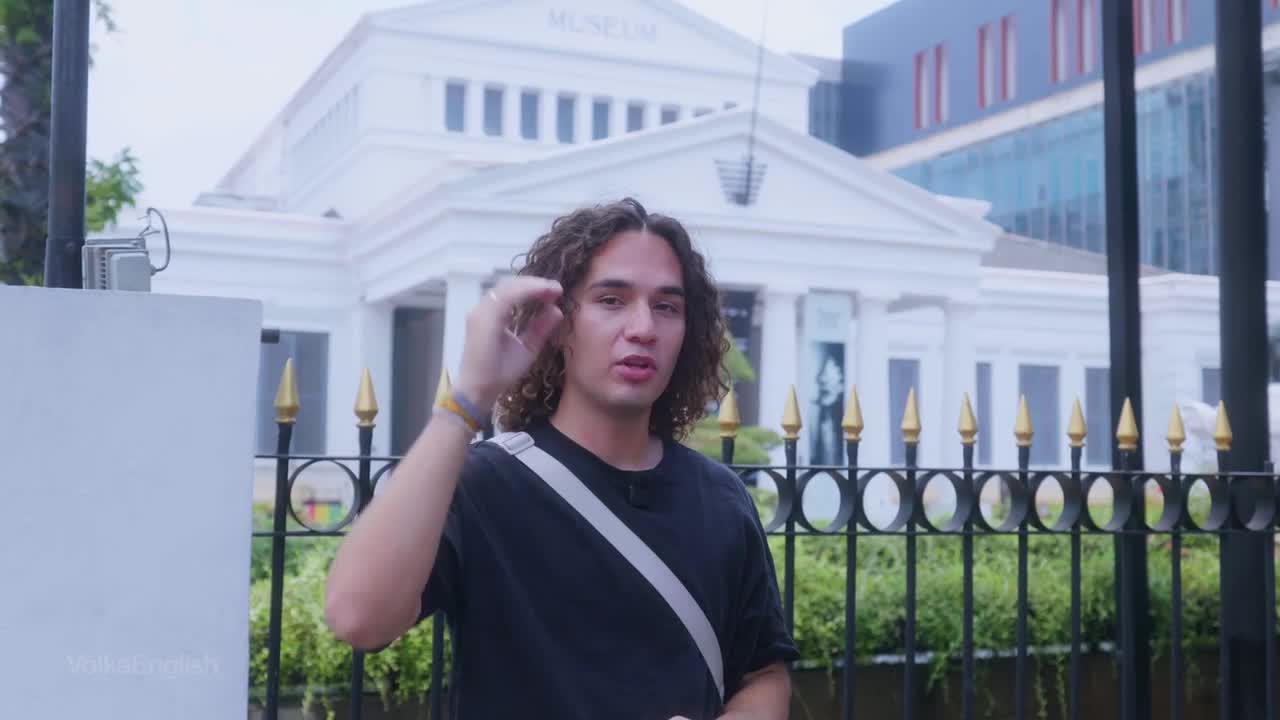
Welcome back to a new video guys.
Today we have another slow English vlog.
I'll be describing everything I see and hear today.
We'll be visiting the National Museum here in Jakarta, Indonesia.
And we'll also be having conversations in slow English so you guys can understand everything.
This video is part of my 3000 most common English word series, designed to help you understand up to 95 of spoken English.
If you guys want to get the PDF with all 3,000 words, it's in the description.
Whirlpool Old Exhibition Carpet.
Okay, so this is the entrance of the museum.
Right there, you can see that is an underground car park.
And over here is the entrance.
Yeah, what do you call that?
So this is called a column and those right there are also called columns.
That's just kind of support the structure above it.
So in this case, it's like a roof.
And in this case, it's also kind of like a roof.
What if they had columns like that but they didn't lift anything or they weren't structural?
If it's more for like design and looks, a better term would be a pillar.
But columns and pillars are both that vertical structure that supports something, columns and pillars.
If you want to learn faster and go deeper than the video, then get the workbook on my website, vocaenglishcom.
The workbook explains everything in greater detail and comes with exercises to help you learn new vocabulary grammar tenses, sentence patterns, comprehension and real English you can actually use.
I also have workbooks for past videos so you can keep practicing and improving every lesson.
Click the link in my description to get the workbooks.
But now we're going to head into the entrance of the museum to buy our tickets.
We're going to walk down these stairs.
We are not walking fast and we are not walking slow.
We're walking at a normal pace.
How would you describe these stairs?
To me, look a little bit old, don't they?
Yeah, they've definitely been here for a couple of years.
How else would you describe them?
What's one other thing?
I would describe these as textured.
They are not slippery.
And even if it rains, you won't slip on them because they are textured.
Yeah, they are textured.
They're not completely smooth and they're not perfect.
There are grooves in them, bumps and other imperfections.
I would also say they're a little dirty because of the bird poop, but it doesn't really matter, since these stairs are outdoors.
So it doesn't matter if they are dirty, because you'll be only standing on them with your outdoor shoes.
However, some people might sit down on them and then get their butt dirty.
But that's not a big deal.
But now we're walking into the entrance of the museum.
Hopefully they let us film.
If not, we'll just have to go somewhere else.
Are we getting the tickets now?
Yeah, so now I'm going to purchase the tickets at this kiosk.
I'm going to select English.
It's not in English.
Oh, foreign tourists.
That's like 20 bucks.
$4, $8, $12, $12 each.
$12 each.
Okay, we ball two tickets, foreigners.
This is pretty normal in Southeast Asia and South America, where they have local pricing and tourist pricing right.
Yeah, I mean, it makes sense.
Tourists usually have a higher ability to pay, but yeah, that's like 24.20 Canadian dollars.
Successful.
Yes, sir.
Thank you.
Thank you.
Okay, perfect.
Awesome.
Thank you.
Thank you very much.
What just happened?
Yeah, so they just put these bracelets on us so that they know we paid.
And they gave us a guidebook.
Yeah, and this QR code on this receipt is used to scan into the gates here.
So we scan in and then we can see the museum.
It's surprising because the one in Korea is free, and that's a huge museum too.
I'll give you yours, and I'll scan it here.
All right, so we just scanned in with this QR code, and now we're going to go see the museum.
I think this museum is big but, as I was saying, right out there, the National Museum of Korea is actually free, which is surprising because when we went there I was expecting to pay, but it was free.
This one makes sense, $12.
Korea is like a different country too, because actually, now that I think about it, most national museums have had to pay, even in like Japan.
Oh, yeah.
In Canada, you have to pay everywhere, dude.
Yeah.
So none of that's free.
Korea is just like an exception.
Yeah well, it's nice and that museum is really nice too.
People that are from here.
It's only like three, four dollars, four dollars, so not that bad.
Yeah okay, where do we want to go first?
Early history, that shoe garden, history is usually something.
Oh, they have an immersive experience immersify.
There was this in Kuala Lumpur as well.
No, that's the word for immersive in Indonesia.
Cut that out, cut that out.
Oh, they have some guided tours as well.
Really?
But there's only a few in English and two in Japanese.
This is the days of the week and then they're only at 10 a.m.
Except for this one.
Oh, that one's at 1.30.
No, today's Wednesday.
Oh, today's Wednesday.
Get my 3000 most common English words PDF and learn the words that will help you understand up to 95 of everyday English.
English.
It includes real definitions, real example sentences for every meaning and everything is organized by CEFR level and topic.
Click the link in the description to get it.
How would you describe this museum so far?
Like this big area?
Honestly, this center area feels super grand.
It's huge, isn't it?
It's like the ceiling is very, very high.
Very high ceilings.
You could look up.
But I was a little confused because that white building with the pillars.
I thought that that was the main entrance to the museum.
Yeah, me too.
I guess that's like an area of the museum.
This type of floor that we're standing on, this is called carpet.
This is carpet.
Carpet is just a material.
There are different types of materials you can use as flooring.
For example, there, you can see it's stone.
Stone. but you could also have hardwood floors or tiles, carpet, stone, cement.
There are a lot of different types of materials, but this specifically is carpet.
And a rug is similar to a carpet, but a rug is usually a smaller piece that you can move around and put wherever you want.
But a carpet is usually wall to wall or covers the entire surface of the floor.
A rug doesn't. and rug.
Now let's go into the museum and check it out.
Okay, this is a mammoth skeleton.
A skeleton.
And this right here and that one behind it, those are the skulls.
The skull.
The skull is... I think it's that animal.
Yeah, the skull is this part of a person's skeleton.
This part right here.
So that's a skull.
And you can see the huge horns of that animal.
It looks like some sort of buffalo or something.
I think that's correct.
A bison.
A water buffalo.
Okay, yeah.
So this was a water buffalo back in prehistoric times.
This isn't in English, eh?
Yeah, none of this is in English.
I guess not a lot of English speaking tourists come here.
But you can see the small one.
This looks to be the skull of a deer because you can see its antlers.
I'm trying to figure out what that is.
This?
It's a big horn, so I would assume it's like a hippo.
No way.
Well, you could see its mouth.
Oh, no, not a horn, sorry.
It's a tooth.
I would say this is a hippo.
What do you guys think?
Now let's see who is right.
Yeah, bro, this is definitely a hippopotamus.
Yeah, ancient, ancient hippopotamus.
Oh, it's a replica, interesting.
Okay, so we just entered another exhibition room, but you can see, here this looks like stone and it's meant to look like stone, like.
This is kind of reminding me of like ancient egypt and pyramids, but it's not.
This is like styrofoam or some sort of like cardboard.
Feels like foam.
It's not actually stone.
It just is meant to look like stone.
It's very similar.
Here we have some skulls of prehistoric humans.
Homo erectus.
Oh, now we know what this means, right?
Yeah.
That's the volume of the skull in cubic centimeters.
Cubic centimeters.
I did not know that.
I did not know that.
This is the skull of a child.
This is a child's skull.
Is it?
It says child skull.
What's it called?
Mojo curto child skull.
Wow, this looks like an adult skull.
It's a lot bigger and you can see the eyebrow, like the eyebrow bones I don't know the correct term for the bone right where your eyebrows, but those are huge.
Imagine getting head butted by that.
Oh, that thing is.
I would natural sunshade.
Yeah, it's like a little lip.
Yeah, but these skulls, how would you describe them?
I would describe these as ancient, delicate, brittle, old, interesting.
And one more word.
Brown. and brown, some of them are brown, correct.
How would you guys describe these skulls?
Do you have any other words to describe them with?
At first, I thought these were tombstones, but these are actually just inscriptions.
So these are just tablets with writing in them.
So that's what they used before paper?
Yeah, they like carved like writing into these stones.
So inscriptions.
But they look very similar to tombstones, don't they?
Yeah, especially like the ones that are standing straight up.
Yeah, the Siwa Gerha inscription.
This literally looks very similar to a tombstone, but it's not.
You can see the writing on there.
Well, tombstones have writing on them too.
But this has like a lot like they're trying to like tell you something you know, like the Ten Commandments or something.
Okay, so we just left the first few exhibition halls and here you can see this is where the rest of the halls are, and this right here is just a sign of things that you can do and can't do, and you can see there are a lot more things you cannot do.
For example, you can't touch anything, you can't smoke obviously, and you can't use flash.
Honestly, it makes sense.
But over here, we have a map of Indonesia, Indonesia.
And we are right here, Jakarta.
Another very popular place to go in Indonesia is around, it's around here, right there, Bali, Bali.
What most people think as indonesia, as bali.
Yeah, most people think of bali indonesia, because that's just the most popular and famous part.
It's always funny to see people comparing bali to other beach countries.
So they would be like where do you guys think i should go?
Bali or thailand.
It's like saying, should i go to bangkok or the philippines?
Right like it's like That's true.
That's true.
But right now, my friend is on this island, Lombok, and he's doing a bike tour.
Four days around the whole island.
Dude, but Indonesia is so big.
It's actually so big.
Have you seen it?
People take Indonesia and put it over North America.
It's wider than the States.
The whole size of North America.
Yeah. even bigger, and the scale is 1 to 1 million.
So time this by a million.
That's the size of Indonesia.
So you can see all these pillars here, all these pillars, and when we came in we came in through there.
That was the entrance, but this part's blocked off so we can't go in here.
But this is like a very nice entrance.
Unfortunately it's closed over here here you can take a closer look at the pillar or the column it's a little dirty.
Actually the whole thing is dirty.
Usually it's just the bottom part that's dirty because people touch it all the time, but this one is just dirty from top to bottom, or maybe that was the way it was painted.
But let's continue.
These floors are marble.
Right, these are marble floors.
This is another type of material you can use for floors and this material is expensive marble.
Here we have wood, wood floors.
This is a statue.
Statue of Ganesha.
Ganesha, it's a Hindu god.
I'm not really too familiar with the Hindu gods.
This whole part is like Hindu gods or Hindu related things.
Yeah, but that's only recently.
Like in the past, I'm pretty sure the majority was like Hindu, because a lot of temples are like Hindu related or a different religion maybe.
I'll have to fact check that statue of a queen.
Oh, maybe we should censor that.
Yeah, close your eyes.
You can see these these, uh skulls on the bottom of this statue.
This is like kind of giving like god of, like death vibes.
Well, it should say somewhere now It says Buddha.
Now let's talk about how we can describe something.
I'll start with this.
First, you can say what it is.
This is a pillar.
Then you can add some basic details.
This pillar is white and tall.
It is white and tall.
Some other details you can add are color, size, shape, number, age, and material.
The next thing you can do is say where it is.
This pillar is on the outside of this square and there are many pillars on the outside of the square.
In some cases, you can say what it is doing.
This pillar is just supporting the structure.
If it was an animal, you can say what the animal is doing.
Then you can say how it looks or feels.
This pillar feels very stable, very stable.
So, to describe things, you can just remember this what it is, what does it look like, where it is, what it's doing and what does it feel like, or seem like?
Let's go.
Okay, so we're in another exhibition hall and these right here are herbs and spices.
This is ginger, very popular cooking ingredient.
What's this?
Root.
And in English depending on what country you live in and what country you're from, you say this word differently.
In some countries, I believe Australia, the UK, and even some parts of Canada, people say herbs.
They pronounce the whole word herbs.
Herbs.
But in America, And some places in Canada, we say herbs.
So we don't pronounce the H. I'm not really sure why.
It's kind of weird, but herbs.
That's new to me.
But you can just say whatever you remember and whatever you're comfortable with.
Herbs or herbs.
People will understand you.
Either way, it's the same word.
So we have now entered another exhibition that is showing us jewelry and gold.
Here you can see different types of necklaces that they used to wear.
This one appears to be gold, but i don't think it is actually real gold.
Maybe it's just gold plated.
It could be real gold, like does it look real enough?
But that looks like a different shade of gold too, so I don't know.
This or that, those crowns, that one right there really looks fake.
That one on the right hand side, that could look real.
What about this one?
That looks like bronze or like brass.
Oh, it is in English too.
Oh, it doesn't say what it's made of.
Look at the details on this headpiece.
Wow.
There are, like, many flowers and, like, different types of ornaments.
It's got to make a noise when you walk.
Oh, yeah.
It's like a crown, no?
But it looks like something a woman would wear, no?
The bride's new life, so it is for a woman.
Kind of has, like, a feminine feel to it.
Yeah, all the flowers and... Yeah, just in the way it, like, comes down to, like, earrings.
It makes it look like hair.
Yeah.
We are outside of the museum now.
How would you describe this area outside the museum, Liam?
So first of all, I don't know if you can see on my face, but it is hot out here.
I'm sweating.
It was a little cloudy when we came in, right?
But now it's clear.
Yeah, now there are only a few clouds in the sky, but not very many.
Yeah, so it's hot out here, the sky is blue, there's a few clouds and it is a little bit windy.
Actually, if we get out of this uh pit area there is a slight breeze.
But yeah, leon was just saying the sky is blue, there are some clouds over there.
Behind leon there are a bunch of trees and there are also buses.
That right there is a bus stop, so there are buses over there.
This right here on the ground, this part, that is a grate, a grate.
Here you have a path with stone and right beside it, you can just see grass and a lot of mud.
It's very wet here.
You can see this is mud. mud this right here is the entrance to the museum this is kind of cool it kind of looks like uh like a black hole yeah like something like uh whirlpool whirlpool yeah actually i think that's probably what it is you think so because it looks like they're swimming or it doesn't say whirlpool oh it's like uh something metaphorical but literally looks like a whirlpool and people swimming in it That reminds me of that ride at West Emden Mall Waterpark.
The toilet bowl.
Oh yeah, the toilet bowl.
That's what the toilet bowl feels like going down.
Just getting sucked into the middle.
Literally.
And over here, We have the museum.
So this whole part on the outside is the museum.
You could see there are some benches there.
Right beside their benches, there is a trash bin, a recycling bin, and an organic bin.
You know what I think that is right there?
I think that's a bonsai tree.
Oh, you think so?
Yeah.
Maybe.
Doesn't look that well taken care of, but it might just be the species of plant that just grows like that.
Yeah.
If you're serious about becoming fluent in English, I've built a full speaking and pronunciation course that shows you exactly what to do, step by step.
You get instant access to 80 plus video lessons right away.
And I add three to five brand new lessons every week so you can keep improving consistently and this is not just a course full of random videos.
You'll get an exclusive ChatGPT prompt that allows you to master the pronunciation of any word, plus a clear practice structure, so you always know exactly how to study, what to focus on and how to make real progress.
Inside we work on pronunciation accent, rhythm and natural speaking so you can stop hesitating, sound more natural and speak English with real confidence.
Join today.
In the description and over there you can see they have a sprinkler going so they are watering the lawn here, the lawn at the front of the museum, with the sprinkler.
So i'm not sure if you guys remember from one of my previous videos, but uh, this is how you ask someone politely to take a photo of you.
Yo, can you please take a photo of me as i stand in front of this vortex?
No problem, get me flicked up for that thumbnail.
I should zoom in to get the optimal focal length.
So now I am posing.
I'm posing.
Why don't you smile?
I don't smile, but I'm posing.
I'm just changing my position and I'm sweating.
Dude, it has gotten a lot hotter.
I should have brought my umbrella.
What time is it right now?
It is 1 pm.
Yeah, after someone takes a photo for you, something nice you could say or offer is would you like a photo?
So someone takes a photo, then i'll ask oh, would you like a photo?
And if they say no, you can just say okay, thank you very much, take your phone back and then go on your way.
Anyways, that was just a quick tip on how to be polite in English.
Always say please, always say thank you.
Canadians say please, thank you a lot.
I assume most people do, although I'm not sure about Americans.
What did you guys think of the museum?
Did you like it?
Did you not like it?
In my opinion, it was a little small.
The museum was small.
There wasn't a lot to see.
I felt like we could have seen everything in like 20 minutes, like max.
What do you think?
Yeah, I think so too.
For a national museum, it was a little underwhelming, but... Yeah, a little bit, but it wasn't bad.
I like the prehistoric section where you saw the mammoth skeleton.
That was really beautiful.
It reminded me of the one we saw in Drumheller.
It's in Drumheller, right?
Yeah.
In Drumheller, Alberta, Canada.
It's one of the largest collections of dinosaur fossils in the world.
So we saw many, many mammoths there and really big ones too.
Overall though, not bad.
If i had to summarize it, i would say if you like museums, definitely come and check it out.
If you don't, you don't really need to.
But uh, i would come again if i never came before.
Now we're gonna go ahead somewhere else.
Probably had to grab a bite to eat, have some lunch.
Remember guys, the framework on how to describe things in english, and use that next time you want to describe something.
And you could even use it right now in your room.
Get my 3000 most common English words PDF and learn the words that will help you understand up to 95 of everyday english.
It includes real definitions, real example sentences for every meaning and everything is organized by cefr level and topic.
Click the link in the description to get it.
Describe these as textured outdoor shoes.
However, some people might sit down on them, this is called Carpet.
This is carpet.
A rug is usually a smaller piece that you can move around.
So we just entered another exhibition room.
This is the skull of a child.
This is a child.
Is it?
Old.
Interesting.
And one more word.
I thought these were tombstones, but these are actually just inscriptions.
These floors are marble, right?
These are marble floors.
This pillar is white and tall.
It is white and tall.
People say herbs.
They spell the whole word or they pronounce the whole word, herbs.
I don't know if you can see on my face, but it is hot out here.
You can just see grass and a lot of mud.
It's very wet here.
Like Whirlpool?
Whirlpool, yeah.
So they are watering the lawn here.
You will become fluent in English.