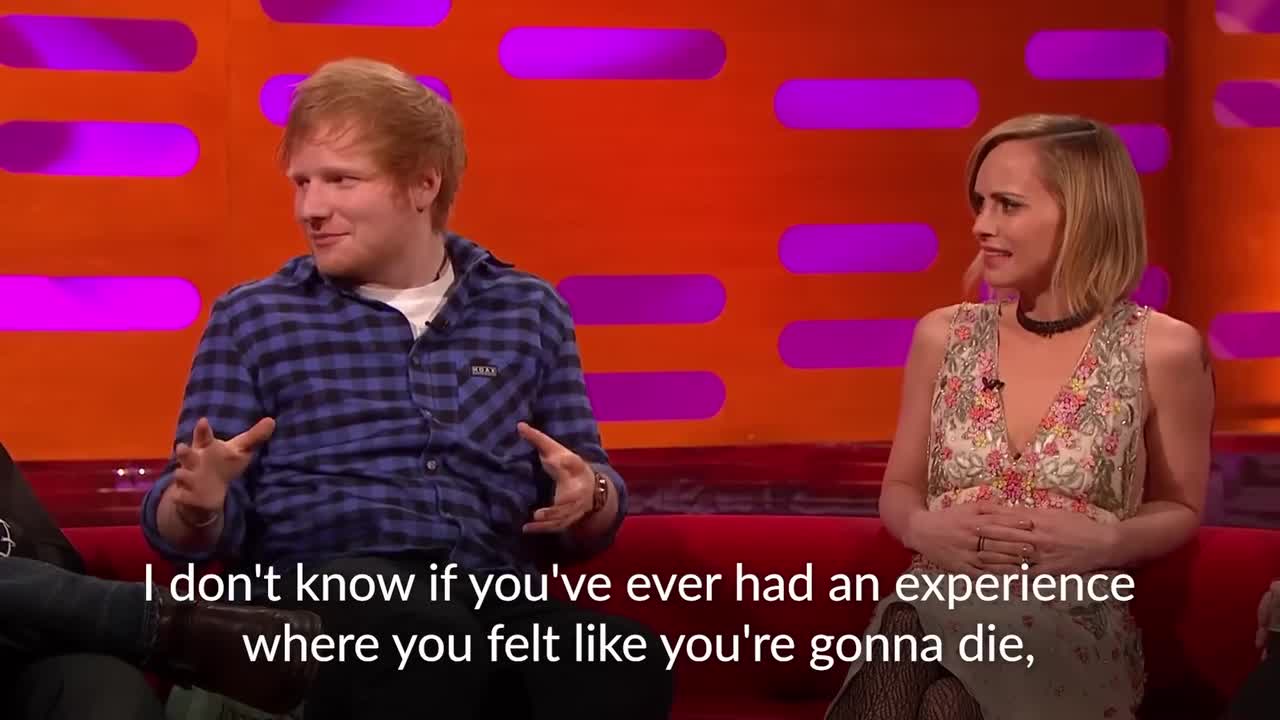
I put my foot in a boiling geyser up a volcano.
I was walking up on my 25th birthday and I went to Iceland to see the Northern Lights and I got went up to the top of a volcano and we were kind of walking around and they were like right, don't go off the pass because it's dangerous.
And I was like, okay.
Didn't really clock it.
And then I saw a little pool of water that was kind of bubbling.
And I was like, that's quite cool.
Volcano bubbling.
Walked over.
They were like, don't walk over there.
I was like, why?
And slipped.
The ground collapsed.
Oh, that's scary.
I don't know if you've ever had an experience where you felt like you're going to die.
But it literally went slow motion.
I was like, ah, all right.
That's it.
That's it.
Oh yeah, global citizens, this is Xenia, your real life english fluency coach, and today we're learning english with a funny interview with the famous sweetest ginger haired singer, Ed Sheeran.
This clip we'll watch is packed with useful expressions in english and i'll help you learn all of this today.
And to help you not only learn these new words, but also never forget them so you can use them naturally when speaking English, we'll give you all the smart flashcards from this lesson for free.
You can access them in our app by clicking the link below.
Thousands of learners just like you are practicing with them and actually getting more fluent every day, while having fun.
If that sounds like something you'd fancy, be sure to try out our method.
You only need a few minutes a day to see real progress.
Now, let's get started.
We'll begin by learning the advanced expressions and pronunciation we saw highlighted in the first part we just watched, before we move on to watching the next part of the clip.
And I guarantee that by the end, you'll be able to understand the whole clip without any subtitles.
You will see.
Okay, so this is the beginning of Ed's wild story about his Iceland adventure.
He starts by describing the location.
Let's have a listen.
Should I put my foot in a boiling geyser up a volcano?
This is a geyser. or a geyser if you prefer to use the British pronunciation.
It's a natural hot spring that shoots boiling water and steam into the air.
Iceland is famous for its geysers because of all the volcanic activity there.
So, Ed is saying he was up a volcano in Iceland but what was he doing there in the first place?
Listen again.
I put my foot in a boiling geyser up a volcano.
I was walking up on my 25th birthday and I went to Iceland to see the Northern Lights.
Oh, the Northern Lights.
Have you ever seen these in person?
They're also called the Aurora Borealis and are this natural light display in the sky, mainly seen in regions near the Arctic.
In case you didn't know, it's caused by energy from the sun hitting the Earth's magnetic field, and it's one of the most spectacular events in nature you can watch.
That's why Ed Shearing was visiting there, and he also used the chance to go see some volcanoes.
But it seems he wasn't taking things seriously enough.
And I went up to the top of a volcano and we were kind of walking around and they were like right, don't go off the pass because it's dangerous.
And I was like, okay, didn't really clock it.
And then I saw a little pool of water that was kind of bubbling.
Here to clock something means to notice something.
Ed's saying he heard the warning but didn't truly understand how serious it was.
You could also say he didn't pick up on it.
Check out these two examples.
Really?
Well, I was so desperate.
She could sense the insecurity.
They pick up on it.
Instantly.
How much time did it take you to get over Max?
I'm not sure exactly.
Approximately.
By the way, pay attention to how he pronounces these two words.
You could easily miss them if you are not aware of this common pattern of connected speech.
So yeah, while it may sound like he's just speaking super fast, let me tell you, he's not.
What you should focus on is the fact that he's linking and reducing words, sometimes cutting a sound here and there.
This is what we call connected speech.
So here he's not saying clock it, but rather clock it, clock it.
The two words are linked and the t at the end of it becomes a glottal stop.
It's a really common pattern.
Basically, the way you do this is by cutting the flow there at the end of the word, like cat instead of cat or bit instead of bit.
Clock it, clock it, clock it.
Cool right, didn't really clock it, didn't really clock it.
Now, keep this in mind.
We'll see it happening again later.
Let's continue with the story.
And listen to this other expression he used to describe that moment.
I don't know if you've ever had an experience where you felt like you're going to die, but it literally went slow motion.
I was like, ah, right, that's it.
In case you don't know, this is slow motion, like playing a video at half the speed.
That's how he's saying he experienced that moment in his head.
This is actually a common experience when humans are under the effects of adrenaline.
Now, before we continue, there's actually an interesting backstory here.
See, Ed had taken a break from social media and decided to travel without his phone.
Kind of a way to sober up from the chaos of fame and constant connectivity.
The expression sober up literally means coming back to normal after being under the effects of a drug like alcohol.
But here it's used to mean clearing your mind and becoming more present.
So to do that, he wanted to properly visit places he'd only seen in his tours as a singer, like Australia's famous landmarks the Sydney Opera House, the Great Barrier Reef and the Gold Coast.
Let's watch how this conversation started and then we'll get back to that terrifying geyser moment.
I got rid of my phone completely.
Still don't have a phone.
Should try it.
Way to sober up on that, huh?
No, it's good.
I bought an iPad.
Now I just do emails.
Okay.
So I got rid of my phone completely.
And then it was like I want to go to the countries where I've been to and toured and only seen a dressing room venue and a bar.
And then uh, so australia was one of those like i'd never been to the sydney opera house or like gone to barrier reef properly, or even like gold coast or anything.
So i rented a mini and drove up the coast and then i did like new zealand and then japan for like two months.
Iceland, which is great.
Ever as you go to iceland yep, There was a lot of death wish, I feel, in your trip.
Iceland was the death wish.
I put my foot in a boiling geyser.
By the way, quick note on a couple of expressions here.
When Matthew hears that Ed took a break from having a phone, he says, way to sober up on that.
Way to sober up on that, huh?
That basically means a nice job doing that.
A really common expression you'll also hear natives use is way to go as a way to show support and congratulate someone.
That's very brave of you, detective.
Let's get going.
We don't have much time.
Way to go, Malone.
And then Graham jokes that there was a lot of death wish in Ed's trip.
A death wish is when someone is taking crazy dangerous risks, almost as if they wanted to die.
Graham just making fun of Ed, though.
We already covered some great expressions today.
And by the time we're done with this lesson, will have learned more than 20.
So that begs the question, Will you be able to truly remember all of this?
As I was telling you earlier, we've created a set of flashcards for this lesson, which we're giving you for free today.
It's a really fantastic tool for internalizing the vocabulary you learn from our lessons.
Now, the reason why it magically works is the science and technology behind it.
Basically, the app knows the exact words you've learned, like the expressions way to go or sober up, and all the expressions you've seen from from all the lessons.
Then, just when you're about to forget one of these expressions, the app brings it back to you for review and practice.
It's that easy.
Thousands of learners just like you are using our app, some of them for as little as 10-15 minutes a day, on their way to work, during a short break at home wherever, and becoming more fluent in English every day.
And so should you!
Give yourself a chance to finally start speaking naturally.
We're going to help you do it by letting you practice what you're learning using our own technology the RealLife app.
Just click the link in the description below and get started with this Ed Sheeran lesson for free.
All right, now let's get back to the story and see what happens after Ed's foot goes into that boiling geyser was wearing steel-capped Timberland boots, so it slipped in and I kind of fell on the side and pulled it out and I just felt melting and I was like, oh my god God screaming screaming screaming, and they were like don't take it off, don't take it off.
And I was like why?
And I took my sock off and all the skin came with okay.
So, even worse, I get helicoptered out and they put a skin graft on it because there's literally no skin.
And I'm kind of like shaking like this in bed, like trying to get to bed, but I'm kind of like having a real
In bed and then I just pass out and then I wake up to the tannoy of the hotel being like right there It is folks, the greatest sighting of the Northern Lights in the last 20 years.
That won't be happening again for a while.
There is folks.
Let's continue learning now with these crazy details of Ed's geyser accident.
I was wearing steel cap Timberland boots, so it slipped in.
Steel cap boots are boots like these, with a protective metal piece in the toe area to protect your feet from injuries.
Timberland is just a popular brand.
Okay, so let's hear what happened next.
And I was like, oh my God, God, screaming, screaming, screaming.
And they were like, don't take it off, don't take it off.
And I was like, why?
And I took my sock off and all the skin came with it.
Something important to take note of here.
The phrasal verb take off is the one we normally use when referring to removing clothing, shoes or accessories.
Like you take off your jacket, take off your shoes, take off your glasses, take off your hat.
Or you could say take your hat off.
You're just switching the order, but it means the same thing.
And the opposite is do you know?
Put on put on your boots, put on your jacket, put on your hat.
Okay so so, even worse, that's not the end of the.
I get helicoptered out and they put a skin graft on it, because there's literally no skin.
Here Red is using helicopter as a verb which you may hear people say when talking about emergency situations or in news stories.
Like when Olympic skier Lindsey Vonn was helicoptered off the slope after crashing during her downhill race at the Winter Olympics this year.
And you could also say chopper instead of helicopter.
It's a more informal, casual word for it.
You authorized him to broker a deal allowing our people to be taken to safe passage to an extraction point.
Then you chopper them out.
So he says, the doctors put a skin graft on his foot, which is what we call the medical procedure, where they take healthy skin from one part of the body and attach it to the area where the skin had been burned.
And I'm kind of like shaking like this in bed, like trying to get to bed, but I'm kind of like having a real
Man up is an informal expression that means be tough or stop complaining and deal with it.
It's telling someone usually a man, but not always to show courage and stop being weak or emotional about something.
But we understand that Graham says this jokingly here.
Just be careful.
This expression can sound rude if you're not talking to a friend.
Check out this example from Brooklyn Nine-Nine.
You can't let them gang up on you.
You need to man up.
Man up?
Sexist.
I'm sorry, but I don't see gender, sir.
And I'm kind of like shaking like this in bed, like trying to get to bed, but I'm kind of like, Oh man up.
Real...
I'm like in bed and then I just pass out.
To pass out means to lose consciousness suddenly, like this.
You could also say to faint or black out.
Or even get knocked out if you pass out because of a blow to the head.
In bed and then I just pass out and then I wake up to the tannoy of the hotel being like right there it is folks, the greatest sighting of the Northern Lights in the last 20 years.
That won't be happening again for a while.
A tannoy is a loudspeaker system like this used to make announcements to a large group of people.
You more commonly hear them in schools, airports, or train stations.
And just a fun fact, the term tannoy comes from a British brand name that became generic, just like how people say band-aid for these adhesive bandages.
In American English, this is more often called a PA or public address system.
Now, did you pay attention to what was announced through the tannoy?
Right, there it is, folks.
The greatest sighting of the Northern Lights in the last 20 years.
That won't be happening again for a while.
This is a good word to know.
A sighting is a moment when something is seen, especially something rare or unusual.
We often use it for things that don't appear, often a whale sighting, a UFO sighting or bear sightings, like in this example.
She's scared out here.
She doesn't want you to leave.
There's no reason to be scared.
Bear sightings are pretty rare.
In this case, Ed is talking about the Northern Lights.
The crazy thing though, is that he traveled all the way to Iceland specifically to see the Northern Lights, but he was unconscious in a hospital bed during the best display in 20 years.
No, it's pretty bad, but it's... Wow.
Is it all right now?
They're scoring.
Scarring is the process of forming scars.
A scar is the mark left on your skin after a wound heals.
Kristina is asking if Ed's foot has scars from the burn.
They're scarring.
Yeah, it just kind of looks like that.
Take your word for it.
When you take someone's word for it, you believe what they're saying without needing evidence.
You simply trust what they're saying.
Graham is joking that he'll just believe Ed about how bad that scar looks without actually needing to see it.
It's like a polite way to say, I don't need to see that, thanks.
But you can use this expression without being joking.
See this example.
And if you were paying attention, you should have heard that glottal T pattern I mentioned earlier.
In fact, this pattern was all over Ed's speech.
Check it out and I got, and then I just passed out and pulled it out all right now.
Are you ready for the final and most important step of the lesson?
We're going to take everything you've just learned the new vocabulary and the advanced pronunciation and put it into practice.
You'll watch the whole scene again, this time without subtitles, and answer some quiz questions.
Are you ready?
Let's do it!
What does sober up mean in this context?
Needing to stop after drinking too much?
Needing to become more serious.
Needing to have a digital detox.
No, it's good.
I bought an iPad.
Now I just do emails.
Okay.
So I got rid of my phone completely.
And then it was like I want to go to the countries where I've been to and toured and only seen a dressing room, a venue and a bar.
And then so Australia was one of those like I'd never been to the Sydney Opera House or like gone to Barrier Reef properly, or even like Gold Coast or anything.
So I rented a mini and drove up the coast and then I did like New Zealand and then Japan for like two months Iceland, which is great.
Ever as you go to Iceland.
Yep, There was a lot of death wish, I feel, in your trip.
Iceland was the death wish.
I put my foot in a boiling geyser up a volcano.
I was walking up on my 25th birthday and I went to Iceland to see the Northern Lights and I got went up to the top of a volcano and we were kind of walking around and they were like right, don't go off the pass because it's dangerous.
And I was like, okay.
Didn't really clock it.
What does Ed mean here when he says he didn't clock it?
He didn't take his watch, so he didn't see a notification.
He didn't give proper attention to the warning.
Or he didn't remember the warning message.
And then I saw a little pool of water that was kind of bubbling.
And I was like, that's quite cool, volcano bubbling.
Walked over, they were like, don't walk over there.
I was like, why?
And slipped the ground.
What's the word Ed uses here to explain what the ground did?
The ground collapsed.
Slip, the ground collapsed.
Oh, that's so scary.
I don't know if you've ever had an experience where you felt like you're going to die, but it literally went slow motion.
I was like, ah, right, that's...
I was wearing steel cap, Timberland boots, so it slipped in and I kind of fell on the side and pulled it out and I just felt melting and I was like, oh my god god screaming screaming screaming, and they were like don't take it off, don't take it off.
And I was like why?
And I took my sock off and all the skin came with it.
Okay so, even worse, that's not the end of the story.
What's another way to say pass out, fade or blackout?
And then i wake up to the tannoy of the hotel being like right there, it is folks, the greatest sighting of the northern lights in the last 20 years.
That won't be happening again.
For a while i was hoping the announcement was there is folks, ed sheeran with the birds.
Why is Graham saying take your word for it?
He's got no reason not to believe Ed's story?
He's avoiding seeing something unpleasant?
Or he wants Ed to show them the proof of the injury.
Oh yeah, amazing job, guys.
Now, if you are new to this youtube channel, you should know that every single week we make new lessons, just like this one with celebrities movies, tv series to help you understand fast speaking natives without getting lost, without missing the jokes and without subtitles.
So if that sounds like something you want to be able to do, hit the subscribe button and the bell down below, so you never miss any of our new lessons.
Lalisa Manobal, better known as Lisa from K-pop group Blackpink, is incredibly admirable.
She was the first ever artist signed to a K-pop group by YG that is not ethnically Korean.
And she totally deserved it.
Not only is Lisa an incredible singer and dancer, but also a polyglot.
And language learners like you and me can learn a lot from her.
Lisa?
I'm Thai.
I've been living in Korea for 6 years.
Lisa, how many languages do you speak?
Three.