Who are you and how did you find me?
I know not who you are nor how I came to find you, but may I just say...
Aww yeah!
I'm Ethan, your RealLife English Fluency Coach.
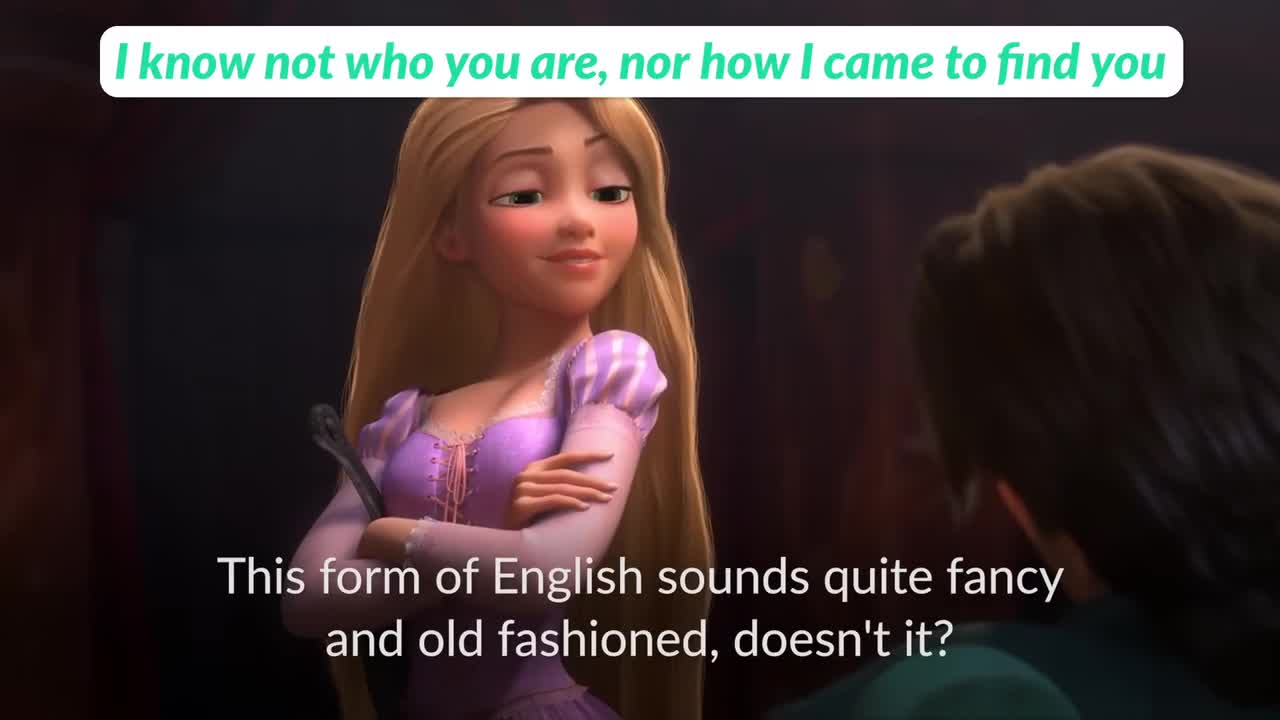
Now in the clip we just saw, Flynn says, I know not who you are, nor how I came to find you.
This form of English sounds quite fancy and old-fashioned, doesn't it?
But actually it's a form of early modern English, which is the form of English used by writers such as Shakespeare.
In this sentence the word know is used in the present tense, but it is turned negative with not, which is commonly placed after the verb in early modern English.
The phrase I know not means I do not know.
Now.
We have so much more to learn in today's lesson and a special announcement coming up in just a little bit that you won't want to miss.
But before we get into any of that, I want to let you know that, if you are new to our Niche With TV series, every single week we make lessons just like this one that help you to understand fast speaking natives without being lost, without missing the jokes and without subtitles.
So join our community of the 7 million subscribers by hitting that subscribe button and the bell down below, and you won't miss a single new lesson.
Aw yeah.
Is this hair?
Struggling.
Struggling is pointless.
Huh?
I know why you're here.
And I'm not afraid of you.
What?
Who are you?
And how did you find me?
Aha.
Who are you, and how did you find me?
I know not who you are, nor how I came to find you.
But may I just say... Hi.
How you doing?
The name's Flynn Rider.
How's your day going?
Huh?
Who else knows my location, Flynn Rider?
All right, Blondie.
Rapunzel.
Gesundheit.
Here's the deal.
I was in a situation, gallivanting through the forest.
I came across your tower, and... Oh.
Oh, no.
Where is my satchel?
I've hidden it.
Somewhere you'll never find it.
It's in that pot, isn't it?
Before I explain what the word pointless means in this scene, answer this question.
Which of these pictures accurately demonstrates something that is pointless? all of them.
In the first image, the point or nib of the pencil has broken off, so it is literally pointless.
In the second image, the man is using a hairbrush even though he doesn't have any hair.
In the third image the man is running really fast but isn't going anywhere, so his efforts might be pointless.
So, as you can see, when we say something is pointless, we mean it lacks purpose, meaning or significance.
Check out this example from The Simpsons.
Here we have a nice example of elision, which is a common feature of connected speech.
Elysian is when a sound or sounds are left out or shortened in the pronunciation of words because of the way they sound when spoken quickly in conversation.
In this case, when the d at the end of did connects with the y in you, the d is not fully pronounced and what we hear is a j sound, did you?
Let's listen again.
Who are you?
And how did you find me?
I
Notice that we have another example of elision here when the word doing is reduced to doing.
Also, here's a quick grammar point to take note of.
Although we generally use the auxiliary verb are to form questions in the present continuous tense, in informal or colloquial speech the auxiliary verb are is often omitted.
So we say, how you doing?
If you've seen the TV show Friends, you probably notice the similarity between how Flynn says this line and Joey's famous catchphrase how you doing.
How you doing?
All right, Blondie. we use the word blondie to refer to a person with blonde hair.
Depending on your tone and relationship with the person.
This can be used as an affectionate nickname or simply a way to point out this physical characteristic.
Here's a funny example from Friends.
Okay, season's greetings and everything, but still.
Bite me, blondie!
So I know how frustrating it can be for you when you struggle to understand fast-speaking natives, especially when we use more specific expressions such as pointless or blondie, or maybe when we cut and connect our speech, just like how Flynn and Joey say how you doing.
And it's really common for learners to get stuck in their learning because they don't understand how all these collocations are actually used in real life.
Do you ever have this problem?
If so, I can say that there's nothing wrong with you personally.
What's actually wrong is the way teachers and schools have been explaining the English language out there.
Now.
I've spoken with thousands of learners from all around the globe, just like you, and I know how much it hurts to study for years with ineffective methods and still not have the fluent, confident English that you desire.
And then to keep missing those important opportunities in life because you can't quite speak English confidently just yet.
And that is exactly why we created the Fluid with Friends course and the RealLife app.
Now that's the only place online where anytime anywhere, you can just press a button and instantly connect to another English speaker in another part of the world to have a conversation and practice speaking together.
Just imagine what would it be like if, a month from now, you could feel a bit more confident having a conversation in English.
And what would it be like if, this time next year, you could get a job where you use your English every single day, or even travel internationally without worrying about being stuck in awkward situations?
Well, to celebrate our recent achievement of seven million subscribers on this channel, I mean wow, it's just still so hard to believe.
Seven million.
We want to give back to our amazing community of supporters.
So we've put together one of the best package deals that we've ever offered.
It's a discount of 55 on the Fluent with Friends Complete Plan, plus a bonus one month of unlimited access to all the creative features of the RealLife app.
Over 10000 learners, just like you have benefited from our innovative method for developing English fluency.
For example, our student Iza from Poland says that she never thought she could have so much fun learning English.
And now that she's finished the course, she can enjoy series in English even without the subtitles.
And this other learner from Brazil says that our app has helped her a lot in developing her confidence to speak and also her listening skills.
So what are you waiting for?
Grab your opportunity to get fluent and feel natural and confident using your English right now, at a great price, by clicking on the link down in the description, where you'll be able to learn more about the course and the app and join our global community of students who have found the most fun way to live their English and use it to achieve their dreams.
Ah, and just in case you're still not convinced, I should tell you that we are so sure that this will be the most fun and effective way you've ever learned that we will happily refund 100 of your money if you are not satisfied with our lessons within the first month.
All right, so don't wait any longer.
This offer will end soon.
Just click on the link up here or in the description and make sure to use the coupon code 7million at checkout to get your exclusive discount of 55 and the premium app bonus.
Now let's get back to learning with Flynn and Rapunzel.
Who else knows my location, Flynn Rider?
All right, Blondie.
Rapunzel.
Gesundheit.
In English, we borrow many words from other languages.
Gesundheit is a great example.
It's a German word that means health.
In English we use it to wish good health to someone who has just sneezed.
In this instance, Flynn is mocking Rapunzel because when she says her name for the first time, he thinks it sounds strange.
Rapunzel is a German fairy tale, so the name sounds German, just like Gesundheit has.
Here's the deal.
Which of these clips shows a similar usage of the word deal as in the scene?
I will open the box.
Could you?
I will deal the cards.
It's a deal!
This is class picture day.
This is a big deal.
The answer is C.
In the first clip to deal cards involves shuffling the deck of cards and then giving out a specific number of cards to each player in a game.
In the second clip.
To make a deal means to come to an agreement with someone else about something, usually involving a trade or exchange of goods or services.
In the third clip, the word huge means important or significant and deal means situation.
So, if something is a huge deal, it's an important situation.
Here's the deal is a common phrase.
That means let me explain the situation or let me tell you what is going on.
For example, here's the deal.
If you study hard and complete all your assignments, you will pass the course.
Check out this other example.
Okay, okay, look.
See?
Gallivanting or to gallivant is an advanced term that means to go around to different places looking for amusement or entertainment.
For example, she's been gallivanting around Europe for the past few months, visiting different countries.
A satchel is a bag with a long strap.
It is usually made from leather or cloth and is commonly used to carry books.
Notice how the sounds in this phrase blend together when spoken quickly and naturally.
When we have an N and T together at the end of a word or syllable, we often drop the T sound.
Here's some examples.
Isn't, isn't.
Can't, can't.
Pint pint fountain, fountain.
Next, the i sound in it is reduced to a schwa sound.
Uh, the t at the end of it is a glottal t, which means we don't pronounce a full t, rather we cut off the sound at the back of the throat.
It it, it.
Some other examples are hat hat bit, bit Cut.
Cut.
As a result, the two words isn't and it are linked together to sound like isn't it?
Let's listen again.
It's in that pot, isn't it?
Would you stop that?
Now it's hidden where you'll never find it.
So, what do you want with my hair?
To cut it?
What?
Sell it?
No!
Listen, the only thing I want to do with your hair is to get out of it.
Literally.
Wait, you don't want my hair?
Why on earth would I want your hair?
Look, I was being chased, I saw a tower, I climbed it.
End of story.
You're telling the truth?
Yes.
Hmm.
So here we have several great examples of the American T.
This usually happens when we have a T between two vowel sounds, even if they are in different words.
For example, before we heard Rapunzel say cut it.
Listen to how she said that.
So how do you think Flynn said this?
The T in both get and out turned into this American T sound and all of these words linked together.
So Flynn said, get out of it.
Get out of it.
Listen, the only thing I want to do with your hair is to get out of it.
Listen, the only thing I want to do with your hair is to get out of it.
Literally.
Wait.
There's a funny play on words here.
Figuratively, we use the expression get out of someone's hair to mean to stop bothering them, to leave them be.
So maybe if you are trying to cook dinner and your child is playing in the kitchen, you might ask them to get out of your hair so that you can focus on finishing cooking.
Or if you realize someone is trying to work or study and you're distracting them, you could say let me get out of your hair so you can focus.
Thanks, Brian.
Brian?
Here Flynn says he wants to get out of Rapunzel's hair, not because he is bothering her although maybe he is but rather because he is literally wrapped up in her hair and cannot escape.
Why on earth is an expression used to show confusion, disbelief or shock to a question, request or statement?
In this instance, Flynn is confused when Rapunzel says that he wants her hair.
Hence the reason he asks, Why on earth would I want your hair?
What?
What do you want?
Do you want my blessing?
No!
You want me to talk you out of it?
No!
Then what?
What do you want?
Well, I guess I figured of all people you would understand.
Why on earth would I understand this?
End of story is used at the end of something you say or write to show or indicate that no further discussion or opinion is needed on the topic.
Here's a nice example from Friends.
Ah yeah, so I hope that you are having a ton of fun with Tangled.
But let's challenge ourselves a bit now.
Are you ready?
So let's watch the scene again without subtitles to see how much you remember.
And I'll also give you some quiz questions so you can test your comprehension.
Let's go.
Is this hair?
Struggling, struggling is pointless.
Huh?
I know why you're here and I'm not afraid of you.
What?
Who are you?
The word nor means neither of two options, either of two options, not neither option.
How you doing?
The name's Flynn Rider.
How's your day going?
Huh?
Who else knows my location, Flynn Rider?
All right, blondie.
Rapunzel.
Gesundheit.
Here's the deal.
I was in a situation, gallivanting through the forest.
I came across your tower, and the... Oh.
Oh, no.
Where is my satchel?
I've hidden it.
Somewhere you'll never find it.
Someone who gallivants, hates new places, stays in the same place, goes to different places.
Now it's hidden where you'll never find it.
So, what do you want with my hair?
To cut it?
What?
Sell it?
No!
Listen, the only thing I want to do with your hair is to get out of it.
Literally.
Wait.
You don't want my hair?
Why on earth would I want your hair?
Look, I was being chased.
I saw a tower.
I climbed it.
End of story.
You're telling the truth?
Yes.
What emotion is generally expressed with the phrase, why on earth?
Shock, disbelief, confusion.
All right now.
Remember that you just have a few more days to take advantage of this tremendous 7 million sale.
So remember to learn more about the course and the app with the link that is down in the description below, and use your coupon code 7 million at checkout to get that fantastic discount.
And if you've loved learning with Rapunzel and Flynn, the next, I highly recommend that you check out this other lesson we have with Tangled on the chores and sweep till the floor's all clean.
Polish and wax, do laundry and mop and shine up.
Sweep again and by then it's like 7.15.
So I'll read a book or maybe two or three.
I'll add a few new paintings to my gallery.
I'll play guitar, paint that and cook and basically just wonder when will my life begin.