Girls, I want you to meet Mr. Gru.
He's going to adopt you.
And he's a dentist.
I got your leg.
I got your leg.
OK, that's enough, little girl.
Let go of my leg.
Come on.
Higher.
Higher.
Wow.
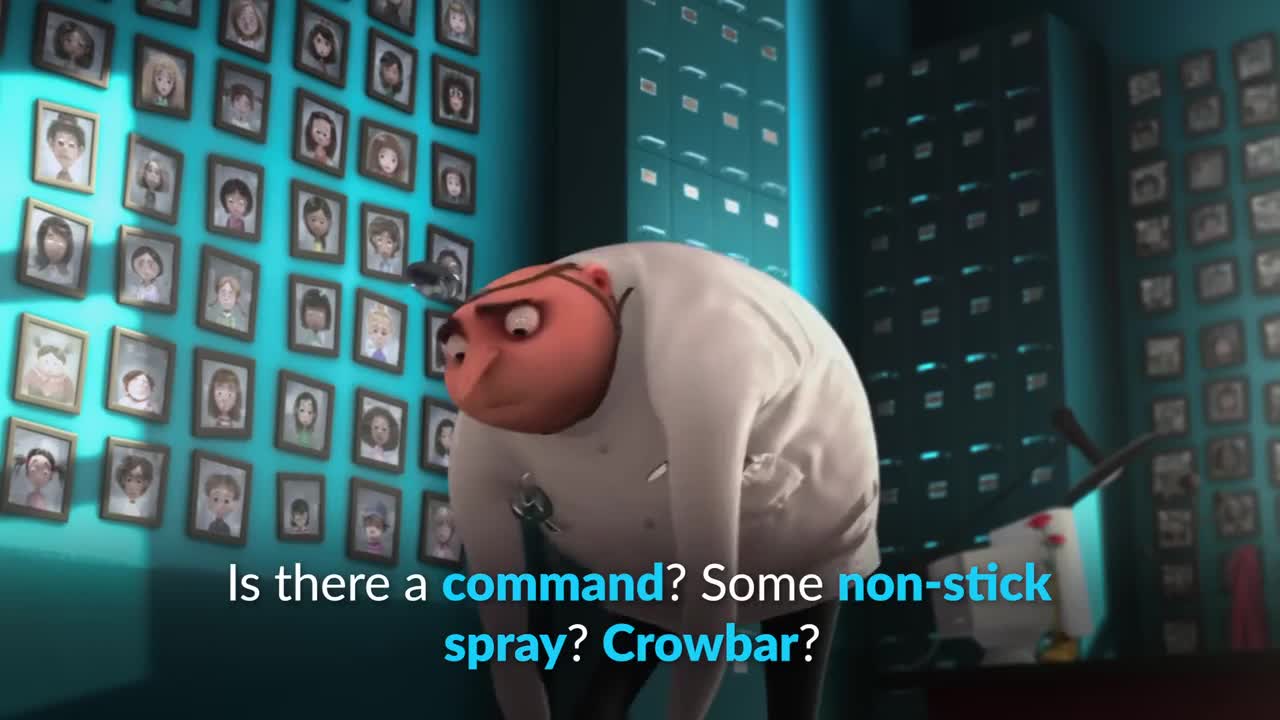
Move them, is there a command?
Semantic spray?
Crowbar?
Okay, girls, let's go.
I'm Ksenia, your real-life English fluency coach, and today we are learning English with a sweet and hilarious 2010 movie Despicable Me.
So Gru is a washed-up supervillain.
This means that he was once successful and famous, but he's not anymore.
So he comes up with a plan that will put him back in the spotlight.
He's gonna rob the moon.
However, first he has to steal a shrink ray.
So, as we saw at the start, he adopts three young girls to help him.
But there is a problem this super villain has absolutely zero experience with children.
He lives in a dark lair full of dangerous weapons and inventions not exactly a kid-friendly environment.
So let's break down what happens when he tries to establish some ground rules.
Here's how the lesson will work.
First, you'll watch each scene.
Then I'll teach you the most useful expressions, grammar, and pronunciation.
And finally, you'll test yourself by watching again without subtitles.
And I'll be asking some quiz questions to make it more challenging.
So let's do this!
As you can see, I have provided everything a child might need.
All right.
Uh, okay.
As I was saying... Hey!
Oh!
Somebody broke that.
Okay.
Okay.
Clearly, we need to set some rules.
Rule number one.
You will not touch anything.
Uh-huh.
What about the floor?
Yes, you may touch the floor.
What about the air?
Yes, you may touch the air.
What about this?
In that hilarious first scene where Gru adopts the girls, we already have some great advanced expressions to learn.
And if you want to remember these expressions forever so you can confidently and naturally use them in your next conversation, whether at work or with friends, let me share you something that will help you a lot.
It's our magic flashcards on the RealLife app.
They use science to bring back words for review right when you're about to forget them.
That way, expressions like washed up in the spotlight layer let go and set some rules will stick in your head like super glue.
You'll speak much more like a native.
Check it out for free right now with the link in the description.
Now let's actually learn all of these everyday expressions.
Let's start off with a common phrasal verb.
Let go means to stop holding on to something or someone.
It's super common in everyday english.
You might hear you need to let go of the past and move forward.
Or let go of me.
Check out this other real life example.
Impatience is fear of the present.
Let go of desire, let go of fear.
Release the grip is a more formal way of saying let go.
When you have a grip on something, you're holding it tightly.
To release means to let something go or set it free.
This phrase is often used in instruction manuals like release the grip slowly to avoid injury.
As Gru is an evil genius, he often uses advanced technical language like this.
And this is part of the movie's humor, because it contrasts with how most people speak to children using simpler, cuter language.
We see him continue treating the children like a technical problem he needs to solve in the next line.
Wow!
How do you remove them?
Is there a command?
Semantic spray?
Crowbar?
Alright, let's break down these few advanced words.
A command in this context would be a specific word or instruction that makes something happen like a computer command.
Gru is wondering if there's a magic word that makes children let go.
In the tech world, you might hear, what's the command to shut down the system?
This is also common when training a dog.
You might say your puppy knows basic commands like sit and stay.
Nonstick spray is actually a real product used in cooking.
It's an oil spray you put on pants so food doesn't stick to them.
The irony here is that Gru wants something to make Agnes not stick to his leg, treating her like food stuck to a pen.
Clearly, he knows nothing about kids.
This is a crowbar.
It's used to lift heavy objects off the ground or open things by force, often used in construction or breaking into places.
Alright, before we move on to the next clip, I want to help you understand fast-speaking natives and speak more naturally and clearly yourself with something called connector speech.
That's how natives cut, reduce, and link words together in fluent speech.
Listen to how Agnes says this.
So she didn't say a clear got your.
She said it like gotcher.
This happens because when we have a word ending in T followed by a word like you or your, it morphs into a ch sound.
Got your becomes gotcher.
Your speaking will only get better with lots of practice.
So listen again and try to say that just like her.
I got your leg.
I got your leg.
I got your leg.
I got your leg.
Now let's jump forward a bit to when Gru arrives home with the girls and is giving them a tour.
This is actually a super useful phrase, especially if you ever need to give presentations or explain something to someone.
When you say, as you can see, you are directing someone's attention to something visible.
Basically saying, look at this evidence right in front of you.
For example, in a business meeting you might hear.
As you can see from the graph, sales increased dramatically last quarter.
Check out this example.
As you can see, the fortress lies so far beneath the bedrock, it's untouchable.
Okay, okay.
Clearly, we need to set some rules.
When something is obvious to everyone, you can use the word clearly to emphasize that fact.
Like, you're clearly tired.
You should go to bed.
Which means I can see you're tired.
It's obvious.
And here's another example.
Are you a ghost?
No, it's complicated.
But clearly you're not a.
What does gru want to do?
He wants to set some rules.
This means to establish rules that everyone must follow.
Parents set rules for their kids, teachers set rules for their classrooms and apparently, supervillains set rules for adopted children.
Rule number one you will not talk.
All right, let's pause here for a grammar moment, because this is important.
Notice that Ogru says you will not touch anything instead of you're not going to touch anything.
What's the difference?
When we use will for future actions, it often sounds more formal, commanding, or like a threat.
It's perfect for rules, warnings, and official statements.
You'll often see this on signs like trespassers will be prosecuted or Smoking will activate the fire suppression system.
On the other hand, going to is more casual and conversational.
It's used for plans or predictions based on evidence.
Like, I'm going to watch a movie tonight.
Or look at those clouds, it's going to rain.
So Gru uses will here because he's trying to sound authoritative and establish firm rules.
He's basically saying this is what's going to happen.
Learners often confuse three similar but different words – floor, ground, and earth.
So, let's peel apart their meaning.
The floor is the surface inside a building that you walk on.
For example, I dropped my keys on the floor.
The ground is the surface outside that you walk on – dirt, grass, pavement.
If you have a picnic outside, in most cases, you'll sit on the ground.
Earth has two meanings.
I'm sure you know it's the planet we live on with a capital E, but it's also dirt.
For example, we plant the seeds in the earth.
We had another great example of connected speech in this scene.
Check this out.
Natives use this question, what about, all the time, and usually you'll hear it pronounced this way.
When it is between two vowel sounds in American English, it morphs into a D sound.
This happens with what and it's connected to about, so it's not what about, but what about, what about?
And we heard this two more times in the scene.
What about the air?
What about this?
Cool, right?
Now you try.
Listen to those three lines again and practice saying this question just like a native.
Moving on, let's hear what Gru's second half rule is.
Okay, rule number two, you will not bother me while I'm working.
Rule number three, you will not cry, or whine, or laugh, or giggle, or sneeze, or burp, or fart.
So, no annoying sounds, right?
Does this count as annoying?
Very.
I will see you in six hours.
Okay, don't worry.
Everything's going to be fine.
We're gonna be really happy here.
Right, Agnes?
Okay, rule number two you will not bother me.
To bother someone means to disturb, annoy or interrupt them when they're trying to do something.
It's a super common word in everyday English.
You can use this term to be polite.
Like, sorry to bother you, but do you have a moment?
It's worth noting that bother is pretty mild.
It's not as strong as harass or annoy, so it's safe to use it in most situations.
Check out these examples.
I will always be here to make sure nobody bothers.
Excuse me, I'm sorry to bother you, but my son and I couldn't help but admire your teddy bear.
Rule number three, you will not cry, or whine, or laugh, or giggle, or sneeze, or burp, or fart.
So no annoying sounds, all right?
Wow, Gru just listed basically every sound a child makes.
Whining is when someone complains in an annoying, high-pitched voice.
Think of it as complaining, but in the most irritating way possible.
Check out this example.
You're going to be my deputy trainees.
Come on, stop whining.
Your kids are soft.
You lack discipline.
What do you think giggle means?
To laugh very loudly at something hilarious?
To laugh quietly, usually because something is funny in a silly way?
Or to make fun of someone?
That's right, little kids giggle a lot.
You might giggle at a funny text message or when someone tickles you.
Finally, let's tackle these body function words because they're surprisingly useful.
Sneeze is what happens when your nose and throat suddenly react to something, maybe dust, or when you have allergies.
Achoo!
That's sneeze.
By the way, people usually say bless you or gesundheit after someone sneezes.
You can also use it as a verb.
The pepper made me sneeze.
Children think burping is hilarious.
A burp is when gas comes up from your stomach and out through your mouth, usually after drinking soda or eating too fast.
In some cultures, burping after a meal is actually considered polite.
In English-speaking countries, though, you usually say excuse me if you burp accidentally.
And...
Probably, I don't need to explain fart, right?
There are tons of slang words for this, like pass gas, if you want to be more polite.
When you ask if something counts as something else, you're asking whether it fits into a particular category.
Let me give you more examples.
Does this count as formal wear?
Does coffee count as breakfast?
Or does watching a movie count as English study?
The answer can be a simple yes or no or, like Gru's sarcastic response here, very meaning yes.
That definitely counts as annoying.
And before we wrap up the lesson, I have a final bit of connected speech to teach you.
Okay, don't worry.
Everything's going to be fine.
We had another instance of the tab T we saw earlier here.
Instead of to, Margu says duh, and she links all three words, going to be, going to be.
Often, this would reduce even more to gonna be.
Check out this example.
It's gonna be okay, it's gonna be okay.
He's gonna be fine.
You've done awesome today!
Now comes the most important part of the lesson.
You will test everything you learned today by watching all the clips again without subtitles.
For an extra challenge, I'll also ask you some quiz questions.
And if you had trouble remembering some of these new expressions well, our real-life app will help you with that.
After learning these expressions with our flashcards, you'll be able to use them confidently and naturally next time you have an English conversation.
So, get that for free right now with the link in the description.
He's going to adopt you.
And he's a dentist.
I got your leg.
I got your leg.
Okay, that's enough, little girl.
Let go of my leg.
Come on, you can do it.
Just release the grip.
Wow.
How do you move them?
Is there a command?
Semantic spray?
Crowbar?
Okay, girls, let's go.
As you can see, I have provided everything a child might need.
Which of these is not an appropriate situation to use as you can see?
When presenting data in a meeting?
When showing someone physical evidence?
When talking about your personal feelings?
True or false?
You will not do this and you're not gonna do this mean exactly the same thing and can always be used interchangeably.
False.
Will not is more formal and commanding, perfect for rules, while not going to is more casual and conversational.
Fill in the blank.
Sorry to you, but could you help me with this?
Sorry to bother you.
Match the definition to the word.
When someone complains in an annoying, high-pitched voice.
When you laugh quietly at something silly.
When you let go of something you're holding.
So no no, no.
Annoying sounds right.
Does this count as annoying?
Very write a sentence using does this count as about something in your daily life?
Share your example in the comments.
For example, does scrolling through social media at 2am count as relaxing?
I will see you in six hours.
Okay.
Don't worry.
Everything's going to be fine.
We're going to be really happy here.
Right, Agnes?
I had so much fun teaching you with this hilarious movie.
And if you want to understand fast-speaking natives without getting lost, without missing the jokes and without subtitles, we help you do it with two new lessons every week.
Hit the subscribe button and bell down below to join our community of over 10 million global citizens and you won't miss a single new lesson.
Oh yeah, today we're learning english with the hilarious animated movie madagascar.
In this film, four friends