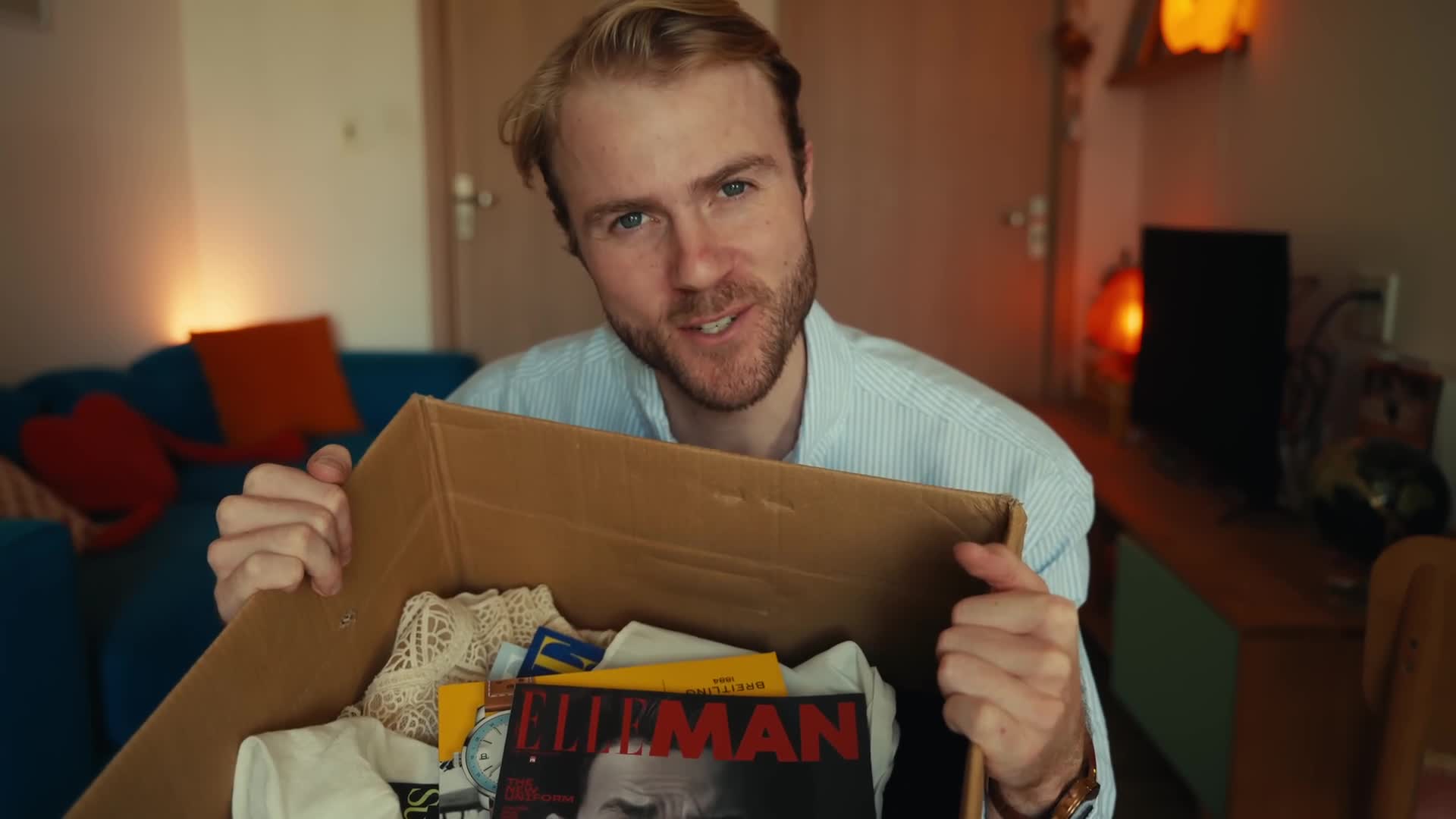
This box is full of old clothes and magazines and today I've decided to reuse them and help you guys learn some clothes English.
But first, what do we need?
A pair of scissors.
Some coloured pens.
A glue stick.
A magazine.
And last but not least, a sketchbook.
The plan for today is to make my own magazine using this sketchbook and these old magazines.
I'm going to use my pair of scissors to cut up or cut out different sections, and I'm going to use the glue stick to stick the cutouts in my sketchbook.
So let's jump in.
Right now I'm flicking through the magazine to find a page or a design that catches my eye.
When something catches my eye, it gets my attention.
And I think I've found something already.
I'm going to take my pair of scissors and cut out the trainers.
I'm going to take my sketchbook of London.
This is Big Ben because obviously England.
Why is it called a sketchbook?
Okay, nice, thank you for that question.
It's called a sketchbook because we sketch in it, we draw in it.
If you'll notice, the pages are blank.
This is perfect for sketching, which is rough drawing.
Do I want my magazine vertical or horizontal?
Normally a magazine is portrait, vertical.
Okay, I have drawn my title and we've called it casual.
And that represents casual clothes.
Clothes that you wear every day.
I have my trainer on my sneaker.
My glue stick taking off the lid of the glue stick and I'm using my fingers to press it down.
That trainer is stuck to the page and now I'm going to label it.
The front part of the trainer, the things that you tie, are called laces.
That part of the shoe is called the tongue and, just like the tongue that you have in your mouth, that's the tongue of the trainer.
This back part of the trainer is called the heel.
And the front part of the trainer, just like on your foot, is called the toe.
The bottom part of the trainer is called the sole.
S-O-L-E, sole.
Not like your soul or your spirit.
First part done.
Here I have stuck the trainer to the page.
This is my first part in my fashion collection.
Back to the magazine.
Let's flick through the magazine.
Alright, I found the perfect thing A pair of trousers.
These trousers are quite skinny, quite slim, And I used to wear skinny trousers.
But for my birthday, Chang bought me some loose trousers, Some baggy trousers.
Wasn't sure about them initially, but when I tried them on I thought these are great, lovely.
Now I'm going to take my glue stick and stick these in my English magazine.
I'm sticking the trousers.
Okay, where am I gonna put these?
I'm gonna put these nice and straight right.
Trousers done.
I need to label them.
Next item of clothing I'm gonna flick through the magazine once more.
Oh, all right, we have a jacket and the material that this jacket is made from is called denim.
Bob's your uncle denim jacket.
It's very common for denim to be used in jeans.
Here is the pocket where you put your pen inside or your phone.
And these jeans are from Levi's, Levi Original 501s.
If you know, you know.
These are very good quality jeans, but they're quite old now.
And actually, they're ripped.
There's a rip in the jeans.
You can see here, there is a small hole.
We call that a rip in my jeans.
So, they need to be fixed.
This is a sewing needle and this is the thread.
Chang is sewing the hole with a needle and thread.
The thread is red.
It's red thread.
Beautiful.
Next, we have a stripy shirt.
This is a long sleeved shirt.
Just like the one I am wearing right now.
This top part of the shirt is called the collar.
The end of the shirt, this part here, is called the cuff.
Cuff.
This is the button.
And I've shared this in my last video, but if you want to undo your shirt, you unbutton it.
I'm unbuttoning my shirt, hairy belly, and buttoning up my shirt.
Now let's compare this shirt to my t-shirt.
This is a short sleeved t-shirt and the color of this t-shirt is navy blue or dark blue.
All right, moving on, let's talk about women's clothes.
Chang is wearing a black tube top, a red back and a polka dot skirt.
Now she's wearing a blue flowery dress.
Thank you, Chang.
Now let's talk about fancy clothes.
Fancy clothes When a man puts on a suit for an event, you can say he's suited and booted.
It means he's dressed in a suit, ready for an event like a wedding.
So for my fancy page, I'm gonna do it horizontal.
Hey, it's James Bond.
I'm gonna cut out James Bond.
007.
Has anyone ever seen James Bond?
My favourite James Bond film with Daniel Craig is called Casino Royale.
There we go.
Daniel Craig is wearing a full black suit, black leather gloves.
That looks funny.
License to kill.
I have found a kilt.
A kilt is a traditional Scottish outfit.
Scottish men will wear a kilt at a wedding.
This is a Highland cow.
A coo is a cow in the Scottish accent and this Highland coo is wearing a tartan kilt.
A kilt.
I've just cut out this man's torso and he's wearing a maroon or burgundy blazer with a black tie and in his suit pocket or his blazer pocket we have a pocket square, which is that little piece of fabric that goes inside a men's or a man's suit pocket.
Tie can also be a verb.
You can tie your laces.
You can tie a knot in something.
And actually an idiom to tie the knot is to get married.
This man is holding a briefcase.
If a man or a gentleman is looking very handsome well-dressed, a good compliment you can give him is calling him suave.
Fancy.
Next for the accessories.
The first accessory is a watch. and it's going around my wrist.
Here I have stuck a watch to the page and written some times.
Seven o'clock.
Seven o'clock.
For 7.15, we say quarter past seven.
For 7.30, we can say half seven.
What time is it?
It's half seven.
I would say sarf seven.
7.45 is quarter to eight.
It's 15 minutes until eight o'clock, we say quarter to eight.
And 7.55 here, it's five minutes to eight o'clock, so we say five to eight.
This man is wearing a beanie hat and above him are a pair of sunglasses.
Speaking of hats, what do you think about this one?
The front part of the cap is called the peak.
The peak of the cap, which is the same word for the top of a mountain.
The peak of the mountain or the summit of a mountain.
Another word for sunglasses. is sunnies, as we say in the UK.
And the part around the edge, the structure is called the frame.
The part in the middle is called the lens.
Oh, there's some perfume and aftershave.
Let's do that.
So in this image, we have a bag and at the top here, we have some woman's perfume.
Can you go get your perfume?
In the UK in general, We tend to refer to a man's cologne as aftershave.
And I'm gonna spritz myself or spray myself.
And this one is a woman's.
So we call this perfume and it's in a bottle.
This at the top is called the nozzle.
And I would, can I spray it?
Spray the perfume.
Just had to ask Chang before I spray it, because it's very fancy.
Oh, that's cool.
It's like it's magnetic.
Look at that.
And it pops off and on like that.
Wow, I love the design of these things.
Mmm smells beautiful, a sip of tea.
Why did I decide to create my own English magazine today?
I believe in being creative.
It is a wonderful way to express ourselves and actually feel better.
Which leads me on to the final word of the day.
Catharsis.
Catharsis is an emotional release when you do something artistic.
So, making this English magazine has given me a sense of catharsis.
Thank you so much for watching.
Have a lovely day.
See you next time.
Peace.