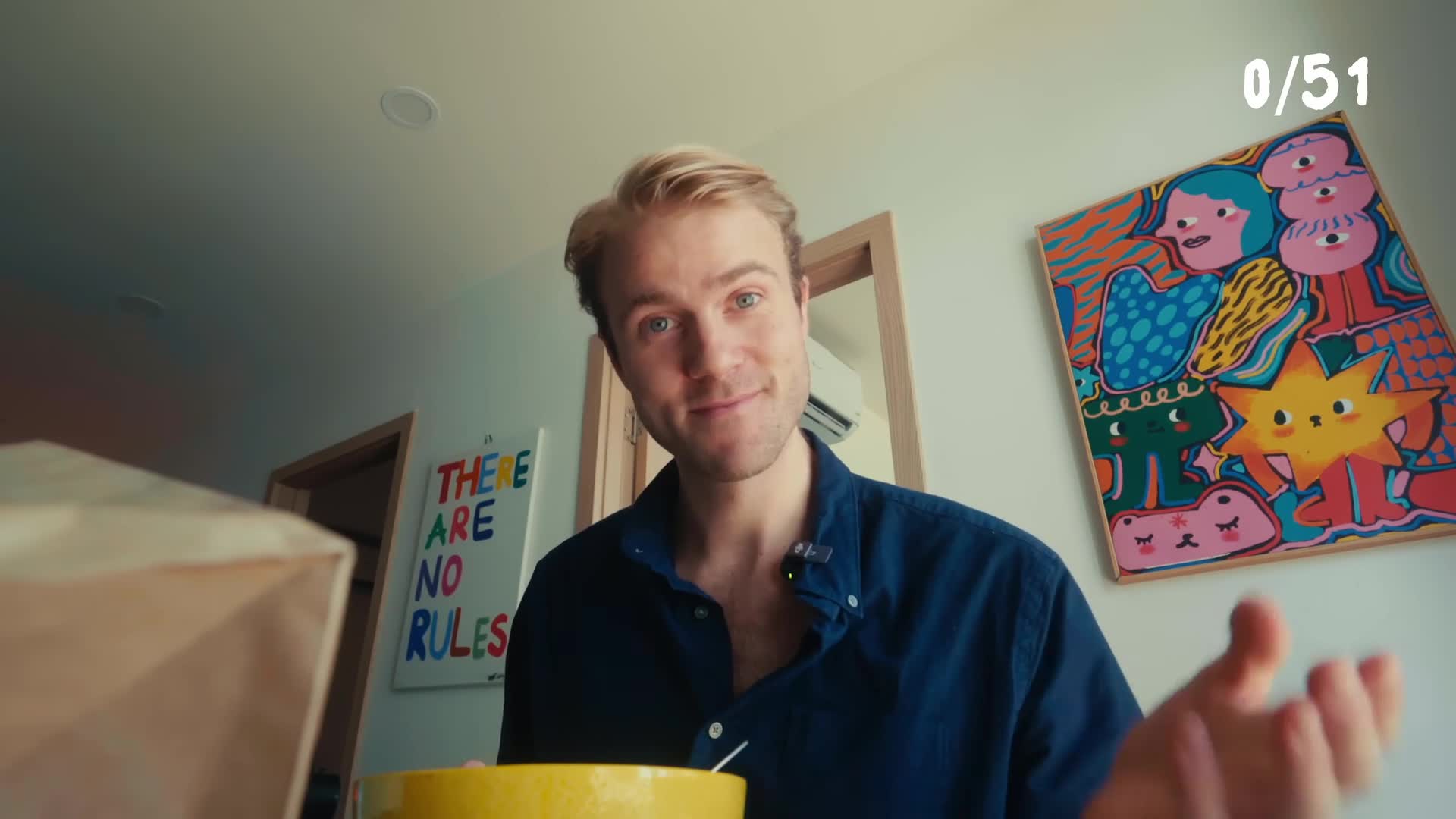
My house is a mess.
I need to clean it before 8.30pm tonight because my friends are coming for dinner.
But I would love some company.
You, join me.
We'll learn lots of English.
But first, fuel.
Music, please.
I am ready.
Let's learn some English.
This is a mug.
This is the handle of the mug.
I can see you through the handle.
This is a coffee pod and I lift up the handle and put the coffee pod inside the coffee machine.
In this little plastic tank, I just filled up the water.
Right, I need to get my mind clear before I tidy up.
So... So, my first task of the day is to wash the dishes.
I have my dirty dishes and I'm putting them in the sink.
I have a scourer or a scourer sponge.
The soft part is the sponge.
The rough part is the scourer.
This is the tap where the water comes out.
This is the sink and under the sink is where I keep my bottle of washing up liquid.
I am squeezing the washing up liquid onto the sponge and the scourer.
I'm picking up the bowl and inside the bowl, these are called suds, soap suds.
I need to rinse off the soap suds.
So I'll turn on the tap.
I'm rinsing off the soap suds.
Now i can put this watermelon bowl on the drying rack.
One more thing move that out the way there we go.
In the uk we say to do the washing up.
So right now i am doing the washing up, or i am washing up ouch.
The pattern of this cup or goblet is spotty.
Polka dots.
This is a polka dot pattern.
Very stylish.
And this is a glass jar that had coconut yogurt inside.
I have just washed it because I'm going to recycle this glass to save planet Earth.
Here I have four spoons.
These are known as dessert spoons.
You can also spoon someone.
If you spoon someone, you are laying behind them cuddling.
Like two spoons.
Very cute.
This is a fork and I won't tell you about what forking is.
This is a plug hole.
Now I am wiping down the worktop.
This is the worktop and I am wiping it down.
To wipe down is like a thorough clean of something.
To wipe is just a small wipe.
You can wipe your forehead or wipe an ant off the side.
And while I'm here, I have some cool kitchen words to teach you.
This is for soup.
And it's called a ladle.
A ladle.
And it rhymes with table.
A ladle.
This little thing is called a spatula.
A spatula.
And that rhymes with Dracula.
This is a whisk.
And you whisk scrambled eggs.
This is a sieve, spelled S-E-I-V-E.
Very weird word, but we pronounce it sieve.
These are tongs.
You pick things up with the tongs.
I would never pick up a scourer normally, but for demonstration purposes I am picking up the scourer with the tongs.
And I think that is it.
I've just been for a long weekend away and I still haven't unpacked.
So let's do that now. what is in my suitcase?
Let's find out.
First we have a wash bag.
This is where my toothbrush, my mouthwash, my toiletries go.
I'll put that in the bathroom later.
This is a grey pair of socks and this is a mustard pair of socks.
These socks are for when I'm feeling a little more garish.
Garish means bright and showy.
I don't often wear mustard socks, only on special occasions.
Next is a t-shirt.
This is a gray t-shirt.
I'm wearing a shirt, a long sleeved shirt.
This is a short sleeved t-shirt.
My t-shirt is clean because I didn't wear it during my weekend away.
So I will fold it.
I'm folding my t-shirt and I'll put it in a neat pile.
What are these?
Not a trouser, but a pair of trousers or trousers.
This is a pair of trousers.
And for my Vietnamese students out there, remember your S, trousers.
Nice one.
I'll fold these.
I'm folding my trousers.
Not very well.
Next, I won't show you these for very long, but it's a pair of boxers.
Underwear.
This is a vest.
This is a vest and the shop it's from is H&M.
This is a label.
The label goes inside of your clothes.
I'm folding the vest and putting it on the pile.
Some more boxes.
You don't need to see them.
This side of the suitcase is empty.
Now I will open this compartment and in this compartment I have some dirty clothes.
Clothes that I have already worn.
Alright, so these clothes are going to go in the laundry basket.
But first I'll show you them.
This is a jumper.
A jumper.
In America, they say sweater.
This I'm going to scrunch up into a ball and toss it or throw it aside because that's dirty.
Here is another shirt, but this shirt is short sleeved.
This is a short sleeved shirt.
And FYI, for your information, this part of the shirt is called a collar, a collar.
And these small parts, which I'm not going to undo, are the buttons.
The buttons.
I'll see if I can show you that more clearly.
This is a button.
And the verb you use is to unbutton or button up.
Right now I'm buttoning up my shirt.
Lovely.
The suitcase is unpacked.
Wonderful.
Now I need to put the dirty clothes in the laundry basket and put the clean clothes in my wardrobe.
So let's do that now.
Dirty clothes, dirty clothes, dirty clothes go in the laundry basket.
This is the laundry basket.
I'll deal with you later.
Next, I'm going to put my clean clothes away.
This is my pile of clean clothes.
They are neatly folded.
This is the label.
Now I have two choices.
I can put them in the drawer.
Close the drawer.
Or I can put them in the wardrobe.
Right now, my clothes are hanging up in this wardrobe.
They are hanging on coat hangers.
I'm going to hang my shirt up on this coat hanger.
Here's the shirt and I'm hanging it on the coat hanger and putting it away in my wardrobe. wonderful no actually there I have unpacked my suitcase I've put it away on top of the wardrobe now let's tick that off the list all right oh my gosh this is dusty i need to dust this wardrobe but i don't have a feather duster normally people dust with a feather duster i don't have one so i'm going to use ah wet wipes we call these wet wipes or baby wipes i'm going to use these to dust my dusty wardrobe i'm opening the wet wipes taking one out and wiping away the dust you can see this is where the dust is and when i wipe it with the wet wipe it disappears or does it That is minging.
Minging is UK slang for disgusting.
You can also say it's manky.
I remember the word manky as a classic British slang word, manky.
I'm going to put this in the bin.
I've just dusted the wardrobe.
Next, I need to clear the floor.
Oh, wait, these dishes from earlier are dry.
So first I'll put them away.
This is a chopping board.
This is a plate and that goes in the cupboard.
This sound is called clanking.
The plates are clanking together.
Clank, clank, clank, clank.
Next is a colander.
Don't use a colander as a hat.
It's not very effective.
The rain can still seep through.
Use it to drain your pasta.
I'll pop this in the drawer.
Putting the colander inside.
Closing the drawer.
This is the drawer handle.
This is a pot or a saucepan.
I'm holding the wooden handles.
Let's put this away.
This mother lover is a cheese grater.
You grate cheese with the cheese grater.
I'm not going to grate it, because that would be a waste of cheese, and I bloody love cheese.
Oh well, i'm a little bit knackered, so i'm gonna take a quick rest.
All right, feeling good, let's get back to it.
As you can see, my floor is a mess.
There is a massage ball, a foam roller and a kettle bell.
Let's do a few squats.
One and two and three and four.
All right, that's enough of that.
Right, let's get down here.
I need to hoover this floor.
I need to vacuum it.
We say Hoover in the UK.
So I'll clear these up.
I'll put the foam roller and the massage ball under my desk.
Clean and tidy.
One of my favorite quotes from my old teachers was, a tidy room is a tidy mind.
Thank you.
All right.
Tidy.
It's funny how tidying your place really does make you feel better.
It always makes me feel less cluttered in my mind.
Like suddenly I can just think so much clearer. than when the place was messy.
But clearing the floor is just half the battle.
Now it's time for the main event.
This is harry the hoover.
Everybody harry harry everybody, hello everybody.
Harry lives in my cupboard but sir, i hate it in that cupboard.
I think he likes it.
Occasionally i let him out to eat all the dust and crumbs on my floor.
Oh, i hate the dust.
Don't make me eat the dust again, sir.
He loves it Right, Harry?
Say goodbye.
You're going back in the cupboard.
No, sir, please, not the cupboard again.
No, please, not the... Let's get you out of there.
Come on, come with me.
Right, I've hoovered the apartment and it is looking spick and span.
Spick and span means spotlessly clean.
Now this is the hob.
In the uk we call this a hob.
The hob is the flat cooking surface above an oven or on top of the counter.
I put pots and pans on the hob, but my hob is a little bit dirty so i need to clean it.
This hob is dirty, filthy.
You can see the streak marks on the hob, So I need kitchen cleaner and kitchen roll.
Give it a shake.
Take off the lid.
See ya.
Put it down.
Pick it up.
Tear off a piece.
Get ready.
Foam.
Wipe.
This is wiping and this is scrubbing.
And when you scrub really hard, it's called elbow grease.
I'm giving it some elbow grease.
Elbow grease.
What's next?
All right.
Rubbish.
This is in a black bin bag and it's going outside.
And you're coming with me.
Get out of here.
Open up with my elbow.
There we go.
Look at that, skills.
Hello.
Oh, forgot my card.
I guess we're down the stairs.
Two fire extinguishers.
A staircase.
It's dark.
This is a green waste bin.
I'm opening it, the lid, putting in my bin bag.
Okay, close that.
Get out of here.
Right, this may look like a normal sofa, but somebody tells me it's a magic sofa.
Look what happens.
Looks like a normal sofa.
Let's take a look.
Magic.
Well, I've transported to my bedroom.
I'm on my bed.
Let's make it.
Alright, where can I put you?
I'll put you there, I guess.
So, on my bed, I have a duvet.
Ends with a T, it's a French word, sounds funny.
Duvet.
But we say duvet, like the French.
This is a pillow.
The pillow is inside the pillowcase.
I'm taking the pillowcase off the pillow.
When you want to take off your bedding.
All of this is called bedding.
We say to strip your bed, not to strip your clothes.
That's something very different.
Not for this youtube channel.
This duvet cover has a zip.
I'm unzipping the duvet cover and taking out the duvet again.
This is the duvet.
I actually used to work in a bed and breakfast, which is like somebody's house mixed with a hotel.
You stay overnight and they serve you breakfast, and i used to be the chambermaid, which is the person who cleans the rooms, and yeah, i got quite good at making beds.
Some might say i'm a pro at making beds.
One thing that i do love to do is to make my own bed every morning.
It's the first thing i do on a morning and i like to do it because It sets my day up for success.
If I begin the day with intention and awareness, then that carries into the rest of my day.
This is the mattress.
This is a mattress topper, which is like a soft topping for your mattress.
So your bottom is comfortable.
This is the bed sheet.
And I'm taking off the bed sheet.
You would say i am stripping the bed one-handed because my other hand is holding your eyes.
Okay, i'm gonna throw that over there.
This is the head of the bed the bed head.
A bed head is also when you've slept all night and you wake up and your hair is messy.
You call this a bed head.
All right, let's get rid of my bed head.
Neaten my hair while I'm on the bed.
This is a bedside table where you put usually a lamp, a book, your phone, an alarm clock, a watch or a glass of water.
This is the leg.
There are four legs on a bed.
Just like your legs.
Legs.
Leg.
Go!
Well, at this point in the video, my microphone decided to stop working.
Actually, it was my fault.
Anyway, here's some fun music, and me frantically trying to make my bed in record timing.
Go, go, go!
You got this!
Don't be slow now!
I might just have a cheeky little nap.
I'll see you guys in five minutes.
That was a lovely nap.
I feel refreshed, revitalized and rejuvenated.
Now I've not got much left to do on my list.
Just a few bits and bobs.
Bits and bobs is a very British saying, and it means little things, small tasks.
So I'm gonna go do my bits and bobs now.
First, I need to untangle the wires.
Look at that.
Messy.
There are lots of tangled wires.
So I'm gonna organize them.
This is my Sony speaker.
Love this thing.
Right now it's plugged in, it's charging you may say.
I'm gonna unplug that.
This is the extension socket and you plug the charger in to the extension socket.
This is the power button.
Turn off, turn on.
You can also turn a person on and if you're a more advanced learner you'll know what that means.
This wire is tangled, so I'm untangling the wire.
I just untangled the wire.
Now I can close the box.
All nice and tidy, put the box back here, let it go.
Excuse the mess, but this is cluttered toothpaste in the toothpaste pot.
Sun cream, this cupboard.
All right, as we say in england, out of sight, out of mind, which means when you put something away, you don't think about it.
Even if it's messy inside the cupboard doesn't matter.
And now you get a clear visual on what the hell it is i'm using.
If you're wondering, by the way, at this point, how I've been filming certain shots,
I've been using this thing called a magic arm.
And if anybody is into filmmaking, I highly suggest to buy a magic arm.
Super versatile.
You can essentially clamp it.
Clamp it onto anything, any surface, and create these unique angles and cool POV shots.
Face wash to wash that face.
As you can see now, this is a little tidier than it was before.
Good enough for me.
Bathroom done.
Now the sun is setting.
I would love to go up to the rooftop and water some plants.
So why don't you join me?
Wow.
There's not many things better in life than a sunset.
I'm watering the plants to help them grow.
And I've actually been growing something behind the scenes for you guys.
I'm super excited about it.
It's completely new and I can't wait to tell you now.
The final word of the day is not actually a word, it's a quote, and the quote is from leonardo da vinci learning never exhausts the mind.
I love to learn.
I hope you love to learn.
I hope I can inspire you to learn and continue to keep growing, keep improving yourself.
Thank you for watching.
We're going to eat some pizza and watch a film.
Oh no, I've lost my face.
Don't worry about it, lad.
Don't worry, lad.