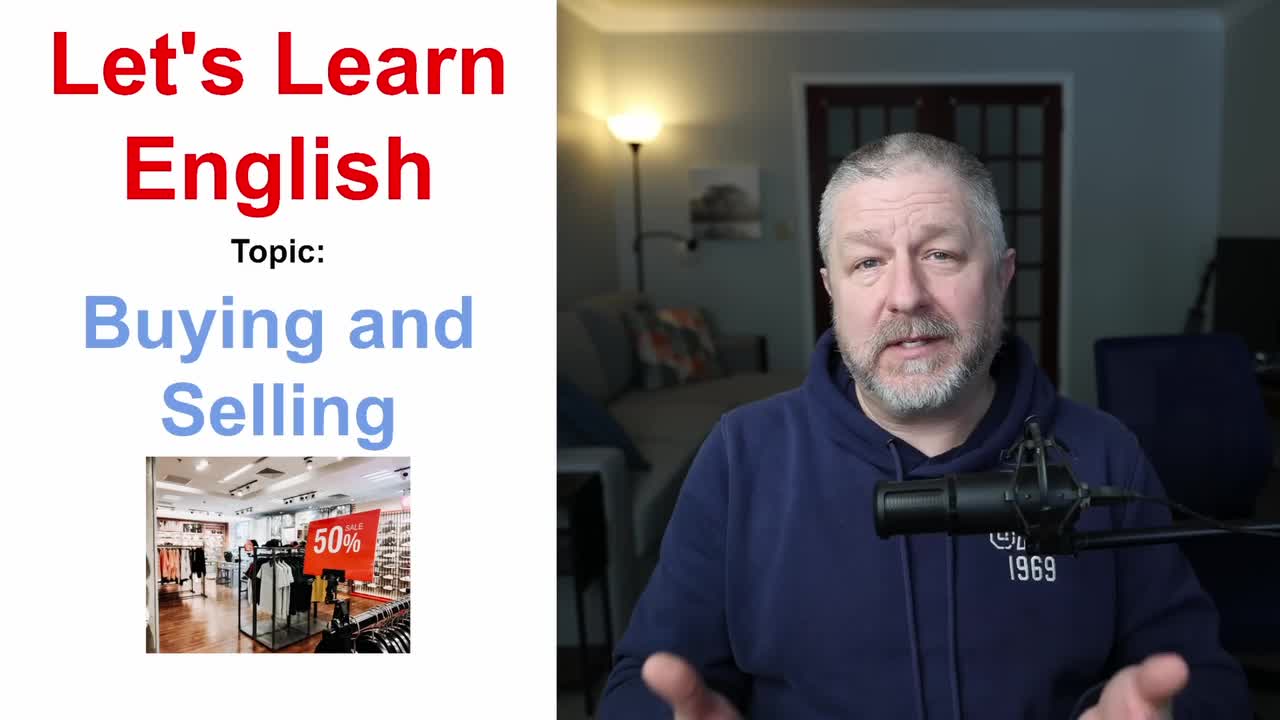
Well hello and welcome to this English lesson about buying and selling.
As you go through life you have to buy things.
It's just the way it is.
You need to buy food.
You might need to buy a ticket to be able to go on the train or the subway.
You might need to buy lunch.
You might did I say food already?
I guess most of my examples will involve food for some reason.
But yes, as human beings we have something called money and Um, and we use that to buy things.
So in this English lesson we'll talk about, I think 30 34, maybe 33 English verbs that we use when talking about buying and selling.
So once again welcome to this English lesson about buying and selling. buy.
To get something by giving money for it.
This means that you are the person that needs something.
If you need to buy something it means you don't have it.
If I'm hungry and I go to Tim Hortons I can buy a donut.
I give money and they give me a donut.
It's a great transaction.
But sometimes I go to certain places and when I buy something they ask for a lot of money.
But then I'm not happy with the transaction.
When I was in Toronto, Jen and I went to a restaurant and it was 11 for a small little breakfast sandwich.
So, we decided to buy them but I wasn't happy with the price.
So when you buy something, you're the person with money and you give the money so that you get something that you need to buy.
Get something by giving money for it.
These people look really happy to to give their money to buy the things they need.
Maybe they maybe they have some yummy snacks there.
I'm not sure.
To sell then is the opposite.
To give something to someone and receive money for it.
So as many of you know Jen and I sell flowers in the summer.
In the spring, summer, and fall, we grow flowers and we sell those flowers at the farmer's market.
That means that we give flowers to people and they give us money.
It's kinda like with buying and selling there's always two people.
There's the buyer and the seller.
The buyer gives money and gets something.
The seller gives something and gets money.
I think you guys understand that, but I wanted to start with the two basic verbs for buying and selling purchase to buy something that's more formal.
So for instance sorry to buy something and this is a more formal way of saying it.
In fact, you might have something at.
You, might have someone at your place of work and their job is to purchase things for the business.
It means to buy, but it's simply more like a business term.
Like at my school I need to purchase textbooks every year for my students.
Okay that's not true.
We reuse the same textbooks but there are things we need to purchase regularly.
We need to purchase paper to we use a lot of paper.
We need to purchase pencils and pens for the teachers to use.
So it's simply a more business like word to say buy.
You could say we need to buy more paper.
We at work I would probably say when's the last time we purchased paper?
I think we need to purchase some more paper.
So more business like more formal way of saying to buy, to pay, to give someone money for something or to give someone money for work done.
So there's two meanings in here.
Okay, when I buy a donut.
I have to pay for the donut.
So when you buy something you give money and you get something.
But part if you look at a smaller part of that action you need to pay.
So I guess you pay before you get the item.
So to give money for something or to give someone money for work done.
The second meaning would be if I work for you you need to pay me.
Okay so I mean it's a similar thing.
Money is being given, but certainly if you go to a pizza place and you say I would like a small pepperoni pizza please, and they say that's 1199.
You then need to pay.
You need to give them money, or you need to tap your phone, or you need to tap your bank card um, or you might need to insert your bank card.
I use the word tap, which someone told me is quite Canadian.
Um, but that's what we, that's how we refer to doing this like beep.
When you do that to pay for gas, to pay for what you need.
To charge.
To ask someone to pay a certain amount for something.
So, let me explain this as best I can.
If someone was to call me on the phone and say, hey, I'd like to buy some flowers.
Sorry.
I'd like to buy some flowers.
I would say, okay, what do you want? would like two bouquets.
How much do you charge for that?
And I would say okay two bouquets that would be $35.
So it basically means the amount of money that you need to buy that thing.
In town.
At the one coffee shop they charge 2 for a cup of coffee, and at the fancier coffee shop they charge 7 for a cup of coffee.
I won't mention any names but you might be able to figure it out.
Um that simply means that's how much that item costs, okay?
If you fix things, Let's say you are a plumber and my toilet is broken.
I could say, hey, how much do you charge to install a new toilet?
And you would say, we would install a new toilet for $450.
I don't need a new toilet, by the way.
Our toilet's working fine. spend to use your money to buy something.
So this is simply a general term for going out in the world and, but this looks kind of sketchy, doesn't it?
I I should I should have sorry I should have picked a better picture.
There's like two random guys at the park.
The one guy's giving cash and he's getting a I don't know what.
The I'm sure I guy in the yellow shirt makes homemade dog treats or something.
It's something above board.
This is not an illegal transaction.
Sorry.
Um I just I do pick my pitchers carefully but this one just cracked me up a little bit.
But to spend is a general term uh to talk about using money to buy things.
You know, every day you need to spend money in order to live.
You need to pay to heat your home.
You need to buy food.
You need to spend money.
You need to use your money to buy the things that you need afford to have enough money to buy something.
I can't afford to buy the $7 cup of coffee.
But I can afford the $2 cup of coffee a couple times a month.
I don't mind spending to $5 a month to buy something yummy like a cup of coffee.
I can afford that.
I have enough money to do that.
But I can't afford to buy a $7 cup of coffee every day.
I don't know who usually is able is able to afford that but that is what that means.
To afford to have enough money to buy something. order.
To ask for something to be made, prepared, or delivered.
So, we have more and more of these things when you go to a fast food restaurant.
This is a kiosk where you can order what you need.
You can see right there on the screen.
I'll make it bigger, but it's going to go off the bottom a bit.
Can see it says Tim Hortons order here.
So basically, when you order, you either say what you want or you punch it into a machine, like one donut, one cup of coffee, and then you can pay right at the machine as well.
But to order to ask for something to be made prepared or delivered. refund.
To give money back to a customer after a return or problem.
So let's use the example of selling flowers.
If I sell a bouquet of flowers to someone.
And if they come back a week later and say my flowers died.
Like I went home and the next morning my flowers died.
Usually our flowers last three, five days, seven days, sometimes even two weeks, so in that case Jen and I might decide to refund that person.
We might say okay here's a refund or we might give them a replacement bouquet.
But to refund means to give money back to a customer after a return or problem.
So if you buy something and you don't like it like I bought what did I buy from Amazon?
I bought a network cable that Um and then I realized I bought the wrong length and so I sent it back to Amazon and they refunded me.
So, they gave me a refund.
It's also a noun, but they decided to refund me the money I had paid for it.
Return to take something back to the store after buying it.
So most stores have a place like this somewhere.
Sometimes it's at the back.
Sometimes it just says customer service.
And this is where you can return items.
Now you can't always return things.
My part of the world, if you buy a sweatshirt and you take it home and try it on and it doesn't fit, you can return it.
So you can return clothing.
But if I buy a carrot and I take it home and a week later I decide I don't want it, I can't bring it back.
Okay, if the carrot didn't taste right or there was something wrong with it, I probably could.
But to return means to take something back to the store after buying it the way.
You don't want to be in this line after Christmas in Canada.
This is a very long line.
To negotiate to talk about the price in order to get a better deal.
So we had a question about negotiation earlier.
When you negotiate you you try to pay less than what the seller wants you to pay.
So a good example of this would be if you buy something used.
If I go on Facebook Marketplace and I look at a used camera. the person wants $200 for it.
I could try to negotiate.
I could say would you take $150 for it?
And they might reply and say no I really need at least 190.
And then I could say well what about 185?
So I'm negotiating.
I've decided to negotiate the price to try and get a better deal.
To discount.
To lower the price of something.
So sometimes people try decide to put something on sale.
A store will will decide to discount whatever's on this table.
I can't quite see it.
Are they books?
I know it's all blurry.
They might be handbags.
But they've decided to discount them.
Now I will tell you this. most often we use the verb to put on sale.
The store is going to put that on sale.
Uh or we just say something is on sale.
But if Jen and I had lots of sunflowers one week, we might decide to discount them and sell them for 50 off because we have so many.
To resell this is something that happens a lot in the world means to sell something again after buying it.
So if I go to the store and buy really expensive shoes, I might decide to resell them at a later time.
If I buy tickets to let's say I buy tickets to go see a Raptors game and then realize I can't actually go I the day the tickets are for.
I could resell the tickets.
It's actually legal to do that in Ontario Canada.
I could resell the tickets.
So it simply means to sell something after buying it.
And we have a relatively new verb called to flip.
This verb has been around for 10 or 20 years.
Probably longer.
But I'm not sure if you've heard it.
It means to sell something after buying it to try and make more money. some people will flip houses.
It doesn't mean that they put the house upside down.
It means they buy a house.
They fix up a few things and they very quickly within a few months sell it again for more money.
What I noticed at Christmas.
I was trying to find a plant stand because I wanted to give it as a gift.
And I went on Facebook marketplace.
Sorry.
I went on Amazon and looked at plant stands and then I went on Facebook Marketplace and saw some of the same plant stands that I saw on Amazon but for more money.
People were trying to flip them.
So they were buying them from Amazon and then selling them for more money on Facebook Marketplace.
I think they were trying to trick people.
So Um but yeah, the two far plant stands with the lights.
Um they were on Amazon for $5 less or $10 less and they were trying to flip them.
So, to resell means to sell something again.
Um doesn't necessarily mean for more or less money, but to flip means you're trying to make more money.
Like he bought the house, he fixed up the bathroom and kitchen and he's gonna flip it.
He's gonna sell it in a few months for more money. trade.
To exchange something for something else instead of using money.
So this is of course how we all used to do this before money was invented.
Uh like a thousand years ago or I'm not sure when money was invented.
But these two boys are trading playing cards.
Um sorry not playing cards.
They're trading sports cards probably.
Actually they might be magic the gathering cards.
I can't tell.
But when you trade, it means instead of giving me money and I give you something.
I give you something and you give me something of equal value.
When I was a kid because I'm Canadian we had hockey cards.
So we would get a pack of hockey cards in the winter every week from our parents.
And then my brothers and sisters and I would trade.
Uh I would say hey will you will you take this useless Wayne Gretzky rookie card? didn't happen.
By the way if you have a Wayne Gretzky rookie card it's probably worth a lot of money.
Uh we would trade.
At school we would trade hockey cards.
You know we would say hey I have Darryl Sittler.
Can I trade it?
Can I trade it for this person?
So when you trade, it simply means to exchange things without using money.
To invoice means to send a bill asking someone to pay for goods or services.
So by the way goods are things that exist.
So you can sell someone a cup.
That is a thing.
Okay.
Uh I can also help you learn English.
That is a service.
When you invoice someone, it means you send them a piece of paper in the mail, or you send them an email and it says you owe me this much money.
So if I gave you an English lesson, I would then send you an invoice saying you owe me this amount of money and you would need to pay the invoice bid.
To bid.
There's two meanings to this.
So generally when we talk about to bid it's to offer a price you are willing to pay for something.
This happens quite often at an auction.
Where there is an auctioneer that says who will give me 10 10 10, who will give me 10 10 10, 10 once.
Who will give me 20?
Who will give me 20?
Who will give me 20 20?
Who will give me 20?
Who will give?
I don't want to be an auctioneer, but it is kind of fun.
If you ever want to hear someone speak English really fast, go to an auction and then eventually the auctioneer says who will give me 20?
I got $20 at the back.
20 going once.
Going once.
Going once, when it's sold for 20, to bidder number seven, or five, in this case.
So to bid is the price you're willing to pay for something, but we also use it you want to do.
Let's say, Jen and I heard about a big wedding coming up and they needed flowers.
We could bid to provide the flowers.
So it can be the buyer who bids but also sometimes the seller.
So to offer to do a job for a certain amount of money.
This is most often used in my part of Canada in the construction industry.
And I wanted to build a new house.
I would have two or three companies bid on building the house for me.
One would say I'll build it for this much money, this much money, and then I would choose which bid to go with.
To quote to give a price for a product or service.
So again, let's say you needed to get your car fixed, but you're not sure how much it's going to cost.
The garage might give you a quote.
So they might say hey, it's going to be 24150, because you need an oil change, a wheel alignment, brake pad replacement and replacement of spark plugs.
It's kind of an odd mix of things.
This must just be an example quote, and then you would look at the quote and you might say hey, we just hold off doing the spark plugs till next month.
Uh cuz it's I can't afford the 40 extra.
This is a really cheap car repair by the way.
Just a sec here.
Replacing the spark plugs.
Brake pads on the front.
Wheel alignment.
Oil change.
Uh maybe not.
But in my world this would be more like $450 probably.
Plus the cost of all the parts.
So anyways to quote uh to give a price for a product or service.
To stock means to keep goods ready to sell in a store or business.
So let's say I wanted to buy a large jug of water.
I could call the store and say hey, do you, do you stock eighteen liter jugs of water?
And they they might say no, we only stock up to four liter.
We don't have the eighteen liter.
So to stock is a is word that stores would use to talk about what they have readily available to sell.
To restock means to add more goods after they have been sold.
So if you go to a store and you go to buy a garden hose.
And you get to the store and the the place where the garden hoses are supposed to be is empty.
You can say hey do you have any garden hoses?
And they might say hey we have to restock.
We'll get more in on Wednesday.
And to restock means to add more goods after they have been sold.
Um trying to think of another example of restock.
Like I went to buy Cheerios the other day.
It's a breakfast cereal.
Uh and they had to restock because it was on sale.
So they were all all the boxes were sold.
To supply means to provide goods to a store or customer.
So Jen and I supply flowers a variety of people who do wedding flowers.
What I mean by that is we grow the flowers and we supply them to them.
They pay for the flowers.
We supply them with flowers.
They use them to decorate a wedding.
So to supply means to provide goods to a store or customer.
Um, I'm trying to think of another example, like a?
Um, there's a company that supplies food to our school.
So they are the ones we regularly buy food for our cafeteria from. mark up.
To raise the selling price of something.
So if you buy something for 100 and you mark it up 25 and you sell it for 125, you have made 25 of profit.
So this happens quite regularly.
When, let's say, you go to a camera store and you buy a camera for 400, the store is didn't make the camera.
They bought it from DJI.
Um but they didn't pay that much for it.
They paid less and then they decided to mark up the price.
So if you were to run a small store and you were going to sell apples, you would might buy apples for 50 cents each, and then you might decide to mark up the price of the apple to a dollar, so that every time you sell one you make 50 cents.
Hopefully all my numbers added up there.
To preorder.
To order something before it is available.
Sometimes something new is going to come out.
But you can't buy it yet.
And then you can preorder it.
So I think a good example of this was Starlink Internet in Canada.
And my part of Canada you could preorder Starlink before it was available.
So that when it became available you could get it.
You could preorder a Cybertruck.
I think it looks like on September 17th, you could preorder this iPhone, which I think is actually an older one.
But it means to give money, usually not the full price, but to give some money to that.
When the item does come out or get released, you are the first one to get it.
To settle.
To pay the final amount that is owed.
So let's say I'm trying to think of an example here.
Let's say I bought a car from my mum.
My mom wanted 5000 and I gave her 3000 and said I'll give you the other 2000 next week.
I'll come to settle with you next week.
It means you've paid for part of something and you need to pay the rest of it.
If you pre-order a phone you need to settle with the store before they give you the phone.
So if the phone is $1000 and you paid 200 when you pre-ordered it you need to settle.
You need to pay the remaining amount. usually say to settle up as well.
Like to subscribe.
To pay regularly usually monthly to receive a service or product.
I think the most common thing is to subscribe to something like Netflix or, on this stock photo, something called cinema with a big, with a play word, the word play.
Um so when you subscribe you pay regularly usually monthly to receive a service or product.
When I was a kid I mom decided to subscribe to Popular Science Magazine.
And so from the age of seven or eight that was like my favorite day every month was when the magazine came, because we subscribed to that magazine.
To cancel to stop an order or agreement.
So let's say you decided to Netflix.
At some point you might decide it's too expensive and then you might cancel Netflix.
Uh if you had a magazine subscription like in the olden days you can cancel your subscription.
So it means to stop an order or agreement.
If I order a pizza, I.
Then Jen comes in and says um oh I I, I have something I'm making for supper.
Then I could call and try to cancel the pizza.
But if they've already started making it at the pizzeria I probably need to still buy it.
If they haven't started making it, I might be able to cancel the order.
Redeem to use a coupon or discount code to pay less for an item.
When I was younger in the newspaper there would be coupons and would say one dollar off butter and we would cut out the coupon and take it to the grocery store and redeem the coupon, which meant to give the coupon to the cashier the modern era.
It would be a discount code.
You might be buying something online and you might have a discount code that says like pay 50 now, and you type that in.
You redeem the code.
You use the code and then you pay less for that item.
Collect to receive money that is owed from a customer.
If I had an apartment that I owned and I rented it out I would collect the rent every month.
So I might go to the apartment and collect the rent.
But more likely I would send an invoice and my tenant would send me the money via e-transfer or another electronic method.
But to collect to receive money that is owed from a customer.
I this usually means later.
Like if I sold you flowers you would give me money.
I wouldn't use this verb.
But if I delivered 20 bouquets of flowers and then a week later I went to collect the money.
Like it does imply that there's some distance between the, the actual transaction and the final payment remit.
To send money to another person or business.
I only use this verb once.
A year.
Actually four times a year.
We have to remit money to the government for our taxes.
So we collect sales tax and we have to remit that to tax to the government.
So I think this is for me this is a government business buying and selling verb.
Uh we remit money.
I think we use this for tuition too at a university.
You need to remit your first payment.
So it means to send money to another person or business. ship to send goods to a customer.
I think we're all familiar with these types of trucks.
Um they're different colors and different companies in different parts of the world.
Uh but when you ship something you send that thing to a customer.
Jen and I do not ship flowers.
Because flowers would die while we were shipping them and then people would want to return them and get a refund.
So to ship to send goods to a customer. fulfill.
To prepare and send an order to the customer.
So let me explain how I would use this.
If Jen said someone's picking up 100 stems of sunflowers today.
In order to fulfill that order, we would need to go, get the flowers from the field, put the flowers in a pail, trim the leaves off of them and then give them to the customer, and we would then have fulfilled the order.
So when you fulfill an order it means you do it from start to end.
So let's look at a pizza shop.
You could say how many pizzas do they sell in a day?
And the owner might say oh yesterday we fulfilled 2486 orders.
So basically it means from start to end to do that. authorize.
To give permission for a payment to be made.
I'm pretending this is my boss.
I'm pretending this is the paperwork needed to purchase something but he needs to authorize it.
He needs to put his signature on it, because I do not have the ability to actually order that without authorization.
So to authorize means to approve the know your manager or your boss might need to authorize that purchase.