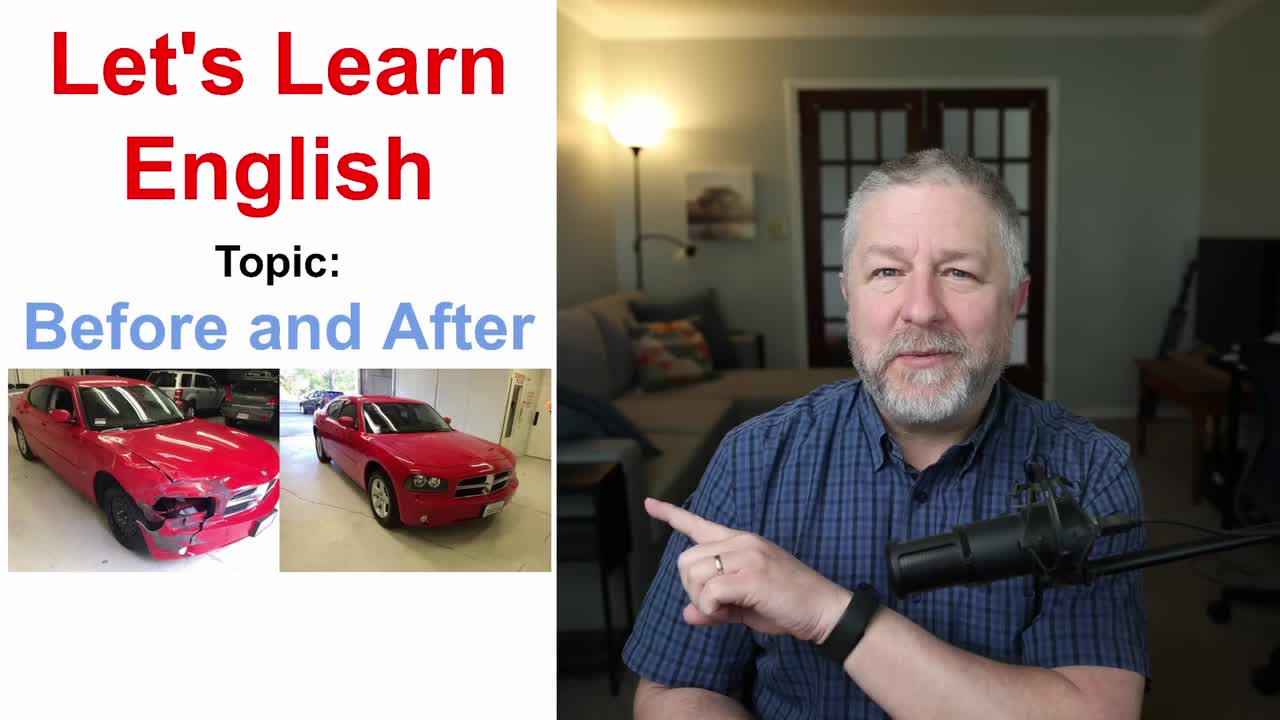
Well hello and welcome to this English lesson which I've titled before and after.
I did this lesson for a very unique reason, and that's that I walked by a dandelion a couple of days ago and it looked yellow, and then a couple days later, it was all poofy and white like that.
So I thought I should do a lesson about before and after.
Now I'll explain more about before and after later, but you can see from these two pictures that definitely, when you talk about before and after,
It's usually when something goes from not so good a shape to much better shape.
It can be a thing.
It can be a person, and I will explain more later.
But welcome to this English lesson about before and after.
I think you'll enjoy it.
So please stick around and watch the entire thing. and after.
Showing the difference between how something was earlier and how it looks or works now.
So you can see here we would call this a deck.
A deck is kind of an outdoor living area.
And if you look at the far side of the picture you'll see the before.
And if you look closer to me you'll see the after.
Let me make this a little bit bigger.
Basically, this person's deck did not look great and they decided they were going to refinish it or put a coat of paint on it.
And so now you have a before and after photo.
So before and after is a common phrase, like if someone says oh, I'm going to paint my car, someone might say oh, take a before and after photo so I can see the change.
And So before and after, showing the difference between how something was earlier and how it looks or works now dandelion.
So this is why we are doing this lesson.
Because my lawn was filled with yellow dandelions and a dandelion is a common yellow wildflower.
We actually call it a weed.
That later turns into a white puffball of seeds that blow away in the wind.
So So this isn't a traditional before and after photo but this is what inspired the lesson.
So I thought I would show you.
If you have dandelions where you live, you'll know that the a little while they're all yellow, they're all little yellow flowers and then all of a sudden, within a day it seems, they all turn into these nice white poof balls.
And then, as a kid, we would.
We would blow them and then all the little seeds would fly off.
Anyways, not a true before and after subject, but the inspiration for this lesson a dandelion Losing weight, reducing body weight through healthier eating, exercise or lifestyle changes.
I'm not sure and I do not want to comment on your weight.
I will comment on my weight.
I am in the process of trying to lose a little bit of weight.
Over the winter I relaxed too much.
Well I was actually spending a lot of time recovering from various health things.
And so I'm a little heavier than I like to be, and naturally I will lose weight over the summer because I do a lot more physical labor.
But I've never actually taken a before and after picture, but some people who are overweight will take a before picture and then they will go through a time where they are trying to lose weight, where they are losing weight and they are reducing body weight through healthier eating, exercise or lifestyle changes, and then they will take an after picture and then you will see the difference in their body size.
So losing weight is a common time for people to take a before and after photo. getting in shape.
Now you might think this is similar to losing weight and it can be.
Getting in shape means improving your fitness, strength and overall health through exercise and healthy habits.
Probably the difference is this.
If you're losing weight you might be exercising but you don't have to exercise to lose weight.
When you are getting in shape you might be eating healthier but you're definitely exercising.
And usually in both situations losing weight and getting in shape you're doing both you're trying to eat healthier and you're also exercising.
So here you can see this gentleman's before and after photo.
He is a lot slimmer and a lot more he has a lot more muscle in the after photo.
So getting in shape, improving your fitness, strength and overall health through exercise and healthy habits.
Restoring a car.
Repairing an old or damaged vehicle and bringing it back to excellent condition.
So this is something that I don't know I know my uncle has done this.
My uncle has restored a car.
I don't know someone currently though who is restoring a vehicle.
So again, when you restore a vehicle, you find it in this condition the top part of the photo where it might be dirty and rusty, it might not even run, like if you try to start the car the engine won't start.
And then when you restore it, eventually it looks like this you will clean it, you will most likely fix all the rust, will definitely paint it and then inside the car you might fix all of the seats and everything else.
But restoring a car before, after repairing an old or damaged vehicle and bringing it back to excellent condition, detailing a car,
So you may have heard this word before and it's different than restoring a car.
So detailing is deeply cleaning and polishing a vehicle inside and out to make it look like new.
By the way we do use that phrase in English inside and out.
I cleaned my car inside and out.
Um because that means you are cleaning the outside and the inside.
But you can see here in the before the car is kind of dirty and not very shiny.
But in the after picture let's make it bigger yet.
You can see that the the car is very very shiny.
So detailing a car if you get your car detailed it means that someone is deeply cleaning and polishing a vehicle inside and out to make it look like new.
I don't do this with my vehicles.
My vehicles just get washed when it rains, and I do clean out the inside of the vehicle every once in a while, but I don't ever pay someone to detail my car.
Photo touch up.
So this uh something where if, if you have imperfections or if the photo isn't taken in good lighting, someone might put it on a computer and use Photoshop to do some photo touch ups.
Sometimes we call this Photoshopping, but I think the general term if a photographer is doing this is that they will touch up the photos.
They are photo touch ups.
So making small improvements to a photo by adjusting color, lighting, or imperfections.
So.
So if you look at this photo on the far side you can see the lighting isn't is kind of harsh and the picture closer to me the lighting is a little more soft.
I think they've also used some sort of filter on his skin to make it look smoother.
Um and I think his hair they change his hair a little bit.
It's hard to say but basically skin smoothing, color correction, remove dust.
They've made the picture look better.
They have uh taken some time to touch up the photo.
Photo restoration though, is repairing and improving old or damaged photographs so they look clear and complete again.
So we didn't have this done.
I had a friend who knew how to do it.
We took a lot of old photos and we digitized them.
We actually took pictures with our phones.
We took pictures of the pictures.
Uh and then they were able to they didn't colorize them.
This one is colorized.
There's another word for you.
So the original is black and white and the restored version is colorized.
Um, but they were able to remove imperfections that were on the photo because of age and do some correction on that.
So that was very nice.
So photo respirator, photo restoration, repairing and improving old or damaged photographs so they look clear and complete again.
They did a good job on this one.
That's pretty cool. renovation.
So the short form for this is reno.
I'm gonna do some renos on my house this summer or he's doing a reno right now.
And a renovation is the process of improving or updating a room, building or space to make it newer or work better.
So you can see here by the way I would have been really happy with the before kitchen.
I don't know if I would have changed much.
But the after definitely looks more modern.
So often when people do a renovation they will take a before picture.
They will take a picture before they do the renovation, and then they will take a picture after, and then you will see the difference.
So a renovation, the process of improving or updating a room, building or space to make it newer or work better.
So Jen and I don't do a lot of renovations but that does look nice doesn't it?
New floor even.
I'm not sure I like the grey cabinets though.
Now you might be wondering what is the difference between a renovation and a remodel.
The Technically there is a difference but we use the words interchangeably.
So a remodel.
Changing the design or layout of a room or building to create a different look or use.
So someone might say this.
We're doing a renovation this summer.
Oh what are you doing?
Well, we're gonna remodel our kitchen and remodel our bathroom.
In that sense, they are the same thing.
I think a remodel more specifically refers to when you change how everything looks and you change maybe how some of it works.
But I use the the words interchangeably.
Okay, so a renovation, you're changing something in your house so it looks better.
A remodel, you're changing something in your house so it looks better.
I should read this again though.
A remodel.
Changing the design or layout of a room or building to create a different look or use.
Cleaning your house.
So sometimes people will take a before and after photo when they're cleaning their house.
Cleaning of course is removing dirt, mess, and clutter to make your home neat and organized.
I need to do that in the room behind me.
You can't see all of the mess because all of the mess is on this side of the camera.
Um, but I will at some point get to uh, cleaning up this room, maybe once the school year has ended, decluttering.
This is similar to cleaning, but mostly it has to do with getting rid of unnecessary items to create a cleaner and more organized space.
So cleaning is simply putting everything back where it's supposed to be, wiping things with a cloth and some cleaner.
Maybe mopping the floor.
Whereas decluttering has two things that are happening.
You are getting rid of things.
Like you're thinking okay I don't need this anymore.
And you get rid of it.
You no longer have it.
And then you're also organizing.
So So decluttering getting rid of unnecessary items to create a cleaner and more organized space.
They did a nice job on this closet.
Our closets look a lot more like the before.
And I wish they looked a lot more like the after.
I think they bought some closet organizers too.
Like there's nice baskets at the bottom and then it looks like on the door.
They put some shelves right on the door.
That's kind of cool.
I should do that in one of our closets.
Refinishing.
Restoring the surface of furniture floors or objects to make them look new again.
So if you have a hardwood floor you might refinish your hardwood floor.
You might sand it with sandpaper and then put stain and lacquer or whatever people put on floors.
If you find an old dresser like this one.
Maybe you find an old dresser and it's made of really really good wood but it doesn't look great.
You might decide that refinishing it is a good idea.
So you're going to sand it and maybe paint it.
In this case it looks like they've that the same dresser?
It is the same dresser.
Yeah.
It looks like they put feet on the bottom and they replaced all the handles and they painted it white.
That's pretty nice.
That's a nice dresser.
I like the the I like the after a lot more than the before.
But refinishing, restoring the surface of furniture, floors or objects to make them look new again makeover.
So a dramatic improvement in appearance, style, or condition.
So when you get a makeover you will have things about you that are changed.
You might have your hair done differently.
Um in this case let's look at what has all happened here.
So she has gotten a makeover.
Obviously her hair looks different.
So she probably had her hair trimmed and her hair looks a little more alive now.
She's also, I think, wearing a bit more makeup.
But have you noticed something you ever?
You see pictures before and after, pictures when someone gets a makeover or when they've lost weight or when they're in shape.
They're usually not smiling in the before and then they are smiling in the after, and people always just look at better if they're smiling.
So I think it's a little bit of a trick sometimes, but I think what she's done is she's.
She has a little bit more makeup on.
She's smiling.
She has had her hair done.
She had a little bit of a makeover.
So now she looks better.
So a makeover.
A dramatic improvement in appearance, style, or condition. vision.
Your ability to see clearly.
So sometimes people can't see clearly and it's hard to take a before and after photo of this.
But if you don't have glasses. when you look at things it looks like the far picture.
It's kind of blurry and not very colorful.
Then after you start wearing glasses it might look vibrant and it might be in focus.
So you might describe it as before I had glasses everything was blurry.
Before I had glasses it was hard to read things.
But After I got glasses I can now see clearly.
Everything is in focus and it's really, really nice.
This is what happened to me with reading glasses.
Like, I slowly but surely realized that, oh, see, I can read.
My microphone says, so, yeah, I can't read that now.
So, in order to read, I do need reading glasses.
So before I realized that everything was blurry, and then after, everything was much easier to read fluency.
So you might have a before and after fluency story, which is your ability to speak or use a language smoothly, naturally and confidently.
So I got some images here.
Maybe before you started watching YouTube videos to learn English.
Your speed was really low.
So you couldn't actually understand speakers at full speed.
Your accuracy when speaking was low and your confidence was really low, but after a couple years of watching English teachers on YouTube, I your your fluency is now really good.
So your speed is awesome.
Your accuracy is better and your confidence is higher.
Sorry I got confused there because I this dial it should say speed not after.
So I think it got a little confused making the image.
But yes, your fluency, that is, your ability to speak or use a language smoothly, naturally and confidently.
You are fluent in your native language.
And you are looking to be fluent in the language you are learning.
That is everyone's goal. surgery.
So this is medical procedures that change or improve a person's appearance or repair physical damage.
So when you have plastic surgery a doctor actually like it is a surgery.
They will do things to make you look younger.
Usually that's the goal.
To look younger.
So Although you might have plastic surgery after having an accident.
Maybe you have an accident and you have a scar or some damage to your face that you would like to reduce or remove, might then have plastic surgery.
So medical procedures that change or improve a person's appearance or repair physical damage.
So you can see here she has had basically in English too we sometimes say they had work done.
So she probably had plastic surgery on her neck area.
That's my guess.
If she was smiling in the second photo, we would be more impressed with the plastic surgery.
Again um plastic surgery or getting work done.
So you you might hear this on a on an American or Canadian TV show.
I think he had work done or she had work done.
So that means that they've had plastic surgery of some type.
So once again, medical procedures that change or improve a person's appearance or repair physical damage work.
Treatments or procedures done to repair, improve, or maintain your teeth.
So here we have another before and after.
So before you can see that this person's front teeth are chipped. they're not even.
And then in the after photo you can see that all of their teeth are very white and straight.
And the front two have been repaired.
So this is a before and after photo of dental work.
Treatments or procedures done to repair, improve, or maintain your teeth. reupholstery.
So, that's a very hard word to say.
I had to pause.
Reupholstery.
So upholstery is putting fabric on furniture and then reupholstery is putting fabric on old furniture.
Replacing or replacing or repairing the fabric and padding on furniture to make it look new again.
So if you found an old chair, you might decide that you want to make it look a little more modern, and so you might decide you're gonna do some reupholstery, reupholstery.
Did you get that?
And so you would take all the fabric off, maybe take the padding out and then you would redo it.
Here you can see, the wood of this chair has remained the same, although they may have refinished the wood and then reupholstered the chair.
So possibly both of those things are happening there, but reupholstery, replacing or repairing the fabric and padding on furniture to make it look new again.
I'll try to say the word slow but I think I'm going to mess up the pronunciation.
So, it's here's the normal speed.
Reupholstery.
So the slow version would be reupholstery.
I'm really mushing stuff together there but that is how you would say it.
Yard work.
Outdoor tasks like mowing, gardening, trimming, and cleaning around a home.
And you can see here this person went a step further rather than just cleaning up.
They actually did some improvements.
So they built looks like some raised beds.
I keep pointing the wrong way today. raised beds.
The fence is the same.
Uh but they built some raised beds.
They put some gravel down.
So they have a nice before and after photo of that yard work.
Okay there's also another thing similar to before and after and it's called then and now.
So then and now is comparing how something or someone was in the past with how it is today.
And this is normally after years of change.
So you might see pictures like this on the internet, where they show a, a street from a city from many, many years ago and the same street today.
So here is a then and now. street.
I'm not sure where this street is.
But you can see in 1971 there were a lot of cars on the street and today it's all bikes.
So they must have decided that this is a car free zone.
So only bikes and people walking are allowed.
But here you have a then and now.
1971 2020. then sometimes it is a neighborhood and sometimes it is a celebrity.
So here we have a then and now picture of another neighborhood.
You can see in the a long time ago it is the same house.
Yeah, I think it's the same house.
Have to be careful with these then and now photos, because sometimes it isn't the same.
But you can see in the older picture there are no cars.
And in the newer picture there are cars.
And then you might have a then and now picture of a celebrity.
So here we have Matt Damon.
You can see in the far picture he is much younger.
This must be 30 years ago.
And then this is a more recent photo.
So this is a then and now of a celebrity.
So, then and now, comparing how something or someone was in the past with how it is today or how they are today.
So a neighborhood, a celebrity.