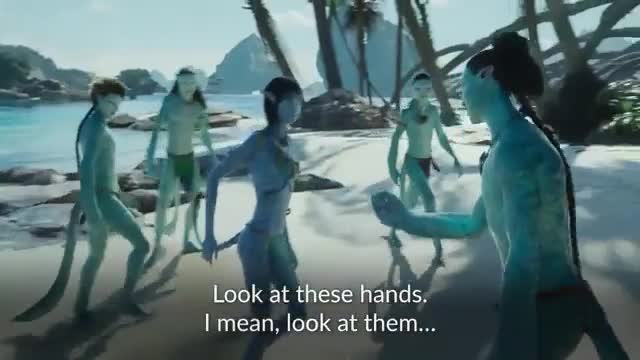
What is she doing?
I don't know.
She's just looking at the sand.
Huh?
What did you say?
Are you some kind of freak?
He asked if you are a freak.
No.
Are you sure?
I mean, you're not even real, not real.
Look at these hands.
I mean, look at them.
Hey!
Back off, fish lips.
Oh, another four-fingered freak.
Look at this little baby tail.
Don't touch me.
Oh, baby tail.
Leave us alone.
Look at his tail.
Oh, baby tail.
It is so cute.
You heard what she said.
Leave them alone.
Oh yeah, I'm Xenia, your real-life English influencer coach.
And today, we will learn English with one of my favorite film franchises, Avatar.
So things are heating up between Jake's kids and the kids from the Water Clan.
We'll watch what happens there and learn more than 20 useful expressions.
But first, make sure to grab the vocabulary flashcards for this lesson in the description below.
They cover all the key expressions we'll see today, and practicing with them will help you internalize everything and Never forget what you learned.
Just click the link below to get them for free right now.
And before we see how that tense moment plays out, let's go back in time a bit.
Because earlier that very day, Jake gathered his family and gave them one very clear instruction.
Let's see what he said.
I want to go home.
No, don't.
This is our home now.
No.
No, we're gonna get through this.
We're gonna get through this if we have each other's backs.
Right?
What does your father always say?
Sully stick together.
Yeah, that's right.
Sully stick together.
This time with some feeling.
Sully stick together.
Sully stick together.
All right, did you notice how this little clip was absolutely packed with advanced expressions?
Let's break down all those words you saw highlighted in blue, starting from how Jake addressed his family.
Check it out.
Remember family meeting?
Jake's last name is Sully, so he's referring to his family members as Sully's.
This is a common thing you'll hear, like, for example, the Simpsons or the Obamas.
Now, notice the command he gives them.
In the military fall in is a command that tells everyone to gather and line up, being ready for instructions or inspection.
Check out this example.
All right, team, fall in.
Jake was a soldier before becoming Na'vi and he still uses this strict military language with his kids.
Throughout this whole scene, you'll hear him speaking like a commander, giving orders to his troops.
It shows how he approaches parenting.
Very disciplined, very structured.
Like with this other expression he used.
Remember?
Family meeting.
Come on, take a knee.
Let's go.
Take a knee means to kneel down on one knee.
This is another military or sports command.
Coaches and commanders use it to gather everyone for a quick talk.
Or in Game of Thrones, we often hear bend the knee, meaning to swear loyalty.
When you're on your best behavior, you're as polite and respectful as you can be.
Parents often say this to kids before going somewhere important, like we're going to a restaurant.
So I need you to be on your best behavior.
And when he says, I mean it, what do you think he's trying to say?
I need you kids on your best behavior.
I mean it.
It's like saying I'm not joking.
Remember that scene from the Titanic where Rose decided to jump off the ship?
She used this phrase there too.
Check it out.
Stay where you are.
I mean it.
I'll let go.
And he used two other great expressions in his instructions for his kids.
Learn fast.
Pull your weight.
Don't cause trouble.
Got it?
To pull your weight means to do your part of the work.
Imagine a rowing crew.
If one person doesn't pull, the whole boat slows and everyone else has to work harder to make up for it.
In this case, he doesn't want his kids to cause trouble in the village.
That means to create problems or make things difficult for others.
That's what we did.
Glad to hear you pulled your weight, Mr. Bridger.
I knew you would.
You be nice to that Miss Hanley.
She's single.
What's that supposed to mean?
Repopulating the Earth.
Start pulling your weight, young man.
We're gonna get through this.
We're gonna get through this if we have each other's backs.
To get through something means to overcome or survive a difficult situation.
And when you have someone's back, you protect and support that person.
This expression actually comes from a military combat, where soldiers watch each other's backs in battle, making sure nobody attacks them from a direction they can't see.
But nowadays we use it in everyday situations, like when a friend defends you in an argument or when your coworker helps you when you get sick.
You may also hear have got your back or simply got your back.
Check out these examples.
What are you doing?
I've got your back.
And, by the way, did you know that if you don't dedicate some time later to reviewing the expressions you are learning today, you might misunderstand them and actually forget them pretty quickly?
In my experience, that actually happens to all learners who don't have the habit of activating what they've learned.
We got your back.
We've actually created the perfect solution.
A set of flashcards for this lesson that is available for free on our app for you to internalize all the vocabulary you learn.
And the reason why this works is that we put science and the right technology behind it.
Basically, the app knows the exact words you've learned from a lesson.
Just when you're about to forget a particular expression, we bring it back to you for review and practice.
It's that easy.
And...
By using it for just 10-15 minutes a day, wherever you are, you'll see how to help you start speaking English naturally, having all these words at the tip of your tongue.
Click the link in the description below using your phone to get the real-life app right now.
I'm sure you will love it.
Now, talk about becoming more fluent.
Let's take a look at an advanced pattern in pronunciation that, if you practice, it will help you sound more like a native.
I want to go home.
Oh, Duke.
Duke, this is a home.
Did you notice the connective speech in those words?
I'm referring to the way natives often link, reduce, and cut the sounds when they speak.
Here, Jake basically linked those three words together.
So instead of this is our home, he said this is our home.
This is our home.
Make sure to work on that z sound from is.
Is.
Is.
This is our home.
Let's try to repeat after Jake.
This is our home now.
This is our home now.
What does your father always say?
Stick together means to stay united and support each other as a group, especially during difficult times.
When people stick together, they don't abandon each other, they remain close and loyal.
Alright, so we've got the ground rules.
Stay out of trouble, be on your best behavior, and Sally stick together.
Got it?
Good.
Now, let's see how long those rules last when they run into Oh Noong and his friends.
Look at his little baby tail!
Oh, baby tail!
Leave us alone!
Look at his tail.
Oh, baby tail.
It is so cute.
You heard what she said.
Leave them alone.
Oh, big brother, come... Back off.
Now.
Smart choice.
And from now on, I need you to respect my sister.
Let's go.
Bye-bye.
Look at them.
They're all freaks.
The whole family.
Look.
I got this, bro.
I know this hand is funny.
Look.
I'm a freak.
Alien.
But it can do something really cool.
Watch.
First, I ball it up real tight like this.
The Boys Why are you always fighting?
Let's look at the vocabulary.
Huh?
What'd you say?
Are you some kind of freak?
A freak in this case is a rude insult for someone who looks or acts different from what's considered normal.
It's used to make someone feel like they don't belong.
Aonung uses it here because Kiri and Loaq have four fingers instead of four and skinnier tails compared to the reef people.
Hey!
Back off, fish lips!
Back off means to move away or stop bothering someone.
It's what you say when you want someone to leave you alone or stop being aggressive.
Remember that verbal fight between Shrek and Donkey?
Check it out.
Fish lips is an insult Loek created for the Metcayena clan.
Since they've adapted to ocean life, they have features that remind Loek of fish.
It's his way of insulting them back by pointing out how they're different too.
Oh, another four-fingered freak.
Here's an interesting grammar pattern.
When you use a number with a noun to describe something, you add -ed at the end and use the singular form of the noun.
So it's a four-fingered person, not four-fingers person.
I know this hand is funny.
Look, I'm a freak.
Alien.
But it can do something really cool.
To bowl it up means to form your hand into a tight bowl shape to make a fist like this.
The word bowl here becomes a verb and we add up to show the action forming something into that shape.
You can do this with other things, like bowling up your clothes before you throw them into the laundry machine.
And English does this a lot with up.
We take it down and turn it into a verb with up to show the action of creating that shape or state, like fold it up, roll it up, bunch it up.
And I love how he says real tight instead of really tight.
In informal speech, many native speakers use a real instead of really to emphasize adjectives.
Technically, really is more correct, but real is very common in casual conversation.
You know, the mediation is tomorrow and I've been working my ass off on that.
Yeah, you've been working real hard on that.
Mama was a real smart lady.
You did real good.
You did real good.
You should be very proud of yourself.
Let's watch the final scene and see how Jake reacts to his children losing control.
What was the one thing I asked?
The one thing.
Stay out of trouble.
Stay out of trouble.
Right.
It was my fault.
I don't think so.
You've got to stop taking the heat for this knucklehead.
Look, Dad, Al Moon was picky on Kiri.
He called her a freak.
Go apologize to Al Moon.
What?
He's the chief's son.
Do you understand?
I don't care how you do it.
Just go make peace.
Just go.
That's what the other guys look like.
Worse.
That's good.
A lot worse.
As a parent, I can understand Jake's emotions here.
They come from fear and from his instinct to protect his kids.
But does he need to be so harsh with them?
I don't think so.
Though that might be easier said than done.
What do you think?
Share your thoughts with me in the comments.
What was the one thing I asked?
The one thing.
Stay out of trouble.
Stay out of trouble.
Right.
Staying out of trouble is the opposite of causing trouble.
It means not doing things that will create problems.
Parents say this to kids all the time before they go out.
Have fun, but stay out of trouble.
By the way, natives will often pronounce the words out of with two connected speech patterns.
First, instead of a true T sound, Americans will almost always make an American T sound, also known as a flap T.
So that would be out of out of.
Then the other pattern is related to the word off.
It gets reduced to a simple schwa sound.
So Jake here doesn't say out of, not even out of, but rather out of.
Stay out of trouble.
Stay out of trouble.
Stay out of trouble.
It was my fault.
I don't think so.
You've got to stop taking the heat for this knucklehead.
When you take the heat, you accept the blame or punishment for something, even if it wasn't entirely your fault.
Natayim keeps protecting Lovak and taking the blame for his younger brother's mistakes, and Jake is telling him to stop.
Here's another example.
I'll take the heat for it.
We'll wait for your father to come home, and when he gets here, I'll tell him that I did it.
He hates me anyway.
Calling someone a knucklehead is not as harsh as calling them an idiot, but you definitely show your annoyance.
Basically, describe someone who keeps making silly mistakes.
Pay attention to the pronunciation.
The K is silent.
Knucklehead.
You've got to stop taking the heat for this knucklehead.
For this knucklehead.
Dad, I'll know who's picking on Kiri.
Pick on someone means to tease or make rude comments about someone.
Here's lowak, who's picking on, took in this example.
She's such a cry baby i'm telling you're not supposed to go to the battlefield.
I'll tell mama, if you don't, let me come, don't pick on her.
Go, apologize to our home.
What he's?
The chief's son.
Do you understand?
A chief is the leader of a tribe or clan.
For the Metcayena, the chief is like their king.
He makes important decisions and leads the people.
And his next expression he used is a must-have for any parent.
I don't care how you do it.
Just go make peace.
Just go.
We often collocate make with peace.
You make peace just like you make a deal, make a promise, or make amends.
It means to resolve the conflict and restore a friendly relationship with someone you've been fighting with.
Now, are you ready for the final and most important step of the lesson?
We're going to take everything you've just learned the new vocabulary and the last pronunciation and put it into practice.
You'll watch the whole scene again, start without any subtitles, and answer some quiz questions.
So, are you ready?
Let's do this.
Which command is used to tell soldiers to line up information?
Fall for, fall in, or fall up?
I need you kids on your best behavior.
I mean it.
Learn fast.
Pull your weight.
Don't cause trouble.
You got it?
Yes, sir.
I want to go home.
Oh, Duke.
Duke, this is our home now.
No.
No, we're going to get through this.
We're going to get through this if we have each other's backs.
What is Jake emphasizing with this expression here?
They need to protect each other from attacks.
They should always walk back to back.
They must stay loyal and supportive.
What does your father always say?
So we stick together.
That's right, so we stick together.
At least time with some feeling.
Yeah.
So they stick together.
So they stick together.
So they stick together.
What is she doing?
I don't know.
She's just looking at the sand.
Huh?
What'd you say?
Are you some kind of freak?
He asked if you are a freak?
No.
Are you sure?
I mean, you're not even real, not real.
Look at these hands.
I mean, look at them.
Hey!
Back off, fish lips!
When Luwak tells Ao Noong to back off, what does he want him to do?
Stop bothering them, turn away, or fight him one-on-one?
Oh, another four-fingered freak.
Look at this little baby tail.
Oh, baby tail.
Leave us alone.
Look at his tail.
Oh, baby tail.
It is so cute.
You heard what she said.
Leave them alone.
Oh, big brother coming.
Back off.
Now.
Smart choice.
And from now on, I need you to respect my sister.
Let's go.
Bye-bye.
Look at them.
They're all freaks.
The whole family.
Look.
I got this, bro.
I know this hand is funny.
Look, I'm a freak.
Alien.
But it can do something really cool.
Watch.
First I ball it up real tight like this.
Okay?
Then... It's called a punch, bitch.
Don't ever touch my sister again.
Jake tells Natayim to stop taking the heat for Lowak.
What does this mean?
Stop getting angry at him?
Stop accepting blame for his mistakes?
Or stop fighting alongside Lowak?
Dad, Al-Nun was picky on Kiri.
He called her a freak.
Go apologize to Al-Nun.
What?
He's the chief's son.
Do you understand?
I don't care how you do it.
Just go make peace.
Just go.
Hey.
That's what the other guys look like.
A lot worse.
Get out of here.
Thank you.
Tonight, we drink from our ancestors' bowl, as Taltai Vassa once did, to bestow this title on you.
To connect to our past, our present, and the future that lies beyond.
May the ancestors continue to guide us.
I am honored to serve our people.