Hey everybody!
Welcome back to my YouTube channel.
My name is Arianita La Gringa and in today's video, I will teach all of you 20 verbs in 20 minutes.
But first off, what is a verb?
A verb is a word that describes an action, an occurrence, or a state of being.
It's a crucial part of a sentence.
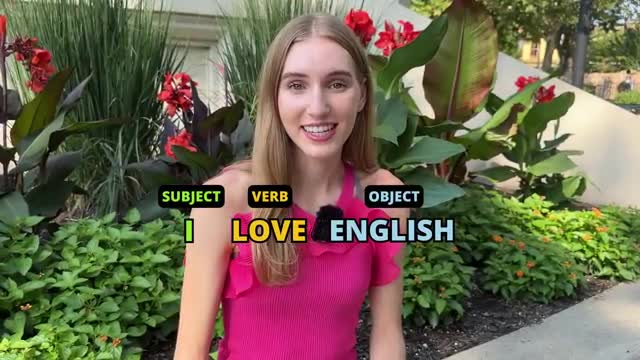
For example in this sentence I love English.
I is the subject, love is the verb and English is the object.
Oh no, the orange fell on the ground.
This sentence my orange fell on the ground is a little bit more complicated, but it still has the same structure.
For example, the orange is the subject, fell is the verb, but it's used in the past tense.
So the past tense of fall is fell, and then the object is the ground.
Now let's learn 20 verbs in 20 minutes.
The first verb I will teach you is an action verb or active verb, and it is to walk.
So an action verb or active verb is a verb that describes what someone is doing, like an activity or an action.
I walk on the sidewalk.
I'm on the sidewalk.
And I walk on the grass.
This is the grass.
I walk slow.
I walk fast.
I am walking my dog in the park.
I don't like to walk on the street.
It's safer to walk on the sidewalk.
Right now, I'm walking on the sidewalk and I'm not walking on the street.
The next verb is a stative verb.
Stative verbs describe a state rather than an action.
For example, these verbs can describe how you feel, what you know, and what you own.
And the next verb is a stative verb.
It's to hope.
I hope you are learning English in this video.
And if you are, don't forget to subscribe.
I hope this restaurant is open because I'm really hungry.
Oh yeah, it's open.
It's open until 11 p.m.
Bye Ozuna.
I hope to see you soon.
Bye buddy.
I hope it doesn't rain today because I'm going down to the beach.
Now, some verbs can be tricky because they can act as active verbs or state of verbs, depending on the context.
For example, the verb to smell can be an action verb or state of verb.
The dog smells the treat before he eats it.
So the dog is actively using his sense of smell.
I will smell the milk to see if it has spoiled.
Oh yeah, that smells gross.
In this sentence, I smell the milk for a specific reason, to see if I can drink it or if I should just throw it away.
I will smell my cat to see if he needs a bath.
Oh yeah, he needs a bath.
But smell can also be used as a stative verb to describe how someone or something smells.
For example, this perfume smells like roses.
Woo!
The garbage smells awful.
This garbage can has an unpleasant odor.
The flowers smell sweet.
So these flowers have a very pleasant smell.
The next verb is to buy.
So is this an active verb, a stative verb, or both?
Well, this verb to buy can be a little bit tricky.
So depending on the context, it can be an active verb or a stative verb.
For example, it can be an active verb when you say, I will buy a bowl of pasta.
But before that, I need to go in line and order over there.
I just bought my meal and I bought a drink.
I am buying flour and ham.
I need to buy a new phone because this one doesn't work and it's broken.
So when I say the verb to buy, that is the action of me wanting to buy a new phone because it doesn't work.
The verb to buy can also be used in the stative form.
For example, This watch buys well.
I am not talking about the action of buying the watch.
That just means that this watch is popular.
This new restaurant buys well.
They're always packed.
The next verbs are to eat and to drink.
So are these verbs active verbs, stative verbs, or both?
If you guessed active verbs, you're correct.
These verbs, to eat and to drink, describe the action of consuming food or consuming a liquid.
For example, right now I am eating food.
It's delicious and I drink tea with a straw.
I am drinking my tea.
This drink is very cold.
It has ice in it.
And I like to drink cold beverages when it gets really hot and humid.
I will eat and drink my meal outside the restaurant.
That's the restaurant, but right now I am on the patio.
So I will eat and drink right here.
I just ate my meal.
As you can see, this bowl is empty, but I still need to drink my tea.
This is soda and this is water.
Both of these are beverages and you can drink them.
I don't drink soda because it has a lot of sugar.
So I'd rather drink water because it's healthier.
The next verb is to want.
Is this verb an active verb?
So does it describe an action or is it a stative verb where it describes a feeling or is it both?
If you guessed state of verb, you're correct.
For example, I want new shoes because these shoes are super dirty.
So when I say the verb to want, I am expressing a desire, not an action.
Another example is, I want to travel to Mexico so I can practice my Spanish.
I want to take a selfie.
I don't want to pay for parking in the parking lot because it's too expensive, so I'm going to walk downtown.
I don't want white chocolate.
I want milk chocolate.
The next verb is to study.
Is this verb an active verb, stative verb, or both?
If you said both, you're correct. but this verb to study is primarily an active verb.
When using to study as an active verb, it describes the action of acquiring knowledge and learning more things.
The people behind me are studying in a study room.
So maybe they are working on their homework or studying for an exam.
And you can use the verb to study as a stative verb.
For example, this book studies the history of ohio.
Here the verb to study focuses on the book's content, for example the people in the book, not the action of studying or gaining knowledge.
Do you know any of these people on the cover of this book?
Well, this is neil armstrong and he was born in ohio, and this book studies the history of the cincinnati subway.
Did you know that the subway was never completed and now it's abandoned?
The next verb is to jump.
Is this an active verb, a stative verb, or both?
If you said active verb, you're correct.
For example, I will jump over the rock.
I will jump from the bench to the ground.
Woo!
I was a little bit wobbly.
I almost fell.
I jump over the water so I don't get wet.
I can't reach the peanut butter.
I have to jump.
I jumped to grab the peanut butter.
I will jump over the bush.
Whoo!
I just jumped over the bush.
Now let's jump into the next verb.
Now the next two verbs are to love or to hate.
Are these verbs action verbs, stative verbs, or both?
Actually, both of these verbs are stative verbs.
They describe a feeling or emotion.
I hate when it's so hot and I'm sweating, but I would love to be in the pool right now.
My dog Ozuna loves to be in the dog park, but he hates when he has to leave.
Come on, Ozuna!
I love to drive around the city, but I hate when there's so much traffic.
Hurry up!
I love listening to music with my headphones, but I hate when they don't have any battery.
Like they don't work right now, so I can't use them.
I love my subscribers and the people watching this video, but I hate when I can't answer all of your comments.
The next verb is to laugh.
Is this an active verb, where it shows an action, a stative verb where it describes a feeling, or both?
This verb is an active verb, because you are expressing yourself by using your facial expressions or even the sound from your voice.
That mural makes me laugh.
There are so many different people on the mural, like Mr Red Legs, Elton John, Mr Rogers and the Nutcracker.
My friends are laughing at me because my T-shirt is inside out.
Guys, stop laughing at me.
This video is making me laugh.
It's so funny.
She almost fell.
I think I'm going to laugh until I cry.
Her laugh is really loud and it sounds really weird.
The next verb is to have.
Is this an active verb, a stative verb, or both?
If you said both, you're correct.
So an example of using this verb to have in the active form is I'm having a great time at the beach.
Having a great time is an ongoing experience, so that's why this verb is an active verb.
But it can also be a stative verb if it describes a feeling or state of being.
I had a delicious meal.
I would order it again.
So in this sentence i use the past tense of have, which is had, and you can also use have as a state of verb.
For example, i ate too fast.
Now i have a stomach ache, because this is a feeling i have and not an action.
I don't have a car, so i have to ride the train.
This restaurant has a bathroom.
They have a bathroom for women and a bathroom for men.
This watch has a beautiful and simple band.
So when I use the verb to have in this sentence, I'm describing the quality of the band.
I'm not doing an action.
Now let's move on to the next verb.
The next verb is to remember.
Is this verb an active verb, a stative verb, or both?
This verb can be both an active verb or a stative verb.
I will remember to buy eggs at the store because I want to make a cake.
I remembered to lock my car before I left.
I'm trying to remember my phone password because I need to call my brother.
So you use this verb in the active form if you describe recalling something or remembering something at that same moment.
For example, I will remember to get eggs at the store and I remembered to lock my car door.
And this verb, to remember, can also be a stative verb.
For example, I can't remember how much I paid for my meal.
Basically, I am describing my current state of not remembering how much my food cost.
And I am not describing the current action of recalling how much it was.
Oh, now I remember.
My meal costs $10.20.
I remember this theater and especially this pig, the flying pig, because I came here last year.
The next verb is to throw.
Is this verb describing an action, a feeling, or both?
To throw is an action verb.
For example, I will throw the ball against the wall.
I am throwing the ball against the wall.
I threw the ball against the wall.
I will throw the tennis ball really high.
I am throwing the ball really high.
I just threw the tennis ball really high.
This orange has spoiled.
I throw away the orange in the trash.
Behind me, they are throwing a luau party.
Even though the sentence focuses on a party.
To throw a party means to organize a party or to host something.
So, they are throwing a party.
The next verb is to ride.
Is this verb an active verb, a stative verb, or both?
If you said both, you're correct.
It's an active verb when you ride something.
For example, I'm sitting on a bike, and if you move it, you are riding the bike.
And before riding this bike, I need to put on a helmet.
This is a helmet.
Oops, it's backwards.
And right now, I am wearing a helmet.
I will ride this bike to the park.
I just rode my bike to the park.
Right now I'm riding a bike and there are other things you can ride, like a horse, a roller coaster or a motorcycle.
However, the verb to ride can be used in a state of way, especially if you are being transported or carried.
For example, the train ride was nice.
Here, ride describes the state of being transported by the train, not the act of riding itself.
Thanks for the ride.
Oh my gosh, the car ride was terrible.
I don't think I'll ever ask for a ride again.
The next verb is to own.
Is this an active verb, a stative verb, or both?
If you said state of verb, you're correct.
To own is a state of verb.
It describes a state of ownership or possession of something.
For example, I paid for this car.
I own this car, therefore I am the owner.
And these are my keys.
I don't own this bike.
My friend Santiago owns the bike.
Santiago, thanks for letting me borrow your bike.
I owe my friend a favor since he's letting me use his bike.
So next time he needs a favor, I'll do it.
I don't own this dog.
This dog, unfortunately, doesn't have an owner because it's a stray dog.
This is actually true.
I just found this dog on the street under a car, but I will try to find her a new home.
The next verbs are push and pull.
So are these verbs active verbs, stative verbs, or both?
If you guessed active verbs, you're correct.
Both push and pull involve applying force to something.
So you use your strength to make something move.
For example, this door has a handle.
This is a handle.
I pull the door open.
Now if I want to exit this building, I push the door open.
So to enter the building, I have to pull the door open and to exit, I push the door open.
I pull out the chair to sit in it.
I pull in the chair to be next to the table.
I pull the leash so I can get my dog's attention.
Come on Ozuna, let's go.
I will push the cart out of my way.
I push the cart out of my way.
I push the button in the elevator to go down one level.
The next and final verb is to give.
Is this verb describing an action, a feeling, or both?
It's both, so the verb to give can be an action because you are giving something to somebody.
You can make it available for something else, you can hand it over, or you can share it.
You can use this verb as an active verb when it describes an action, by saying, for example my father gave me a card for my birthday.
This is a birthday card and now since he gave it to me, this is a gift and it's mine.
I will give food to my fish.
I am giving food to my fish.
I just gave food to my fish.
I will give my cat a treat.
I am giving my cat a treat.
I just gave my cat a treat.
And this verb is also a stative verb if it describes how something makes you feel.
For example, this is the oldest brick house in Cincinnati, Ohio.
This house gives me a sense of history.
So, this house evokes a feeling and is not describing an action.
This is an alley.
An alley is a narrow passageway between buildings or walls.
This job teaching English gives me a lot of responsibility.
So I am not using the verb to give as an action.
So I'm not giving something.
I'm using it to state that this gives me a lot of responsibility and sometimes puts me under a lot of pressure, because I want to teach all of you guys English in an easy and understandable way, with context.
Okay, everybody, that's it for today's video.
And I hope you guys learned the way we use different verbs.
For example, we use active verbs to describe an action like throwing a ball or jumping up and down.
And we use stative verbs to describe a feeling or a state of being.
For example, I hope it doesn't rain today because I forgot my umbrella in my rain jacket.
If you liked this video, go ahead and give me a big thumbs up and don't forget to subscribe.
I'll see you guys next week.