Grownups, Wundery Plus subscribers can listen to Wow in the World early and ad -free right now.
Join Wundery Plus in the Wundery app or Wundery Kids Plus on Apple Podcasts.
And three, two, one, love em!
Hey Grownups, did you hear the big news?
Wow in the World now has toys!
Stem toys! We've partnered with our friends at Wundery Kids and Thames and Cosmos to create hands -on stem toys that connect learning to playing and playing to tinkering.
Like... drumroll! The Wow in the World Everlasting Volcano!
With the Everlasting Volcano, your family can erupt their own volcano again and again and again and again and again and again.
Hey, I think they get it Mindy!
This volcano works with three different types of lava eruptions.
Color -changing slime and soft foam.
Plus, you can even use the Everlasting Volcano to make the classic chemical reaction with baking soda and vinegar from your very own kitchen!
With this toy, your family can learn about volcanoes, magma, and more while experiencing the science right before their very own eyeballs.
Plus, the base of the toy helps make it so much easier to clean up your lava so you can get back to playing quickly after each volcanic eruption!
Aw man! I wanted to make a mess!
Well, um... And like every Wow in the World stem toy, with the Everlasting Volcano, your Wowzer gets access to exclusive audio content from me and Mindy!
Like a mini episode of Wow in the World!
Plus, a collectible stem toy for your Wowzer to add to their tinkering tool kit!
Want to learn more?
Grownups, visit tinkercast .com slash shop!
You can also click the link in the episode description or visit your local specialty toy retailer.
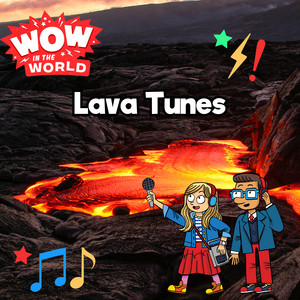
And speaking of volcanoes, here's a brand new episode of Wow in the World all about how volcano music can help scientists better forecast when volcanoes will erupt in real life!
Hit it, Reg! Oh my God!
Mindy? Are you okay?
I'm okay! Phew. Sorry, Guy Ross.
Just fell over some loose pans over there.
What's up? Well, did you forget?
It's the night of the big concert, Mindy.
Oh, yeah! Yeah, the big concert!
The concert with all the music and stuff.
The concert! Mindy, you didn't forget, did you?
No... Maybe? Yeah, I totally forgot.
How could you forget, Mindy?
I could barely get to sleep last night.
I was so excited! Yeah, about that.
So, Guy Ross, I think that you and I might have very different ideas of what counts as exciting when it comes to musical concerts.
Well, how so? Well, for example, the last time you took me to a concert, we just went to an office building downtown and listened to elevator music for three hours.
I know! Wasn't it amazing?
It was something all right.
Well, you've got nothing to worry about, Mindy.
I'm definitely not taking you to an elevator concert this time.
You promise? I promise.
Swear on your microgreens vegetable garden?
Yes! Yes, of course!
I swear on my microgreens vegetable garden.
All right, Guy Ross, I'm going to trust you this time.
Where are we heading?
Well, Mindy, we are going to...
Yes? Wait for it? Yes?
Wait for it? Yes? Wait for it?
Guy Ross! Ecuador! You mean the country in South America between Peru and Colombia?
That's the one. And specifically, we're going to the Cotopaxi volcano in the Andes Mountain Range.
Wait a minute. We're going to a volcano?
Yep! I thought we were going to a music concert!
Well, we are. The music concert is in the volcano?
The music concert is the volcano, Mindy.
What? It's a whole new genre of music, Mindy, and I'm obsessed with it.
I like to call it lava tunes.
Lava tunes? Yeah, it's music that's created by the lava inside the volcano.
Okay, I'll say it again.
What? Yeah, I know.
I first heard about it from this volcanologist at Boise State University named Jeffrey Johnson.
And ever since, I haven't been able to get enough of this stuff.
Music from the inside of a volcano?
So how does that even work?
Well, Mindy, I could tell you.
Or you could show me by dragging me all the way to the other side of the planet?
Exactly. Alright, Guy -Roz, I'm sold.
Let me just see what Reggie's up to.
Can I borrow your guy phone for a sec?
Well... Here, thanks.
Dialing, dialing, dialing, dialing?
Hey, Rich! What's up?
Huh? Oh, yeah, I don't know.
Maybe just try using some maple syrup on it?
Hey, it works for me.
Yeah, quick favor. Could you take Guy -Roz and me to Ecuador real quick?
Yeah, Ecuador. No, it'll only be...
No, just a quick in -and -out 20 minute adventure toss.
Aw, I grew the best, buddy.
See you soon. Oops!
What was it, Mindy?
Got him in the middle of a bird bath.
Oh, ha ha. Come on, he's gonna pick us up outside.
Alright, well, let's go.
Okay, follow me. Walk, walk, walk, walk, walk, walk, walk, walk.
Opening the door. Closing the door.
Locking up my gingerbread mansion.
Beep, beep, beep, beep.
Beep, beep, beep, beep.
Uh... Candy canes armed.
There we go. Reggie!
Whee! Hey, Rich! Okay, Guy -Roz, come on, climb aboard.
Alright. Alright, let me just grab my megaphone here as I get settled into the captain's seat.
Good evening, folks, and welcome aboard this avian airlines flight direct to volcano Coto -Paxi in Ecuador.
Uh, looks like clear skies most of the way, and, uh, the local weather in Ecuador is a balmy 80 degrees Fahrenheit, and, uh...
Lizzy! Buckle up and enjoy the flight.
Buckle up? You've got no seatbelts on this thing.
Well, then you better hold on to something, Guy -Roz, because here we...
go! Look over there, Guy -Roz.
Is that the volcano?
No, Mindy, that's a mailbox.
Oh, what about that to my left?
Is that a volcano? No, just a stray cat.
How about that thing straight ahead?
Is that a volcano? That's a pine tree.
Oh, what about that thing we just passed?
Is that a volcano? Indeed.
Oh, wait, uh... That actually is the volcano.
Better make a U -turn.
Come on, Reg. Whoa!
Wow! Look at that volcano, Guy -Roz.
It's huge! Wow. It's almost 20 ,000 feet tall.
That's like 15 Empire State buildings stacked on top of each other.
Yeah, and it's still only the second tallest peak in all of Ecuador.
Conquer balls. Oh, Reg, land over there.
Uh, next to that brick building with the big satellite dish and the antenna next to it?
Yes, yes, exactly. That's the one.
Light crew, prepare for landing.
Another smooth landing.
Uh -huh. Oh, Guy -Roz.
What even is this place?
Well, it's an observation station, Mindy.
And what exactly are we observationing?
Well, the volcano. Ugh, this is sounding less and less like a concert to me.
Well, it's still a concert, Mindy.
Just more of a private concert.
Oh. Come on, follow me.
Wait, you can just walk right in this place?
Well, I know a guy.
Oh, okay. Whoa! Pretty interesting, huh?
Yeah, looks just like my laboratory of bad ideas, but only with nicer stuff and more organized and less sticky and less dangerous and less explodey and also less...
Mindy! What's all this stuff for, anyway?
Well, it's for monitoring the volcano.
What do you mean, monitoring the volcano?
Well, you know, even though human beings have been living near volcanoes for thousands of years, we're still not that great at being able to tell when they're going to erupt.
And that's what all this tech is for?
To help predict when this volcano's going to pop its top?
Well, yeah, yeah, pretty much.
More than 150 ,000 people live within 20 miles of this volcano.
So knowing when it's going to erupt would give people more time to evacuate.
Yeah, I guess that would be a nice thing to know.
Hey, what's this big long stick thingy do?
Oh, that device measures the heat coming off the volcano.
Well, the scientists stick that pointy end in the top of the volcano and...
And what about this one with the tripod?
Oh, that's called a correlation spectrometer, Mindy, and it actually measures the gases coming out of the volcano and it's very...
Okay! Sensitive. Sorry.
Oh, how about this one?
What's this thing? Oh, that one is very special, Mindy.
It measures the sound coming out of the volcano.
You mean... Yup. Are you ready to hear some lava tunes?
I trust that's literally the only reason I'm here.
Okay, well, let's see here.
Oh, this is a classic.
I love this one. Okay, prepare to have your mind blown.
So... when are you going to start playing it?
This is it, Mindy. This is the lava tune.
Wait, this is the music we came to hear coming from this volcano?
Uh -huh. What we're hearing right now, Mindy, is coming from the inner structure of that volcano.
Wait a second, Guy Roz.
You're telling me that this new genre of music...
Uh -huh. The one that you're totally obsessed with.
The one that you can't get enough of.
Right? Is this? Oh, yes.
Isn't it amazing, Mindy?
Doesn't it just sound so earthy?
Uh, yeah. It does, Guy Roz, because it's literally a recording of the earth moving.
Wow. Mindy, I was listening to that.
Hey, what does it say here above the machine?
Infrasonic sound wave reader?
Yeah, that's what these scientists are calling these recordings.
Infrasonic sound waves.
Yeah, but I still prefer to call them lava tunes.
So how does it work?
Well, these sounds are made from the shape of the inside of the volcano.
So kinda like that time that Thomas Fingerling and Grandma Geforce and I tried to start that bottle -blowing band?
Uh... Okay, Mr. Fingerling, when I point to you, you gotta blow, okay?
Blow what? Over the top of your bottle, like this.
Okey -doke. Ha! Still got it.
Grandma Geforce, why don't you try yours out?
Okay, three kind mice on the count of three.
One, two, three. Mindy, it's 3 AM!
Gosh boy. Sorry guy Rosy!
Oh yeah, how could I forget?
So, it's kinda like that?
Well, it's a little more complicated, but essentially the same principle.
With your bottles, if you blow over it and there's not a lot of liquid inside, it makes a low sound.
But if there was a lot of liquid inside, then it would make a high -pitched sound?
Exactly. The amount of liquid inside, as well as the shape and size of the bottle, changed how the note sounded.
And it's the same for these volcanoes?
Well, like I said, volcanoes are a bit more complicated, but their size and shape and how much liquid lava is inside it can change how it sounds.
And so why do researchers want to listen to that?
I mean, why do you want to listen to it?
Well, I want to listen to it for its artistic merit.
But these scientists are listening to it to try and understand when these volcanoes might erupt.
So how does listening to the volcano help these scientists to find out when these volcanoes are going to blow?
Well, when an infrasonic sound wave changes.
So, for example, let me show you.
Here, here's a recording from last month.
Listen to this. Uh, huh?
Oh, yeah, that's so smooth.
Uh, Guy Rod? Listen to that high note.
Guy Roddy! Oh, I can listen to this forever.
Guy Rod! What, what?
You were saying? Oh, yeah, well, you can tell there's a difference between this recording from last month and then this recording from this morning.
Oh, yeah, the one from today sounds a little different.
Which means that the shape of the inside of the volcano has changed somehow.
Huh, like there might be more lava in the cone of the volcano now than there was a month ago?
Exactly. Or something else about the structure of the volcano has changed.
So, what does this volcano sound like right now?
Uh, well, um, let's see.
Um, I think it's, uh, this button.
Huh. Um, Guy Rod? Uh, yes.
Is it just me or does this sound a little different from the recording this morning?
Uh, yeah, uh, definitely different.
I think that might not be good news.
And that's really not good news.
Oh, Mindy, I think the volcano's starting to erupt!
You think? Good idea, Reg.
Let's get outta here!
Reggie, prepare for take -up!
Please! Come on, Guy Rod!
Mindy, wait up! Here, grab my hand, and they'll pull you up!
Ahh! Ah! Okay, I'm on.
Uh, welcome back everybody.
Yeah, this is a one way flight to anywhere but here.
I'm your flight captain, Mindy.
Mindy? Okay, okay, I got it.
Just get us out of here, Reg.
Flight crew prepare for takeoff.
And here we go! Whoa, watch out, Reggie.
A flying boulder. Ah, lava.
Watch out. Reggie, I'm your left.
No, you're right, I'm left.
Nice one, buddy. We're almost in the clear.
These lava tunes of yours aren't feeling so relaxing now, are they, Guy Roz?
Nope. Incoming! Watch out!
Ah! Ah! Ah, got out of there just in the nick of time.
Ah, you got that right.
So, who's up for a little song for the ride home?
A song? Yeah, I even brought my own instrument.
Mindy, Mindy, is that a beaker from the observation station?
Shh, a little souvenir, Guy Roz.
Ugh. Any requests? No?
Okay, here's three kind mice.
Oh no. Hey, grownups, Mindy here from Wow in the World.
And let me tell you, Carly Q and I are so excited to make it wow in New York City, I mean, New York, and San Francisco with our new live show, Make it Wow, presented by Audible.
There's more to imagine, would you listen?
And apparently, you're excited too, because our San Francisco performance is filling up, and our New York City performance is almost sold out.
So, we're adding even more wow with a second show for New York City.
Grownups, get your tickets today at tinkercast .com slash events.
That's tinkercast .com slash events.
That's it, we'll see you there.
Hee hee hee hee hee.
Wow in the World, we'll be right back.
Grownups, this message is for you.
That's it, back to the show.
Wow in the world. Hi, thanks for calling Wow in the World.
After the beep, get ready to record.
Hi, I'm Indian Guy.
Roz, my name is Ahmed, I live in Minneapolis, Minnet, SODA, and my wow is at the Northern Lights Form 1 charged particles emitted from the sun during a solar -connotrate, dearest magnetic shield clogs with atoms and molecules in our atmosphere.
These questions result in countless little bursts of light called photons, which make up the aurora.
Say hello to Reggie for me.
Hi. Hi, my name is Nate.
My name is Andrew. And we live in Houston, Texas.
Our Wow in the World is that vampire stories were first created to explain sickness and death.
Bye, Love Your Show.
Hi, Reggie. Hi, my name is Ellie Mano and I am nine.
I live in Dallas, Texas and my wow in the world is that there is a type of jellyfish that can live forever.
Bye, I love your show.
Say hi to Reggie for me.
Hi, my name is Harper and I'm from Pittsburgh.
My wow in the world is that swaths are faster and louder than they are on land and can hold their breath for up to 40 minutes, bye.
Hi, my name is Imri and I'm from Washington, Florida and my wow is at Morpila and Kill Best Volume, so connect then, Sharka, Kiss, bye, Love Your Show.
Hi, Mindy and Guy Roz and Reggie and Dennis, I guess.
My wow in the world is that my friends thought of me when they heard your episode called Spit Take, The Science of Saliva and Those Bitter Bites.
I don't like kale, so they challenged me to do the experiment and I of course said anything for science.
So I eat kale every day for seven days and evaluated the level of bitterness.
I am not at all happy to report that after a week, kale did not taste as bitter.
Bye and thanks for your show.
Hi, my name is Eva, everything Columbus, Ohio and I'm eight years old.
And my wow in the world is that gangsters can jump 20 feet in the direction that they're facing, bye, Love Your Show.
Hi, Mindy and Guy Roz, my name is Meredith and I'm from Tulsa, Oklahoma.
And my wow in the world is that the word, the scientific word for brain freeze is single -galactine ganglionaralgia.
Bye, Mindy and Guy Roz.
End of messages. Grownups, if you like wow in the world, you can listen early and ad -free right now on Wondery Plus.
Join Wondery Plus in the Wondery app or on Wondery Kids Plus on Apple Podcasts.
Prime members can listen ad -free on Amazon Music.
And before you go, tell us about yourself by filling out a short survey at wondery .com slash survey.
Wow in the World is written by Mindy Thomas and Tom Van Calken with help from me, Guy Roz.
Original sound design and music editing is done by our supervising producer, Jed Anderson.
You can also hear Jed Anderson in the voices of Dennis, Thomas Fingerling, Reggie, and many of the other silly characters that you hear on our show.
And Lizzie Freilich can also be heard as some of the silly characters on our show.
Jessica Bodie keeps our facts straight as our fact checker and Meredith Halpern -Ranser powers the wow at Tinkercast.
Our theme song was composed and performed by three -time Grammy nominees, the Pop Ups.
Find them at thepopups .com.
Special thanks to Kit Ballinger, Rebecca Caban, Dr.
Nikasha Crandall, Kenny Curtis, Kristin Yang, Tui Mack, Erika Medina, Henry Moskal, Jodi Nussbaum, Ali Paxima, Linda Rothenberg, Steph Sosa, Joanna Weber, Anna Zagorski, Tyler Tholl, and all of the other Tinkerers at Tinkercast HQ.
And to keep the wow rolling after you finish this episode, visit us at Tinkercast .com.
There you can become a member of the World Organization of Wowsers to get year -round mailings and weekly activities.
Shop our wow shop, get tickets for upcoming events, find our bestselling books, and learn about some of the other amazing podcasts from Tinkercast.
Grownups, you can follow Wow and the World on Facebook, Instagram, and Twitter at wowintheworld, and our email address is hello at Tinkercast .com.
And if you're a kid with a big wow to share with us, call us at 1 -888 -7 -WOW -WOW for a chance to be featured at the end of our show or an upcoming episode of Two What's in a Wow.
Thanks again for listening.
We're here every Monday.
Or you can check out Two What's in a Wow every Friday right here in the Wow and the World podcast feed.
And don't forget, We Wow on the Weekend with Dennis Saturday and Sundays.
Keep on wow -ing! Wow in a wow!
Wow in a wow! Wow in a wow!
Wow in a wow! Wow in a wow!
Wow in a wow! Wow in a wow!
Wow in a wow! Wow in a wow!
Wow in a wow! Wow in a wow!
Wow in a wow! Wow in a wow!
Wow in a wow! Wow in a wow!