Grownups, Wondery Plus subscribers can listen to Wow in the World early and ad-free right now.
Join Wondery Plus in the Wondery app or Wondery Kids Plus on Apple Podcasts.
Hey, Wowzer fans, Mindy here.
And before we start the show, I got to let you know that this November, with a special new episode featuring our friends at Circle Round and Terrestrials on Radiolab for Kids,
And don't miss when Elmo from Sesame Street stops by Wow in the World to make us all belly laugh on November 24th.
Oh, but that's not all, Reg.
On December 1st, we are sharing our 250th episode of Wow in the World with all of you.
We think this one is going to be music to your ears.
Literally.
Did I mention it's a musical?
And if you're a member of the World Organization of Wowzers...
Oh boy, do I have a surprise for you.
You can listen to our 250th episode early with me and other members from around the world on Saturday, November 22nd, at 7 pm.
Eastern.
That's right, we are throwing another listening party.
Join us as we dance along to our new songs.
React to the episode with other members in the chat and more.
Grownups.
If you want your wowzer to join this members-only listening party, you can sign up to become a member today at Tinkercastcom.
Slash wow.
Already a member?
Well, you can find the link and password to join the event when you sign in at Tinkercastcom.
Slash wow.
That's it.
It's going to be a November to remember.
But for now, let's get on with the show.
Woo!
Ah, what a Beautiful day for a little gardening.
Let me just turn on my old garden hose here.
There we go.
Some for you, Ms.
Petunia.
And for you, Mr. Hydrangea.
Oh, we're thirsty today, aren't we?
Oh, hey, good morning, Mindy.
Watch out for the... Hose.
Morning, Guy Raz.
Are you okay, Mindy?
Yeah, I'll be fine.
Harmonica broke my fall.
Your harmonica?
Yeah, let me just... Yep, still pitch perfect.
So what you doing out here?
Little medical research?
Medical research?
No, Mindy, I'm just doing some light gardening.
Look, look here.
Everything is in bloom.
I've got some hydrangeas.
Nice.
I've got some tulips.
Ooh, such friendly flowers.
There's some orchids.
Ooh la la.
But that donut tree you planted earlier this year still hasn't sprouted.
Huh.
Well, do you remember what kind of Cheerios we used?
I think it was whole wheat.
Well, there you go.
Whole wheat Cheerios always bloom late.
Well, if you say so.
Hey, wait a minute.
Why did you think I was doing medical research?
Well, my first clue was that white lab coat you're wearing.
Mindy, I always wear a lab coat when I garden.
Of course you do.
But second of all, I was just reading this new scientific study that says that the next medical breakthrough could be found in the dirt beneath our feet.
The dirt beneath our feet?
You mean like, like this stuff?
Yep.
Living inside that handful of dirt are millions of tiny microscopic life forms called bacteria.
Ah, yes, of course, bacteria.
Bacteria are those tiny little organisms that live almost everywhere on planet Earth.
Yep.
From our oceans to the soil, even in our own guts.
What?
Hold the phone, Guy Raz.
Huh?
There's bacteria in my guts.
Almost 29 trillion in you alone mindy, 29 trillion.
Hang on a second.
I gotta write this down.
Okay, now let's see here.
Carry the one okay, no wait, i got it.
29 trillion is 29, with 12 zeros after Exactly.
And 29 trillion bacteria live inside of you.
And another 29 trillion live inside of me and everyone else and so on.
Whoa.
Bacteria comes in all shapes and sizes, too.
Sometimes they're helpful.
Oh, yeah, like how bacteria can help turn milk into yogurt.
Right.
Or some of the bacteria in our guts that help keep us healthy.
That's nice of them.
But...
There are some bacteria that are bad for us.
And these kinds of bacteria often infect us with diseases and can make us sick.
Oh, how dare you, bacteria.
But since the 1940s we've been using a special type of medicine called antibiotics to help us fight off these nasty bacterial bugs.
Right, antibiotics.
That's what this new research is about.
Oh, really?
Really.
First, I think we need a crash course in antibiotics.
And Guy Raz.
This crash course in antibiotics will give me the opportunity I've been waiting for to try out my new home theater system.
Home theater system?
Oh, yeah.
Reggie helped me set it up last weekend.
5.1 surround sound, 4K display.
There's even a machine that shoots popcorn right into your mouth.
That's a real time saver.
You're telling me.
Come on, let's go.
Okay.
Walk, walk, walk, walk, walk, walk, walk, walk.
Why do you always do that, Mindy?
What?
Talk to yourself as you walk.
Oh, well... Or run.
I... Or basically do anything.
Well, how else would I know what I was doing?
Uh... Okay, here we are.
Just need to kick in the door here.
Hey!
Yo Mindy, you could probably save yourself a lot of time from having to bake a new gingerbread door every few days if you just stopped kicking them all in.
Well, the last time I ate my way through the door, I got sick.
So where's this brand new home theater of yours?
Right this way.
Just follow me, Guy Raz.
Oh, hey, before we start, you want a snack for the movie?
Movie?
Wait, wait a minute.
What does a movie have to do with antibiotics?
Oh, it came with the system.
What did?
The entire history of antibiotics.
The entire history of antibiotics came with your home theater system?
I know.
Crazy coincidence, huh?
You can say that again.
Crazy coincidence.
Mindy.
Okay, so you want a movie snack or what?
Uh, do you have any kale chips?
Uh, no kale chips, but I can scoop some mayonnaise into a cone for you.
Uh, no thanks.
Uh, OK, let me see here.
Oh, I got some gravy.
To munch on during the movie?
You don't munch on gravy during a movie, Guy Raz.
Huh?
You suck it through a straw.
Uh, I think I'll pass on the movie snacks, Mindy.
Suit yourself.
More for me.
OK, Guy Raz.
Now I just need you to squeeze right through that door and then you'll be in my home theater, okay.
Through that doggy door?
Well, it's only a doggy door if you have a dog, which I do not.
So, come on.
You can get through there.
You're small.
Just take a deep breath and squeeze your way through.
Okay.
I'll be right behind you.
Okay, tighter squeeze than I thought.
I'm going to give you a little shove.
What?
Ready?
On the count of three.
One, two, three, and... Do it.
Come on.
Just keep on...
Alright, coming in right behind you.
Mindy!
So, what do you think of my home theater?
Wow.
You could fit like 300 people in here.
Yeah, first I thought maybe it's a little too much, but then Reggie was like please, I want to have all my friends over to watch some old movie called The Birds.
And I was like, this is for the birds.
Okay, fine, Reggie.
You always get your way.
This is so cool, Mindy.
Mindy?
I'm back here, Guy Raz, in the projector booth.
Somebody's gotta run this bad boy.
Oh, right.
Okay, just gonna boot up the old projector here.
There.
Should be in business now.
Okay.
Hello, and welcome to the Grandma G-Force Theater.
Thank you for joining us today.
For updates on upcoming movies, special deals and discounts on food...
Please ask one of our attendants for information on how to sign up for our... Mindy!
Okay, fine.
Tonight's film will be Antibiotics A History with running commentary from yours truly.
Running commentary?
So sit back and relax as we take you through the history of molecular medicine.
The year is 1928.
And Dr. Alexander Fleming, a famous bacterial ologamist.
Huh?
No, a famous bacterial olologist.
What the?
Wait, bacterial ologamist.
Bacterial allergist.
I practiced this word all night.
Hang on a second, Guy Raz.
Dr. Alexander Fleming, a famous bacteria back, back, scabacula.
Are you trying to say bacteriologist?
Oh Guy, Raz time.
But you did mean a bacteriologist, right?
A scientist who studies bacteria.
Yeah, that's what i was trying to say.
Who cares?
Start the movie.
Ah, who is that?
Sorry okay, back to the film.
When alexander returned home from his summer vacation ah, how i do enjoy the scottish moors he found that his lab was a complete mess.
This lab is a complete mess.
And there he discovered that a mold called Penicillium Notatum had contaminated or poisoned all of his Petri dishes.
Oh no!
My Petri dishes!
And many Petri dishes are those little disks of plastic or glass that scientists put bacteria and other things on so they can look at them under the microscope.
You got it, Guy Raz!
And when he put one of these moldy Petri dishes under the microscope, he noticed that the penicillium mold had completely stopped the growth of the bacteria that he already had on that petri dish.
And what type of bacteria was that, Mindy?
It was a bacteria called... Staphylococci.
Ah, staphylococci.
Mindy, isn't that a deadly disease?
Well, technically...
Technically, it's a big family of bacteria, Guy Raz.
And, just like in most families, there are some members that are totally fine, but others well, let's just say they're the kinds that can be a little cuckoo for Cocoa Puffs, if you know what I mean.
You mean like your Aunt Mojo?
Yeah.
But unlike my Aunt Mojo, these guys don't stay out singing karaoke till three in the morning.
Instead, they cause all kinds of problems for us humans.
Everything from food poisoning to skin infections.
Oh, boy.
But you're right.
They can sometimes turn deadly, especially before Alexander Fleming's discovery.
I can imagine, because before the discovery of antibiotics...
Things as simple as a paper cut or a scraped knee could be deadly because open wounds could let infectious bacteria like Staphylococci.
Exactly.
Which is why Alexander Fleming's discovery was such a huge deal.
So what happened next?
Well, he spent the next few months just toiling away creating more and more of this penicillium mold.
Toil, toil, toil, toil, toil, toil, toil, toil.
And eventually he discovered that this mold could be used to create medicine that could not only stop staphylococci, but all sorts of other infectious bacterial diseases as well.
Creating the world's first antibiotic medicine.
I call it penicillin.
Fascinating.
But That's not the end of the story.
It isn't?
Not even close.
Now let me just find the fast forward button here.
Oh, here it is.
Wait a minute, Mindy.
When you said you had the entire history of antibiotics, I didn't think you meant you literally had the entire 100 years on tape.
Oh yeah, I got everything from that day Alexander Fleming found a worm in his apple.
Yuck, there's a worm in my apple. talking about antibiotics in your backyard just a few minutes ago.
What?
Mindy, I always wear a lab coat when I garden.
Of course you do.
But secondly... Whoops, too far.
Let me just hit the rewind button here.
We need to stop it around... 1941.
There.
Right this way, sir.
Righty-o.
Very good.
Huh.
Who's that, Mindy?
Oh, that guy, Roz, is Dr. Howard Florey.
He's just showing Mr. Albert Alexander into his lab.
Oh, Albert Alexander.
I know him.
He's the first person who was ever treated with antibiotics.
You know it.
He got pricked by a rose thorn in his garden, and then his cut got infected with staphylococci.
The bacteria from Fleming's lab.
Yeah, and even though Alexander Fleming had been able to combat small, microscopic doses of staphylococci in his lab.
To treat a whole person, that would take a lot more mold.
Oh, my cheesy whiskers.
What on earth is going on here?
Well, um... Oh, my gosh, Mindy.
Look at Flory's lab.
It's covered in bottles and flasks and tubes of... Wait, wait.
What is that?
That, my friend, is beautiful, 100% organic, certified, fresh mold.
Mold?
Mindy, that's disgusting.
And look, Flory's lab is completely covered in the stuff.
I know, right?
Turns out you need 2000 liters or 528 gallons of mold just to get enough penicillin to treat one person.
528 gallons, Mindy?
That's like three hot tubs worth of mold.
Yep, and all for just one guy.
Or gal.
So obviously, they had to find a better way to make this much penicillin.
Obviously.
And that better way came in the form of a cantaloupe.
A cantaloupe?
Yep.
And for this, we're going to need to fast forward again to 1941.
Hey, who's that walking into Flory's lab now?
Oh, that's his laboratory assistant, Mary Hunt.
And look, she's just returned from the market with a cantaloupe.
I got that cantaloupe you asked for, sir.
Ah, just in time for brunch.
And growing on that cantaloupe is a very special kind of mold.
Ah, more mold?
More mold, Guy Raz.
But the fungus found in this mold produced 200 times as much penicillin as that fungus Alexander Fleming discovered.
Wow.
That's a lot of mold.
And that's not even the best part.
With a little bit of tinkering... Tinker, tinker, tinker, tinker, tinker.
They were able to make this fungus produce 1000 times as much penicillin as Alexander Fleming's original discovery.
So that means they were now able to make enough of it to treat people?
Exactoritos, Guy Raz.
And as they say, the rest is antibiotic history.
Wow, what a movie.
And you know what?
It gets me thinking.
Oh, yeah?
Since that first antibiotic penicillin, made its way to our hospitals almost 80 years ago, we've made so many more medical discoveries and developed a whole bunch more antibiotics.
Yeah, and so much so that when people have access to doctors and medicine, bacterial infections are prevalent.
Pretty much a thing of the past.
I mean, nobody freaks out about getting a deadly infection from a paper cut anymore.
And it's probably also made surgery a lot safer, too.
Hey, Mindy, what are you doing?
Much better.
Man, it was so cramped in there.
So Mindy, as much as I enjoyed the movie, I still don't understand what any of this has to do with my gardening.
Oh, right.
So as much as these antibiotics have helped us keep these nasty bacterial bugs away... Yeah?
Well, these bugs have basically spent the last 80 years getting smarter and learning new ways to fight back.
The bacterial bugs are trying to fight the antibiotics?
Oh, yeah.
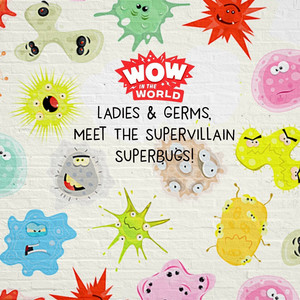
And the smartest bugs, or at least the bugs that are winning the battle, are called superbugs.
And they are what scientists call... antibiotic resistant.
Antibiotic resistant?
Yeah, which is basically just a fancy way of saying that antibiotic medicine doesn't always work against these bacterial infections anymore.
Oh, that's right.
And I was reading that some scientists are concerned that if more and more of these bugs become antibiotic resistant, then we'll soon go back to a world like the one before Fleming's discovery.
Yeah.
A world where a paper cut could be deadly.
Exactly.
But have no fear, Guy Raz.
Superhero scientists to the rescue!
Phew.
These super scientist men and women are on the case, searching high and low for new antibiotics to fight these new superbugs.
Huh.
Well, where are they searching?
Well, you know that dirt in your backyard?
Scientists are looking for the next big antibiotic in the dirt in my backyard?
Well, I mean, not just the dirt in your backyard, but dirt everywhere.
Wait a minute.
You know what?
Let's head back out to your backyard, and I'll show you.
Plus, I think I hear the cleaning crew is about to come in.
Yep, looks like it's time to get out of here.
Walk, walk, walk, walk, walk, walk, walk, walk, walk.
After you.
Thank you very much.
Ah. back in my beautiful, pristine, well-kept... Antibiotic farm!
Well, I was going to say horticultural display, but... But nothing, Guy Raz.
You are currently standing on a potential gold mine of medical wonders.
But Mindy, all I see here is my beautiful flower display and those pogo sticks you and Reggie left.
I told you not to leave pogo sticks in my backyard anymore.
Oh, so that's where we're going.
He laughed dumb.
Well, anyway, I don't see any antibiotics from mold anywhere.
Well, the antibiotics that we're looking for aren't going to be found in some gross mold, Guy Raz.
They're not?
Nope.
They'd be found in some gross dirt.
In my flower dirt?
Exactoritos.
And like I said earlier, there are trillions of bacteria living inside this dirt.
In fact, in just one ounce of dirt, there can be as many as 8.5 million different bacteria.
Wow!
8.5 million!
That's like the entire population of New York City living in this tiny morsel of dirt.
And guess what?
What, Mindy?
Those bacteria are at war.
That's right.
Every day, underneath our feet...
Millions of bacteria are clashing in epic microbial battles.
Ah!
And each of these microbes uses a different type of microbial weapon to fight the others.
Oh, yikes.
And some of these bacteria are the ones that spread infectious diseases and make us sick.
Huh.
And so I'm guessing that these scientists are studying how these warring bacteria defeat each other.
So
They can try to use that same technique in hospitals, right?
Right.
These superhero scientists are trying to take the weapons that the good bacteria is using against the bad.
Infectious bacteria.
Wow.
And then use these weapons to defend ourselves the next time the bad bacteria decides to infect a human.
Huh.
So how do they do it?
Well...
After inspecting soil samples sent in from other scientists from all over the world, the team was able to extract or take out 10000 new microbial weapons that could potentially be used to fight superbugs.
Superdrugs for superbugs!
Yep!
And one of these microbial weapons that they were able to get from these dirt samples has proven to knock out a nasty superbug called Streptococcus.
So I guess there's hope for the future of medicine after all.
I mean, just think about it, Guy Raz.
There could be a million more medical discoveries still waiting out there.
Some maybe even lurking right beneath our feet.
You're absolutely right, Mindy.
But you know, in the meantime there's a much more effective and potentially cheaper way to combat antibiotic resistance.
Really?
Really?
Well, it may seem like a pretty simple thing Mindy, but washing your hands is actually the best way to stop these bacterial infections in their tracks.
We've even got the science to back it up.
Battling bacteria with soap and water?
A baby could do that.
Yeah.
In fact, researchers at the University of Southampton in the United Kingdom recently conducted a huge survey where they divided 20000 people into two groups.
Uh-huh.
And one group was told to go to a website that encouraged them to wash their hands.
Okay.
And that website would remind the people in that group about the benefits of washing hands and the dangers of not washing your hands.
Huh.
And so what happened?
Well, three years later, the researchers went back to that group and compared them with another group that never saw the website at all.
So what did these researchers find?
Well, they found that the group that was reminded to wash its hands, the people in that group, didn't get sick as often as the people in the other group that weren't washing their hands.
Like less cold, flu, and all those other infections we get?
Exactly.
But do we know exactly why?
Well, I'm glad you asked, Mindy.
Uh, Guy Raz, what are you doing?
I'm just getting out my PowerPoint.
You made a PowerPoint presentation for this?
Well, I'm really into hand washing.
Yeah, I can tell.
It's even on my family crest.
See, check it out.
It's on this patch on my shirt here.
Let me see.
Emundare manuum tuorum?
What?
It's Latin for?
Wash your hands.
Got it.
Okay, let me just finish getting set up here.
Boot up the projector.
Man.
There we go.
Okay, where was I?
Oh, right, right.
The three benefits of hand washing.
Number one.
Oh, boy.
It stops us from catching infections from the people around us.
Number two.
You said number two.
Number two.
It stops the people around us from catching any infections we might have.
And number three.
If you don't get an infection, that means you don't have to visit a doctor, which saves you...
So what you're saying is that our hands are like a highway that infections use to travel, and hand washing with soap is the big roadblock we need.
Spoken like a true member of the hand washing society.
So there's something that all of us can do to help defeat these nasty superbugs?
That's right.
I even put it into a song.
Man, now there's a song?
I was so impressed with your gratitude appreciation song last year.
Thank you.
Thank you.
Thank you so much.
I was about to launch into the good part.
Well, I thought I'd make up my own song for hand washing.
Oh, well, look at you, you little show pony.
I knew I'd rub off on you eventually.
Look, do you want to hear it or not, Mindy?
Guy Raz, there is literally nothing.
I'd rather hear more in this moment than your hand-washing pump-up jam.
Okay, well, let me just get out my boom box here.
Man, you sure do keep a lot of tech out here in your backyard.
And here we go.
All right, here we go.
Put your right hand in and wash it around.
Get some soap in your left hand and go to town.
All right, yeah.
This is the kind of hand washing I can really get into.
Put your right hand in and wash it all around.
Get some soap in your left hand and go to town.
Guy Raz, you show that bacteria who's boss.
Wow in the world, we'll be right back.
Grownups, this message is for you.
Hey, grownups, it's Mindy and Guy Raz here from Wow in the World.
Mindy and I have some brand new Wow in the World toys out in the world just in time for the holidays.
Made for the kids who love science and for the ones who don't yet.
From our 100 experiments, that Wow kit to the telescope and astronomy kit.
Our Wow in the World toys help your wowzer learn about their world through play.
Plus, you can hear exclusive audio content from me and Guy Raz to help your wowzer discover even more wows.
Grownups.
Give the gift of wow and wonder this holiday season with our latest Wow in the World toys designed with your curious wowzer in mind.
You can shop our Wow in the World toys at Tinkercast.com slash toys.
That's Tinkercastcom slash toys to record.
Hi, mindy and guy rod.
My name is jeremy, i am nine years old, i live in sherwood oregon and my wow are that beavers can chew their way through brick wood, concrete and even a one centimeter thick shemel.
Love your show.
Bye hi, mindy and guy rod.
I my name is tessa and i live air.
You have a bone that's called the hammer and in your stomach you have a part that's called the ladder.
Bye!
I love your show!
Hi, Mindy and Dyrus.
I'm Waylon, and I'm seven years old.
I'm from the United States and my whale in the world is that a blue whale can swallow a school bus whole.
Bye!
Hi, my name is your soul.
My law on the world is that I'm the only sister in my family and I have four brothers.
Bye.
Bye, Roz and Mindy.
I love your show.
Hi, Mindy.
Hi, Roz.
My name is John and I'm from Vienna, Virginia.
My law on the world is that I've been reading about endangered species and got concerned about how they could go extinct.
So I wrote a letter to Congress saying that self-endangered species and then I actually got a letter back saying that they're trying.
I'm bumming you by the way.
And by the way, your shows are definitely the best.
Hi, I'm Annie, and I'm from Jupiter, Florida.
I'm seven years old and my wow in the world is if Mars swapped place with Earth, the Earth would freeze over, and the cool part about it is the whole solar system would go crazy.
I love your show.
Keep up the good work.
I'm a part of the World Organization of Wilderness.
Bye.
Hi, Mindy and Guyroz.
My name is Elijah.
I live in Auckland, New Zealand.
And my word in the world is that two-thirds of the human body is made out of water.
Bye, Mindy and Guyroz.
I love your show.
Now what do I do?
End of messages.
Hey, everyone.
Thank you so much for joining us this week on Wow in the World.
And if you want to keep the conversation going, check out some of the questions we posted on this episode at our website, wowintheworldcom.
And grownups.
There you can find more details on how your kids can become part of the World Organization of Wowzers.
Lots of cool perks, exclusive t-shirts, autographed pictures of us and a bunch of other cool stuff wowintheworldcom.
Our show is produced by Jed Anderson.
Say hello, Jed!
Yo!
With help from Thomas Van Kalken, Chelsea Erson, and Jessica Bode.
Meredith Halpern-Ranzer is the big boss.
Our theme song was composed and performed by The Pop-Ups.
You can find more of their awesome all-ages music at thepopups.com.
And parents and teachers.
If you want to send us an email, our address is hello at wowintheworldcom.
Grownups, you can also find us on Facebook, Twitter, and Instagram at WowInTheWorld.
And if you want to be featured at the end of the show, call us up and tell us your wow in the world.
Our phone number is 1-888-7-WOW-WOW.
That's 1-888-7-WOW-WOW.
And parents.
If you want to upload any photos or videos or messages to us, please visit wowintheworldcom and find a link where you can do just that.
And if you haven't already done so, please subscribe on Apple Podcasts, or however you get your podcasts.
Leave us a few stars and a review and be sure to tell a friend about the show.
Until next time, keep on wowing.
Wow in the world.
Made by Tinkercast.
Grownups, if you like Wow in the World, you can listen early and ad-free right now on Wondery Plus.
Join Wondery Plus in the Wondery app or on Wondery Kids Plus on Apple Podcasts.
Prime members can listen ad-free on Amazon Music.
And before you go, tell us about yourself by filling out a short survey at wondery.com.