Ted Audio Collective You're listening to TED Talks Daily, where we bring you new ideas to spark your curiosity every day.
I'm your host, Elise Hugh.
Something really exciting is happening when it comes to global influence, and it's especially exciting for me as someone with Asian identity.
Think Squid Game, Cricket Leagues, Asian star Michelle Yeoh.
We are all watching the rise of Asian culture across the globe and its influence on business, innovation, and global economy.
As Niraj Agarwal shares in his talk from 2024, this cultural and intellectual influence is growing and lasting.
It's coming up after the break.
I want to tell you about a podcast I love called Search Engine hosted by PJ Vote.
Each week, he and his team answer these perfect questions, the kind of questions that, when you ask them at a dinner party, completely derail conversation.
Questions about business, tech, and society, like, is everyone pretending to understand inflation?
Why don't we have flying cars yet?
And what does it feel like to believe in God?
If you find this world bewildering but also sometimes enjoy being bewildered by it, check out Search Engine with PJ Vote, available now wherever you get your podcasts.
And now, our TED Talk of the Day.
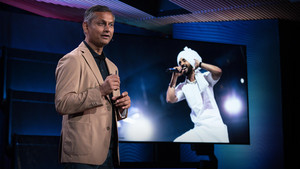
Our global culture has a fascinating new look to it, and it has to do with this guy, Indian actor and musician, Diljeet Dusanj.
Diljeet's star has risen big time off late.
He performed at Coachella last year.
He had incredible energy and had the audience in a foot tapping, head banging spell.
He had the audience in North America where he toured this year, had the same experience, and performed in large takterinas.
You know what is even more noteworthy?
Diljeet does not perform in English.
He performs entirely in Punjabi.
Diljeet's momentous rise is an indicator of something fundamental happening in the world around us.
The West for long has set the cultural and intellectual agenda for the world.
But now East is coming to the limelight as well.
Asia today claims the cultural and intellectual authority all of its own.
Yes, Diljeet is popular, but even more than that, he takes pride in his own identity and is not reduced to a stereotype.
He wears traditional Punjabi garb.
Imagine an Indian pop star in the West dressed in a turban and a kurta.
My name is Neera Jagarwal, and yes, I am a slightly lesser -known Indian than Diljeet.
With BCG over the last 25 years, I have worked on tough problems across industries and have spent time thinking about big picture trends.
In my current role of leading BCG Asia -Pacific region, I travel extensively, and I meet a wide range of Asians across business, government, and civil society.
Drawing on these experiences, I want to share with you how Asia is changing in ways you may not have imagined and what that could mean for all of us.
In the 20th century, most Americans got a taste of Asian culture but just a taste.
If you went to a local mall, the taste may be quite literally Panda Express.
Asian cultures were somewhat exotic, somewhat stereotyped, but never had full context.
Today, the scenario is vastly different.
Recently, Malaysian actress Michelle Yeoh won the Oscar for the best actress.
First Asian ever. Korean production's Crit Gain became Netflix's most popular show ever.
In the US now, there are 400 ticket leaks, and more than 200 ,000 kids pick up a bat.
So you may ask me, what is driving Asia's rising cultural and intellectual expansion?
It has to do with Asia's rising economic power.
There have been massive changes in the income pyramid.
By 2030, Asia is expected to have five times as many high -income households as it had in 2000.
An absolute number hard on the number in the West.
Walk the streets of Mumbai, Jakarta, or Shanghai.
You can feel it. It's everywhere.
Millions of low -income households, they're almost all digital natives, and they want more convenience and better quality of life.
No wonder Asian businesses strive to be more innovative.
Asia, of course, is incredibly diverse.
I would argue the same diversity makes this change even more profound and prolific.
I started by talking about pop culture, but Asia's cultural and intellectual influence extends to ideas and business innovation.
For long, we've created Asian workers with outsourcing and factories.
Today, however, many Asians are intellectual leaders.
They're bypassing jobs with Western multinationals to start new ventures.
That's a big shift.
Many kids who come to the West to study are keen to go back because they spot opportunities in their own countries.
And this is disrupting industries.
Take FinTech. Twenty years ago, FinTech was almost entirely a North American play, hardly visible in Asia.
And living in India, it used to seem like a trivesty to me.
Why? Because back then, only a third of the Indians had bank accounts, and many others used to pay outrageous sums of money to money lenders to live a basic life.
It changed with the mass adoption of cell phones.
Today, India's payment system, UPI, does about a trillion -dollar plus of transactions.
When I go to a local street -side vegetable vendor, he says, Saab UPI, Kartho.
Please do buy UPI. The same change exists in Indonesia, Philippines or Singapore.
Alipay in China does 100 times more transactions than PayPal.
FinTech in Asia is innovative, is deeply entrenched, and is not done growing.
By 2030, I expect FinTech revenues in Asia will be larger than any other part of the world.
I could give you any number of such examples across industries.
Instead, I want to step back and talk about the broader intellectual contributions that Asians are making.
As a consultant, I deeply believe in the power of three.
So I'm going to give you three of them.
First, Asian companies are investing on developing at -scale solutions with different but attractive unit economics.
Take climate. Asia has more polluted cities than any other part of the world.
And it's roughly half the planet's carbon footprint.
Driven by adversity, many Asian companies are investing at scale in solar production and battery storage.
In this case, China in particular has invested massively, and in the last two decades, brought down the cost of solar panels by 95 percent.
Battery storage costs are also declining.
Combined, that is resulting in a huge decline in the cost of accessing solar power.
The sun is coming down, but in a good way.
And when I talk to the CEOs of these companies, they smile and say, Neeraj, we're far from done.
Far from done is really encouraging, because if these trends play out, solar power could muscle aside fossil fuels as a source of energy.
By 2030, Asia will have twice the amount of solar deployment as the west.
And thanks to Asian innovation, large parts of the world could have low -cost renewable power whenever they like.
And a new panda may enter a lexicon, the solar panda.
Asia's second intellectual contribution has to do about solutions rooted in collective good.
Young Asians maintain close ties with their families throughout their lives.
For them, the group is as important as they are.
The same ethos permeates in businesses, so family -run enterprises and state enterprises dominate.
Today, when many Western companies talk about social purpose and multi -stakeholder orientation, remember, Asia embodies that.
Actually, Asia pioneered that.
The region also continues to raise the bar on social consciousness.
A good example is the Abasho centers, which encourage the elderly to stay involved in their communities.
Originating in Japan, these centers are now traveling across Asia.
An Asian CEO I know well put it this way.
If I had to put a person on Mars in five years, I'd look to the west.
To make sure the same person survives on Mars, I'd look to the east.
And now, back to the episode.
Which brings me to the third intellectual contribution that Asians are making, which is driven by their own unique challenges and what I call a leaf frog mindset.
Take healthcare. Asia is 60 percent of the world's population, and more than half of the burden of diseases like diabetes, cancer.
Asian countries cannot replicate the path taken by the Western nations, as that path is prohibitively expensive and is not always guaranteed to get you the best outcomes.
They need to leaf frog and take an alternative path.
Healthcare that is less costly and gets you to better outcome, and accomplishes more.
Digital technology today offers exciting possibilities.
Interoperable health records is one way of addressing this challenge because they allow continuity of care from a small doctor's clinic to a big hospital.
Many countries have stumbled to implement this, but India in this case has taken a big leap forward and digitized 400 million health records.
Of course, a lot more needs to be done.
The Asian private sector is getting into the mix as well.
My daughter recently interned at a startup which does low -cost portable diagnostics for diseases like diabetes and respiratory infections.
In Asian healthcare, I feel the same kind of energy that propelled FinTech to where it is today, and I find that extremely promising.
Asia's intellectual contributions can be summed up in my mind as a new kind of URL.
We have unit economics, rooted in collective good, and a leaf frog mindset.
As you may have guessed, consultants love acronyms too.
So what does Asia's rising cultural and intellectual influence mean for the world?
In the short term, it may mean some disruption, but in the long term, it will mean progress for everyone.
As Asian culture moves westward, and as Asian ideas and business innovation take root, our lives will be more diverse, more interesting, and frankly, more fun.
Our societies will be more resilient.
As we deal with climate change or potentially the next pandemic, we will have two different paradigms to work with, and not just one.
So let's embrace Asia's new place in the world.
Let's celebrate our interdependence and the richness it brings us.
Let's look to Asia as a place for learning, growth, progress, and excitement.
Let's enjoy our Taylor Swift and our Diljeet Dusanj too.
Thank you. That was Newraj Agarwal speaking at TED at BCG in 2024.
If you're curious about TED's curation, find out more at TED .com slash curation guidelines.
And that's it for today.
TED Talks Daily is part of the TED Audio Collective.
This episode was produced and edited by our team.
Martha Estefanos, Oliver Friedman, Bryan Green, Autumn Thompson, and Alejandra Salazar.
It was mixed by Christopher Faizi Bogan.
Additional support from Emma Tomner and Daniela Ballarezo.
I'm Elise Hugh. I'll be back tomorrow with a fresh idea for your feed.
Thanks for listening.
Looking for a fun challenge to share with your friends and family?
TED now has games designed to keep your mind sharp while having fun.
Visit TED .com slash games to explore the joy and wonder of TED games.