This is question time, not sledge time.
Order.
Order.
Sit down.
Prime Minister, resume your seat.
Members will cease interjecting.
I'm issuing a general warning.
There's no point me repeating myself over and over again.
I have asked for silence.
I've asked for silence.
It applies to you.
Order.
Alrighty Squiz Kids, before we dive into my chat with the amazing Catherine Bunnell-Pegg, here's your chance to hear your name on TV.
For our next Squiz Kids Q&A, we've roped in the Speaker of the House, Milton Dick.
He's the bloke you see on the TV news at night, sitting in the big chair in the middle of all those shouty politicians in Canberra during question time.
Kind of like an umpire at a tennis match or a ref in a footy game, doing his level best to make sure everyone in federal parliament plays by the rules.
He's all about disagreement and debate and the exchange of ideas, but only if it's done in a respectful way.
And this is where he needs your help.
He's looking for new things to say to our federal politicians to keep them in line.
And he reckons there's no one better than Aussie kids to help him out.
Send in your suggestions of what Milton should say to our politicians when things get heated in the House of Reps.
He's going to choose the best ones and read them out in an upcoming session of federal parliament.
And read out your name too.
It might be something that your parents say to stop you fighting with your siblings, or or something your teacher says to turn your classroom from chaos into calm.
Send in your suggestions via email to squizkids at thesquiz.com.au.
We can't wait to hear them.
And you can stay listening at the end of this episode for our full Speaker of the House mashup.
Now, for Australia's very first astronaut, Catherine Bunnell-Pegg.
Squiz Kids acknowledges the traditional owners of the lands on which we podcast the Turrbal and Gadigal people.
Squeeze Kids!
It's your daily news fix.
Fun, free, fresh.
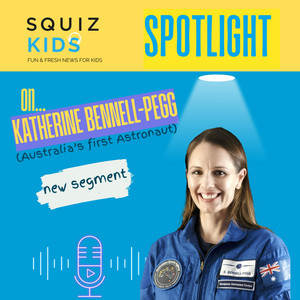
Hello and welcome to this very special Squiz Kids Spotlight, the podcast where we throw the spotlight on someone cool and have a chat with them.
And today's spotlight is being shown on Australia's first astronaut.
Whoa!
Her name is Catherine Benalpeg and, having recently completed all her astronaut training, she will soon be the first astronaut to go into space waving the Aussie flag.
How cool is that?
Wow!
Catherine grew up on Sydney's northern beaches and studied engineering and physics at uni before heading overseas to work with space agencies like NASA and the European Space Agency.
And in 2022, she put her name in the hat for astronaut training with the European Space Agency, alongside more than 22000 other people, and made it all the way to the final shortlist.
In 2023, she began 13 months of astronaut training in Germany, learning everything from how to survive in the ocean to how to stitch up a cut and even how to float around in zero gravity.
She graduated last year, making history as the first person to ever complete astronaut training under the Australian flag.
And now she's back home working as director of space technology at the Australian Space Agency and inspiring the next generation of Aussie space explorers.
And she'll be in Sydney on October 3 for the International Astronautical Congress, the IAC 2025 Space Day, powered by Lego Play.
That's a free, family-friendly space festival at Darling Harbour, designed to spark kids' curiosity about space and STEM, one brick at a time.
Catherine, welcome to Squiss Kids.
Thanks, Christy.
Thanks for having me on.
I'm excited to talk to you and everyone listening.
Oh, we're so excited to have you here.
We have so many Squiz kids who are interested in space and technology.
Should we jump straight in?
Yeah, let's go.
All right.
So you grew up in Sydney's northern beaches.
When you were a kid, playing in the surf, did you ever imagine that you'd be Australia's first qualified astronaut?
Oh, goodness.
Well, I certainly dreamed of being an astronaut and exploring space one day, but I knew that it would be extremely unlikely to be an astronaut because when I grew up, Australia didn't have the Australian Space Agency, let alone a path to being an astronaut.
But I went to talks by Australians that had been to space before Paul Scully-Power and Andy Thomas and I saw that you can find your own path.
And so I've figured out I might as well back myself and give it a go.
And here I am.
It's been an amazing journey.
Oh, that's absolutely brilliant.
When you applied for astronaut training with the European Space Agency, there were about 22500 other applicants and you made it all the way to the final 25.
First of all, congratulations.
Well, thank you.
What do you think it was that made you stand out?
Oh, that's a really hard question.
And I think you'd probably have to ask the astronaut selectors.
I
The thing is there were 22 countries that are members of the European Space Agency and a lot more people than that could have applied.
So those 22500, we're just the people that were confident enough to try to throw our hat in the ring and give it a go.
And the selection process went for about a year and a half.
There were six knockout rounds.
We got to do maths tests and memory tests and spelling and science and everything.
Things that were a bit like games.
We had to show how we worked in a team under pressure, so team-based activities.
We lived in a hospital for a week.
We did impromptu speeches, had to speak in other languages we might have claimed to know.
But ultimately, astronauts today have to be team players.
You need to be able to work in an international environment with lots of different kinds of people and get along and do great science up there.
So you want to be the kind of person that people want to go camping with.
You know you can rely on them, but you can have a bit of fun and get along with the team spirit too.
Yeah, it's hard to know, but I just did my best.
I didn't want to leave anything on the field and I'm really grateful to have the opportunity I do now.
Oh, that's fantastic.
And you've probably also done so many other things.
Was there anything that you did that was like surprising, in that it really came in handy when you were doing your application?
Absolutely.
So when I was a teenager, I looked up what it would take to be an astronaut.
And I saw that to be an astronaut, you can be a scientist or a medical doctor or an engineer or a pilot or combinations of those things that you should do expeditions.
So things like going to Antarctica or being in the military or being on scientific research ships.
That you should live internationally at some point in your life or work in international teams, that you have to be fit and healthy and have operational skills like flying or scuba diving.
And I ticked off a lot of those boxes.
But what I didn't realize would be really helpful is a broader extracurricular piece.
So, you know, at school, I happened to enjoy English as much as I did maths, right?
And I enjoyed sports and debating and drama and a lot of extracurricular activities.
But I did them because I liked doing them.
And they taught me so much about the other aspects of how to enjoy space and how to think about the world.
And I think that helped me to be a more well-rounded person and perhaps that helped too.
So yeah, for kids that want to be astronauts, I'd suggest keeping your eyes open for lots of opportunities and do what you enjoy and apply that to space.
And that helps you have a more fulfilling life anyway.
Yeah, you must have had so many wonderful experiences within all of that that you did.
And then you went into astronaut training and it was 13 months, I believe, where you did survival training, spun around in giant centrifuges, even learned how to stitch up wounds.
And that's all pretty amazing.
But was there a weirdest or hardest part, something that you'll always remember doing?
Oh, astronaut training was as fun as you can imagine, but also as intense as you can imagine.
It was very, very busy.
The best part about it was the people you do it with.
The other ASCAMs.
You're called an ASCAM until you graduate.
Then you can call yourself an astronaut.
I was training in a class with five others from all across Europe.
And we were there to help each other get through it.
We weren't in competition.
We were there as a team.
We're all good or less good at different things.
And we helped each other through.
I loved the science and the maths.
That was my happy place.
I loved the expeditions winter survival, ocean survival, which is a little bit like surf life-saving.
Firefighting and rescue, which is a bit like being in the fire service or the state emergency service.
The operational skills, learning to do space walks or be in the centrifuge.
Floating in a zero-g plane, like operating the robotic arm.
We learned about how the International Space Station works and how to fix it.
We learned how to be almost like medics, to help each other and to take blood samples, because astronauts are guinea pigs up there.
We had to learn foreign languages.
We learned about space history and strategy and economics, and we even learned photography so that we can take photos of the earth and our experiments up there.
So I think yeah, the best part about it was the people, followed by the breadth of what you have the chance to learn.
It was hard to pace yourself.
You had to keep enough energy for the next day.
We had over 300 teachers all willing to share all their knowledge with us.
Yeah, it was really wonderful and a privilege.
And now I'm focused on, you know, bringing that knowledge back home to Australia to give more people opportunity to be part of this world.
Oh, that's brilliant.
Off script for a moment.
My 13 year old daughter asked if you had to have high pressure water squirted into your ears to test.
Just your resilience.
I don't remember that.
Unless I blocked it from memory.
No, but we did do a lot of medical tests.
And that's because, well, first of all, you have to be safe in space.
So you need to be able to be healthy enough that something won't go wrong at a critical moment.
But you also need to be healthy to have a long career because it takes a lot of training.
And maybe you'll go to space multiple times.
So they're the two main reasons you have to go through these tests.
The other is...
In addition to that, you are a medical guinea pig in space.
In space, your body does weird and wonderful things.
Every system in your body changes because we are the ultimate adapters.
If you think all life as we know it evolved under 1G gravity exactly Earth's gravity and we go to space in free fall and we can live and work up there.
We adapt.
But we don't have to hold ourselves up.
We don't have to sit up straight against gravity or walk around.
So as one example, your bones and your muscles don't need to be as strong up there.
So your body reduces the mass in your bones.
It makes your muscles weaker so you don't have to spend energy on that.
But that can be a problem if it happens too quickly.
Right.
You also have to be able to adapt back to Earth and to work hard in spacewalks.
So in space, we have to go to the gym for two hours a day up there.
Oh, wow.
To keep as healthy and fit as we can.
But because our body does that, this is similar to some diseases on Earth.
So we can be used to test new medicines and approaches to counteract that, for example.
Oh, wow.
So astronaut and guinea pig.
Yep.
You are a medical scientist and the test subject at once.
But you know, it's really a privilege to be able to help with these breakthroughs for people on Earth.
That's amazing.
So now that you've graduated as an astronaut, as you said, you could be picked for a mission or multiple missions.
If you did get selected to go to the International Space Station, what other sort of jobs might you be doing up there?
So astronauts today aren't specialised.
Like in the shuttle era, there would be, you know, the pilot, the mission specialist, the payload specialist, looking after the experiments.
Today, most astronaut missions are to the International Space Station, which is huge.
It's almost the size of an Australian soccer field.
The inside air part is about as much as like a five-bedroom house, say.
It's got a few bathrooms, a couple of gyms, kitchen areas to eat at sleeping bays, and it's just filled with scientific experiments.
But you go up there usually for six months at a time.
And when you do that, you need to be able to do any job.
You won't be the boss, at least until your second mission.
They don't do that on the first mission.
But all the other jobs you have to be able to do.
You're a scientist in the sky for your country on the ground.
You're a space tradie, fixing the toilet and the plumbing and the air and doing spacewalks to install new equipment.
You do that medical research I talked about.
You're also a communicator doing lessons for kids on Earth, showing them what weird and wonderful things happen in microgravity.
So cool.
Yeah, it's amazing.
So you need to be able to do lots of different things, which is why the training is so broad.
Oh, wow.
And we know that education and play both help to spark curiosity in kids.
You once worked at NASA's Research Centre on a low-cost spacecraft.
Do you think kids that love Lego and Minecraft and robotics are already training themselves for space jobs?
Absolutely.
Yeah, that time at NASA was great.
I was an intern a long time ago and it was a really formative experience.
I made some lifelong friends there.
And I think that today, kids can absolutely be preparing themselves for this future by doing things at home, hands-on activities like playing with those toys.
That's helpful.
Use your creativity.
Try and create because as an engineer, as an astronaut, you get to create every day.
You If you enjoy that and you can foster that, that sets you up very well.
Kids today in Australia at high school are already putting payloads on the International Space Station.
So it's right there.
You don't have to wait till you know you're at a space agency, like I did, to be able to work on a real space mission.
You can start right now and you can start by prototyping and being creative at home.
You heard that, kids.
Get into it.
Now Catherine, I've already asked you a lot of quite serious questions but, to be honest, there's one thing I'm sure that we'd all like to know.
How do you go to the toilet in space without it getting super messy?
Very carefully.
Very carefully indeed.
I've done the toilet lesson.
I'm so glad I can now explain it.
Basically in space.
You want to recycle as much as you can, so you don't have to bring things up in a rocket.
So When you do a number one in space, it's recycled.
So yesterday's glass of water that you drink becomes tomorrow's glass of water that you drink.
Ew!
Gross!
Which sounds a little bit gross.
But you know, if you drink a glass of water on Earth, I'm told that some of that water probably once was dinosaur pee, a long time ago.
And the Earth has recycled it just on a longer timescale.
Incredible.
So in space, you basically have a funnel for that in the toilet.
The toilet's about the size of like a portaloo, if you've ever used a portaloo.
And when you start using it early in your missions until you're used to it, most astronauts take all their clothes off to avoid a mess.
And so they can avoid floating back with everyone watching them covered in a mess.
But you get used to it quite quickly.
And for a number twos, there's no seat, right?
You don't need to sit down in zero G, you're floating.
You can strap your legs down if you want, but that is not recycled.
So there's a little bag for each use, just sort of like a nappy bit.
It is kind of what it looks like as well.
And then they get bagged up and they get put into storage on the space station until a cargo vehicle might come a few weeks or months later, even to take it away and burn up in the atmosphere.
So if you see a shooting star, maybe you're wishing upon something else.
That's an awesome thought.
Thank you for that.
Even though when you go up in space you'll be looking down on all of us, I imagine you'll probably miss home quite a bit when you're up there, especially if it's for six months.
So if you got the chance, what special thing from home would you like to take with you?
Oh, that's such a good question.
I haven't decided on anything in particular.
I think...
For me personally, something from my kids would be great to take to space and then to bring back for them as well.
Of course I'd love to take something that you know represents the deep Australian First Nations connection to Sky Country and the stars.
I think that would be really wonderful.
I'm told that there's already been a boomerang in space which has got to have absolutely beaten the world record for distance lapped around the planet before being returned.
But perhaps some people can help me with some ideas there.
In space, astronauts also often miss home from an environmental perspective.
Plants dirt that kind of material.
So it would be wonderful to have something like that from home as well.
Oh, brilliant.
Oh, Squiz Kids, if you've got any ideas, write into us and let us know.
We'll pass it on to Catherine.
Catherine, that's it for all our questions.
That went so quickly.
Oh, thank you.
Thank you so much for sharing your story with us today.
It's a reminder that big dreams can start small, with curiosity persistence, maybe even a box of Lego bricks.
And Squiz Kids.
If you'd like to see that curiosity in action, don't miss the IAC Lego Space Day, powered by Lego Play at Darling Harbour on October 3.
I've stuck a link in the episode notes so you can find out more, and you might even run into Catherine there.
Catherine, can you help me with the Squiz Kids sign off today?
Now get out there and have a most excellent day.
Over and out.
He doesn't know what he really thinks.
He does not know what he really thinks, Mr Speaker.
This is question time, not sledge time.
Promise to resume your seat.
Members will cease interjecting.
And you don't need to be terribly experienced to know that this is a very bad time to interject.
Order.
Order.
The member will resume his seat and leave under 94A.
Can't see he's yelling for your back.
I'm issuing a general warning.
If members want to continue interjecting, I'll eject them.
There's no point in me repeating myself over and over again.
I have asked for silence.
I, my, my, order, order, order, order.
It's time for silence.
I'm not quite sure what whoever found that so funny laughed out loud then.
Ensure that the protection the committee outweighs...
Members on my left will cease interjecting.
Order.
I have asked for silence.
It's time for silence.
There is far too much noise.
I can't hear a word that is being said.
I'm just going to dial it down.
The member for Gippsland, it may be your birthday, but you're getting close to a warning as well.
I've asked for silence.
It applies to you.
Order.