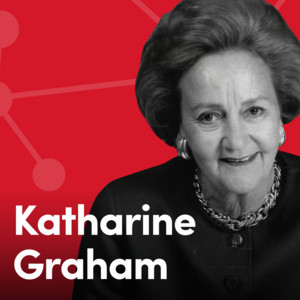
Catherine Graham was hosting a farewell party in her Georgetown home when she got a phone call that would change history.
While the Capitol's elite filled her living room, her editors waited on the line with an impossible question.
Should they publish the Pentagon Papers and risk destroying the company?
Frightened and tense, she took a big gulp and said, go ahead, let's publish, and she hung up the phone.
In that moment, the self -described doormat wife became one of the most powerful women in American media you.
And one of the most powerful women ever.
Welcome to The Knowledge Project.
I'm your host, Shane Parrish.
In a world where knowledge is power, this podcast is your toolkit for mastering the best for what other people have already figured out.
Katherine Graham documented her remarkable life and journey in a Pulitzer Prize -winning memoir called Personal History, which is the main source of the material today.
She wrote it with an unflinching honesty because she wanted everyone to understand that courage isn't the absence of fear.
It's doing what's right despite being terrified.
The image of me is this tough, sort of decisive, combative person who's taken on all these fights.
And I just like to say that I hate fights.
And I am very courageous only when forced into a corner.
And all the battles we got in were ones in which you had very little choice or no choice.
There's no corporate spin.
It's just a raw blueprint for turning self -doubt into unshakable resolve.
Catherine Graham, or Kay as her friends called her, is one of the most powerful women in history.
She published the Pentagon Papers, exposed the Watergate scandal, faced the full force of the U .S. government coming after her, brought down a president and weathered a strike that would have crippled any other company.
Oh, and if that wasn't enough, thanks to an unlikely friendship with Warren Buffett, she ended up with one of the best track records by shareholder return in business history.
It's time to listen and learn.
Imagine a little girl so isolated by wealth that she doesn't know clothes need to be washed until she goes away to college.
At home, servants take them away dirty and return them clean.
She grows up thinking, this is how the world works.
This is Catherine Mayer in 1921 at the age of four, the daughter of one of America's most powerful financiers.
She was known to her friends as Kay.
Her father, Eugene Mayer, had already conquered Wall Street.
J .P. Morgan himself warned to colleagues watch out for this fellow mayor because if you don't he'll end up having all the money on wall street by the time catherine was born in 1917 eugene was already making millions and thriving in a career they would later earn him the top job at the federal reserve but here's a side of privilege most people don't see it can create the exact opposite of confidence the mayor household operated like an institution not a family a 40 -room mansion in washington a a sprawling estate in Mount Kisco.
The children followed rigid schedules, French lessons, music, riding, dancing, but emotional connection?
That was too expensive.
Catherine's mother, Agnes, was brilliant and overwhelming, a pioneering journalist who collected friendships with Einstein and Thomas Mann like others collected stamps.
Yet she viewed her children and Catherine's brutal assessment as burdens.
Her father remained very shy and remote, capable of wit but not intimacy.
The result? Catherine felt like the peasant walking around the brilliant people.
She had every material advantage but no confidence in her own voice.
At least, not yet. While there's a subset of people who have belief before ability, there's also a subset of people with no belief and a lot of ability.
People who have never had to prove themselves or overcome obstacles struggle with self -doubt.
quote, when crisis comes, and it always does, the people who have learned to overcome obstacles often outperform those who never faced any.
In 1933, an event occurred that would change everything.
The Washington Post was dying.
It was Washington's fifth best newspaper in a five newspaper town.
Its owner had inherited it and ignored it for 15 years.
By 1933, as Eugene Mayer put it, the Post was mentally, morally, physically, and in every other way bankrupt.
The circulation at the time was $50 ,000.
It had mounting debt.
In the heart of the Great Depression, it went to auction.
Eugene Mayer bought it anonymously for $825 ,000.
Here's the beautiful part, though.
He didn't tell his daughter.
Catherine was studying for college when she and a newspaper -owning friend spent afternoons speculating about the mystery buyer.
That summer, sitting on the porch, her mother casually mentioned, When you take over the post. What are you talking about?
Catherine asked. Oh darling, didn't anyone tell you?
Dad bought the post. Eugene's vision was grand.
The first mission of a newspaper is to tell the truth as nearly as the truth may be ascertained.
Beautiful words, profound even, but expensive ones.
They would come to test everything.
Two years in, the post was still hemorrhaging money.
It was still dead last in a five -paper town.
One successful publisher delivered the verdict.
No morning paper, especially the Post, will ever amount to anything in Washington.
Eugene's response? The capital of this great nation deserves a good paper.
I believe in the American people.
When an idea is right, nothing can stop it.
The Post became a family obsession.
Eugene visited the newsroom nightly.
Agnes sent weekly memos about delivery problems, Catherine, away at college, read every issue, and mailed critiques home.
When Eugene Mayer purchased a struggling newspaper during the Great Depression, no one thought he had a chance.
In fact, nearly everyone thought he was crazy.
But if you believe something is important and you're prepared to lose everything, you can ignore the skeptics.
After graduating from the University of Chicago in 1938, 1938 Catherine worked as a reporter for the San Francisco News earning $21 a week.
After one day on the job Kay went to her father's hotel room in tears.
I can't do this. I'm not worth the $21 a week.
Eugene Mayer's response was perfect.
Nobody is worth it at first but you will be.
She stayed. Within a month she was having the time of her life covering major labor disputes, learning to write fast under pressure, while constantly worried about being scooped.
Two months in, a strike forced papers to cut costs.
Her father called her boss to make it easier for him to let her go.
Instead, he wanted to keep her permanently.
She's doing fine work, he said, and Eugene Mayer had a right to be proud.
Most importantly, she discovered something that had been missing from her entire childhood.
She could do the work.
But her father needed her back at the post. Her her father said it directly.
If it doesn't work, we'll get Rover.
So she went to work at the Washington Post, proofreading and assembling letters to the editor, making friends with all the junior employees.
Most days weren't glamorous.
Though on September 1st, 1939, she found herself at FDR's press conference on the exact day that Germany invaded Poland.
And in 1940 at a party, she met a brilliant Harvard lawyer named Philip Graham.
That would change everything.
Confidence isn't inherited.
It's earned through doing the work.
It's earned in the grind.
It's earned in the dark hours that nobody sees.
Catherine's father gave her something more valuable than money or connections, the permission to be terrible at first. While her father might have lacked the emotional connection, I love that he told her no one's worth it when they start, but you will be.
Just keep putting your head down and grinding away and you will get there.
He wasn't being kind.
He was giving her room to grow.
Philip Graham came from the opposite end of privilege.
Born in 1915 in the dirt poor Florida Everglades, he arrived at Harvard Law School in what a classmate described as a badly cut country suit, looking as though he had straw hanging out of his rather large ears.
But Phil had something money can't buy.
He was magnetic, the kind of person who walked in a room and everyone turned to watch. Brilliant, witty, with what Catherine called that right mix of intellectual, physical, and social charm.
He was the president of the Harvard Law Review, clerk to a Supreme Court justice, Felix Frankfurter.
People who met him came away thinking the exact same thing.
This man would one day be president of the United States.
Catherine was smitten.
They fell in love fast. On their second date, he suggested marriage.
I agreed that it sounded quite a good idea, but perhaps a bit rash, she recalled.
On the inside, she was incredulous.
This brilliant golden boy wanted her, the tall, awkward girl who spent her childhood trying to please everyone.
Her father approved after one dinner.
The engagement was on.
But there was a moment that should have been a warning.
They went dancing before the wedding, and Phil drank way too much. He wasn't just drunk.
He became something darker, something unpredictable.
The evening worried me a lot, Catherine later wrote.
A friend asked her if she had seen him like that before, and Catherine responded no, and he warned her in that moment, well, you better think about it right now.
But when Phil sobered up, the charm returned as if his switch had been flipped.
That was that for the time being.
Catherine Mayer was about to become Catherine Graham, but the brilliant, charismatic man she was marrying carried demons she couldn't yet see but could already feel in her bones.
They married in June 1940.
Catherine was 23, determined to be the perfect wife.
The division of labor at the time was clear.
Phil would lead, she would follow.
That was the deal. That's how it was then.
The first year was a shock.
Phil insisted that they live on their combined salaries, his $3 ,600 as a Supreme Court clerk and her $1 ,500 at the post. For someone raised with servants, walking blocks to save 10 cents on laundry felt like a form of poverty.
And then Pearl Harbor changed everything.
Phil tried to enlist, but was rejected.
Married men with poor eyesight weren't wanted yet.
By July 1942, standards had loosened.
He shipped out of the Pacific, leaving Catherine to follow him between training posts, living in boarding houses and cheap hotels.
Two pregnancies ended in heartbreak.
The third nearly did, too.
When doctors said it looked hopeless, she ignored their orders to stay in bed.
Somehow, the pregnancy held.
Their daughter, Lally, was born on July 3, 1943.
Phil shipped out to work in intelligence in the Philippines.
Catherine moved back to Washington.
This is where something interesting happened, though.
She didn't see it that way.
With Phil overseas, she managed everything.
The household, the baby, her job, the post -circulation department, where she learned how terrible a confused and poorly managed apartment is for those who work in it.
Her son Donald was born in April 1945.
She did it all, essentially, as a single parent, balancing work, life, running the post, and family obligations.
But in the letters to Phil, she deprecated her abilities.
She worried constantly about competency.
she saw herself as barely managing and barely getting by until he could return to take charge.
When the war ended, Philip came home to Eugene Mayer's offer.
Would he become the associate publisher of The Post?
Would he learn the business and eventually take over?
Catherine's response at the time revealed everything.
She wrote in her memoir, far from troubling me personally, that my father thought of my husband and not me.
It pleased me. In fact, it never crossed my mind that he might have viewed me as someone to take on an important role with the paper.
The woman who had just managed a household, a job, and two children through a war couldn't imagine running a newspaper.
She was still blind to her own competence.
But that would change.
The post -war years created a dangerous pattern.
Phil Graham was building one of America's great newspapers while slowly destroying himself.
self. They settled into a grand house on our street with four children and clear roles.
Phil conquered the business world.
Catherine managed everything else, including her job, the home, the children, the staff, the social calendar.
I became, she wrote, the drudge and what's more accepted my role as kind of a second class citizen.
But Phil was electric at the post. At 30, he became the youngest publisher of a major American newspaper.
He immersed himself in his work, and he was very competent.
Eugene Mayer had left to head the World Bank, and Phil attacked every aspect of the business.
He recruited talent, negotiated with unions, and personally supervised newsroom renovations.
His memos were stunning in their detail of outline of problems, potential, and objectives.
He looked and analyzed at everything from the use of space to the the tiniest expense.
The paper began taking stands.
A crusade against local crime led to a four -year battle with the police chief that championed the Marshall Plan with front -page features.
The Newspaper Guild praised them.
In these days, when playing it safe and treading softly is so general, the record of the Washington Post in 1947 is truly extraordinary.
extraordinary in 1948 two things happened that changed their prospects phil acquired w top a 50 000 watt radio station marking their entry into the broadcasting industry and that same year eugene myer transferred ownership to phil and katherine the arrangement was telling phil received 3 500 shares while katherine received 1500 shares eugene's explanation typical of the the times, no man should be in the position of working for his wife.
Catherine's response, I not only concurred, but was in complete accord with this idea.
But it went even deeper.
To help Phil pay for his shares because he didn't have the money, she volunteered to pay for all of their living expenses from her trust fund.
The houses, the cars, the schools, the entertainment, Everything except Phil's personal expenses was carried by her.
No problem, she thought.
This arrangement was never an issue.
It didn't bother either one of us.
I never thought about it, and we never talked about it.
Only 15 years later, when things were very bad, did I look at the situation ruefully.
Meanwhile, the warning signs were starting to accumulate.
Phil's drinking increased.
Their no -fighting rule meant problems festered.
The more successful Phil became, the more he needed Catherine to hold everything together behind the scenes.
Phil Graham was transforming the post while his personal life deteriorated, and everyone focused on the success story instead of the warning signs.
From the outside, it seemed like the perfect relationship.
From the inside, it was getting darker and darker.
The 1950s brought Phil Graham's greatest triumphs and biggest warning signs.
He was running the post at full speed.
Then came the deal that made everything possible.
In 1954, a cryptic letter arrived about a business matter of importance.
The Times -Herald might finally be for sale.
Phil wrote down the payment, $2 million, on a crumpled personal check from his wallet and then called the treasurer to cover it somehow.
He didn't have the money.
Overnight, the post circulation doubled from 200 ,000 to 400 ,000.
They jumped from third to first in the morning market in a single day.
But success came with a price.
The more Phil achieved at work, the more demanding he became at home.
Catherine provided it completely, deferring to his judgment on everything.
When guests came for dinner, she'd stop talking if Phil gave her a certain look.
And something else was happening.
Phil's energy wasn't just intense, it was manic.
18 -hour days, a dozen initiatives, heavy drinking, and then crashes into what everyone called exhaustion.
The first real crisis came in October 1957.
Phil broke down in the middle of the night weeping uncontrollably, saying everything was black.
The diagnosis that nobody used the term for years was manic depressive illness.
For the next several years, Catherine's life became a careful dance between Phil's soaring highs and crushing lows.
During depression, she couldn't leave him alone, I was on duty a great deal of time, and if I had any strength, much of it came from surviving these exhausting months.
The outside world saw none of this.
To Washington Society, the Kennedy administration, Phil remained the brilliant publisher of the renowned Washington Post. When his mood was up, he was magnificent.
But the cycles worsened.
In 1962, Phil began an an affair with Robin Webb, a young employee at Newsweek.
Catherine discovered the affair on Christmas Eve.
Her world, built entirely around Phil, shattered.
He left her for his mistress, but he kept control of the post. After all, Eugene Mayer had given him the majority voting shares.
Consider Catherine's position here.
She's 45. She's devoted her full adult life to supporting Phil and raising their family with no career of her own.
And now she faced losing not just her husband, but the newspaper that her father had saved.
And then two friends changed everything.
Justice Frankfurter pulled her aside and said, hey, you've got to fight for this paper.
It does not belong to Phil Graham.
Your father created this paper.
There is not room in Washington for two Graham families.
Then came the walk that changed her life.
She told her friend, Luvvie about how she would try to hang on and fight for the paper until the kids were old enough to run it.
And her friend's response, don't be silly, dear.
You can do it. Me? That's impossible.
I couldn't possibly do it.
You don't know how hard and complicated it is.
Of course you can do it.
And Luvvie's voice grew firm.
You've got all those genes.
It's ridiculous to think you can't do it.
You've just been pushed down so far.
You don't recognize what you can do.
Sometimes the best gift that you can give someone is believing in them, believing in someone else when they don't quite believe in themselves.
In June 1963, Phil's latest manic episode crashed into depression.
He broke with Robin, begged Catherine to take him home, and entered the Chestnut Lodge Psychiatric Hospital.
For the first time in months, there was a glimmer of hope.
On August 3rd, Phil convinced the doctors to let him spend the weekend at the Virginia farm.
arm. After lunch, he said he was going to lie down.
Minutes later, Catherine heard a gunshot.
Phil Graham was dead at 48.
The funeral filled the National Cathedral.
President Kennedy sat alone, sunlight from stained glass windows illuminating him as if he were the one being mourned.
In fact, nearly three months later, Kennedy himself would be dead.
The day before the funeral, General Catherine did something that would have seemed impossible months earlier.
She went to a board meeting.
Her daughter Lally, still in her nightgown, jumped in the car scribbling notes about what her mother should say.
Standing before the all -male board, Catherine delivered a simple message.
The paper would not be sold.
It would remain in the family.
A new generation was coming along.
What she didn't say was that she herself would lead the company for the next three decades.
heads. She didn't say that she would publish the Pentagon Papers and bring down a president, that she would become the first woman CEO of a Fortune 500 company, that the stock performance during her tenure would be one of the best in history, that she would become a force that would change the course of history.
No, on that day in August of 1963, she was simply a widow trying to hold things together moving forward as she would write blindly and mindlessly, into a new and unknown life.
The apprenticeship was over.
Catherine Graham's real education was about to begin.
Phil's suicide didn't just end his life, it began hers.
The woman who thought she was holding the company together temporarily is about to transform it permanently.
Do you ever struggle to stay focused?
There's a reason I reach for my remarkable Paper Pro when I need to think clearly.
If you're looking for something that can help you really hone in on your work without all the distractions, Remarkable, the paper tablet, might just be what you're looking for.
Remarkable just released their third -generation paper tablet.
Remarkable Paper Pro.
It's thin, minimalist, and feels just like writing on paper, but comes with powerful digital features such as handwriting conversion, built -in reading light, productivity templates, and more.
It's not just another device.
It's a subtractive tool.
No notifications, no inbox, no apps.
Just you, your ideas, and a blank page that feels like paper, but smarter.
In a world built to steal your focus, this tablet gives it back.
It's become the place I do my deepest work, and it travels light.
Slim enough for any bag, powerful enough for any boardroom.
Not sure if it's for you?
No worries. You can try Remarkable Paper Pro for up to 100 days with a satisfaction guarantee.
If it's not the game changer you were hoping for, you'll get your money back.
Get your paper tablet at Remarkable .com today.
This episode is brought to you by LifeLock.
When you visit the doctor, you probably hand over your insurance, your ID, and contact details.
It's just one of the many places that has your personal info.
And if any of them accidentally expose it, you could be at risk for identity theft. LifeLock monitors millions of data points a second.
If you become a victim, they'll fix it.
Guaranteed. Or your money back.
Save up to 40 % your first year Here at LifeLock .com slash podcast. Terms apply.
Picture this, the president of the Washington Post sitting in her first editorial meeting, finally working up the courage to speak.
Her voice comes out as a whisper.
The men around the table have to lean in to hear her.
This was Catherine Graham, one month after Phil's death, walking into a building as publisher of a major American newspaper.
paper. In 1963, there were zero female CEOs in the Fortune 500 companies.
To put things in perspective, Harvard Business School had just started accepting women that very year.
The idea was incomprehensible even to Catherine herself.
She'd absorbed her generation's assumptions that women were intellectually inferior to men, that they were not capable of governing, leading, managing anything other than our homes and our children.
She had modest ambitions.
She had plan to hold things together until her son Don could take over.
She saw herself as a placeholder, not a publisher.
But something interesting happened when she started showing up for work.
She began at the ground level, answering phones in circulation, sitting on classified ad sales, attending meetings where she was too terrified to speak.
She didn't know how to read a balance sheet.
Terms like liquidity made her eyes glaze over.
I stumbled around the post building, talking to people, not realizing that I shouldn't always start with the first person I encountered.
The learning curve was brutal.
When she gave a farewell dinner for the post -long -time telephone operator, a woman she'd known since she was a teenager, the business chief exploded.
Didn't she see that this set a precedent?
She disagreed but was reduced to tears in front of him, an unacceptable response, she later wrote.
But she kept showing up, and slowly, something shifted.
It crystallized when she attended IBM's executive computer course as the only woman among 10 male CEOs.
When they gathered in dormitory rooms to share contraband alcohol, she stood among them drinking from paper cups.
By the week's end, she learned something crucial.
These confident men were just as overwhelmed by the new technology as she was.
You are sort of formed by what you are engaged in, she would later explain.
And so gradually you get some confidence.
And with that, it means that you're not going to be something else, but it means you can forget yourself and become engaged in what you are doing.
When Scotty Reston asked her, don't you want to leave a better paper for the next generation than the one you inherited?
The question stunned her.
She'd assumed the post was fine as is.
This may not seem like a startling question, she said, but it was to me.
After that conversation, she started to see the problem.
She wrote, how could I tell?
I certainly didn't have a sophisticated judgment about the quality of our news product.
But I was observing a great deal of indecision among the executives, followed by some odd decisions, especially about people.
I sensed a certain lack of adrenaline, and through the grapevine, I had heard talk of stagnation in the city room.
All of these were clear warning signs.
She realized good enough wasn't good enough anymore.
Sometimes the most important questions are the simplest ones.
Catherine had been so focused on just surviving and not messing up that she'd never asked whether the post was actually excellent.
Ben Bradley had twice turned down promotions at Newsweek rather than move to New York.
He was committed to Washington, and now he was sitting across from Catherine Graham, and she was asking him what he would like to do.
His answer was typical Bradley.
I'd give my left one to be managing editor of the post. Catherine was stunned.
This wasn't the answer she expected.
She barely knew Bradley personally and still associated him with Phil's troubled final years.
But something about his directness intrigued her.
His energy, his absolute confidence that the post could be more than just good.
His confidence that it could be great.
The decision wasn't easy.
When she floated the idea to the post's top editors, they reacted negatively, suggesting he should come in as a reporter like anyone else and work his way up.
But Catherine had made up her mind.
In July 1965, she announced that Ben Bradley would join the Post as deputy managing editor.
The newsroom was shocked.
An outsider from Newsweek was leapfrogging over longtime Post people.
Bradley arrived like a force of nature.
He hit the ground running, working into the night and on Saturdays.
Within months, he had learned more about the Post's operations than some people knew after years.
years under bradley the post experienced a surge in energy he hired talent he created new beats he expanded coverage and he demanded the paper take risks the editorial budget rose 2 .25 million in just three years katherine established what she called the no surprise rule she wouldn't dictate coverage or second -guess decisions but never wanted to be surprised by what she read each morning.
This created accountability without micromanagement.
The partnership worked because it was built on mutual respect and earned through crisis, not corporate hierarchy.
Ben would take over as managing editor within months.
Sometimes the best hire is the one that makes everyone else uncomfortable.
Catherine chose talent over internal politics and an outsider's perspective over insider loyalty.
When building a team, the person who challenges your thinking is often more valuable than the one who confirms it.
Warren Buffett had bought 5 % of her company without telling her.
He sent a letter to her.
Dear Miss Graham, I just bought 5 % of your company and I mean you no harm.
I think it's a great company and I know it's Graham owned and Graham run and that's fine with me.
Her board panicked and told her to do the same.
Instead of listening to them, she went to see what it was all about for herself.
Sensing her anxiety, offered to stop buying if it worried her.
Catherine saw an opportunity after she got to know Warren better, she invited Buffett to join the Washington Post board. People thought he was manipulating me.
Actually, I was just asking for advice because I realized how brilliant he was.
What followed was the most intensive business education any CEO has ever received.
Buffett literally took her to business school.
He would arrive at board meetings carrying 20 annual reports, walking her through each one line by line.
She took notes like a schoolgirl at the feet of a great professor.
Buffett didn't just teach her history, he demystified business entirely.
He explained that while others collected antique cars, he collected antique financial statements.
He taught her to take snapshots of businesses at different points in time and analyze what factors produce change.
Warren, she said, is a great teacher and his lessons took.
The mentorship went far beyond Beyond formal meetings, Warren sent constant memos, guidance on major decisions, and alerts about problems. For someone who'd spent years feeling inadequate about business knowledge, having one of the world's greatest investors as her personal tutor was transformative.
But the relationship worked both ways.
Catherine helped Buffett with things money couldn't buy, social situations, connections, clothing choices, even tried to help him with basic nutrition.
nutritionist. Before meeting her, his diet consisted largely of hamburgers, steaks, cheese candy, and cherry coke.
She introduced him to dinner parties, taught him social graces, and helped him navigate the social scene in Washington.
He never did give up the hamburgers.
They became genuine friends who talked for hours about everything from politics to philosophy.
As Warren once told her, you handled me at the dinner table like I handled you at the accounting books.
Those $10 .6 million in shares that Buffett bought would eventually be worth well over a billion dollars.
But the real value wasn't measured in dollars.
It was transforming an uncertain widow into one of America's shrewdest business leaders.
The best opportunities are sometimes disguised as problems. After Buffett bought 5 % of her company, everyone on the board was whispering that she should panic.
Of course, they all had their own motivations for this, and none of them were what was best for the post. Catherine didn't panic.
She met with Buffett to gauge his intentions.
By choosing curiosity over fear, she ultimately received the best business education in history.
Okay, picture this.
Catherine Graham is hosting a dinner party in Georgetown.
The Capitol's elite are in her living room, toasting a departing colleague, and she's playing the perfect hostess when someone taps her on the shoulder.
You're wanted on the phone.
Three miles away, American democracy is hanging by a thread.
The Nixon administration had just done something unprecedented in U .S. history.
They've silenced the press.
The New York Times had started revealing the Pentagon Papers, 7 ,000 pages proving the government had lied about Vietnam for decades.
The administration got a court injunction and the times went silent.
Now, the Washington Post had the same documents and they faced a choice that would define history.
Ben Bradley is caught between two wars.
In one room, lawyers are in full panic mode.
The legal team is saying this is suicide.
The Post will face criminal prosecution under the the Espionage Act.
People will go to jail.
This will be the end of the paper, the end of the company.
In another room, the editors are threatening to resign unless they are published.
At stake? Only everything.
The Post had just gone public two days earlier.
They desperately needed the IPO for expansion.
Everything could be lost if they were to publish.
But there's something larger at stake, the death of the free press, the role of press in a democracy.
Never before had the U .S. government stopped a newspaper from publishing.
If the Post doesn't act, that precedent becomes permanent.
The first amendment becomes meaningless.
Ben is running between rooms, updating each side, watching the deadline approach. Someone has to decide right now.
The phone rings in Catherine's library.
She steps away from her guests and closes the door.
Ben gets on the line.
Kay, I need to know.
What do we do? Think about her position.
Eight years ago, she could barely whisper in a board meeting and now she's being asked to risk her entire company on a principal.
A federal court had silenced the Times.
The first time in American history, the government had successfully stopped a newspaper from publishing.
If the Post didn't challenge this, the precedent would stand.
The First Amendment would be meaningless.
meaningless. In that moment, Catherine thought of her father's words.
The first mission of a newspaper is to tell the truth as nearly as the truth may be ascertained.
The deadline was approaching.
Ben needed an answer.
Frightened and tense, I took a big gulp and said, go ahead, go ahead.
Let's go. Let's publish.
And I really was convinced by the editors and the reporters is that they were right and that we really had to go ahead.
And so I really gulped.
And I really was not what your heroic leader is.
I just said, oh, go ahead.
She hung up immediately, too terrified by what she'd done to say another word. Then she walked back to her party, smiled at her guests, made small talk, all while knowing she might have just risked everything her family had built.
The next morning, the Post published.
The government sued within hours, but they refused to stop publication.
Two weeks later, the Supreme Court ruled 6 -3.
The government cannot engage in prior restraint of the press.
The woman who eight years earlier could barely whisper in meetings had just told the President of the United States, No. When everything you've built is on the line, you discover what you stand for.
Catherine didn't feel brave making this decision.
She felt terrified.
But the most important decisions in leadership aren't about strategy or tactic, they're about principles and character.
And character is revealed when the stakes are the highest. This wasn't the last time she'd make one of the most consequential decisions in history.
On June 17, 1972, five men in surgical gloves, carrying burglary tools and sophisticated electronic surveillance equipment were caught inside the Democratic National Committee headquarters at the Watergate complex. The White House dismissed it as a third -rate burglary.
What began as a bizarre police story evolved into one of the greatest political scandals in American history.
And for nine months, nine long months, the Washington Post stood alone against the most powerful office in the world.
The break -in itself was bizarre.
Something felt off.
Why would anyone need electronic surveillance equipment to rob the Democratic Party?
As Bob Woodward and Carl Bernstein investigated, they discovered something far more sinister.
A web of political espionage and dirty tricks leading directly to the White House.
Nixon won re -election in November in a landslide, 49 states, 60 % of the vote.
He should have been celebrating.
Instead, he was plotting his revenge.
On election night. the white house tapes captured nixon's chilling words we're gonna fix the son of a bitch believe me we've got to the son of a bitch he's referring to was the washington post the plan was to destroy it between december 29 1972 and january 2nd 1973 during the holidays when nobody was paying attention nixon's allies struck with surgical precision four separate challenges were filed against the Post's Florida television licenses.
This wasn't a coincidence, it was war.
The television licenses were the profit center, they funded the paper.
The Post company stock plummeted from $38 to $21, representing a catastrophic 45 % decline.
For a company that was barely public, this represented a crisis.
The television stations were the company's most profitable assets.
Losing them would kill the company.
But the financial pressure was just the beginning.
For nine months, from June 1972 to March of 1973, The Post stood virtually alone in the pursuit of the Watergate scandal.
Other major newspapers ignored the story or actively undermined it.
When CBS planned a two -part investigation, threats from the White House to the network president, William Paley, resulted in the second segment being significantly curtailed.
Fellow editors warned Ben Bradley that the Post had gone nuts.
The Chicago Tribune and Philadelphia Inquirer refused to publish the Post's revelations, but they eagerly printed the White House denials.
Nixon's strategy was working.
It was to isolate the Post and make it look like a vendetta by one liberal newspaper against the President.
No one would pay attention as long as it was just the Post, or so he thought.
But the attacks turned personal and vicious.
On September 29, 1972, at 11 .30 p .m., former Attorney General John Mitchell delivered his infamous threat to Carl Bernstein.
Katie Graham's going to get her tit caught in a big fat ringer if that's published.
the crudeness was deliberate the use of katie and named nobody called her added insult this was about humiliating a woman who dared challenge presidential power mitchell's threat was just the beginning nixon ordered the irs to go after his enemies including her and the post the white house compiled list targeting post journalists the reporters lives were in danger catherine found found herself socially isolated in Washington, even close friends told her the post was out on a limb.
They were standing all by themselves.
While Catherine took the institutional pressure, two relatively unknown reporters were methodically building an unshakable case.
Woodward and Bernstein worked with legendary persistence.
400 stories over 33 months, often until 2 a .m., repeatedly interviewing sources until the truth emerged.
Ben Bradley's two -sources rule meant that every significant fact required independent confirmation.
Multiple editors reviewed each story.
When prosecutors demanded notes and files, Catherine personally took possession of them, making herself, not her reporters, the target.
If anybody would go to jail, it would be her.
The methodology was exhausting but unbreakable.
Each thread, pulled persistently, unraveled more and more of the conspiracy.
Through it all, Catherine felt in her memorable phrase as if she were pregnant with a rock.
The pressure was unlike anything in American journalism history.
A sitting president of the United States was using every tool of the government at his disposal to destroy her and her company.
Board members worried about financial ruin.
Business colleagues warned the coverage could destroy the Post. Legal costs mounted into millions.
Stock analysts downgraded the company.
Advertisers grew nervous.
But Catherine had learned something crucial from the Pentagon Papers.
The only way to assert the right to publish is to publish.
She told her newsroom she would go to jail before serenading their notes.
The Post's isolation finally ended in March 1973 when convicted burglar James McCord sent his explosive letter to the judge.
There was political pressure applied to the defendants to plead guilty and remain silent.
Perjury occurred during the trial.
When the judge read the letter and opened court on March 23rd, everything changed.
The Los Angeles Times, the New York Times, and television networks around the country suddenly discovered Watergate.
The Senate voted 77 -0 to investigate, largely due to the post. By May 17th, when televised hearings began, Watergate had become a national obsession.
Every major revelation confirmed what the Post had been reporting in isolation for nearly a year.
On August 8th, 1974, Richard Nixon became the first American president to resign from office.
The Post won a Pulitzer for public service.
Its circulation nearly doubled, but more importantly, it had proved that in America, even presidents are not above the law.
The journalism plays a fundamental role in checking power, something I personally wish I would remember.
During it all, Catherine didn't feel brave. She was terrified.
She believed in a free press.
She believed in the First Amendment.
She believed in the role of the press.
and she stood on principle and risked everything.
A few years later, Catherine Graham stared at the picket line outside of her building.
Union workers were using her husband's suicide as a weapon against her.
It's October 1st, 1975.
The pressmen at the Post didn't just go on strike, they went to war.
They systematically destroyed equipment, set fires in the pressroom, beat a foreman unconscious when he tried to keep the presses running.
Then they walked out, expecting Catherine to cave within days.
They clearly weren't paying attention.
They didn't know her very well.
Catherine had been secretly preparing for months.
She had trained non -union employees to run the presses.
She had arranged for helicopters to distribute papers when picketers blocked trucks.
She lined up printing facilities to keep publishing.
The strike lasted 139 days.
The personal attacks were brutal.
They burned her in effigy.
They carried signs that said Phil shot the wrong gram.
Death threats arrived regularly.
The uncertainties, the difficulties, the violence were all overwhelming, she later admitted.
I felt desperate and secretly wondered if I might have blown the whole thing and lost the paper.
But outwardly, she projected steel.
Catherine didn't hide in her office.
She worked alongside replacement workers, taking classified ads, bundling papers in the mailroom, cleaning trash in the press room.
Employees who had never spoken to the publisher suddenly found her next to them, sleeves rolled up asking how she could assist. It created loyalty that lasted generations.
The strike ended with complete victory.
The pressman's union ceased to exist at the post. New technology was installed without interference.
Production staffing was reduced from over 1 ,000 to just a few hundred, resulting in a dramatic improvement in efficiency.
Labour historians criticised her union busting.
however the numbers don't lie.
The changes saved millions of dollars annually and positioned the company for continued growth.
While the public saw the tough negotiator, behind the scenes Catherine was quietly becoming one of America's shrewdest investors.
Under Buffett's guidance she authorized aggressive stock buybacks when the shares were undervalued, maintained a conservative balance sheet with virtually no debt, made selective acquisitions that transformed the company.
The most prescient move came in 1984 when managers proposed buying Kaplan, a test preparation company, for $40 million.
Within two decades, Kaplan's revenues would surpass those of the newspapers and become the company's largest profit center.
That casual $40 million investment became worth billions.
When Katherine Graham took over in 1963, the Washington Post Company had revenues of $84 million.
By 1991, when she stepped down as CEO, revenues reached $1 .4 billion, a 20 -fold increase that beat the market by orders of magnitude.
But numbers don't capture the full story of her true impact.
She turned a struggling local newspaper into one of the world's great media companies.
She published the Pentagon Papers when it could have destroyed her business.
She stood virtually alone for nine months investigating Watergate while the President of the United States tried to crush her and her company.
She broke a violent union strike and worked alongside replacement workers in the press room.
And through it all, she never compromised the newsroom's independence.
While Katherine's role as the first female Fortune 500 CEO is undeniable, focusing only on gender diminishes her broader legacy.
legacy. She was simply one of the 20th century's great business leaders, period.
Her approach to capital allocation was masterful.
She understood what many CEOs often overlook, that excellence and profitability aren't opposing forces but complementary ones.
As she put it, journalistic excellence and profitability go hand in hand.
She proved it through decades of strong returns well, never compromising her father's mission.
Her diversification strategy showed remarkable foresight.
Unlike media conglomerates that diversified randomly, she stayed focused on related fields, broadcasting, magazines, and education.
By the time she retired, the Post company wasn't just a newspaper, but a balanced portfolio that could weather any storm.
Her crisis leadership has become legendary in business schools.
The Pentagon Papers and and Watergate are taught as case studies and ethical leadership under extreme pressure.
They've been made into movies starring Meryl Streep and Tom Hanks.
But equally instructive was their handling of smaller crises.
In 1981, when a Post reporter's Pulitzer Prize -winning story turned out to be fake, Graham didn't cover up or deflect.
The Post returned the Pulitzer, published a front -page apology, and investigated the circumstances surrounding the incident.
incident. Swift accountability preserved the paper's credibility.
Perhaps most importantly, she built something that survived her.
The principles she embedded, editorial independence, financial discipline, long -term thinking, public service, became part of the post -DNA.
When she told employees to love what you do and feel that it matters, how could anything be more fun?
She was describing the culture she created.
Purpose wasn't separate from profit.
It was the the foundation of profit.
Think about her journey.
The shy widow who whispered in her first board meeting became a titan who stared down the president.
The woman who thought she was just holding the company together until her son could take over built one of the most successful media empires in history.
She demonstrated that principled leadership isn't only morally right, but also practically effective.
In an age of short -term thinking and compromise, that may be her most enduring lesson.
While she died in 2001, tributes came from across the political spectrum.
Warren Buffett captured her essence best. The paper, really the company, has always been the most important thing in her whole life.
This was not a step in the long dance of life.
It was the whole show.
The total commitment to excellence and truth made her not just a successful publisher, but one of the great American business leaders of any era.
As she once said, looking back on those pressure -filled decades, what I essentially did was put one foot in front of the other, shut my eyes, and step off the edge.
Wow, I just want to have a couple reflections and then get into the lessons learned here.
So, Catherine was such a badass.
She had this quiet power and magnetism that sort of drew you into her.
She faced three of the hardest decisions that happened in the 1900s, the Pentagon Papers, Watergate, the Presbyterian strike, how she dealt with the story that turned out to be fabricated.
This was trial by fire.
And this woman was there.
She met every challenge.
And how did she do that?
I think her quote was best, right?
What I essentially did was put one foot in front of the other, shut my eyes and step off the edge.
And I think that that is, that is how we all are.
She didn't have the confidence to get where she wanted to go, but she had the confidence to put one foot in front of the other.
She had next step confidence.
One of the things that strikes me when I was researching this is I got a bit nostalgic about the role of newspapers and society and the role of free press.
And Catherine, there's this quote, it didn't make it into the episode, but she said the press should be the critic of the government.
And it's very important that they do that with a lot of responsibility.
And I think that's been lost today in today's world, in a world where media outlets receive a lot of funding from government through tax breaks, subsidies, rebates, laws, advertising and subscriptions.
descriptions, they stop being what they've always sort of been, the main opposition.
Politicians used to fear the press and now to a large part they bought it and use it as a tool.
And I'm really hopeful and optimistic that we can find our way back to the Washington Post of the 1970s and holding government to account no matter who is in charge.
This isn't a political party thing.
This is about the role of a free and independent press in a democracy.
And yes, yes, we have X and we have Substack and we have all these independent citizen journalism.
There's still a fundamental role to be played by legacy media if they choose to take it.
Okay, I want to talk about some of the lessons here because I think there's a lot that we can take away from this that is different from other people that we've studied so far in Outliers.
So number one, the velvet hammer.
Catherine never raised her voice.
She didn't pound tables.
She She didn't try to out -masculine the men.
She stayed soft -smoking while becoming as hard a steal.
The Nixon administration learned this too late.
The quiet ones hit the hardest. Competence whispers.
It doesn't shout. Two, values beat analysis.
The Pentagon Papers arrived during Catherine's Georgetown dinner party.
The Washington Post had just gone public two days earlier.
Everything was at stake.
publishing classified documents meant likely criminal charges which meant losing the television licenses and destroying not only the ipo that they had just had but destroying the whole company i mean everybody would be out of work it meant that she might go to jail her lawyers said it was financial suicide her editor said not publishing was journalistic suicide and she remembered her her father's principle.
Newspapers exist to tell the truth.
Let's publish, she said, and then hung up.
Three, don't care what they think.
Nine months into Watergate, the Post did a loan.
They were the only major paper digging.
Everyone thought they were wrong.
The Chicago Tribune and other major media outlets openly mocked them.
The administration went after the Post, causing the stock to crash 45%.
The President of the United States targeted their TV license.
She was ostracized in Washington.
everyone thought they were crazy.
The Post lawyers begged them to stop.
But Catherine kept going because she thought she was right.
The rest is history.
Four, bounce, don't break.
The Pressman destroyed equipment, beat a foreman, unconscious and walked out.
They expected Catherine to fold.
After all, what choice did she have if she wanted to print papers?
But Catherine had been preparing for months, training replacements and arranging backup presses.
When picketers blocked trucks, she hired helicopters.
When they marched outside, she worked the mailroom floor.
It lasted 139 days before she won.
Five, find a teacher.
Warren Buffett bought 5 % of her company without asking.
The board panicked.
Catherine ignored them.
She met Buffett herself, saw his genius, and made him her professor.
He'd bring 20 annual reports to meetings, teaching her line by line.
She was humble enough to know she didn't have all the answers and smart enough to know who to listen to.
Six, freedom with transparency.
Ben Bradley got total editorial freedom.
The only rule was no surprises.
He could fight presidents.
He could spend millions and pursue any story that was in the public interest. And she never questioned his judgment.
He never blindsided her.
The result was the Pentagon Papers, Watergate, 18 Pulitzers.
Maximum freedom requires maximum transparency.
Seven, step off the edge.
This is one of my favorite quotes.
she said, what I essentially did was to put one foot in front of the other, shut my eyes and step off the edge.
That's how Catherine described taking over the post. There was no grand strategy.
There was no 90 day plan.
There was just the next step.
Eight years later, she was staring down presidents.
You'll never feel qualified for what matters.
Step anywhere. Eight decades over quarters.
Wall Street wanted quarterly earnings and exciting acquisitions.
Catherine wanted to to create a company that would last generations.
She went against all of their wishes, buying back stock when it was cheap, and it was very uncommon to do so back then, and acquiring a boring education company, Kaplan, which would eventually generate more revenue than the newspaper.
She was a public company, but operated it like it was a private one.
9. Keep the main thing the main thing.
Catherine faced constant pressure to choose profits or principles, safety or stories, shareholders or journalism.
The Pentagon Papers could have killed the IPO.
Watergate bled millions in legal fees and threatened their television licenses.
The Pressman strike threatened the entire operations.
Every crisis offered an excuse to compromise, but she never took it.
The Post's mission to hold power to account stayed the main thing.
She proved what others deny.
When you keep the main thing the main thing, everything else follows.
Principles aren't an expense, they're your compass.
Ten, keep your word. When Nixon came after the post with the full force of the executive branch challenging TV licenses, crashing their stock, and threatening prison, Catherine never wavered.
She told her reporters to keep digging, and she meant it.
When the prosecutors arrived with a subpoena and demanded their notes, she took them home herself.
If anyone went to jail, it would be her, not them.
For nine months, while other papers stayed silent and friends begged her to stop, she kept her word. The President of the United States couldn't make her break.
Most leaders fold under pressure.
She knew something they didn't.
Your word is all you have. Once broken, it's worthless forever.
Thanks for listening and learning with us.
Be sure to sign up for my free weekly newsletter at fs .blog slash newsletter.
The Farnham Street website is also where you can get more info on our membership program, which includes access to episode transcripts, my repository, ad -free episodes, and more.
Follow myself and Farnham Street on X, Instagram, and LinkedIn to stay in the loop.
if you like what we're doing here leaving a rating and review would mean the world and if you really like us sharing with a friend is the best way to grow this community until next time